MDL
MDL is the ISO 4217 currency code for the Moldovan leu, the official legal tender of the Republic of Moldova, issued and regulated by the National Bank of Moldova under a managed floating exchange rate regime.
The Moldovan leu (ISO 4217 currency code: MDL, numeric code: 498) is the official currency of the Republic of Moldova. Subdivided into 100 bani, the leu (plural: lei) is issued and regulated by the National Bank of Moldova (Banca Națională a Moldovei, or BNM), headquartered in the capital city of Chișinău. The name “leu” translates to “lion”, sharing historical etymological roots with the Romanian leu (RON) and Bulgarian lev (BGN), originating from the seventeenth-century Dutch silver thaler (leeuwendaalder) that circulated extensively across the Balkan and Danubian principalities.
Under the statutory framework of the BNM, the Moldovan leu operates under a managed floating exchange rate regime. The central bank uses open-market foreign exchange interventions to smooth short-term exchange rate volatility without defending a rigid administrative parity. In domestic wholesale and commercial trade, the leu is priced against the US dollar (USD/MDL) as the primary intervention benchmark, while cross-rates against the euro (EUR/MDL) dictate retail consumer pricing, diaspora remittances, and external European trade invoicing.
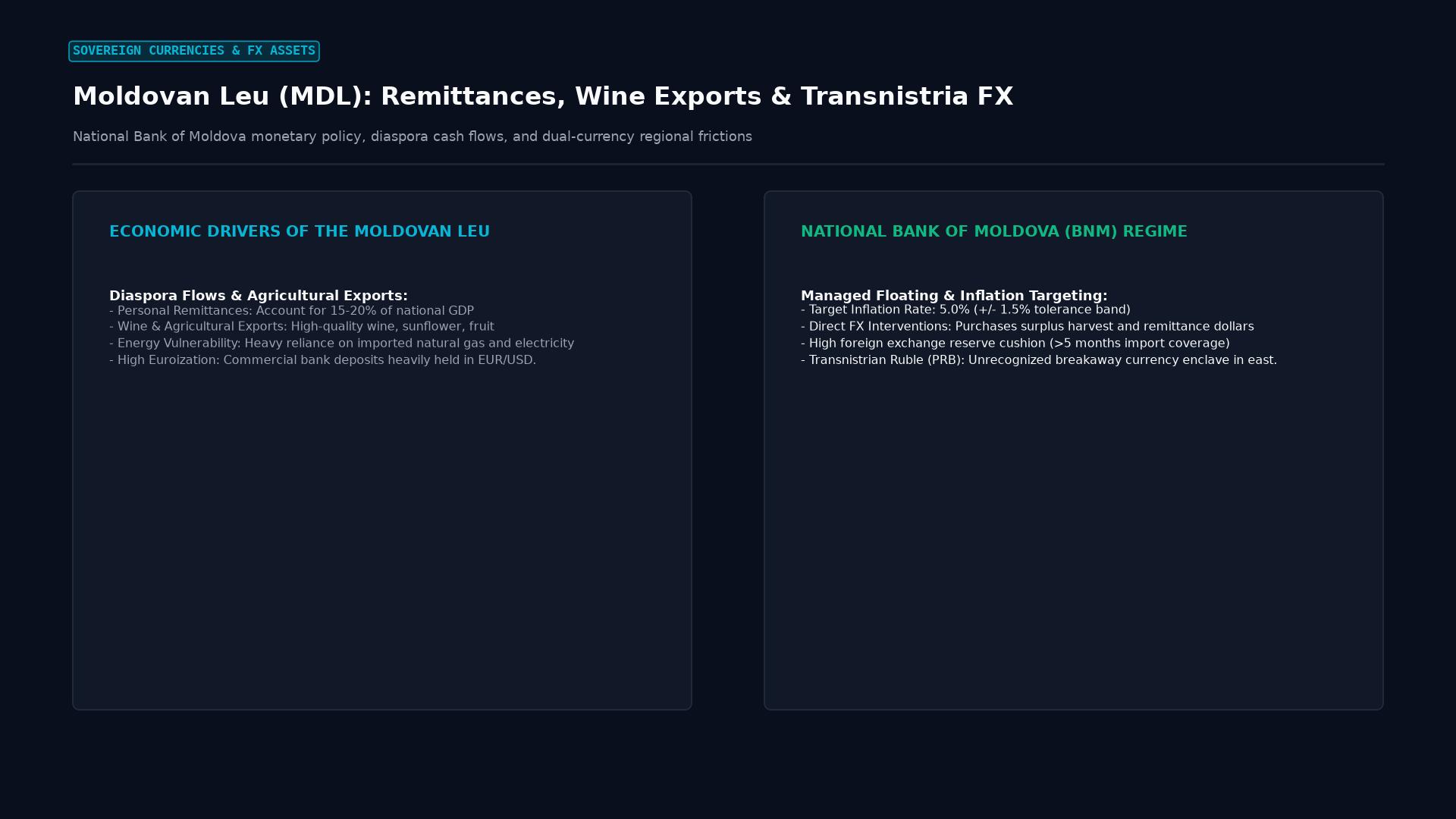 Figure: National Bank of Moldova monetary policy, diaspora cash flows, and dual-currency regional frictions
Historical Evolution and Post-Soviet Monetary Reforms
The monetary lineage of modern Moldova reflects its transition from a planned Soviet republic to an independent sovereign state integrated with European commerce:
1. The Post-Independence Transition and the Cupon (1991–1993)
Following the dissolution of the Soviet Union in 1991, Moldova declared independence, initially continuing to use the Soviet ruble and Russian ruble. Hyperinflation in Moscow and severe fiscal deficits severely depreciated the domestic monetary base. In June 1992, the newly established National Bank of Moldova issued provisional paper coupons (the Moldovan cupon) to circulate alongside rubles as temporary scrip. By late 1993, regional hyperinflation rendered the cupon virtually worthless.
2. Introduction of the Modern Leu (November 1993)
On November 29, 1993, under BNM Governor Leonid Talmaci, Moldova executed a comprehensive monetary reform, introducing the Moldovan leu at a conversion rate of 1 leu = 1,000 cupon units. The reform established the leu as the sole legal tender across government-controlled territory, instituted independent central bank governance, and prohibited direct central bank financing of state budget deficits.
3. The Transnistrian Monetary Division
Following the 1992 War of Transnistria, the breakaway region on the eastern bank of the Dniester River established a de facto unrecognized state. The Transnistrian authorities refused to accept the Moldovan leu, establishing their own central bank (the Trans-Dniester Republican Bank, or PRB) and issuing the unrecognized Transnistrian ruble (PRB). The Transnistrian ruble is not recognized internationally, cannot be converted outside the breakaway region, and does not carry an ISO currency code. Within legal Moldovan territory, the Moldovan leu remains the exclusive legal currency.
       CHRONOLOGY OF MOLDOVAN CURRENCY REFORMS

Period      Currency Unit          Conversion Ratio          Key Characteristic
----------------------------------------------------------------------------------
1944-1992   Soviet / Russian Ruble Parity (1:1)              Monetary union with Moscow
1992-1993   Moldovan Cupon         1 Cupon = 1 Ruble         Emergency transitional scrip
1993-Pres.  Moldovan Leu (MDL)     1 Leu = 1,000 Cupons      Sovereign convertible fiat
Foreign Exchange Architecture and Balance of Payments Mechanics
The external stability and valuation of the Moldovan leu depend heavily on its balance of payments dynamics, characterized by a structural merchandise trade deficit offset by capital inflows:
1. The Merchandise Trade Deficit
Moldova operates a persistent structural trade deficit. As a country without domestic commercial hydrocarbon deposits, Moldova must import 100% of its natural gas, refined petroleum fuels, and electrical coal, alongside machinery, vehicles, and consumer electronics.
2. Diaspora Remittance Inflows
The primary offset to the merchandise trade gap is private cash transfers from Moldovan emigrant workers residing abroad. Between 800,000 and one million Moldovan citizens work internationally, concentrated across the European Union (Italy, Germany, France, Romania) and the United Kingdom.
Annual diaspora remittances channeled through formal banking networks and money transfer operators (MTOs) consistently generate between $1.5 billion and $1.9 billion, representing between 12% and 16% of national GDP. These inflows arrive primarily in cash euros and US dollars. Commercial banks purchase this foreign exchange from retail citizens, selling the excess reserves to the BNM in the interbank market.
3. Agricultural Exports and the EU DCFTA
Moldova’s primary merchandise export revenue stems from agriculture and food processing:
- Table grapes, fresh apples, plums, and walnuts.
- Wine and spirits (Moldova holds the world’s highest density of vineyards per capita, with global exports to over 70 countries).
- Cereal grains, corn, and sunflower seed oil.
Under the Deep and Comprehensive Free Trade Area (DCFTA) ratified with the European Union in 2014, over 65% of Moldovan merchandise exports are directed toward the European single market, increasing the structural dominance of the euro in domestic corporate invoicing.
       MOLDOVAN EXTERNAL LIQUIDITY BALANCING

+---------------------------------------------------------------+
| Structural Outflow Pressure:                                  |
| - Energy Import Invoices (Refined Petroleum, Natural Gas, Power)|
| - Consumer Manufactured Goods & Industrial Machinery          |
+---------------------------------------------------------------+
                               ^
                               | Counterbalanced By
                               v
+---------------------------------------------------------------+
| Foreign Exchange Inflow Channels:                             |
| 1. Diaspora Private Worker Remittances (EUR & USD Cash)       |
| 2. Agricultural Exports under EU DCFTA (Wine, Fruits, Grains) |
| 3. European Union Budgetary Grants & Macro-Financial Loans    |
| 4. Western Direct Investment into Free Economic Zones (FEZs)  |
+---------------------------------------------------------------+
The 2014 Banking Crisis: “The Theft of the Century”
The institutional resilience of the Moldovan leu was severely tested in November 2014 during what became known internationally as the “Theft of the Century” (Furtul Miliardului).
+--------------------------------------------------------------------+
|               THE 2014 MOLDOVAN $1 BILLION BANK FRAUD              |
+--------------------------------------------------------------------+
| 1. Coordinated Capture: Ilan Shor and political confederates       |
|    acquired controlling stakes across three major domestic banks:  |
|    Banca de Economii (BEM), Banca Socială, and Unibank.            |
| 2. Fraudulent Lending: Between Nov 24-26, 2014, the three banks    |
|    issued massive unsecured loans totaling $1.0 billion to offshore|
|    shell companies registered in the UK and Caribbean jurisdictions|
| 3. Systemic Extraction: The siphoned capital represented 12% of    |
|    Moldova's entire annual GDP, leaving the banking core insolvent.|
| 4. Emergency State Bailout: BNM provided emergency emergency loans |
|    of 14 billion lei backed by sovereign government guarantees.    |
| 5. Macro Shock: The Moldovan leu plunged over 30% against the USD; |
|    foreign exchange reserves dropped by one-third in two months;   |
|    domestic inflation spiked into double digits.                   |
| 6. Aftermath: The three fraudulent banks were placed in liquidation;|
|    comprehensive Basel III and governance overhauls were mandated  |
|    by the IMF and European Commission.                             |
+--------------------------------------------------------------------+
Institutional Rebuilding Under IMF Supervision
The banking scandal prompted comprehensive institutional restructuring:
- The BNM liquidated the three insolvent banks.
- Strict transparency laws were enacted regarding ultimate beneficial ownership (UBO) of domestic financial institutions.
- Western European banking groups entered the market: Romania’s Banca Transilvania and the EBRD acquired Victoriabank, while Hungary’s OTP Bank acquired Mobiasbanca, stabilizing the commercial credit sector.
- The government converted the emergency central bank loans into long-term sovereign bonds held by the BNM, restoring official capital ratios.
Monetary Policy Framework: Inflation Targeting
Since 2010, the National Bank of Moldova has conducted monetary policy under an explicit Inflation Targeting (IT) regime:
$$\pi_{\text{target}} = 5.0% \pm 1.5%$$
The BNM aims to maintain headline Consumer Price Index (CPI) inflation within a corridor between 3.5% and 6.5%. The primary monetary policy instrument is the BNM Base Rate, applied to 14-day central bank certificates used to absorb excess liquidity from commercial banks.
To manage currency substitution and encourage dedollarization, the BNM imposes differentiated reserve requirements:
- Mandatory Reserve Ratio for MDL Deposits: Typically calibrated between 30% and 40% of eligible commercial bank liabilities.
- Mandatory Reserve Ratio for FX Deposits: Typically set between 35% and 45%, held directly in US dollars and euros at the central bank.
       BNM MONETARY POLICY TRANSMISSION CORRIDOR

Interest Rate %
   ^
   |        Overnight Credit Facility Rate (Ceiling)
   |        ----------------------------------------
   |
   |              * BNM Base Rate (14-Day CB Certificates) *
   |
   |        ----------------------------------------
   |        Overnight Deposit Facility Rate (Floor)
   +-------------------------------------------------------->
   Time
Real-World Case Study: Managing the 2022 Regional Energy Crisis
In February 2022, following the outbreak of war in neighboring Ukraine, Moldova faced a severe macroeconomic shock:
- Refugee Shock: Over 500,000 Ukrainian refugees crossed into Moldova within weeks, with roughly 100,000 remaining long-term, expanding the resident population by over 3.5%.
- Energy Shock: Natural gas prices on European hubs reached historic records. Moldova’s state energy importer faced import bills that consumed up to 30% of total national export earnings.
- Inflation Spike: Annual headline inflation in Moldova accelerated to 34.3% in October 2022, driven by food and heating tariff shocks.
+--------------------------------------------------------------------+
|               BNM CRISIS MANAGEMENT MEASURES (2022)                |
+--------------------------------------------------------------------+
| 1. Aggressive Base Rate Hikes: BNM raised the policy rate from      |
|    6.50% in December 2021 to 21.50% by August 2022.                |
| 2. FX Market Interventions: BNM sold over $450 million in net      |
|    foreign exchange reserves to meet importer energy demand,       |
|    preventing panic depreciation of the leu.                       |
| 3. European Macro-Financial Assistance: The EU, IMF, and World     |
|    Bank disbursed over 600 million euros in grants and cheap credit.|
| 4. Stabilization Outcome: The USD/MDL exchange rate held within a  |
|    stable 18.00-19.50 corridor; inflation plummeted from 34.3%     |
|    down to 4.2% by December 2023, returning inside the BNM band.   |
| 5. Reserve Reconstruction: Gross official reserves closed 2023 at   |
|    an all-time high exceeding $5.4 billion.                        |
+--------------------------------------------------------------------+
The decisive tightening of the base rate, combined with targeted foreign exchange reserve interventions and Western macroeconomic funding, preserved market confidence in the Moldovan leu, averting a systemic currency crisis.
Frequently Asked Questions
Can foreign investors freely buy and sell the Moldovan leu on international retail forex brokers?
No. The Moldovan leu is not an exotic currency offered on standard retail MetaTrader platforms or international retail brokerage networks. Foreign exchange trading in MDL is conducted primarily through licensed Moldovan commercial banks, local exchange bureaus, or specialized institutional over-the-counter (OTC) agreements. International investors who invest in Moldovan sovereign treasury bills or corporate assets transact through domestic custodian bank accounts.
How does the political status of Transnistria affect the Moldovan leu?
The separatist Transnistria region operates an unrecognized local currency known as the Transnistrian ruble, issued by its own regional central bank. However, because the Transnistrian ruble is not recognized internationally, Transnistrian industrial export enterprises (such as the Rybnitsa steel works and Cuciurgan power station) must maintain legal corporate registration within the Republic of Moldova and use Moldovan bank accounts denominated in Moldovan lei, euros, and US dollars to conduct legitimate international trade.
Why is the Moldovan leu closely influenced by European agricultural harvests?
Agriculture and agro-processing represent over 40% of Moldova’s merchandise exports and employ a large portion of the national workforce. A severe regional drought reduces crop yields, slashing export foreign exchange earnings while forcing the country to import supplemental grain. Conversely, a bumper agricultural harvest accompanied by strong international commodity prices generates substantial foreign currency inflows, boosting commercial bank liquidity and strengthening the external value of the leu.
Ready to trade forex?
Open a free demo account with a regulated broker. Practice with virtual funds before risking real money.