MGA
MGA is the ISO 4217 currency code for the Malagasy ariary, the official legal tender of the Republic of Madagascar, issued by the Central Bank of Madagascar under a managed floating exchange rate system.
The Malagasy ariary (ISO 4217 currency code: MGA, numeric code: 969) is the official legal tender of the Republic of Madagascar, an island nation situated in the Indian Ocean off the southeastern coast of Africa. Currency issuance and monetary policy fall under the statutory jurisdiction of the Central Bank of Madagascar (Banky Foiben’i Madagasikara, or BFM), headquartered in Antananarivo.
In global monetary architecture, the ariary occupies a unique structural position: along with the Mauritanian ouguiya (MRU), it is one of only two circulating non-decimal fiat currencies in the world. Instead of dividing into hundredths based on a base-10 system, 1 ariary is divided into 5 iraimbilanja ($1 \text{ ariary} = 5 \text{ iraimbilanja}$). The ariary operates under a managed floating exchange rate regime, trading through an electronic interbank auction platform known as the Marché Interbancaire des Devises (MID).
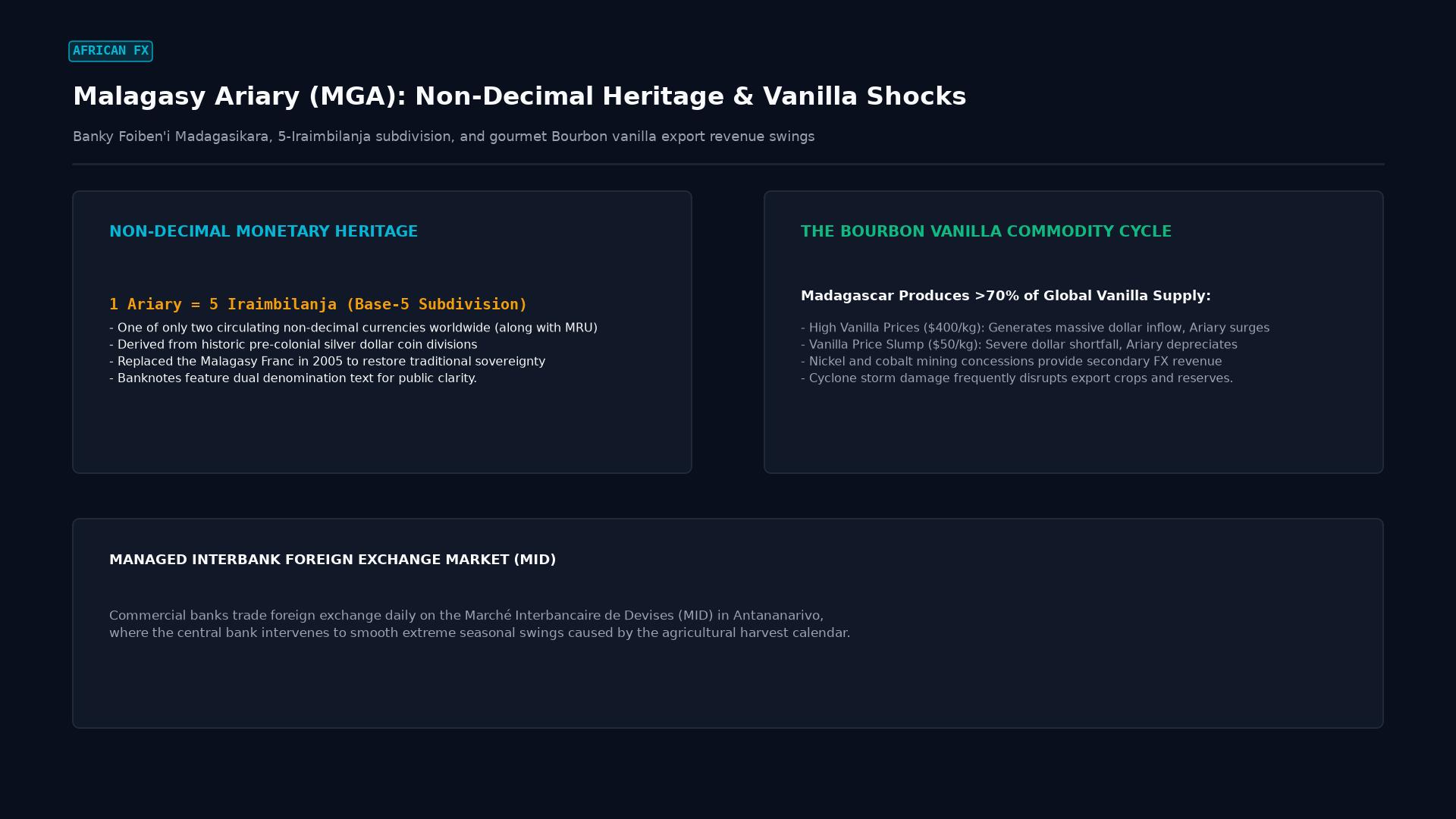 Figure: Banky Foiben’i Madagasikara, 5-Iraimbilanja subdivision, and gourmet Bourbon vanilla export revenue swings
Historical Lineage: Non-Decimal Arithmetic and Currency Redenomination
The origin of the non-decimal division of the ariary traces back to pre-colonial trade practices across the Indian Ocean:
1. The Spanish Pillar Dollar and the Iraimbilanja
During the seventeenth and eighteenth centuries, Spanish American silver pillar dollars (8-real coins) served as the primary trade medium across Malagasy coastal ports. Local merchants referred to the silver dollar as an ariary. To facilitate micro-transactions in village markets, merchants cut the physical silver coin into smaller fragments.
An iraimbilanja (literally translating to “one iron weight” or one part of a balance scale) represented one-fifth of an ariary. When France colonized the island in 1896, the colonial administration replaced silver coins with the French franc, though indigenous populations continued calculating rural transaction prices in traditional ariary units.
2. The CFA Franc Era and Exit from the Franc Zone (1960–1973)
Following independence from France in 1960, Madagascar initially retained the CFA Franc (Franc des Colonies Françaises d’Afrique), issued by the Institut d’Émission Malgache. In 1973, under the nationalist administration of President Didier Ratsiraka, Madagascar formally exited the French Treasury-backed Franc Zone, establishing the Central Bank of Madagascar (Banky Foiben’i Madagasikara) and creating the sovereign Malagasy Franc (MGF).
3. Transition from Franc to Ariary (2003–2005)
For three decades, banknotes were printed displaying dual denominations: both Malagasy francs and ariary, where 1 ariary was mathematically defined as 5 francs. On July 31, 2003, President Marc Ravalomanana enacted monetary legislation that made the ariary (MGA) the primary official monetary unit of the country, phasing out the legacy Malagasy franc at a conversion ratio of:
$$1 \text{ Ariary (MGA)} = 5 \text{ Malagasy Francs (MGF)}$$
The transitional period concluded on December 31, 2004, after which the Malagasy franc ceased to be legal tender, re-establishing traditional non-decimal arithmetic on formal financial statements.
       CHRONOLOGICAL MILESTONES: MADAGASCAR CURRENCY

Year        Currency Event                  Structural Feature
----------------------------------------------------------------------------------
Pre-1896    Spanish Dollar Division         1 Ariary = 5 Iraimbilanja (Physical Silver)
1896-1960   French Colonial Francs          Direct parity with French currency
1960-1973   CFA Franc (IEM Issuance)        Membership in French Treasury Franc Zone
1973-2003   Malagasy Franc (MGF)            Independent central bank; 5 MGF = 1 Ariary
2003-Pres.  Malagasy Ariary (MGA)           Full return to primary Ariary naming
Mathematical Structure of Non-Decimal Currency
Because the Malagasy ariary uses a base-5 sub-unit, fractional financial calculations operate under distinct modular arithmetic compared to base-10 international standards:
$$1 \text{ MGA} = 5 \text{ Iraimbilanja}$$
Fractional coin values represent explicit fractions of the primary integer:
- 1 Iraimbilanja: $\frac{1}{5} \text{ Ariary} = 0.20 \text{ MGA}$
- 2 Iraimbilanja: $\frac{2}{5} \text{ Ariary} = 0.40 \text{ MGA}$
In modern practice, decades of domestic inflation have eroded the real purchasing power of the fractional iraimbilanja coins. Physical coinage below 1 ariary has largely disappeared from commercial circulation, meaning commercial accounting records, interbank forex quotes, and retail transactions are priced in whole ariary integers. However, banknotes and coins continue to be officially labeled with their iraimbilanja equivalents.
Foreign Exchange Architecture: The Interbank Market (MID)
Foreign exchange trading in Madagascar is centralized within the Marché Interbancaire des Devises (MID), managed by the BFM:
- Continuous Fixing Auction: Authorized commercial banks (such as BNI Madagascar, Bank of Africa Madagascar, Société Générale Madagasikara, and BMOI) submit bids and offers for US dollars and euros on the electronic MID platform during daily trading sessions.
- Central Bank Participation: The BFM acts as both market regulator and active participant. The central bank sets daily intervention parameters to dampen speculative volatility and purchase foreign currency to rebuild official gross reserves.
- Reference Rate Determination: At the close of each MID session, the BFM calculates and publishes the weighted average interbank rate for USD/MGA and EUR/MGA, which serves as the legal accounting benchmark for customs valuation, tax assessment, and commercial contracts.
$$\text{Reference Mid-Rate} = \frac{\sum_{k=1}^{n} (P_k \times V_k)}{\sum_{k=1}^{n} V_k}$$
Where $P_k$ represents the transaction execution rate and $V_k$ represents the transaction volume in dollars or euros.
                  MID MARKET CLEARING ENGINE

+--------------------------------------------------------------+
| Commercial Bank Dealing Desks (Antananarivo Interbank)       |
| - Commercial Exporter FX Deposits (Vanilla / Nickel)         |
| - Commercial Importer FX Demands (Fuel / Machinery)          |
+--------------------------------------------------------------+
                               |
                               v Electronic Quote Matching
+--------------------------------------------------------------+
| Marché Interbancaire des Devises (MID Trading Platform)      |
+--------------------------------------------------------------+
                               ^
                               | Open-Market Intervention
+--------------------------------------------------------------+
| Banky Foiben'i Madagasikara (BFM Reserve Desk)               |
| - Absorbs excess seasonal export liquidity                   |
| - Injects USD to cover national energy import bills          |
+--------------------------------------------------------------+
Commodity Export Drivers: The Vanilla and Metals Cycles
The external balance and exchange rate trajectory of the Malagasy ariary are heavily influenced by global commodity markets:
1. The Global Natural Vanilla Monopoly
Madagascar is the undisputed global hub for natural vanilla, producing over 70% of the world’s bourbon vanilla beans. Concentrated in the northeastern Sava region (Sambava, Antalaha, Vohemar, Andapa), the vanilla crop represents the country’s single largest agricultural export revenue generator.
Vanilla economics create extreme seasonality in the foreign exchange market:
- Harvest and Export Window (July to December): International flavor and fragrance conglomerates wire hundreds of millions of US dollars and euros into domestic banks to purchase green and cured vanilla beans. The massive inflow of foreign exchange causes the ariary to appreciate seasonally.
- Inter-Season Deficit (January to June): Export revenues subside, while import demand for rice and manufactured goods persists, causing the ariary to depreciate.
2. Nickel, Cobalt, and the Ambatovy Mining Complex
Madagascar houses the Ambatovy joint-venture mining operation, one of the largest nickel and cobalt extraction and hydrometallurgical refining facilities in the world. Mining royalties and capital equipment investments inject large tranches of US dollars into the central bank’s foreign exchange accounts, making the ariary sensitive to global stainless steel and electric vehicle battery supply chains.
       SEASONAL VANILLA LIQUIDITY TRANSMISSION

FX Inflows /
Ariary Value
   ^
   |                     * Peak Vanilla Export Inflows (Q3 - Q4)
   |                    / \   Surplus FX; MGA Appreciates
   |                   /   \
   |  ----------------/-----\---------------- Baseline Reserve Level
   |                 /       \
   |  * Low Inflow  /         \ * Lean Inflow Season (Q1 - Q2)
   |    (Jan - May)/            Depreciation Pressure on MGA
   +------------------------------------------------------------->
      Q1         Q2            Q3            Q4
Real-World Case Study: The 2017-2020 Vanilla Boom and Collapse
Between 2016 and 2019, a combination of severe tropical cyclones (notably Cyclone Enawo in March 2017) and speculative stockpiling triggered a historic surge in global vanilla prices:
+--------------------------------------------------------------------+
|               THE 2017-2020 VANILLA COMMODITY CYCLE                |
+--------------------------------------------------------------------+
| 1. Supply Shock: Cyclone Enawo destroyed 30% of domestic vanilla   |
|    vines; global vanilla prices skyrocketed from $80/kg to $600/kg.|
| 2. Liquidity Flood: Madagascar's export revenues surged, pushing   |
|    foreign exchange reserves at the BFM to historic record highs.  |
| 3. Domestic Price Distortion: Cash poured into rural Sava towns;   |
|    local property prices and consumer goods inflated rapidly.      |
| 4. Industrial Substitution: International food corporations        |
|    reformulated recipes, switching from natural vanilla to synthetic|
|    vanillin (derived from petroleum or wood lignin).               |
| 5. Market Collapse: Demand plummeted; prices crashed back below    |
|    $60/kg between 2021 and 2023.                                  |
| 6. Macro Adjustment: The sudden reduction in FX export receipts    |
|    forced the BFM to step in, managing an orderly 25% depreciation |
|    of the ariary against the US dollar to protect reserves.        |
+--------------------------------------------------------------------+
During the price collapse, the government attempted to impose an administrative export price floor ($250 per kilogram). However, international buyers refused to purchase at artificial prices, leaving hundreds of metric tons of vanilla unsold in coastal warehouses.
The resulting plunge in foreign exchange inflows placed intense downward pressure on the ariary, demonstrating how heavy export concentration in a single agricultural crop creates terms-of-trade volatility for an emerging economy.
Comparison: Malagasy Ariary vs Regional Island Currencies
| Feature | Malagasy Ariary (MGA) | Mauritian Rupee (MUR) | Seychellois Rupee (SCR) | Comorian Franc (KMF) |
|---|---|---|---|---|
| FX Regime | Managed Float (MID) | Managed Float | Independent Float | Fixed Peg to EUR |
| Sub-Unit | 5 Iraimbilanja (Base-5) | 100 Cents (Decimal) | 100 Cents (Decimal) | 100 Centimes (Decimal) |
| Central Bank | Banky Foiben’i Madagasikara | Bank of Mauritius | Central Bank of Seychelles | Banque Centrale des Comores |
| Primary Exports | Vanilla, Nickel, Cloves | Sugar, Textiles, Financial | Tuna, Tourism Receipts | Vanilla, Ylang-Ylang, Cloves |
| FX Reserves | ~4.5 Months of Imports | ~10 Months of Imports | ~4.0 Months of Imports | Guaranteed by French Treas. |
| IMF Status | Article VIII Member | Article VIII Member | Article VIII Member | Article VIII Member |
Frequently Asked Questions
Why did Madagascar choose a non-decimal currency system rather than a base-10 standard?
Madagascar chose to retain the non-decimal division of the ariary to preserve historical cultural continuity. For centuries prior to French colonization, indigenous populations conducted rural commerce using the silver ariary divided into five iraimbilanja. When the country demonetized the colonial Malagasy franc in 2003, re-establishing the historical 1:5 ratio restored deep-rooted traditional accounting norms that remained familiar to rural farmers.
Can international traders trade MGA on retail forex brokers?
No. The Malagasy ariary is an illiquid frontier currency. Cross-border capital transactions are strictly monitored by the Central Bank of Madagascar under national foreign exchange regulations. International retail brokers do not offer spot MGA pairs on their trading platforms. Multinational mining and agricultural corporations hedge ariary exposure through customized commercial forward agreements negotiated directly with licensed Malagasy commercial banks or global investment banks.
What are the main economic risks facing the Malagasy ariary?
The primary systemic risks to the ariary are climate shocks and commodity price collapses. Madagascar is located directly in the tropical cyclone path of the southwestern Indian Ocean; a single severe storm can destroy port facilities and wipe out an entire season of agricultural exports. In addition, unexpected collapses in international prices for vanilla, nickel, or cobalt abruptly drain foreign exchange reserves, forcing the BFM to allow the currency to depreciate to prevent balance of payments crises.
Ready to trade forex?
Open a free demo account with a regulated broker. Practice with virtual funds before risking real money.