Middle Rate
The middle rate—or mid-market rate—is the exact mathematical midpoint between the prevailing bid (buying) price and ask (selling) price quoted in the foreign exchange or financial markets, representing the unskewed fair value benchmark.
What Is the Middle Rate?
The middle rate—universally referred to in modern finance as the mid-market rate, mid-rate, or median price—is the exact arithmetic average of the current Bid (the highest price a buyer is willing to pay) and Ask (the lowest price a seller is willing to accept) in a two-way financial quotation:
$$\text{Middle Rate} = \frac{P_{\text{Bid}} + P_{\text{Ask}}}{2}$$
In the global foreign exchange (Forex) market, transactions are executed on either side of this dividing line: buyers pay the higher Ask price, and sellers receive the lower Bid price. The middle rate itself is not an active execution order; rather, it functions as the neutral, unskewed fair value benchmark of the currency pair at that microsecond.
Because it eliminates dealer spread markups and commercial profit margins, the middle rate is the standard rate published by central banks, financial news terminals (Bloomberg and Refinitiv), and corporate accounting standards (IFRS and US GAAP) to revalue multi-currency balance sheets and track macroeconomic exchange rate trends.
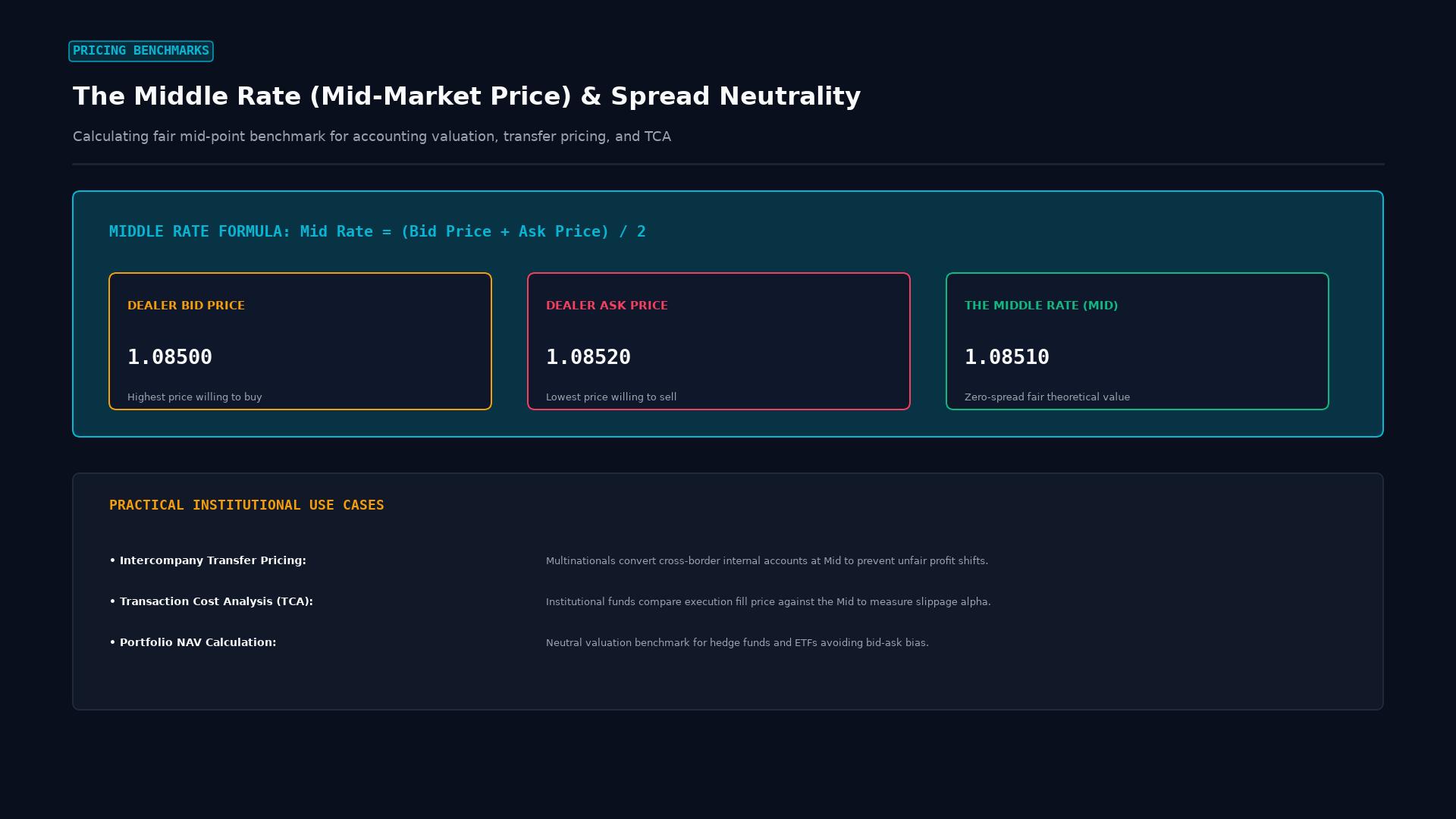 Figure: Mid-market calculation methodology: arithmetic mean of best bid and ask, serving as the fair-value benchmark for commercial accounting.
Key Takeaways
- The Neutral Equilibrium: The middle rate represents the true, unmanipulated balance point between market supply and demand before broker commissions or dealer markups are applied.
- Corporate Accounting Standard: Multinational corporations use the closing middle rate at month-end to revalue foreign subsidiaries’ balance sheets and calculate foreign currency transaction gains and losses.
- Central Bank Reference Fixings: Official daily foreign exchange reference rates—such as the European Central Bank’s (ECB) daily Euro reference fixings—are computed as middle rates derived from regular daily concertation procedures between central banks.
- The Fintech Disruption: Online international transfer companies (such as Wise and Revolut) disrupted traditional commercial banking by executing retail remittances at the true interbank middle rate, charging a transparent, unbundled upfront transaction fee.
- Indicator Construction: Most technical momentum oscillators (such as the Relative Strength Index or Bollinger Bands) default to closing prices, but advanced quantitative models frequently use the middle rate $(\frac{\text{High} + \text{Low}}{2})$ to avoid bid-ask bounce distortion.
Comparative Taxonomy: Price Quotations in Foreign Exchange
| Quotation Metric | Description | Who Uses It? | Relationship to Fair Value |
|---|---|---|---|
| Middle Rate (Mid-Market) | Exact midpoint between Bid and Ask | Central banks, financial media, corporate accounting | Exact Fair Value (Zero markup) |
| Bid Price | Highest price market makers will buy from you | Retail and institutional currency sellers | Below Mid by half the spread |
| Ask Price (Offer) | Lowest price market makers will sell to you | Retail and institutional currency buyers | Above Mid by half the spread |
| Commercial Bank Rate | Heavily widened bid-ask rates | Unwary retail consumers and corporate wire desks | 1.5% to 4.0% worse than true Mid |
| Central Bank Fixing | Official mid-rate snapshot at specific time (e.g., 14:15 CET) | Sovereign funds, corporate cross-border contracts | Official regulatory reference |
The Mathematics of Dealer Skewing Around the Middle Rate
In wholesale foreign exchange dealing, market makers do not always center their quotes symmetrically around the middle rate. A dealer managing heavy inventory will deliberately skew their bid and ask quotes around the prevailing market mid-rate to incentivize the market to relieve their inventory burden.
Suppose the true interbank middle rate for EUR/USD is 1.08500:
$$\text{Neutral Quote (1.0 pip spread)} \implies \text{Bid: 1.08495} ; | ; \text{Ask: 1.08505}$$
If Dealer Desk A accumulates an unwanted long position of €50,000,000, the desk wants to attract buyers and discourage sellers. The dealer shifts their quote downward relative to the middle rate:
$$\text{Skewed Quote (Lowered)} \implies \text{Bid: 1.08485} ; | ; \text{Ask: 1.08495}$$
- The dealer’s Ask (1.08495) is now below the interbank middle rate (1.08500), making them the cheapest seller in the global market and attracting algorithmic buyers to absorb their long inventory.
- The dealer’s Bid (1.08485) is unattractive, discouraging incoming sellers.
Real-World Case Study: The Hidden Cost of Commercial Bank Markups
A British citizen selling a property in Spain receives an inheritance wire of €200,000 EUR to be converted into British Pounds (GBP). The prevailing interbank middle rate is EUR/GBP = 0.85000 (meaning €200,000 is worth exactly £170,000 GBP).
-
Option A: Traditional Commercial High-Street Bank:
- The bank advertises “Zero Commission” foreign exchange transfers.
- However, instead of applying the middle rate (0.85000), the bank applies an internal retail exchange rate of 0.82500 (a 2.94% embedded spread markup).
- The customer receives: $€200,000 \times 0.82500 = \mathbf{£165,000}$.
- Hidden Bank Profit: The bank silently pockets £5,000 ($6,300 USD) in spread gouging.
-
Option B: Modern Fintech Transfer at True Middle Rate:
- The customer uses a transparent foreign exchange transfer service that converts at the exact interbank middle rate of 0.85000.
- Gross proceeds: $€200,000 \times 0.85000 = £170,000$.
- Transparent service fee deducted: £500 (0.29%).
- Net proceeds received: £169,500.
- Net Customer Benefit: By demanding execution anchored directly to the true middle rate, the customer saves £4,500 GBP.
Practical Pitfalls Regarding the Middle Rate
- You Cannot Execute at the Middle Rate Directly on Exchanges: Novice traders frequently calculate potential profits assuming they can buy or sell directly at the middle rate displayed on Google or TV news. In real-world trading, you must always cross the spread—buying at the higher Ask and selling at the lower Bid.
- Illiquid Pair Mid-Rate Illusions: In thinly traded exotic currency pairs (such as USD/ZAR or USD/TRY), the spread can be 50 to 100 pips wide. A middle rate calculation can be misleading if the market is moving rapidly in one direction, as the executable bids may be collapsing far faster than the theoretical mid-point indicates.
Frequently Asked Questions (FAQ)
Can retail forex traders trade at the middle rate?
Not directly on a single transaction. Market makers and liquidity providers require compensation for taking inventory risk, which is earned via the bid-ask spread. However, institutional ECN accounts with razor-thin spreads (e.g., 0.1 pips) execute within fractions of a basis point of the true middle rate.
Why do currency converters online show the middle rate?
Online converters (such as Google Finance or XE.com) display the interbank middle rate because it represents the pure, unbiased fair value of the currency without factoring in the subjective, varying commercial markups charged by individual banks, credit card companies, or airport kiosks.
How is the European Central Bank (ECB) middle rate calculated?
The ECB publishes daily reference exchange rates around 16:00 CET for 31 major currencies. These are middle rates based on the regular daily concertation procedure between European central banks, capturing market conditions at 14:15 CET.
Ready to trade forex?
Open a free demo account with a regulated broker. Practice with virtual funds before risking real money.