Market Rate
The market rate—often termed the spot market rate or prevailing rate—is the real-time price at which a currency, financial instrument, or commodity can currently be bought or sold in the active, open marketplace.
What Is a Market Rate?
The market rate is the prevailing, real-time exchange rate or asset price determined continuously by the collective forces of supply and demand across global financial markets. In the foreign exchange (Forex) market, the market rate represents the exact price at which international banks, hedge funds, sovereign institutions, and retail traders are actively executing spot currency transactions at any given moment.
Rather than being set by government decree or a static central authority, the market rate is inherently dynamic, fluctuating hundreds of times per second as market participants process incoming macroeconomic data, central bank interest rate announcements, geopolitical developments, and multi-billion-dollar commercial corporate order flows. Crucially, the market rate is never quoted as a single, static figure; it is universally expressed as a two-way quote comprising a Bid (the price at which you can sell) and an Ask or Offer (the price at which you can buy).
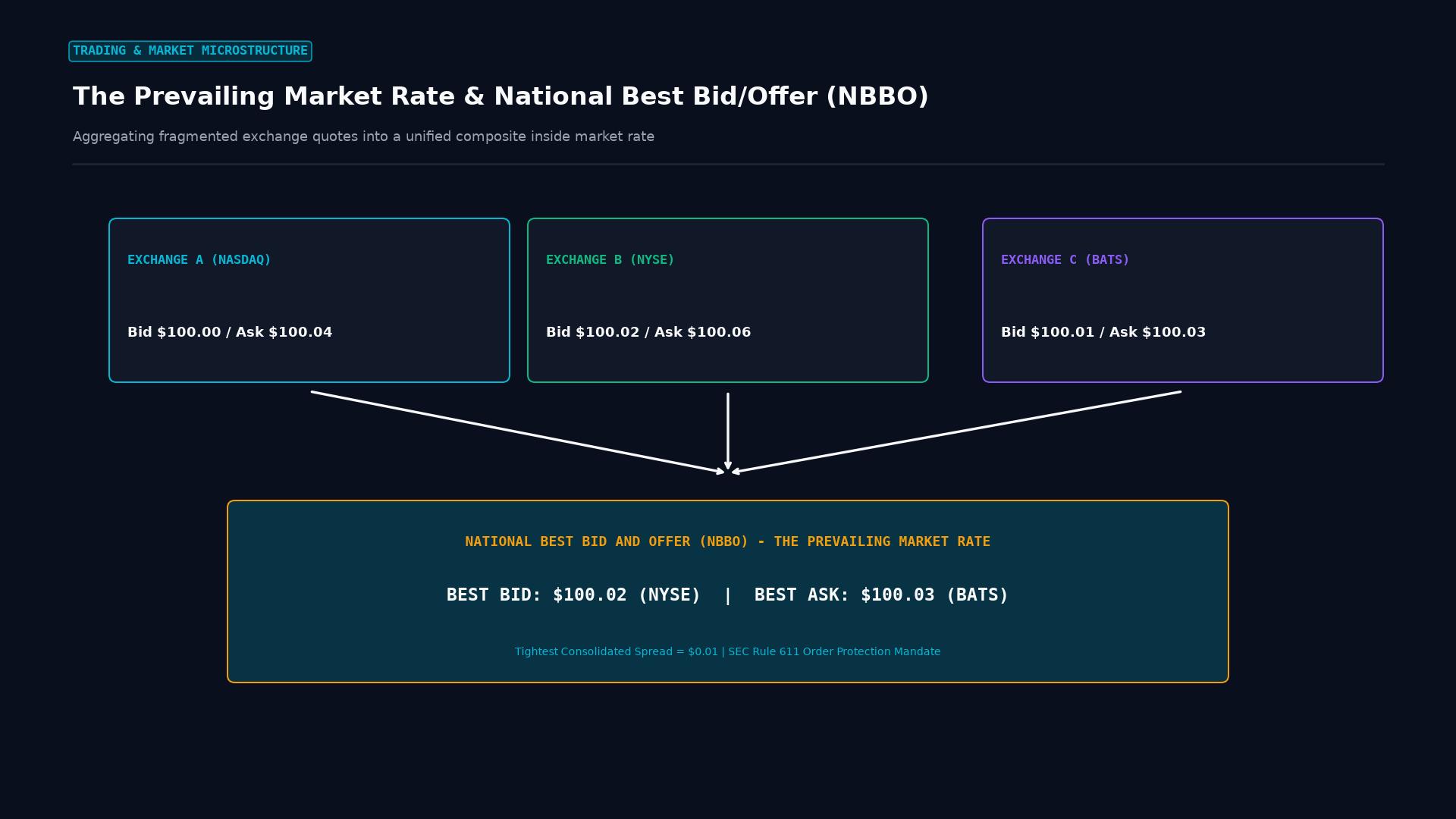 Figure: Formation of the official market rate: real-time intersection of the highest resting bid and lowest resting offer across interbank ECNs.
Key Takeaways
- Dynamic Price Discovery: The market rate is the product of continuous, decentralized price discovery across global electronic communication networks (ECNs) such as EBS, FastMatch, and Currenex.
- Two-Way Price Architecture: Every market rate consists of a Bid Rate (highest buying price available in the order book) and an Ask Rate (lowest selling price offered).
- The Mid-Market Benchmark: The mathematical midpoint—$\text{Mid Rate} = \frac{\text{Bid} + \text{Ask}}{2}$—serves as the neutral international reference benchmark for financial media, accounting revaluations, and global pricing indices.
- Wholesale vs. Retail Disconnect: While the interbank market rate trades with fractions of a pip spread, traditional retail banks and airport kiosks widen the market rate by 2% to 6%, imposing massive hidden markups on unsophisticated clients.
- Microstructure Volatility: High-impact economic releases (such as the U.S. Non-Farm Payrolls or CPI inflation) can cause the market rate to dislocate by 50 to 100 pips within seconds as market makers pull back liquidity.
Comparative Taxonomy: Institutional vs. Retail Market Rates
The price an individual or business receives depends entirely on their point of entry into the foreign exchange hierarchy.
| Market Venue | Quoted Market Rate (Example) | Effective Spread | Transaction Costs | Typical User |
|---|---|---|---|---|
| Tier-1 Interbank (EBS) | 1.08500 / 1.08502 | 0.2 pips ($0.00002) | Volume-based clearing fractions | Global investment banks, sovereign funds |
| Retail ECN Forex Broker | 1.08500 / 1.08502 | 0.2 pips + Ticket Fee | ~$3 to $7 per standard lot | Professional retail traders, prop firms |
| Fintech Transfer (Wise, Revolut) | 1.08501 (True Mid-Rate) | Zero embedded spread | Transparent 0.3% – 0.5% fee | Cross-border freelancers, SMEs |
| Commercial Bank Wire Desk | 1.06500 / 1.10500 | 400 pips ($0.0400) | 2.0% – 3.5% hidden spread + wire fee | Corporate treasuries without FX desks |
| Airport Exchange Kiosk | 0.98000 / 1.18000 | 2,000 pips ($0.2000) | 10.0% – 20.0% predatory gouging | Unprepared retail travelers |
The Mathematics of the Mid-Market Rate
In academic finance and macroeconomic statistics, currency valuation is standardized using the Mid-Market Rate:
$$\text{Mid-Market Rate} = \frac{P_{\text{Bid}} + P_{\text{Ask}}}{2}$$
$$\text{Spread Cost (%)} = \left( \frac{P_{\text{Ask}} - P_{\text{Bid}}}{\text{Mid-Market Rate}} \right) \times 100$$
Numerical Example:
Suppose the prevailing market rate for GBP/USD on an institutional ECN is:
- $\text{Bid} = 1.26500$
- $\text{Ask} = 1.26510$
- Mid-Market Rate: $\frac{1.26500 + 1.26510}{2} = \mathbf{1.26505}$.
- Spread: $0.00010$ (1.0 pip).
- Spread Cost: $\left(\frac{0.00010}{1.26505}\right) \times 100 = \mathbf{0.0079%}$ (Virtually frictionless).
If a high-street retail bank quotes the customer:
- $\text{Bid} = 1.2300$
- $\text{Ask} = 1.3000$
- Spread: $0.0700$ (700 pips).
- Spread Cost: $\left(\frac{0.0700}{1.2650}\right) \times 100 = \mathbf{5.53%}$.
The customer loses over 5.5% of their principal capital simply crossing the bank’s artificial “market rate.”
Real-World Case Study: Corporate Treasury Foreign Exchange Conversion
A German automotive components manufacturer sells €10,000,000 worth of parts to an American automotive firm, receiving a wire payment of $10,850,000 USD. The prevailing wholesale interbank market rate is EUR/USD = 1.0850.
-
Scenario A: Automated Bank Conversion:
- The firm allows its traditional relationship bank to automatically convert the $10,850,000 USD into Euros upon receipt.
- The bank applies an internal retail corporate conversion rate of 1.1050 (a 1.84% hidden markup).
- The firm receives: $\frac{$10,850,000}{1.1050} = \mathbf{€9,818,995}$.
- The bank pockets €181,005 in pure spread revenue.
-
Scenario B: Executing at True Interbank Market Rate:
- The treasurer opens an institutional multi-currency corporate treasury account connected directly to an FX liquidity aggregator.
- The treasurer converts the funds at the true market rate of 1.0852 (including a 0.2-pip institutional commission).
- The firm receives: $\frac{$10,850,000}{1.0852} = \mathbf{€9,998,157}$.
- Net Corporate Savings: By executing at the true wholesale market rate rather than accepting the bank’s quoted rate, the company retains an additional €179,162 in hard operating profit on a single invoice.
Pitfalls When Tracking the Market Rate
- Assuming “Zero-Fee” Means Best Rate: Retail foreign exchange kiosks and legacy bank remittance services heavily advertise “0% Commission” while drastically manipulating the underlying market rate, embedding exorbitant 3% to 10% margins into the bid-ask spread.
- Off-Market Requotes: In volatile markets, dishonest or low-tier brokers may reject orders at the true market rate, issuing a “re-quote” several pips worse than the interbank rate to capture illicit slippage profits.
Frequently Asked Questions (FAQ)
Where can I check the true interbank market rate for free?
Platforms like TradingView, Bloomberg, Reuters, and independent currency converter sites (such as XE.com or Wise) display the live interbank mid-market rate in real time, serving as an unbiased benchmark against which you can evaluate bank and broker quotes.
Why does the market rate differ between different forex brokers?
Because the foreign exchange market is decentralized without a single physical clearing floor, each broker aggregates liquidity from their own specific network of Tier-1 banks, non-bank market makers, and ECN venues. Consequently, market rates between competing brokers can diverge by fractions of a pip.
What is the “spot market rate”?
The spot market rate is the market rate quoted for immediate foreign exchange settlement (standardized as delivery within two business days, $T+2$). It contrasts with forward rates, which lock in exchange prices for delivery months or years in the future.
Ready to trade forex?
Open a free demo account with a regulated broker. Practice with virtual funds before risking real money.