Mine and Yours
In interbank dealing and trading pits, 'Mine' and 'Yours' are standardized verbal and electronic declarations used by traders to execute transactions instantly: 'Mine' confirms buying at the seller's offer, while 'Yours' confirms selling into the buyer's bid.
What Does “Mine and Yours” Mean?
In wholesale financial markets, physical trading pits, and interbank foreign exchange dealing, “Mine” and “Yours” represent the most concise, unambiguous contractual commands in financial history. Originating on the trading floors of the London Stock Exchange, the Chicago Mercantile Exchange (CME), and traditional bank telephone dealing desks, these terms allow traders to execute multi-million-dollar transactions in a fraction of a second without risking verbal ambiguity:
- “Mine!” (or “Take”): Declares that the trader is buying. It signifies that the caller is lifting the market maker’s quoted Ask (Offer) price—meaning “The offered currency is now mine.”
- “Yours!” (or “Hit”): Declares that the trader is selling. It signifies that the caller is hitting the market maker’s quoted Bid price—meaning “The currency you bid for is now yours.”
Under the timeless institutional market maxim “Dictum Meum Pactum” (“My word is my bond”), the instant a trader utters or types “Mine” or “Yours,” a legally binding, irrevocable financial contract is formed. No written signatures or formal purchase orders are required; the verbal confirmation or electronic keystroke obligates both institutions to settle the trade.
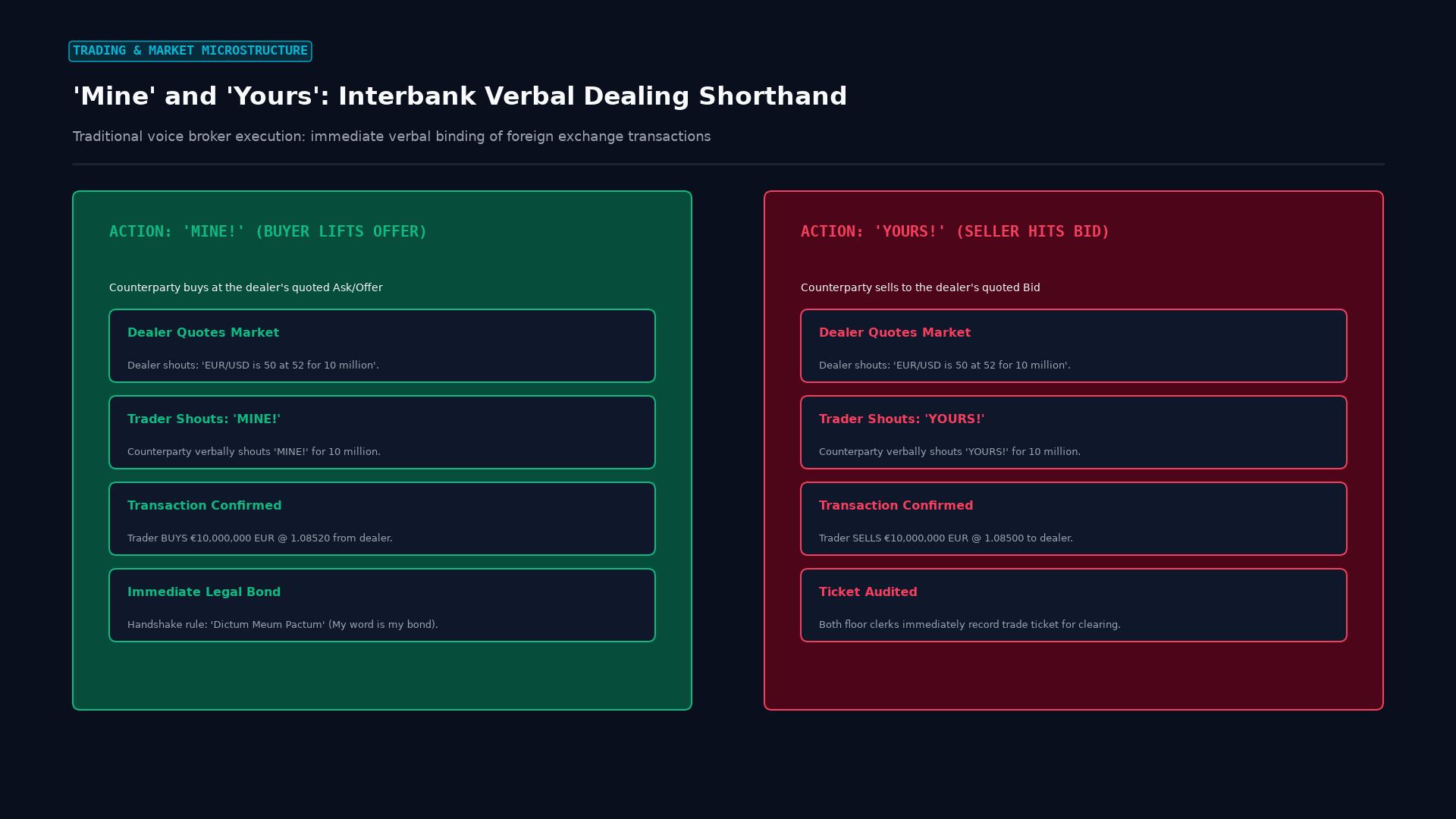 Figure: Interbank voice and chat shorthand: ‘Mine’ to hit the dealer’s offer (buy) and ‘Yours’ to hit the dealer’s bid (sell) for binding execution.
Key Takeaways
- Irrevocable Legal Commitment: Uttering “Mine” or “Yours” constitutes a binding verbal contract under commercial law, recorded on mandatory compliance audio loggers.
- Elimination of Counterparty Confusion: Using “Mine” and “Yours” prevents catastrophic linguistic errors (such as confusing “I will sell to you” with “Will you sell to me?”).
- Physical Hand Signals in Open Outcry: In physical futures pits, “Mine” was accompanied by palms facing toward the trader’s chest (pulling contracts in), while “Yours” was signaled by palms facing outward (pushing contracts away).
- Electronic Keyboard Evolution: When interbank trading migrated to electronic systems (Reuters Dealing 3000 and EBS), dedicated physical trading keyboards featured oversized mechanical keys labeled MINE (BUY) and YOURS (SELL).
- Shorthand Terminology: In modern electronic trading platforms, these terms have largely evolved into “Hit” (hitting the bid / Yours) and “Take” (taking the offer / Mine).
Comparative Taxonomy: Execution Vocabulary Across Trading Eras
| Execution Concept | Open-Outcry Floor Pits | Interbank Voice / Chat Dealing | Modern Electronic Limit Order Book |
|---|---|---|---|
| Buying at the Offer | Shouting “MINE!” (Palms inward) | “Mine [Amount]” | Clicking “Buy Market” or “Take” |
| Selling into the Bid | Shouting “YOURS!” (Palms outward) | “Yours [Amount]” | Clicking “Sell Market” or “Hit” |
| Rejecting the Quote | Shaking head / Hand swipe | “Nothing done” or “Pass” | Canceling RFQ / Letting price expire |
| Volume Specification | Number of fingers or vocal numbers | “Buck” ($1M), “Yard” ($1B) | Inputting numeric lot size or notional |
| Execution Record | Hand-written pit badge trading card | Tamper-proof turret audio recording | Real-time automated STP database log |
The Grammar of Interbank Dealing
In professional institutional foreign exchange, efficiency is paramount. A multi-million-dollar voice dealing conversation between two institutions follows a rigid, centuries-old linguistic structure:
- The Call: The initiating bank identifies the currency pair and volume using established slang. “Euro, ten yards” (€10 billion) or “Cable, ten bucks” (£10 million).
- The Big Figure Assumption: Because both professionals track live exchange rate levels continuously, the dealer omits the “big figure.” If EUR/USD is trading at 1.0845 / 1.0847, the dealer merely quotes: “45 to 47.”
- The Execution Strike:
- If the caller says “Mine ten”, the trade is locked at 1.0847.
- If the caller says “Yours ten”, the trade is locked at 1.0845.
- The Settlement Coordinates: Both desks verify settlement accounts: “My USD to Citibank New York, your EUR to Deutsche Bank Frankfurt.”
Real-World Case Study: The Flash Crash Voice Line Chaos
During periods of extreme market panic—such as the October 2016 British Pound flash crash, where GBP/USD dropped 1,000 pips in two minutes during thin Asian liquidity:
- The Disconnect: Automated electronic matching engines temporarily emptied of bids as algorithms tripped circuit breakers.
- Return to Voice Desks: Institutional hedge funds desperate to hedge sterling risk bypassed frozen electronic screens and called interbank dealer squawk boxes directly.
- The Execution: A dealer quoted an emergency wide two-way market on Cable: “1.1850 - 1.2050!” (a massive 200-pip spread).
- The Resolution: A desperate fund manager immediately shouted: “YOURS TWENTY!”
- The Impact: With those two words, the fund legally sold £20,000,000 at 1.1850, instantly locking in a definitive price. Despite the wild volatility that followed, the recorded audio tape confirmed the trade, protecting both institutions from subsequent legal disputes.
Compliance and Legal Safeguards
- Mandatory Audio Recording: Under FCA (UK COBS 11.8) and CFTC regulations, every single telephone line, turret, and mobile device used by institutional derivatives and forex dealers must be recorded and archived for a minimum of five to seven years.
- Dispute Resolution via Tape Review: If a market participant claims they said “Mine” but the counterparty booked “Yours”, compliance officers immediately pull the synchronized voice recording to verify the exact word spoken.
- “Big Figure” Protection: If the underlying exchange rate shifts by a full “big figure” (e.g., from 1.0845 to 1.0945) while the quote is being given, the dealer must state “Change figure” before accepting “Mine” or “Yours” to prevent unintentional trade disputes.
Frequently Asked Questions (FAQ)
What does “Hit” and “Take” mean compared to “Mine” and “Yours”?
They are modern electronic synonyms. When an institutional trader executes an order against a resting limit order in an electronic order book, clicking the bid is called “hitting the bid” (functionally equivalent to “Yours”), while clicking the offer is called “taking the offer” (functionally equivalent to “Mine”).
Can a trader retract a “Mine” or “Yours” execution if they made a mistake?
No. Once “Mine” or “Yours” is spoken or confirmed, the contract is legally binding. The trade can only be amended or unwound if both counterparties mutually agree to cancel it or if an obvious clerical typing error (“fat finger”) violates the exchange or broker’s clear off-market policy.
Why didn’t traders simply say “Buy” or “Sell”?
In noisy physical trading pits or over crackling trans-Atlantic telephone lines, the words “Buy” and “Sell” sound remarkably similar and are easily misheard. “Mine” and “Yours” possess completely distinct vowel and consonant structures, making auditory confusion virtually impossible.
Ready to trade forex?
Open a free demo account with a regulated broker. Practice with virtual funds before risking real money.