Dealer
A dealer is a financial institution or individual that trades securities, currencies, or commodities for its own account, acting as a principal, holding inventory, and standing ready to quote two-way bid-ask prices.
What Is a Dealer?
In financial markets, a dealer is a financial institution, corporate entity, or professional trader that actively buys and sells financial instruments—including foreign exchange, government bonds, equities, and derivatives—for its own portfolio and balance sheet, acting as a Principal. Dealers stand ready to quote two-way continuous prices (a Bid price at which they buy and an Ask price at which they sell), thereby providing essential liquidity to the marketplace.
Because dealers trade as principals rather than mere intermediaries, they take on direct inventory risk: they hold open positions in the underlying assets they trade, exposing their corporate capital to adverse market price fluctuations. Dealers generate operating profits primarily through the bid-ask spread—the mathematical difference between the lower price they pay to purchase an asset from sellers and the higher price they charge when selling it to buyers—and through skillful inventory risk management.
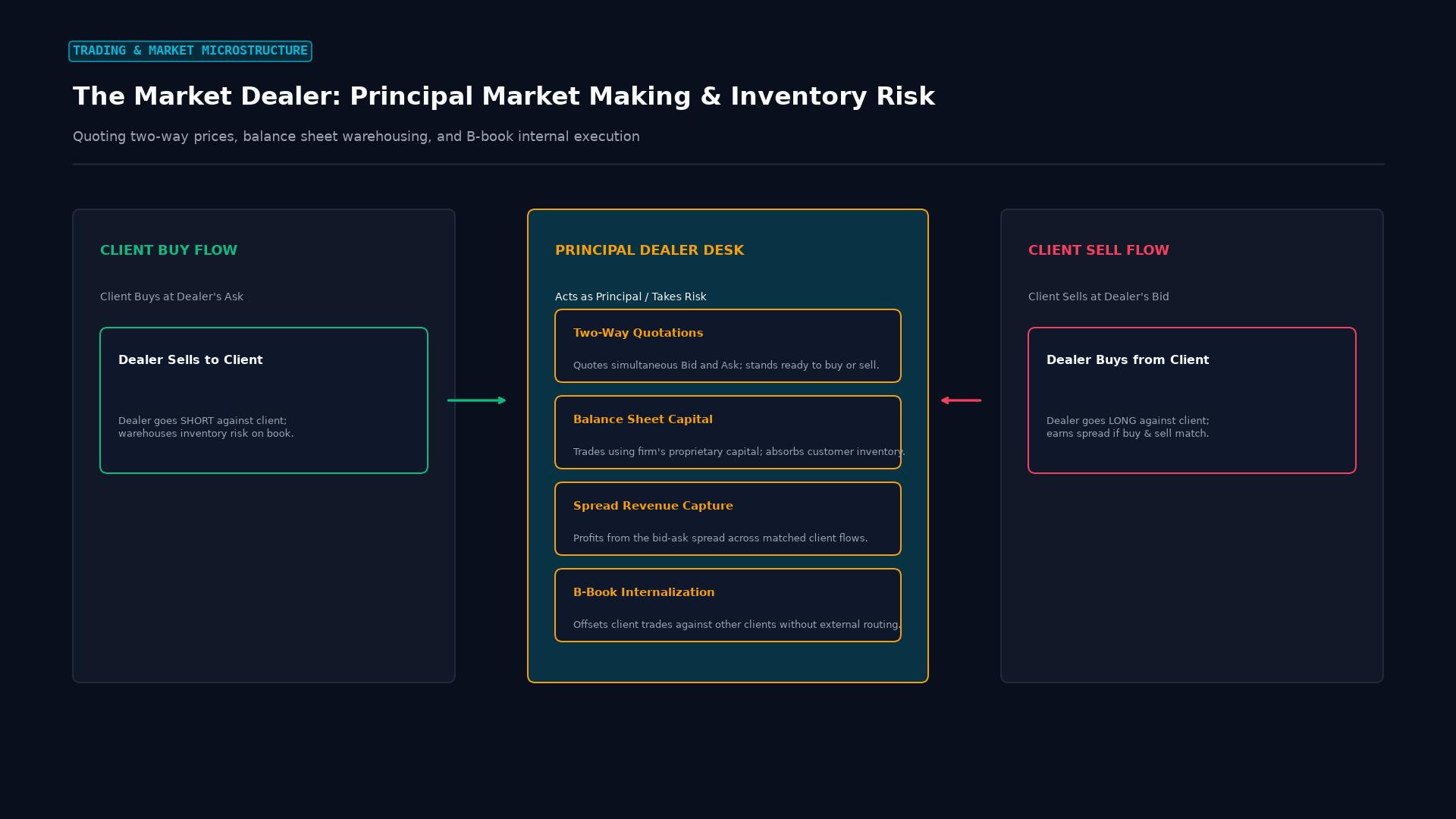 Figure: Principal dealer market-making mechanics: quoting two-way prices, warehousing inventory risk on balance sheet capital, and internalizing order flow through B-book matching.
Key Takeaways
- Principal vs. Agent: A broker acts as an agent, executing trades on behalf of clients without risking its own money. A dealer acts as a principal, trading against clients using its own balance sheet and capital.
- Broker-Dealers (B/Ds): Most large financial institutions operate as hybrid broker-dealers, acting as agency brokers when routing client orders to external markets and as principal dealers when filling orders from their internal inventory.
- Primary Dealers: A prestigious group of elite commercial and investment banks (such as JPMorgan, Goldman Sachs, and Morgan Stanley) authorized by central banks (e.g., the Federal Reserve) to trade sovereign debt directly during Open Market Operations.
- Inventory Management: In foreign exchange, dealing desks continuously adjust their bid-ask quotations to balance incoming order flow, hedging excess net exposure across interbank electronic matching networks (EBS, Refinitiv).
Comparative Analysis: Broker vs. Dealer vs. Market Maker
While often used interchangeably in casual conversation, these market participants perform distinct structural functions:
| Operational Dimension | Broker (Agent) | Dealer (Principal) | Market Maker |
|---|---|---|---|
| Legal Capacity | Agent on behalf of client | Principal for own account | Specialized Dealer committed to quoting continuous prices |
| Capital Risk | Zero; carries no market exposure | High; holds proprietary inventory | High; obligated to absorb continuous two-sided liquidity |
| Revenue Model | Fixed transaction commissions, tickets | Bid-ask spread, trading capital gains | Bid-ask spread, exchange maker rebates |
| Counterparty Identity | Merely facilitates; not the counterparty | Direct legal counterparty to the trade | Direct legal counterparty to the trade |
| Retail FX Analogy | A-Book / STP / ECN Broker | B-Book Dealing Desk Broker | Tier-1 Bank FX Liquidity Provider (e.g., Citi, Deutsche) |
The Economics of Foreign Exchange Dealing
An FX dealer’s core profitability depends on high transaction turnover and disciplined inventory risk management:
The Bid-Ask Spread Revenue Engine:
A dealer quotes EUR/USD at 1.08500 / 1.08520 (a 2-pip spread):
- Client A sells €10,000,000 to the dealer at the bid:
1.08500(Dealer pays $10,850,000 USD). - Client B buys €10,000,000 from the dealer at the ask:
1.08520(Dealer receives $10,852,000 USD). - The Dealer’s Gross Spread Profit: $$\text{Profit} = $10,852,000 - $10,850,000 = $2,000 \text{ USD (Riskless 2-Pip Capture)}$$
The Challenge of Inventory Imbalance:
If Client A sells €50,000,000 but no buyers arrive, the dealer is left long €50,000,000. If EUR/USD drops by 30 pips over the next hour, the dealer incurs an unrealized loss of $150,000 USD, completely overwhelming their spread earnings. To prevent this, dealers dynamically shade their prices (lowering their bid to deter sellers and lowering their ask to attract buyers) or lay off the excess exposure into interbank ECNs.
Primary Dealers and Central Bank Monetary Policy
In the sovereign bond market, Primary Dealers form the direct transmission vector for central bank monetary operations:
- In the United States, the Federal Reserve Bank of New York maintains a formal list of approximately two dozen designated Primary Dealers.
- These institutions are legally obligated to participate in all U.S. Treasury debt auctions, bidding competitively to guarantee the federal government can fund its national deficit.
- When the Federal Reserve implements Quantitative Easing (QE) or Quantitative Tightening (QT), it executes open market purchase and sale transactions exclusively with its primary dealer network.
Real-World Case Study: Retail Broker Dealing Desk (B-Book) Execution
A retail trader deposits $5,000 with a broker-dealer that operates an internal Dealing Desk (B-Book model).
The Mechanics of Dealing Desk Internalization:
- The Order: The trader executes a market buy order for 2 standard lots (€200,000 notional) of EUR/USD at
1.0850. - The Principal Execution: The broker does not route this order to an external liquidity provider. Instead, the broker’s dealing desk acts as the direct principal, selling €200,000 directly to the client from the firm’s inventory.
- The Divergence of Interest:
- If the trader’s position gains 100 pips ($2,000 profit), the broker must pay that $2,000 out of its own corporate reserves.
- If the trader loses $2,000, the broker retains that $2,000 as direct proprietary trading profit.
- Hybrid Risk Hedging: Because professional dealing desks know that over 70% of retail traders lose capital over time, they internalize the flow of novice traders (B-Book) while automatically routing profitable, high-volume traders to external interbank liquidity pools (A-Book) to protect the firm from adverse market exposure.
Frequently Asked Questions
Is it legal for a broker to act as a dealer?
Yes. In most global jurisdictions, retail financial firms are formally licensed as Broker-Dealers. Under regulatory rules (such as FINRA/SEC in the U.S. and FCA in the UK), broker-dealers must disclose their operational capacity on trade confirmations, explicitly stating whether they acted as “Agent” or “Principal” for that specific execution.
What is the difference between a dealer and a trader?
A trader is an umbrella term for anyone buying or selling financial assets (including proprietary retail speculators, institutional asset managers, and portfolio hedgers). A dealer is a specialized, licensed market professional who holds inventory and provides continuous two-sided liquidity to third parties.
Why do institutional dealing desks use electronic pricing algorithms?
Modern foreign exchange markets move at microsecond speeds. Institutional dealers utilize automated algorithmic pricing engines (auto-hedgers) that process thousands of incoming customer order streams per second, instantly calculating real-time inventory risk and automatically executing hedging orders on interbank venues like EBS and Currenex.
Ready to trade forex?
Open a free demo account with a regulated broker. Practice with virtual funds before risking real money.