MIPA
MIPA stands primarily for Membership Interest Purchase Agreement in private equity and corporate M&A, the definitive legal contract governing the sale and transfer of equity interests in a limited liability company (LLC).
In corporate finance, private equity, mergers and acquisitions (M&A), and infrastructure law, the acronym MIPA stands primarily for Membership Interest Purchase Agreement. It represents the definitive, legally binding contract utilized when a buyer acquires the equity ownership (membership interests) of a Limited Liability Company (LLC) directly from its existing equity holders.
In public finance, infrastructure project finance, and municipal development, MIPA also designates a Master Intergovernmental Project Agreement or Master Infrastructure Project Agreement, which formalizes risk allocation and multi-agency capital funding for public-private partnerships (P3). Across corporate transactions, however, a MIPA serves as the LLC equivalent of a corporate Stock Purchase Agreement (SPA), dictating purchase price adjustments, representations and warranties, indemnification escrows, and post-closing operational covenants.
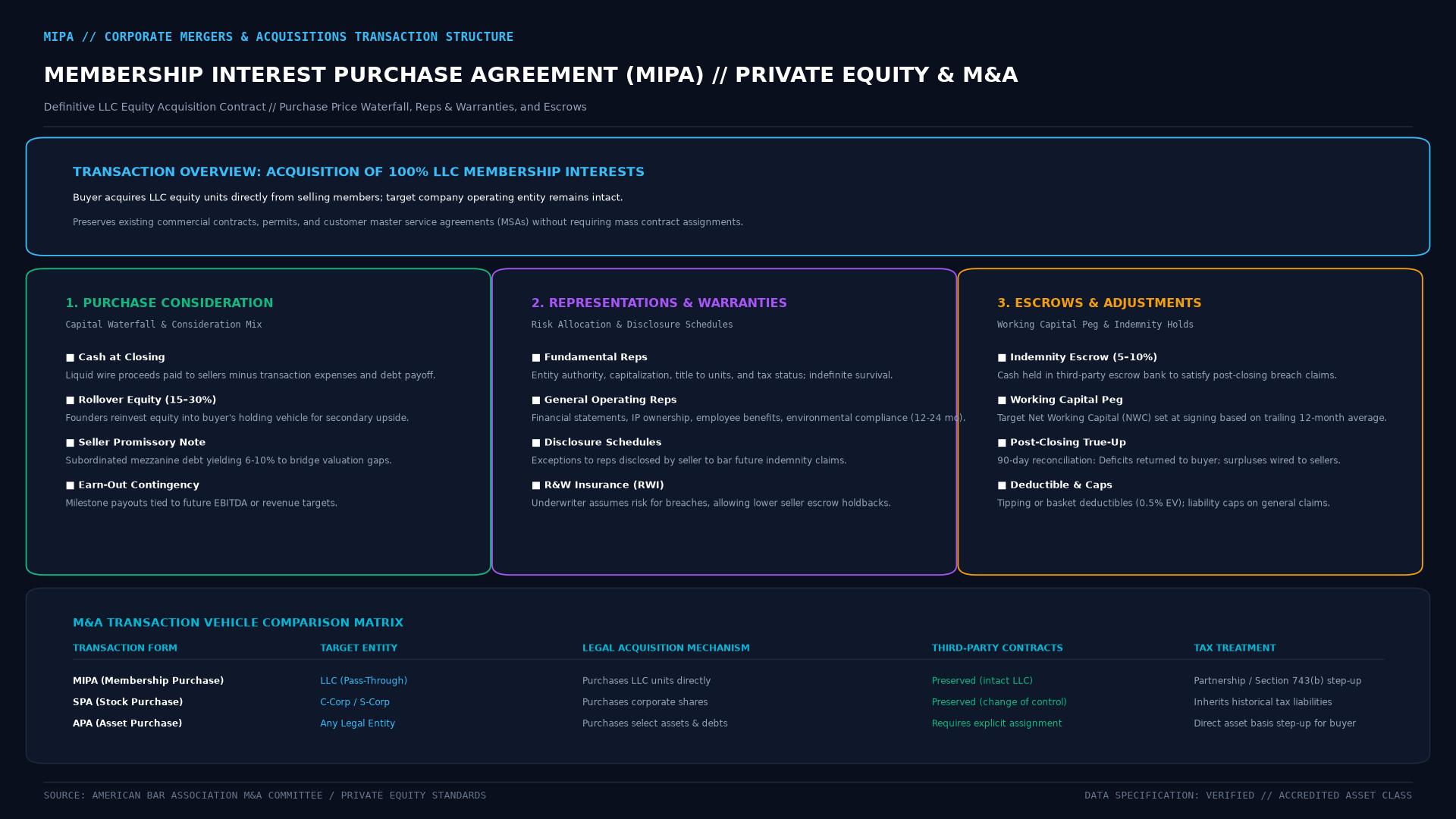 Figure: Transactional anatomy of a Membership Interest Purchase Agreement (MIPA) in private equity and corporate acquisitions, illustrating purchase price consideration waterfalls, representations & warranties (R&W), working capital escrows, and a comparison with SPAs and APAs.
Primary Application: The Membership Interest Purchase Agreement (MIPA)
The explosion of Limited Liability Companies as the preferred legal entity for mid-market operating businesses, real estate holding vehicles, and venture-backed startups established the MIPA as a cornerstone transactional document in private capital markets.
Structure: MIPA vs Stock Purchase Agreement (SPA) vs Asset Purchase Agreement (APA)
Corporate acquirers structure acquisitions through three distinct contractual mechanisms:
- Stock Purchase Agreement (SPA): Applied when the target entity is a C-Corporation or S-Corporation. The buyer purchases corporate stock certificates, inheriting all historical tax attributes, corporate liabilities, and employee benefit plans by operation of law.
- Asset Purchase Agreement (APA): The buyer selectively purchases specific physical and intangible assets (machinery, customer lists, IP) while leaving behind unwanted liabilities with the selling legal entity. While mitigating buyer liability risk, APAs require renegotiating individual third-party customer and vendor contracts, generating administrative friction.
- Membership Interest Purchase Agreement (MIPA): Applied when the target entity is an LLC governed by an Operating Agreement. The buyer purchases membership units directly from members. Because the underlying operating contracts remain housed inside the intact LLC, business continuity is preserved without requiring mass contract assignments.
       M&A TRANSACTION VEHICLE COMPARISON

Feature         MIPA                     SPA                      APA
----------------------------------------------------------------------------------
Target Entity   Limited Liability Company Corporation (C or S)     Any legal entity
Acquired Item   LLC Membership Units     Common/Preferred Stock   Selected Asset List
Liabilities     Inherited inside LLC     Inherited inside Corp    Excluded by contract
Tax Treatment   Partnership (IRC 743b)   Corporate Stock (IRC 338)Direct Asset Stepped-Up
Third-Party OK  Change of Control Rules  Change of Control Rules  Direct Assignment OK
Core Provisions and Legal Architecture of a MIPA
A comprehensive MIPA negotiated by institutional private equity sponsors contains critical structural sections:
1. Purchase Price Mechanics and Working Capital True-Ups
The headline enterprise value ($EV$) is adjusted at closing to derive the final equity purchase price delivered to the selling LLC members:
$$\text{Equity Purchase Price} = \text{Enterprise Value} - \text{Funded Debt} + \text{Cash} \pm \Delta \text{Working Capital}$$
Where:
- $\Delta \text{Working Capital} = \text{Closing Net Working Capital} - \text{Target Working Capital Peg}$.
- If closing working capital falls below the agreed peg, the buyer receives a dollar-for-dollar reduction from an escrow holdback. If working capital exceeds the peg, the buyer pays the excess cash to the sellers.
2. Comprehensive Representations and Warranties (R&Ws)
The selling members provide detailed, sworn contractual warranties regarding the target LLC:
- Fundamental Reps: Verification that sellers legally own the membership units free of liens, have full legal capacity to execute the MIPA, and that the LLC is validly formed in good standing.
- Operational Reps: Financial statements satisfy GAAP, tax returns are fully filed, no unasserted material litigation exists, key employee benefits comply with ERISA, intellectual property is unencumbered, and commercial contracts are enforceable.
3. Indemnification, Caps, and Representation & Warranty Insurance (RWI)
If a representation is breached post-closing, the MIPA governs recovery:
- Indemnity Escrow: Typically 5% to 10% of the purchase price is deposited with a third-party bank escrow agent for 12 to 24 months to satisfy potential indemnity claims.
- Baskets and Deductibles: A “tipping basket” or “true deductible” (typically 0.5% to 1.0% of enterprise value) prevents minor claims from disrupting the parties.
- Caps: Seller liability for non-fundamental reps is capped (often matching the escrow amount).
- RWI Policies: Modern private equity deals increasingly deploy third-party Representation and Warranty Insurance (RWI), allowing sellers to receive near-100% cash at closing while the insurer underwrites breach liabilities up to policy limits.
4. IRC Section 754 Elections and Step-Up in Tax Basis
A primary tax advantage of acquiring an LLC via a MIPA is the partnership tax treatment under the Internal Revenue Code. By filing an IRC Section 754 election, the buyer can adjust the inside tax basis of the target LLC’s underlying assets under IRC Section 743(b):
$$\text{Section 743(b) Basis Adjustment} = \text{Purchase Price of Units} - \text{Buyer’s Share of Inside Basis}$$
This statutory step-up allows the buyer to re-depreciate and amortize the stepped-up fair market value of tangible assets and intangible customer goodwill over 15 years under IRC Section 197, creating a substantial future tax shield.
       IRC SECTION 743(b) BASIS STEP-UP ENGINE

+---------------------------------------------------------------+
| Target LLC Historical Assets:                                 |
| - Inside Tax Basis:  $2,000,000 (Fully depreciated machinery) |
+---------------------------------------------------------------+
                               |
                               v MIPA Purchase for $10,000,000 Cash
+---------------------------------------------------------------+
| IRC Section 754 Election Executed on Form 1065                |
| - New Outside Purchase Basis: $10,000,000                     |
| - Section 743(b) Basis Step-Up: +$8,000,000                   |
+---------------------------------------------------------------+
                               |
                               v
+---------------------------------------------------------------+
| Annual Tax Deductions Generated:                              |
| - Section 197 Intangible Amortization over 15 Years           |
| - Accelerates Cash Flow & Expands Deal Internal Rate of Return|
+---------------------------------------------------------------+
Secondary Application: Master Infrastructure Project Agreements (MIPA)
In public-private partnerships (P3), a MIPA designates a Master Infrastructure Project Agreement. Governed by municipal, state, or national procurement statutes, an infrastructure MIPA formalizes long-term concession arrangements:
- Concession Scope: Grants a private consortium (the Concessionaire) the statutory right to design, build, finance, operate, and maintain (DBFOM) a major public asset (toll highway, airport terminal, water treatment facility, or port complex) over a 30- to 50-year horizon.
- Availability Payments vs Demand Risk: The MIPA defines whether the private sponsor receives revenue through direct user tolls (traffic demand risk) or fixed state milestone availability payments contingent on facility maintenance benchmarks.
- Handback Requirements: Establishes rigorous engineering handback standards, mandating that the asset revert to public municipal ownership in top operating condition upon concession termination.
       INFRASTRUCTURE MIPA RISK-SHARING MATRIX

Project Dimension       Public Sector Responsibility Private Concessionaire Duty
----------------------------------------------------------------------------------
Site Acquisition        Eminent domain & right-of-way Environmental remediation
Financing               Sovereign grants / PABs bond  Private equity & bank debt
Construction            Permitting & environmental    Cost overrun & delay risk
Long-Term Operations    Statutory police & oversight  Maintenance & service uptime
Real-World Case Study: Private Equity Buyout of an Industrial Services LLC
In 2023, private equity sponsor Vanguard Industrial Partners executed a MIPA to acquire 100% of the membership interests of Titan Logistics LLC, an Ohio limited liability company, for an enterprise value of $60,000,000.
+--------------------------------------------------------------------+
|               TITAN LOGISTICS LLC MIPA CLOSING AUDIT               |
+--------------------------------------------------------------------+
| Deal Terms & Financial Engineering:                                |
| - Enterprise Value: $60,000,000                                    |
| - Existing Funded Bank Debt (Paid off at closing): $12,000,000     |
| - Cash on Balance Sheet Acquired: $2,500,000                       |
| - Working Capital Peg: $4,000,000 | Closing Working Capital: $4.5M |
| - Net Working Capital Adjustment: +$500,000 to sellers             |
+--------------------------------------------------------------------+
| Total Equity Purchase Price Calculation:                           |
| $60,000,000 (EV) - $12,000,000 (Debt) + $2,500,000 (Cash)         |
| + $500,000 (WC Surplus) = $51,000,000 Total Equity Consideration   |
+--------------------------------------------------------------------+
| Consideration Distribution Waterfall:                              |
| 1. Rollover Equity: Founders reinvest $10,200,000 (20%) in new units|
| 2. Indemnity Escrow: $2,550,000 (5%) held in third-party escrow.   |
| 3. RWI Policy: Buyer procures $10M Representation & Warranty policy.|
| 4. Net Cash Paid to Selling Members at Closing: $38,250,000.       |
| 5. Section 754 Election: Buyer steps up tax basis of fleet trucks  |
|    and customer contracts, unlocking $4.2M in NPV tax shields.     |
+--------------------------------------------------------------------+
The MIPA structure preserved Titan Logistics LLC’s commercial freight carrier licenses and customer master service agreements (MSAs) without disruption, while the Section 754 tax election allowed the private equity buyer to amortize the purchase premium.
Frequently Asked Questions
Why do buyers prefer a MIPA over a merger when acquiring an LLC?
A MIPA allows a buyer to purchase membership units directly from equity owners, avoiding the statutory mechanics of a state-law merger. In a direct unit purchase via MIPA, specific rollover terms, individualized non-compete agreements, and customized indemnification caps can be tailored across individual selling members based on their equity tier, whereas a statutory merger treats all equity interests within a class uniformly under state limited liability company acts.
Does purchasing an LLC through a MIPA trigger change-of-control provisions?
Yes. Although a MIPA transfers equity rather than assign underlying commercial contracts, most institutional commercial agreements (supplier contracts, commercial bank credit facilities, commercial leases) define a “Change of Control” as any transfer of more than 50% of the voting or economic membership interests of the LLC. Transaction counsel must review the target’s material contracts to obtain necessary third-party consents prior to MIPA closing.
How does rollover equity function within a MIPA?
In private equity transactions, financial sponsors frequently require target founders and key executives to “roll over” a portion of their pre-tax equity (typically 10% to 30%) into the buyer’s holding vehicle. Under the MIPA, selling members contribute a portion of their target LLC units to the acquisition entity in exchange for newly issued equity interests, typically structured as a tax-deferred contribution under IRC Section 721.
Ready to trade forex?
Open a free demo account with a regulated broker. Practice with virtual funds before risking real money.