Acquisition
An Acquisition is a corporate transaction in which one commercial entity purchases a controlling equity stake or operational assets of a target company, absorbing its operations, technology, or market share.
What Is an Acquisition?
An Acquisition is a corporate transaction in which an acquiring entity purchases a controlling equity ownership interest (typically exceeding 50%) or the operational assets of another business enterprise, known as the target company.
In global business strategy and investment banking, acquisitions form half of the broader Mergers and Acquisitions (M&A) discipline. While a pure merger involves two entities of relatively equal size combining to create a brand-new shared legal corporation (a merger of equals), an acquisition involves a distinct buyer taking operational and financial command of the target.
Acquisitions allow corporations to accelerate growth, capture market share, enter foreign geographic markets, eliminate competitors, gain proprietary technology and patents, or achieve supply-chain economies of scale far more rapidly than through organic internal development.
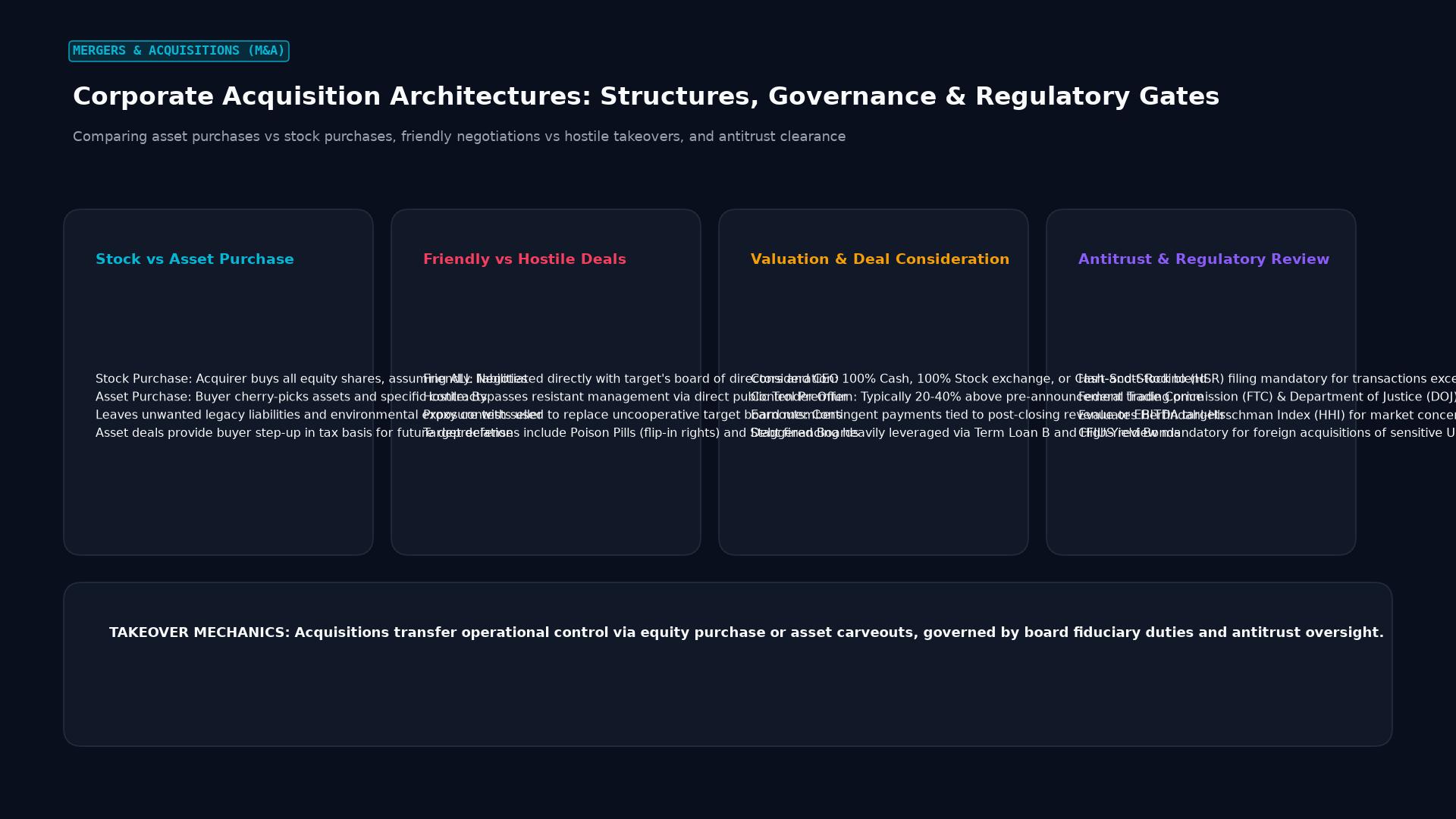 Figure: Comparing asset purchases vs stock purchases, friendly negotiations vs hostile takeovers, and antitrust clearance
Technical Mechanics & Transaction Structures
Acquisitions are executed through specific legal frameworks dictated by tax considerations, liability exposure, and regulatory approvals:
1. Stock Purchase vs. Asset Purchase
- Stock Purchase: The acquirer purchases the voting equity shares directly from the target company’s stockholders. The target company remains intact as a wholly owned subsidiary. Crucially, the buyer inherits all historical liabilities, known and unknown, including pending litigation, environmental clean-up obligations, and past tax liabilities.
- Asset Purchase: The acquirer purchases designated assets (such as customer lists, production plants, and intellectual property patents) and selectively assumes specified contracts. Unwanted liabilities, delinquent supplier debts, and legacy employment disputes remain behind inside the seller’s legal corporate shell.
2. Consideration Structure (Payment Methods)
The acquiring company finances the purchase price through three primary consideration vehicles:
- All-Cash Transaction: Provides immediate liquidity and finality to selling shareholders, but requires the buyer to draw down cash reserves or issue corporate debt.
- Stock-for-Stock Consideration: The buyer issues newly minted common shares to target shareholders using an exchange ratio. This structure defers capital gains taxes for selling shareholders until they sell their newly received stock, but dilutes the buyer’s existing share ownership.
- Earnouts & Contingent Value Rights (CVRs): A portion of the purchase price is held back and paid only if the acquired business achieves agreed future revenue, EBITDA, or regulatory drug-approval milestones.
3. Regulatory Antitrust Oversight
Mega-acquisitions face intense scrutiny from competition regulators, such as the Federal Trade Commission (FTC) and Department of Justice (DOJ) in the United States, or the European Commission in Europe. Under the Hart-Scott-Rodino (HSR) Antitrust Improvements Act, deals exceeding statutory thresholds must be submitted for pre-merger clearance to ensure the combination does not create monopolistic market power that harms consumer pricing.
Comparative Matrix: Acquisition vs. Merger vs. Joint Venture
| Feature | Acquisition | Statutory Merger | Joint Venture (JV) |
|---|---|---|---|
| Control Balance | Clear buyer; buyer takes 100% operational control | Shared governance; board seats negotiated | Shared control (often 50/50 or proportional) |
| Corporate Identity | Target absorbed or operates as subsidiary | Predecessor entities dissolve; new firm emerges | Both parent firms remain completely separate |
| Capital Commitment | 100% buyout cost; permanent capital transfer | Equity exchange; combined balance sheet | Limited equity contribution into JV entity |
| Speed to Exit | Complete ownership; unwinding requires sale | Irreversible corporate consolidation | Dissolved easily via contract expiration |
| Liability Exposure | Inherits target risks (in stock deals) | Inherits all combined predecessor debt | Liabilities ring-fenced inside JV legal entity |
Real-World Case Study: Cross-Border Technology Acquisition
In 2024, a major enterprise cloud software provider completed the $28 billion acquisition of a leading cybersecurity analytics corporation.
The transaction was structured as a cash-and-stock buyout:
- Consideration: $157.00 in cash plus 0.45 shares of the acquirer’s common stock for each share of target stock held, representing a 31% premium over the target’s unaffected share price.
- Financing: The acquirer funded the cash component by issuing $11 billion in investment-grade senior notes across 5-, 7-, and 10-year tranches, while drawing $3 billion from revolving bank credit facilities and deploying $4 billion in overseas balance sheet cash.
- Synergy Integration: The combined enterprise identified $600 million in annualized run-rate cost synergies within 18 months by consolidating overlapping corporate data centers, software licenses, and administrative overhead.
The acquisition expanded the buyer’s recurring annual software subscription revenue by 24%, establishing a dominant market position across enterprise security operations centers.
Frequently Asked Questions (FAQ)
What is a hostile takeover?
A hostile takeover occurs when an acquirer attempts to buy a target company despite active opposition from the target’s board of directors. The acquirer typically launches a public tender offer directly to shareholders or initiates a proxy contest to vote out the incumbent board and replace them with directors who favor the buyout.
What are “poison pills” in acquisition defense?
A poison pill (formally termed a Shareholder Rights Plan) is a corporate defense mechanism that permits existing shareholders (excluding the hostile bidder) to purchase additional shares at a massive discount once an uninvited buyer acquires a threshold percentage (such as 15%) of the company. This dilutes the hostile bidder’s ownership stake and makes the takeover prohibitively expensive.
Why do a high percentage of corporate acquisitions fail to create shareholder value?
Academic and investment banking research indicates that 60% to 75% of acquisitions fail to deliver their projected financial returns. Primary causes include overpaying due to bidding wars, culture clashes between executive teams, customer attrition during integration, and overly optimistic assumptions regarding cost synergies.
Ready to trade forex?
Open a free demo account with a regulated broker. Practice with virtual funds before risking real money.