MIS
MIS stands for Margin Intraday Square-off in electronic trading, an order type granting leveraged intraday exposure subject to mandatory liquidation before market close. In enterprise finance, it denotes Management Information System.
In electronic trading platforms, retail brokerage architectures, and financial risk systems, the acronym MIS stands primarily for Margin Intraday Square-off. It represents a specialized order classification designed for active day traders, granting elevated leverage and reduced margin requirements on the contractual condition that all open positions must be closed (squared off) before the end of the current trading session.
In enterprise management, banking administration, and corporate treasury, MIS also denotes a Management Information System, the institutional data and software infrastructure that synthesizes transactional banking flows into executive operational reports, daily profit-and-loss (P&L) attribution, and regulatory capital filings. Within electronic dealing desks and brokerage order routers, however, MIS is recognized as an intraday order qualifier governed by automated risk management engines.
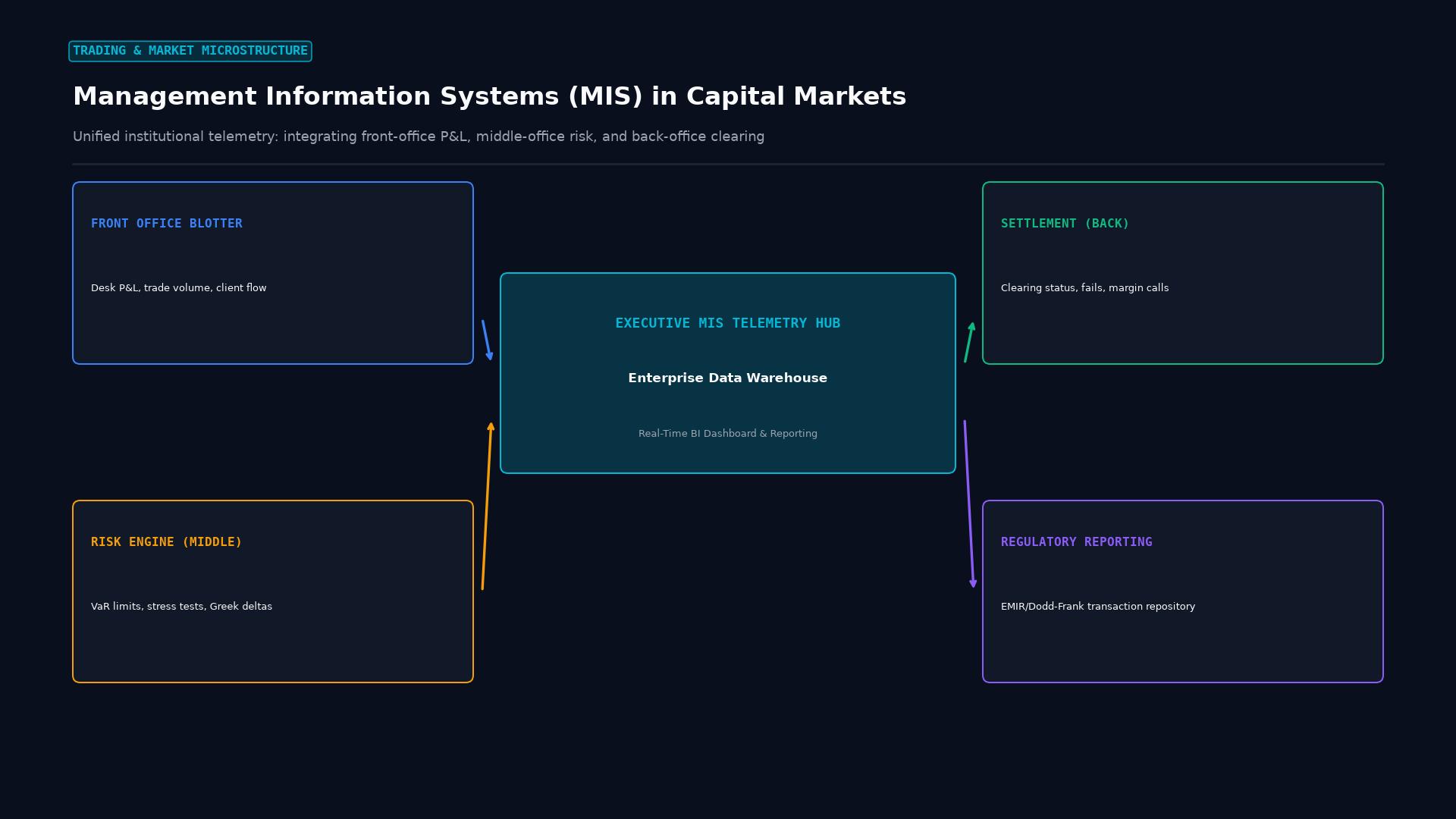 Figure: Institutional MIS framework: integrating tick database storage, enterprise risk analytics, executive dashboards, and regulatory compliance audit.
Primary Domain: Margin Intraday Square-off (MIS) in Trading
The Margin Intraday Square-off product code was engineered by electronic discount brokerages to maximize trading capital velocity while containing institutional overnight credit risk.
1. Leverage Mechanics and Capital Efficiency
When an investor purchases a security under standard cash delivery terms (often designated as CNC - Cash and Carry), the broker mandates 100% upfront cash payment for the total transaction value. Because the investor intends to hold the security overnight or across multi-year horizons, the brokerage cannot reclaim the capital if equity values fall after hours.
Under an MIS order:
- The trader agrees never to hold the position overnight.
- The brokerage pre-trade Risk Management System (RMS) drastically lowers the initial margin requirement, providing an effective leverage multiplier ($M$) ranging from $2\times$ to $5\times$ on cash equities, and up to $3\times$ to $4\times$ on index futures contracts:
$$\text{Required MIS Margin} = \frac{\text{Total Position Value}}{\text{Leverage Multiplier}} = \text{Total Position Value} \times \text{Margin Fraction}$$
If an equity trades at $100 per share and the broker offers $5\times$ leverage ($20%$ margin requirement) for MIS orders:
- Purchasing 1,000 shares under CNC requires: $1,000 \times $100 = $100,000$ cash equity.
- Purchasing 1,000 shares under MIS requires only: $\frac{$100,000}{5} = $20,000$ cash margin.
2. The Auto-Square-off Protocol
The defining institutional feature of an MIS order is the mandatory liquidation cutoff. Every retail brokerage establishes a firm daily cutoff time, typically between fifteen and thirty minutes prior to the official market closing bell (such as 3:15 PM or 3:20 PM in markets that close at 3:30 PM).
If a trader maintains an open MIS position past the designated cutoff:
- Automated Market Sweep: The broker’s central RMS server takes control of the trading account.
- Forced Market Order: The server generates an automated market order to liquidate the open position at the prevailing bid or ask price, regardless of whether the position is in profit or experiencing a severe drawdown.
- Auto-Square-off Penalty Fee: The brokerage debits an administrative handling fee (typically $5 to $20, or a fixed flat fee per executed order) directly from the client’s cash balance as a penalty for failing to close the position manually.
       TRADING ORDER PRODUCT CLASSIFICATIONS

Product Code    Full Name                  Leverage Allowed  Overnight Holding
----------------------------------------------------------------------------------
CNC             Cash and Carry             None (1x Cash)    Permitted (Indefinite)
MIS             Margin Intraday Square-off High (2x - 5x)    Strictly Prohibited
NRML            Normal Delivery            Exchange Standard Permitted (F&O Expiry)
CO              Cover Order (Mandatory SL) Very High (3x-6x) Prohibited (Intraday)
BO              Bracket Order (SL + TP)    Very High (3x-8x) Prohibited (Intraday)
Regulatory Framework: Peak Margin Rules and Leverage Restrictions
Historically, retail brokerages competed aggressively by offering extreme intraday leverage, sometimes granting $20\times$ to $50\times$ margin on intraday equities. When sudden black-swan news events struck during trading hours, leveraged accounts were wiped out within seconds, leaving brokerages with catastrophic deficit balances.
To protect systemic financial stability, securities regulators (such as the Securities and Exchange Board of India - SEBI, and equivalent international regulatory bodies) introduced Peak Margin Norms:
- Intraday Margin Snapshots: Clearing corporations take multiple random snapshots of client margin utilization throughout the trading day.
- Mandatory 100% Upfront Collection: Brokers are legally barred from offering leverage beyond the minimum Value at Risk (VaR) and Extreme Loss Margin (ELM) set by the clearing exchange.
- Prohibition on Broker Discretionary Leverage: Penalties are assessed directly against brokerages that permit clients to trade without posting full regulatory initial margins.
Converting MIS Positions to Delivery (CNC / NRML)
A day trader who enters an MIS position and experiences a favorable price move may decide to convert the intraday trade into a long-term swing position.
Brokers permit Product Type Conversion from MIS to CNC (for equities) or NRML (for futures and options) before the auto-square-off cutoff, provided the account satisfies the full cash delivery margin requirement:
$$\text{Additional Cash Required} = \text{Total Position Value} - \text{Initial MIS Margin Deposited}$$
If the trader lacks the additional liquid cash equity on balance, the trading terminal blocks the conversion request, and the position remains subject to mandatory 3:15 PM auto-square-off.
       MIS TO CNC CONVERSION CAPITALIZATION

+---------------------------------------------------------------+
| Open Position: Long 500 Shares at $50.00 = $25,000 Total Value|
| Initial MIS Margin Posted (20%): $5,000                       |
+---------------------------------------------------------------+
                               |
                               v Trader Requests Conversion to CNC
+---------------------------------------------------------------+
| Broker Checks Available Unencumbered Cash Balance             |
+---------------------------------------------------------------+
                               |
      +------------------------+------------------------+
      |                                                 |
      v Cash Balance >= $20,000                         v Cash Balance < $20,000
+---------------------------+              +---------------------------+
| Conversion Approved       |              | Conversion Rejected       |
| Position converted to CNC |              | Remains MIS Intraday      |
| Held overnight safely     |              | Auto-squared off at 03:15 |
+---------------------------+              +---------------------------+
Secondary Domain: Management Information Systems in Financial Banking
In enterprise corporate banking and institutional treasury, MIS denotes a Management Information System. It refers to the integrated hardware, database, and reporting software framework that transforms raw transaction logs into executive intelligence.
Key functions of a banking MIS include:
- Asset-Liability Management (ALM) Reporting: Measuring the duration gap between bank deposits and loan portfolios to monitor structural interest rate risk.
- Liquidity Coverage Ratio (LCR) Monitoring: Auditing High-Quality Liquid Assets (HQLA) daily to ensure compliance with Basel III regulatory standards.
- Daily P&L Attribution: Segmenting bank trading desk returns across delta, gamma, vega, theta, and credit spread variables.
- Prudential Regulatory Returns: Compiling automated financial filings submitted to central banks and financial conduct authorities.
               BANKING ENTERPRISE MIS ARCHITECTURE

+--------------------------------------------------------------+
| Core Operational Transaction Layer                           |
| - Core Banking Deposits (SWIFT, ACH, Wire Clearings)         |
| - Trading Dealing Desks (FX, Sovereign Bonds, Derivatives)   |
| - Retail Loan Underwriting & Commercial Credit Lines         |
+--------------------------------------------------------------+
                               |
                               v Automated Extraction & ETL
+--------------------------------------------------------------+
| Centralized Enterprise Data Warehouse (MIS Database Engine)  |
+--------------------------------------------------------------+
                               |
      +------------------------+------------------------+
      |                        |                        |
      v Daily Executive P&L    v Risk Management (ALM)  v Regulatory Reporting
+--------------------+   +--------------------+   +--------------------+
| Desk attribution & |   | Liquidity Coverage |   | Central Bank       |
| Trader performance |   | Ratio (LCR) & VaR  |   | Basel III Filings  |
+--------------------+   +--------------------+   +--------------------+
Real-World Case Study: The 3:15 PM Liquidity Cascade
Consider an individual day trader, Ryan Patel, trading a high-beta technology stock, Quantum Dynamics (QD), on an electronic trading platform using an MIS order.
+--------------------------------------------------------------------+
|               RYAN PATEL MIS AUTO-SQUARE-OFF AUDIT                 |
+--------------------------------------------------------------------+
| Setup & Trade Execution:                                           |
| - Available Account Cash: $10,000                                  |
| - Stock Price: $100.00 per share                                   |
| - Broker MIS Leverage: 5x (Requires 20% margin = $20/share)         |
| - Position Size: Buys 500 shares ($50,000 total exposure) at 10:00AM
+--------------------------------------------------------------------+
| Intraday Volatility Shock:                                         |
| - At 02:30 PM, market indexes drop sharply; QD falls to $96.00.    |
| - Unrealized Loss: 500 shares * -$4.00 = -$2,000 (20% of capital). |
| - Ryan hopes for a late-session rebound and refuses to exit.       |
| - Clock strikes 03:15 PM (Broker Mandatory Square-off Window).     |
+--------------------------------------------------------------------+
| Automated Execution Sequence:                                      |
| - Broker RMS server detects open MIS position; cancels open limit  |
|   orders and injects a 500-share Market Sell Order.                |
| - Because hundreds of retail MIS day traders are simultaneously    |
|   auto-squared off by algorithmic servers at 03:15 PM, market bids |
|   temporarily evaporate.                                           |
| - Ryan's market order experiences slippage, filling at $95.20.     |
| - Realized Loss: 500 * ($95.20 - $100.00) = -$2,400.              |
| - Auto-Square-off Penalty Fee Debited: -$10.00.                   |
| - Remaining Account Equity: $7,590.00.                             |
| - The stock rebounds to $98.00 at 03:28 PM, but Ryan cannot        |
|   participate because his position was already closed by the RMS.  |
+--------------------------------------------------------------------+
This scenario highlights the primary operational hazard of MIS trading: forced automated market liquidation during the pre-close square-off window frequently subjects traders to severe execution slippage when multiple risk engines liquidate unhedged positions into thin order books simultaneously.
Frequently Asked Questions
What happens if an MIS order hits a lower circuit breaker?
If a stock hits its daily lower circuit limit, trading is halted, and buy bids disappear from the exchange order book. If a trader holds a long MIS position in a circuit-locked stock, the broker’s automated RMS cannot execute the auto-square-off sell order because there are no buyers. In this event, the broker is forced to convert the position into an overnight delivery (CNC) position, creating a margin shortfall. The trader must deposit full cash the following morning or face immediate liquidation and regulatory shortfall penalties.
Can stop-loss orders be attached to an MIS order?
Yes. Traders can place a Stop-Loss Limit (SL-L) or Stop-Loss Market (SL-M) order alongside an MIS trade. In specialized order types such as Cover Orders (CO), a stop-loss is legally mandatory at order entry, granting higher leverage than a basic MIS order because the broker’s downside risk is bounded. However, if the stop-loss is not triggered during the day, the remaining open MIS position is still subject to automated square-off at the broker’s cutoff time.
How does an MIS order differ from a Margin Trading Facility (MTF)?
An MIS order is strictly an intraday product that must be liquidated before 3:30 PM on the same trading day, carrying zero interest charges. A Margin Trading Facility (MTF) is a formal leveraged lending arrangement where the broker finances up to 70% to 80% of a stock purchase for days, weeks, or months. MTF positions can be held overnight indefinitely, but the investor must pay daily interest on the borrowed funds.
Ready to trade forex?
Open a free demo account with a regulated broker. Practice with virtual funds before risking real money.