MLM
MLM stands for Multi-Level Marketing, a direct-sales distribution model where independent participants earn revenue through personal retail product sales and overriding commissions from a recruited downline network.
The acronym MLM stands for Multi-Level Marketing (also designated as network marketing, direct selling, or referral merchandising). An MLM is a commercial organizational and distribution structure wherein an enterprise sells consumer products or services directly to end consumers through an independent, non-salaried contractor sales force rather than through traditional brick-and-mortar retail storefronts or wholesale distribution networks.
In financial analysis, commercial law, and regulatory compliance, MLMs are evaluated through their compensation structures. Participants generate income through two distinct avenues:
- Direct Retail Sales: Profits earned by purchasing wholesale merchandise from the parent company and reselling it directly to non-participant retail consumers at a retail markup.
- Downline Recruitment Overrides: Commissions, bonuses, and volume royalties earned as a percentage of the wholesale purchases and sales volume generated by the distributor’s recruited network of participants (the “downline”).
Because compensation plans that reward recruitment over actual end-consumer retail demand cross into illegal fraudulent structures, global regulatory agencies closely audit multi-level marketing enterprises.
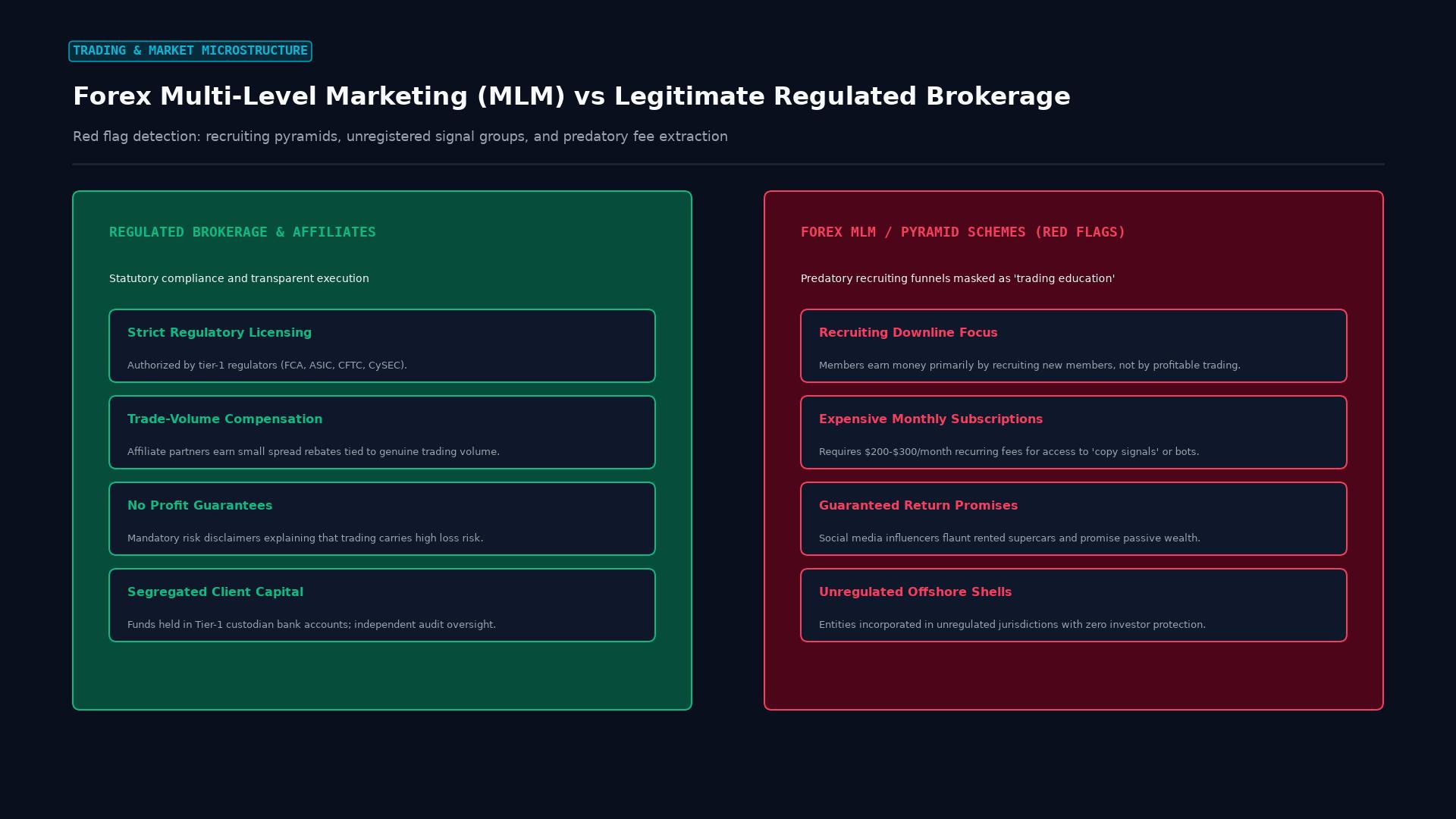 Figure: Structural comparison: pyramid recruitment schemes with high subscription fees versus licensed introducing broker volume-based rebates.
The Legal and Regulatory Boundary: MLM vs Pyramid Scheme
The primary legal challenge confronting the multi-level marketing industry is maintaining the structural distinction between a legitimate direct-selling enterprise and an illegal pyramid scheme under federal trade commission statutes.
1. The FTC “Koscot Test” (1975)
The definitive legal standard was established by the US Federal Trade Commission (FTC) in the landmark decision In re Koscot Interplanetary, Inc. (86 F.T.C. 1106, 1975). The court articulated a two-prong legal test defining an illegal pyramid scheme:
$$\text{Pyramid Scheme Definition} = \text{Condition 1 (Payment)} + \text{Condition 2 (Recruitment-Based Reward)}$$
Where:
- Condition 1: Participants pay money to the company for the right to sell a product or service.
- Condition 2: Participants receive financial rewards in return for recruiting others into the program, where those rewards are unrelated to the sale of products to ultimate retail consumers.
If the primary driver of organizational cash flow is the recruitment of new distributors who purchase mandatory inventory packages (rather than sales to genuine outside consumers), the enterprise operates as an illegal pyramid scheme under Section 5 of the FTC Act (15 U.S.C. § 45).
2. The Landmark Amway Decision and the Three Rules (1979)
In 1979, the FTC concluded an administrative trial against Amway Corporation (In re Amway Corp., 93 F.T.C. 618), establishing that Amway was not an illegal pyramid scheme because it enforced three specific internal operational policies, known historically as the Amway Rules:
- The 70% Rule: Mandates that distributors must verify that at least 70% of all purchased inventory has been resold to retail customers or consumed before the distributor is eligible to place new wholesale orders or collect downline performance bonuses, preventing inventory stockpiling.
- The 10-Customer Rule: Requires distributors to make verified retail sales to at least ten distinct outside retail customers every month to qualify for multi-level overriding commissions.
- The 90% Buyback Policy: Mandates that the company legally contract to repurchase unsold, marketable inventory from any departing distributor within twelve months at a minimum 90% refund rate, protecting participants from catastrophic losses.
       THE AMWAY TRIAD OF COMPLIANCE RULES

+---------------------------------------------------------------+
| 1. The 70% Rule: Resell 70% of inventory before re-ordering   |
+---------------------------------------------------------------+
| 2. The 10-Customer Rule: Sell to 10 retail buyers each month  |
+---------------------------------------------------------------+
| 3. The 90% Buyback Rule: Refund 90% of unsold inventory       |
+---------------------------------------------------------------+
Quantitative Economics and Income Skewness
Empirical econometric studies published by the FTC, consumer advocacy researchers, and academic institutions reveal that multi-level marketing structures exhibit extreme mathematical income inequality, conforming to a severely skewed Pareto distribution:
1. Net Income Distribution Realities
In standard employment or conventional franchise business models, compensation is distributed across a bell curve or moderate power-law curve. In an MLM, because the compensation formula requires an exponentially expanding base of new recruits to fund commissions for top uplines, financial gains are concentrated exclusively at the top 0.1% to 1.0% of the hierarchy.
Statistical audits of mandatory annual income disclosure statements across major public and private MLMs consistently demonstrate:
- Top 1% of Distributors: Capture between 70% and 85% of all cumulative commission payouts.
- Bottom 90% to 95% of Distributors: Earn less than $500 annually in gross commissions before deducting mandatory expenses.
- Net Loss Fraction: When factoring in mandatory monthly inventory purchases (“auto-ship” quotas), starter kit fees, marketing materials, and convention attendance costs, between 99.0% and 99.6% of all joining participants lose net capital.
       MLM COMPENSATION REVENUE DISTRIBUTION

Hierarchy Level
   ^
   |        [Top 0.5%: "Diamond Founders"] -> Capture 80% of All Commissions
   |        +----------------------------+
   |
   |        [Middle 5.0%: Break-Even Tier] -> Earn Modest Supplementary Cash
   |        +----------------------------+
   |
   |        [Bottom 94.5%: Churning Base]-> Suffer Net Losses After Expenses
   |        +----------------------------+  (Annual Turnover Rate: 60% - 90%)
   +------------------------------------------------------------------------>
   Cumulative Participant Population
2. The Fallacy of Geometric Progression
The core mathematical impossibility inherent in recruitment-based direct selling is geometric expansion. If each new recruit is instructed to sponsor five new distributors:
- Level 1: 5 participants
- Level 2: 25 participants
- Level 3: 125 participants
- Level 8: 390,625 participants
- Level 14: Over 6.1 billion participants (exceeding total global adult population)
Because human population is finite, saturation is reached rapidly. The participants situated at the bottom of the geometric tree inevitably run out of potential recruits, guaranteeing that the vast majority suffer complete capital losses.
The Herbalife FTC Settlement of 2016
The regulatory scrutiny of MLMs culminated in the July 2016 landmark enforcement settlement between the Federal Trade Commission and global nutrition giant Herbalife Ltd:
+--------------------------------------------------------------------+
|               THE 2016 HERBALIFE FTC CONSENT DECREE                |
+--------------------------------------------------------------------+
| 1. Allegations: The FTC alleged Herbalife's compensation structure |
|    incentivized distributors to purchase thousands of dollars in   |
|    product to qualify for rewards, regardless of retail demand.    |
| 2. Financial Penalty: Herbalife paid a $200,000,000 settlement to  |
|    reimburse consumer victims who lost money on business ventures. |
| 3. Structural Re-Architecture:                                     |
|    - Bifurcation of Network: Legally separated "Preferred          |
|      Members" (discount retail buyers) from "Distributors"         |
|      (individuals pursuing business income).                       |
|    - End of Wholesale Commission Qualification: Prohibited paying   |
|      commissions based on distributor inventory purchases.         |
|    - 80% Retail Rule: Mandated that at least 80% of all product     |
|      sales must be verified sales to genuine retail consumers.     |
| 4. External Monitor: Installed an independent federal compliance   |
|    auditor for seven years to inspect point-of-sale data receipts. |
+--------------------------------------------------------------------+
The Herbalife consent decree established a modern compliance benchmark across the direct selling industry, forcing network marketing corporations to document physical point-of-sale receipts verified via mobile applications to prove genuine retail consumption.
Real-World Case Study: The Wall Street Herbalife Short Battle
Between 2012 and 2018, multi-level marketing became the center of one of the most high-profile corporate financial battles in Wall Street history:
+--------------------------------------------------------------------+
|            THE PERSHING SQUARE VS HERBALIFE PROXY WAR              |
+--------------------------------------------------------------------+
| 1. The Short Campaign (December 2012): Activist hedge fund manager |
|    Bill Ackman (Pershing Square Capital Management) unveiled a     |
|    $1,000,000,000 short position in Herbalife (NYSE: HLF).         |
| 2. Core Thesis: Ackman presented a 330-slide forensic audit,       |
|    asserting that Herbalife was a sophisticated global pyramid     |
|    scheme that would be shuttered by federal regulators.           |
| 3. The Counter-Attack: Billionaire activist Carl Icahn took the    |
|    opposite side, acquiring a 26% equity stake in Herbalife and    |
|    joining the corporate board of directors.                       |
| 4. Corporate Financial Defense: Herbalife deployed corporate cash  |
|    and cheap bond debt to execute massive share buybacks, shrinking|
|    the available trading float and creating upward price squeezes. |
| 5. Regulatory Resolution (2016): The FTC fined Herbalife $200M and |
|    mandated operational overhauls, but stopped short of labeling   |
|    the enterprise a formal pyramid scheme or halting operations.   |
| 6. Unwind: In February 2018, Ackman completely exited his short    |
|    position at a loss of roughly $1 billion as the stock rallied,  |
|    proving that shorting multi-level marketing corporations carries|
|    extreme short squeeze and regulatory settlement risks.          |
+--------------------------------------------------------------------+
Frequently Asked Questions
What is “inventory loading” in a multi-level marketing company?
Inventory loading (or garage stuffing) occurs when an MLM’s compensation plan incentivizes distributors to purchase large volumes of product each month solely to qualify for commission bonuses or rank advancement, rather than in response to real consumer demand. This results in distributors storing unsold boxes of products in their homes, incurring substantial credit card debt while creating an illusion of corporate sales growth.
Are multi-level marketing companies legal in Europe?
Yes, direct selling and multi-level marketing companies are legal in the European Union, provided they comply with the EU Unfair Commercial Practices Directive (Directive 2005/29/EC). Annex I, Point 14 of the Directive explicitly bans pyramid promotional schemes, defining them as schemes where a consumer pays for the opportunity to receive compensation derived primarily from introducing other consumers into the scheme rather than from the sale or consumption of products.
How can a consumer distinguish a legitimate MLM from an illegal pyramid scheme?
A prospective participant should investigate three critical operational factors:
- Source of Revenue: Are company revenues generated primarily from sales to outside retail customers who do not participate in the business opportunity, or from required wholesale purchases made by newly recruited distributors?
- Mandatory Purchases: Does the company require expensive upfront starter kits or mandatory recurring monthly inventory quotas (“auto-ship”) to qualify for commissions?
- Refund Policies: Does the company enforce an unconditional, contractual buyback policy for unsold inventory? If revenue is driven by recruitment and starter kit sales, the structure is likely an illegal pyramid scheme.
Ready to trade forex?
Open a free demo account with a regulated broker. Practice with virtual funds before risking real money.