Kickback
A kickback is an illegal, undisclosed payment, fee, or commercial benefit given to an individual, intermediary, or purchasing agent in exchange for steering business, awarding contracts, or granting favorable commercial terms.
What Is a Kickback?
A kickback is an illegal payment, secret rebate, or transfer of value provided to an individual in exchange for facilitating a commercial transaction, awarding a contract, or making an uncompetitive referral. Unlike transparent commissions or negotiated trade discounts, kickbacks operate in secret. They corrupt the fiduciary duty that an employee, executive, purchasing manager, or public official owes to their employer, shareholders, or the taxpaying public.
In global finance, commercial banking, and real estate, kickbacks inflate the end cost of goods and services. When a vendor pays a secret 10% fee to a corporate buyer to secure a supply contract, that 10% markup is invariably embedded into the vendor’s invoice price. The purchasing corporation overpays for materials, market competition is stifled, and honest competitors are shut out of fair market access.
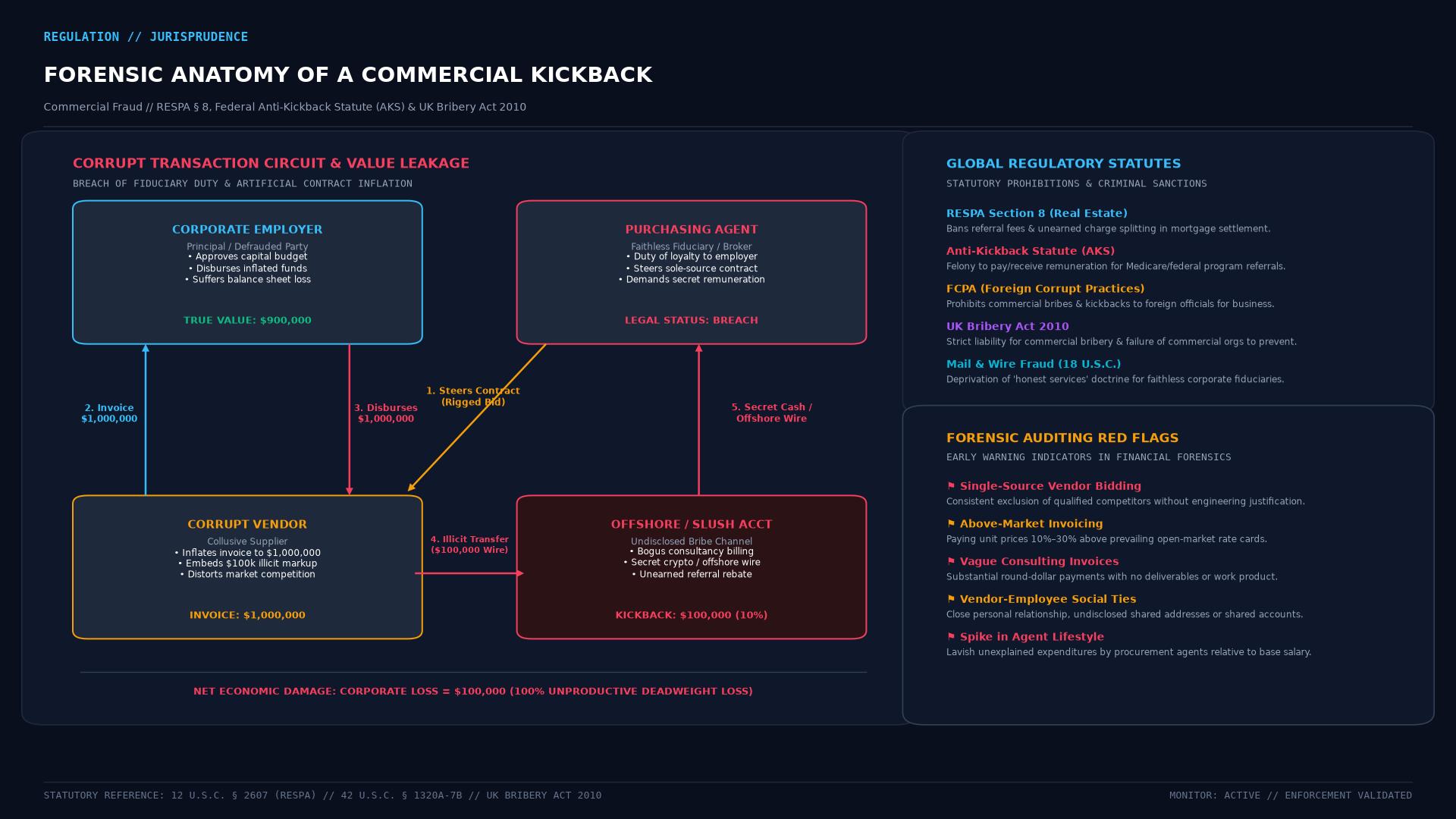 Figure: Illicit commercial kickback payment circuit illustrating fiduciary breach, invoice price inflation, and statutory anti-corruption enforcement frameworks (RESPA Section 8, AKS, and FCPA).
Primary Regulatory Frameworks Prohibiting Kickbacks
Modern legal systems treat kickbacks as forms of fraud, bribery, and unfair trade practices. Several key statutes govern these violations:
1. Real Estate Settlement Procedures Act (RESPA Section 8)
Enacted by the United States Congress, RESPA strictly governs the home mortgage settlement process. Section 8(a) explicitly bans any person from giving or accepting a “fee, kickback, or thing of value” pursuant to an agreement to refer real estate settlement service business involving a federally related mortgage loan. Section 8(b) prohibits splitting unearned charges or receiving portions of fees for services not actually rendered.
Under RESPA, a mortgage lender cannot pay cash or offer lavish gifts to real estate agents in exchange for steering home buyers to that lender. Violations carry civil penalties and criminal sanctions, including fines up to $10,000 per violation and up to one year imprisonment.
2. The Federal Anti-Kickback Statute (AKS)
In the healthcare and public finance sectors, the Anti-Kickback Statute (42 U.S.C. § 1320a-7b(b)) makes it a felony to knowingly and willfully offer, pay, solicit, or receive any remuneration to induce the referral of business reimbursable under federal programs like Medicare or Medicaid. Penalties include criminal fines up to $100,000, imprisonment for up to 10 years, and mandatory exclusion from federal contracting.
3. The Foreign Corrupt Practices Act (FCPA)
For multinational corporations, the FCPA makes it a federal crime to pay bribes or kickbacks to foreign government officials, political parties, or executives of state-owned enterprises to secure foreign business permits, mineral rights, or commercial supply agreements.
4. Commercial Bribery and Securities Regulations
In capital markets, FINRA Rule 2010 mandates that member broker-dealers observe high standards of commercial honor. Paying undisclosed compensation to portfolio managers, research analysts, or pension fund trustees to steer institutional trade flow (often disguised as “soft dollars” beyond permitted research exemptions under Section 28(e) of the Securities Exchange Act of 1934) triggers regulatory enforcement, disgorgement, and industry bans.
Mechanics and Common Typologies of Kickbacks
Perpetrators rarely label payments as kickbacks on general ledgers. Instead, financial forensics teams encounter standardized typologies designed to mask the illicit flow:
| Typology Scheme | Operational Method | Typical Paper Trail |
|---|---|---|
| Phantom Invoicing | Vendor creates inflated invoices for unperformed consulting or logistical services | Subcontractor agreements with vague statements of work and zero deliverable audits |
| Inflated Purchase Orders | Product unit cost is artificially increased, and the premium is split between vendor and buyer | Unit prices significantly above prevailing spot market benchmarks |
| Shell Company Intermediaries | Kickback funds pass through offshore pass-through entities before reaching the recipient | Invoices from jurisdictions with strict corporate secrecy laws and nominee directors |
| Rebates and Bogus Credits | Vendor grants cash rebates deposited into personal or unmonitored bank accounts | Reconciliation discrepancies between accounts payable ledgers and physical bank statements |
| Lavish Gifts and Hospitality | Value transferred via luxury travel, free property usage, or private club memberships | Corporate expense accounts miscategorized as routine client entertainment |
Kickbacks vs Legal Commercial Arrangements
Financial analysts must distinguish between criminal kickbacks and legitimate commercial incentives:
| Parameter | Legal Volume Rebate | Illegal Kickback |
|---|---|---|
| Disclosure | Fully documented in corporate contract | Concealed from employer, board, and auditors |
| Beneficiary | Accrues directly to the purchasing corporation | Accrues privately to the purchasing agent |
| Accounting | Reduces cost of goods sold or recognized as revenue | Hidden off-balance-sheet or masked via fake fees |
| Market Impact | Reflects economies of scale and fair trade | Distorts pricing and destroys fair bids |
A transparent corporate volume rebate (where a manufacturer discounts wholesale pricing by 5% if a retailer buys 50,000 units, credited directly to the retailer’s balance sheet) is legal and pro-competitive. The transaction becomes a criminal kickback the moment the manufacturer deposits that 5% into the personal offshore account of the retailer’s procurement director.
Detection and Internal Controls
Financial institutions and corporate enterprises implement internal fraud controls to detect kickback schemes:
- Vendor Bidding Audits: Procurement policies require three independent, sealed bids for contracts exceeding defined capital thresholds. Contracts awarded consistently to high-cost vendors without compelling technical justification indicate collusion.
- Data Analytics and Anomaly Scanning: Internal audit teams deploy software to cross-reference vendor addresses, telephone numbers, and bank account routing details against internal employee HR records. Shared addresses or identical tax identification numbers reveal hidden employee ownership in third-party suppliers.
- Mandatory Employee Rotation: Requiring procurement personnel to rotate accounts or take mandatory consecutive block leave prevents long-term collusive relationships between buyers and favored vendors.
- Whistleblower Hotlines: Confidential reporting mechanisms protected under Sarbanes-Oxley (SOX) Section 806 and the Dodd-Frank Act represent the primary avenue through which hidden kickback conspiracies are exposed.
Key Takeaways
- A kickback is an illicit, undisclosed payment given to an agent or intermediary in exchange for steering business, contract awards, or commercial favors.
- Kickbacks violate common law fiduciary duties, inflate transaction costs, and corrupt market price discovery.
- Statutory regimes like RESPA Section 8, the federal Anti-Kickback Statute, and the FCPA impose severe civil and criminal penalties on kickback participants.
- Common schemes utilize phantom consulting invoices, shell companies, inflated purchase orders, and concealed travel perks.
- Transparent volume discounts benefiting the corporate principal are legal; secret payments benefiting the individual agent constitute commercial bribery.
Frequently Asked Questions
What is the primary difference between a legal commission and a kickback?
The primary difference is disclosure and authorization. A commission is a legally binding, fully disclosed percentage payment agreed to by all contracting parties and recognized on audited corporate books. A kickback is negotiated in secret and delivered privately to an agent, depriving the principal of objective representation.
How does RESPA Section 8 apply to real estate agents and mortgage brokers?
RESPA Section 8 outlaws any agreement where a settlement service provider (such as a mortgage broker, title insurer, or home inspector) gives money, gifts, or unearned fee splits to a real estate agent in return for referring home-buying clients. Both giving and accepting such referral benefits violate federal law.
What are the corporate consequences of an FCPA kickback investigation?
Corporations caught paying kickbacks to foreign officials face hundreds of millions of dollars in civil disgorgement, criminal fines, the appointment of independent compliance monitors, severe reputational brand damage, and immediate debarment from government contracting.
Ready to trade forex?
Open a free demo account with a regulated broker. Practice with virtual funds before risking real money.