MLR
MLR stands primarily for Medical Loss Ratio in health insurance finance, the statutory percentage of premium revenue spent on clinical services. In central banking and credit markets, it designates Minimum Lending Rate.
The acronym MLR carries two authoritative definitions across insurance corporate finance, healthcare economics, and central banking credit architecture:
- In Health Insurance Underwriting and Healthcare Finance: MLR stands for Medical Loss Ratio (also termed the Medical Care Ratio or Medical Benefit Ratio). Enacted under Section 2718 of the Public Health Service Act as part of the US Patient Protection and Affordable Care Act (ACA), the MLR is a statutory financial metric that mandates the minimum percentage of net premium revenues that health maintenance organizations (HMOs) and commercial insurers must spend on direct clinical medical care and healthcare quality improvement activities.
- In Central Banking and Commercial Lending: MLR designates the Minimum Lending Rate. Historically utilized by the Bank of England (1972–1981) and modern emerging-market commercial banks, the MLR represents the official benchmark interest rate established by monetary authorities or leading commercial lenders below which commercial loans to corporate borrowers cannot be issued.
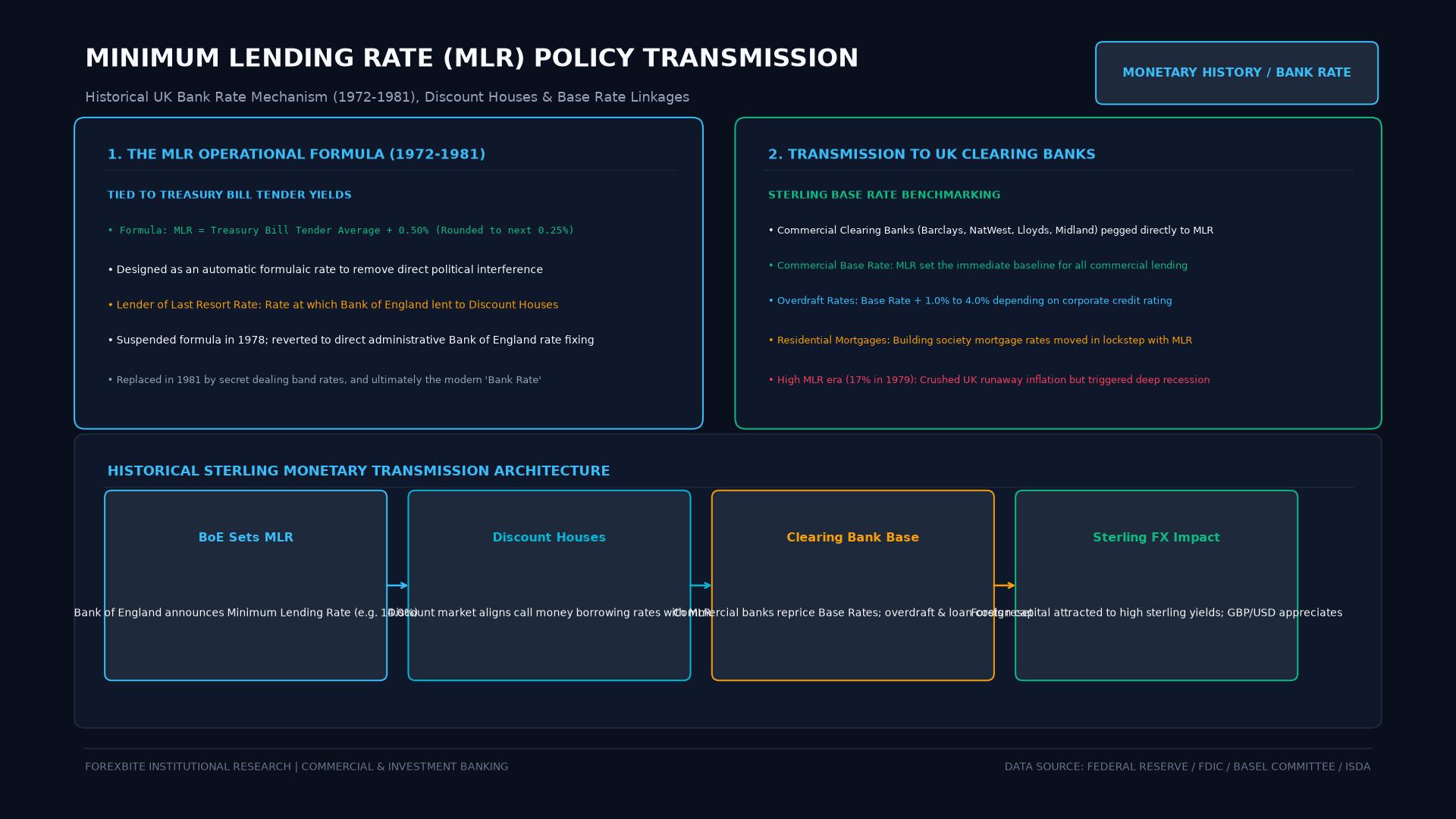 Figure: Central bank base rate framework: statutory lending floor, commercial bank margin markups, and interest rate pass-through to business borrowers.
Primary Domain: The Medical Loss Ratio (MLR)
Prior to the passage of the Affordable Care Act in 2010, commercial health insurance providers operated with unregulated profit margins and administrative expense ratios. Insurers in individual and small-group markets frequently allocated 30% to 40% of collected consumer premiums to corporate marketing, executive compensation, underwriting screening, and shareholder profits, spending as little as 60% of revenues on actual patient medical treatment.
To eliminate excessive administrative overhead and improve value for policyholders, the ACA established the 80/20 and 85/15 Statutory Rules, codified in 45 CFR Part 158:
1. The 80% Benchmark for Individual and Small-Group Markets
Health insurance carriers operating in the individual market (direct consumers and ACA health insurance exchanges) and small-group market (businesses with fifty or fewer full-time equivalent employees) must spend at least 80.0% of net premium revenues on medical claims and healthcare quality enhancements. Corporate administrative costs, broker commissions, marketing, and net profits are strictly capped at 20.0%.
2. The 85% Benchmark for Large-Group Employer Markets
In the large-group market (employers with more than fifty employees), where administrative economies of scale are naturally superior, insurers must spend at least 85.0% of net premium revenues on clinical medical claims. Administrative overhead and corporate profit are capped at 15.0%.
       STATUTORY MLR SPENDING MANDATES

Market Segment          Mandatory Clinical Spending   Administrative & Profit Cap
----------------------------------------------------------------------------------
Individual Market       80.0% Minimum                 20.0% Maximum
Small-Group Employers   80.0% Minimum                 20.0% Maximum
Large-Group Employers   85.0% Minimum                 15.0% Maximum
Mathematical Architecture of the MLR Calculation
Calculating the statutory Medical Loss Ratio requires an explicit mathematical formulation defined by federal regulations enforced by the Centers for Medicare & Medicaid Services (CMS):
1. The Federal MLR Formula
$$\text{MLR} = \frac{\text{Incurred Clinical Claims} + \text{Quality Improvement Expenses (QIA)}}{\text{Total Earned Premium} - \text{Allowable Taxes and Regulatory Fees}} + \text{Credibility Adjustment}$$
Where the individual accounting components are defined as:
- Incurred Clinical Claims: Total cash claims paid to hospitals, physicians, and pharmacies for medical services rendered during the reporting year, plus changes in the actuarial reserve for claims incurred but not reported (IBNR).
- Quality Improvement Activities (QIA): Grounded expenditures on activities designed to improve clinical outcomes, prevent hospital readmissions, enhance patient safety, and improve health information technology infrastructure (e.g., electronic health record wellness portals).
- Total Earned Premium: Gross premiums collected across the coverage block.
- Allowable Taxes and Regulatory Fees: Deductions permitted from the denominator, including state premium taxes, federal income taxes, state insurance licensing assessments, and statutory ACA health insurance provider fees.
- Credibility Adjustment: A statistical adjustment factor added to the calculated MLR for small insurance plans (plans with fewer than 75,000 enrolled member life-years) to prevent random actuarial claim fluctuations from unfairly triggering rebate penalties.
                  STATUTORY MLR FRACTION ENGINE

  Numerator: Legitimate Healthcare Spending
  [ Incurred Medical Claims + Health Quality Improvement (QIA) ]
  ------------------------------------------------------------------
  Denominator: Net Retained Premium Revenue
  [ Gross Earned Premium - (Federal/State Taxes + Regulatory Fees) ]
2. Mandatory Annual Consumer Rebate Formulation
If an insurer’s three-year rolling average MLR falls below the statutory threshold (80% or 85%), the company is legally mandated to issue a cash rebate to policyholders by September 30 of the following calendar year.
The total dollar rebate liability ($R$) owed to enrollees is calculated as:
$$\text{Rebate Amount} = \max\Big(0, \text{Target MLR Benchmark} - \text{Realized 3-Year Rolling MLR}\Big) \times \text{Net Adjusted Premium}$$
Since 2012, commercial health insurance companies (including UnitedHealth Group, Elevance Health, Humana, and Cigna) have rebated over $11 billion in cumulative cash rebates to American consumers and employer sponsors.
       THREE-YEAR ROLLING REBATE TRIGGER EXAMPLE

Year 1 MLR: 77.0% | Year 2 MLR: 78.5% | Year 3 MLR: 78.5%
+---------------------------------------------------------------+
| Three-Year Weighted Average Realized MLR: 78.0%               |
+---------------------------------------------------------------+
                               |
                               v Comparison Against 80.0% Floor
+---------------------------------------------------------------+
| Statutory Deficiency Gap: 80.0% - 78.0% = 2.0% Shortfall      |
+---------------------------------------------------------------+
                               |
                               v Applied to $100,000,000 Net Premium
+---------------------------------------------------------------+
| Mandatory Cash Rebate Due: $100,000,000 * 2.0% = $2,000,000   |
| Distributed Directly to Policyholders by September 30         |
+---------------------------------------------------------------+
Secondary Domain: Minimum Lending Rate (MLR) in Monetary Economics
In central banking and commercial credit history, MLR stands for Minimum Lending Rate:
1. The Bank of England MLR (1972–1981)
In October 1972, the Bank of England replaced its historical “Bank Rate” with the Minimum Lending Rate. The MLR was designed as an operational benchmark rate at which the central bank would lend cash to commercial discount houses against eligible commercial bills and Treasury debt:
- Initially, the MLR was linked directly to the average discount rate on weekly Treasury bill tenders plus 0.50%, rounded up to the nearest quarter percent.
- During the stagflation crises of the 1970s, as double-digit inflation struck the United Kingdom, the Bank of England abandoned the formula in 1978, returning to discretionary administrative MLR announcements.
- In 1981, under the Thatcher administration, the explicit publication of the MLR was terminated to allow market forces greater freedom in establishing short-term interest rates.
2. Commercial Bank Benchmark Lending Rates
In developing commercial banking systems (such as Thailand and India), commercial banks quote specialized MLR (Minimum Lending Rate) schedules alongside MOR (Minimum Overdraft Rate) and MRR (Minimum Retail Rate):
- MLR: The prime interest rate offered to creditworthy corporate borrowers with strong collateral and established credit ratings.
- The spread between the central bank repo rate and commercial bank MLR reflects commercial banking net interest margins (NIM) and credit risk premiums.
       COMMERCIAL BANK LENDING RATE BENCHMARKS

Rate Tier       Acronym    Target Borrower Category     Collateral Status
----------------------------------------------------------------------------------
Minimum Lending MLR        Top-tier corporate enterprises Secured commercial terms
Minimum Overdraft MOR      Corporate cash working lines Revolving credit limits
Minimum Retail  MRR        Retail consumers & SMEs       Mortgages & auto loans
Real-World Case Study: Managed Care Insurer MLR Rebate Calculation
Consider a regional commercial health insurance provider, Blue Horizon Health, operating in the small-group employer market. The company reports the following financial figures for its small-group pool over a three-year evaluation cycle:
+--------------------------------------------------------------------+
|               BLUE HORIZON HEALTH STATUTORY MLR AUDIT              |
+--------------------------------------------------------------------+
| Financial Statement Aggregates (3-Year Consolidated):              |
| - Gross Earned Premiums: $300,000,000                              |
| - Allowable State & Federal Taxes: -$20,000,000                    |
| - Net Adjusted Premium Denominator: $280,000,000                   |
+--------------------------------------------------------------------+
| Healthcare Outlays (Numerator):                                    |
| - Incurred Clinical Medical Claims Paid: $212,000,000              |
| - Health Quality Improvement Expenses (QIA): $6,400,000            |
| - Total Allowable Medical Numerator: $218,400,000                  |
+--------------------------------------------------------------------+
| Statutory MLR Calculation:                                         |
| MLR = $218,400,000 / $280,000,000 = 0.7800 (78.00%)                |
| Credibility Adjustment: 0.0% (Large population >75,000 members)   |
| Realized MLR = 78.00%                                              |
+--------------------------------------------------------------------+
| Regulatory Comparison & Rebate Liability:                          |
| - Statutory Mandated MLR Floor: 80.00%                             |
| - Realized Three-Year Average MLR: 78.00%                          |
| - Shortfall Percentage: 80.00% - 78.00% = 2.00%                    |
| - Total Cash Rebate Owed: $280,000,000 * 2.00% = $5,600,000       |
|                                                                    |
| Financial Outcome:                                                 |
| Blue Horizon must disburse $5,600,000 in cash refunds or premium   |
| credits to its small-group employer clients by September 30.      |
+--------------------------------------------------------------------+
The MLR mechanism ensured that because the carrier experienced an unusually profitable period with lower medical utilization, the excess profits were returned to employer policyholders rather than retained as corporate earnings.
Frequently Asked Questions
Do health insurance brokers’ commissions count toward the 80% or 85% MLR numerator?
No. Broker sales commissions, marketing expenses, advertising placement fees, and executive salaries are classified as administrative expenses. They are excluded from the clinical care numerator and must be absorbed within the remaining 15% or 20% administrative allowance, creating industry pressure to compress broker commissions.
How do health insurers receive credit for quality improvement activities (QIA)?
To include an expenditure in the QIA numerator under 45 CFR § 158.150, an insurer must document that the activity is designed to improve health outcomes through evidence-based medicine, prevent hospital readmissions (such as post-discharge care coordination programs), improve patient safety, reduce medical errors, or promote wellness and health lifestyle coaching. General administrative software upgrades and marketing wellness rewards are strictly excluded.
What happens if an insurer’s MLR exceeds 100%?
If an insurer’s Medical Loss Ratio exceeds 100% (e.g., 104%), it means that direct clinical claims paid and quality improvement expenses exceeded total net collected premiums. The insurer incurred an underwriting loss on that block of business, absorbing the deficit from its corporate surplus and equity capital reserves. An MLR exceeding 100% triggers zero consumer rebate liability, but prompts the carrier to file for higher premium rate increases with state insurance commissioners for the subsequent plan year.
Ready to trade forex?
Open a free demo account with a regulated broker. Practice with virtual funds before risking real money.