Module
A module is an independent, standardized functional component or software unit designed to perform a specific dedicated task within a larger algorithmic trading system, financial application, or structured educational curriculum.
What Is a Module?
In software engineering, quantitative finance, and structured professional education, a module is a self-contained, decoupled functional building block designed to execute a discrete set of operations according to well-defined interfaces. Rather than constructing a complex trading system as an unwieldy, single-piece program (a monolith), modern institutional financial technology relies on modular architecture.
In quantitative and algorithmic trading, a modular framework separates the end-to-end lifecycle of a trade into distinct, interchangeable subsystems: a Market Data Module to ingest and clean raw price feeds; a Signal / Alpha Module to evaluate quantitative trading logic; an independent Risk Management Module to enforce strict drawdown and position-sizing constraints; and an Execution Module to route orders to institutional liquidity providers.
Beyond software engineering, the term “module” is universally adopted in professional financial training (such as the CFA and CMT curricula) to describe structured, sequential instructional units that guide learners from foundational market mechanics to advanced macroeconomic risk modeling.
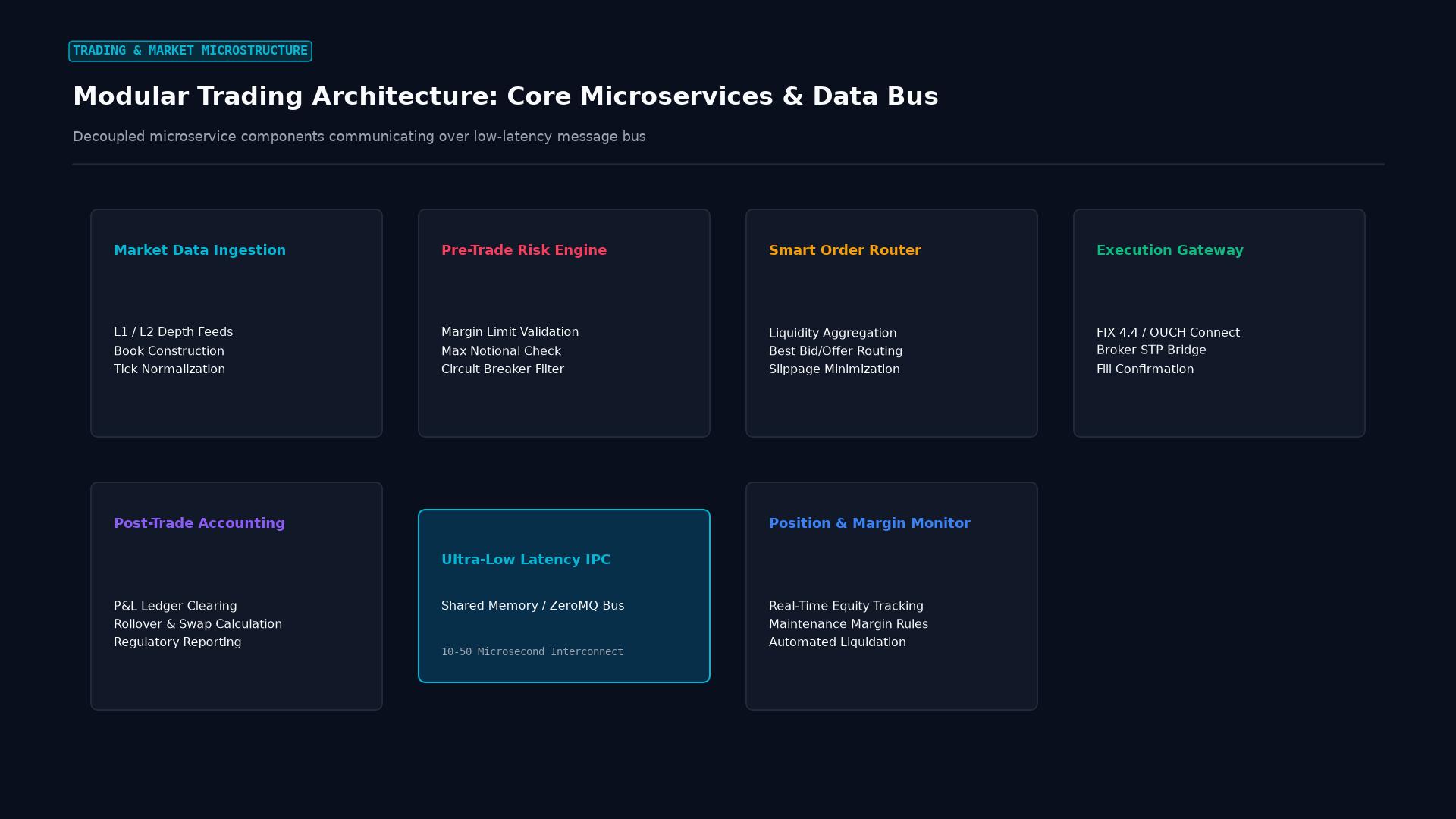 Figure: Decoupled microservice components: market data ingestion, pre-trade risk engine, smart order router, and execution gateway connected via low-latency IPC.
Key Takeaways
- Decoupled Architecture: Modules interact exclusively through standardized Application Programming Interfaces (APIs), ensuring changes in one module do not break unrelated components.
- Independent Risk Verification: Housing risk management in an autonomous, un-bypassable module ensures that rogue algorithms or flawed alpha signals cannot override position-sizing boundaries.
- Accelerated Backtesting & Debugging: Quantitative analysts can isolate, unit-test, and optimize a single mathematical module (such as a volatility filter) without recompiling or redeploying the entire institutional codebase.
- Reusability Across Asset Classes: A well-designed execution or risk module built for spot forex can be plugged directly into futures or equity trading engines with minimal configuration adjustments.
- Educational Scaffolding: In financial education, modular learning breaks down overwhelming professional syllabi into digestible, verifiable competency milestones.
Comparative Taxonomy: Monolithic vs. Modular Trading Systems
| Architectural Characteristic | Monolithic Trading System | Modular Microservice Architecture |
|---|---|---|
| Code Structure | Single massive codebase (All logic intertwined) | Distinct decoupled services / libraries |
| Fault Isolation | Poor: A single bug in UI crashes execution | Absolute: A failure in charting leaves risk checks running |
| Testing Simplicity | Complex end-to-end testing required | Fast unit testing of individual functions |
| Scalability | Must scale entire application on one server | Scale execution modules across high-frequency servers |
| Deployment Speed | Slow; high risk of unintended regressions | Fast; update alpha logic without touching broker connectors |
| Institutional Standard | Outdated retail scripts | Standard at hedge funds, prop firms, and banks |
Practical Application: The Quantitative Hedge Fund Overhaul
Consider a proprietary quantitative fund that originally operated a single monolithic Python script executing statistical arbitrage across 12 currency pairs.
- The Problem: Whenever the quantitative research team updated their mathematical trend-following indicators, the entire system had to be taken offline. During one deployment, a minor syntax error in a charting display library halted trade execution, leaving open trades unhedged during a volatile European Central Bank rate decision.
- The Modular Restructuring: The firm re-architected the system into four autonomous C++ modules:
- Data Feed Module: Normalizes tick data into shared memory buffers.
- Model Engine Module: Computes statistical alphas in isolation.
- Risk Supervisor Module: A standalone, read-only process that independently monitors aggregate account equity and enforces hard stop-losses.
- Execution Gateway Module: Dedicated FIX protocol connectivity to prime-broker servers.
- The Result: The research team can now update, backtest, and hot-swap predictive alpha models multiple times a week without touching the execution or risk modules. System uptime reached 99.99%, and inter-process latency dropped by 70%.
The Role of Educational Modules in Trader Development
In structured financial training, educational modules prevent cognitive overload by segmenting complex market realities into sequential pedagogical tiers:
- Module 1 (Market Microstructure): Bid-ask spreads, pip values, lot sizing, order book mechanics.
- Module 2 (Macro Fundamentals): Central bank balance sheets, interest rate differentials, inflation metrics.
- Module 3 (Technical & Quantitative Analysis): Support/resistance, momentum oscillators, statistical regression.
- Module 4 (Capital Allocation & Behavioral Risk): Risk-of-ruin tables, position sizing algorithms, cognitive bias mitigation.
Critical Risks and Pitfalls of Modular Systems
- Inter-Module Communication Latency: Passing serialized data (such as JSON or Protobuf messages) across separate microservice modules introduces network serialization latency. In ultra-low-latency high-frequency trading (HFT), modules must communicate via shared memory (IPC) to prevent execution lag.
- Interface Drift & Version Mismatch: If the Alpha Module is updated to output new order parameters without updating the Risk Module’s ingestion interface, incoming trade orders may be dropped or rejected during live market execution.
Frequently Asked Questions (FAQ)
What is a module in Python trading development?
In Python, a module is a single .py file containing functions, classes, and variables (e.g., risk_engine.py or indicators.py) that can be imported into other scripts using the import statement, facilitating organized, reusable algorithmic code.
Why is an independent risk module critical for prop traders?
Separating risk management into its own independent module guarantees that the trading strategy cannot “cheat” its own rules. If an algorithm attempts to open a position that exceeds the daily loss limit, the independent risk module intercepts the order and kills the execution before it reaches the broker.
How does modularity help with backtesting?
Modularity allows you to test an analytical strategy against historical data using the exact same Alpha Module code that runs in live trading. Only the Market Data Module (swapped from live WebSocket to historical CSV tick replay) and Execution Module (swapped from real broker to simulated paper fills) are changed.
Ready to trade forex?
Open a free demo account with a regulated broker. Practice with virtual funds before risking real money.