Execution
Execution is the formal completion and fulfillment of a financial buy or sell order submitted to a broker, dealer, or liquidity venue, converting an order instruction into an executed contract at a specified fill price and volume.
What Is Trade Execution?
In financial markets and foreign exchange trading, execution is the successful fulfillment of an order to buy or sell a financial instrument. When an investor clicks “Buy” or submits an algorithmic order via API, the order is merely an instruction. Execution occurs when a counterparty—whether an interbank market maker, an electronic communications network (ECN) matching engine, or a retail broker’s dealing desk—accepts the order and legally commits to the transaction at an agreed-upon price.
The quality of trade execution directly influences a trader’s net profitability. Even a mathematically sound trading strategy can fail if poor execution results in excessive delays (latency), unfavorable price shifts (negative slippage), partial fills, or frequent dealer re-quotes.
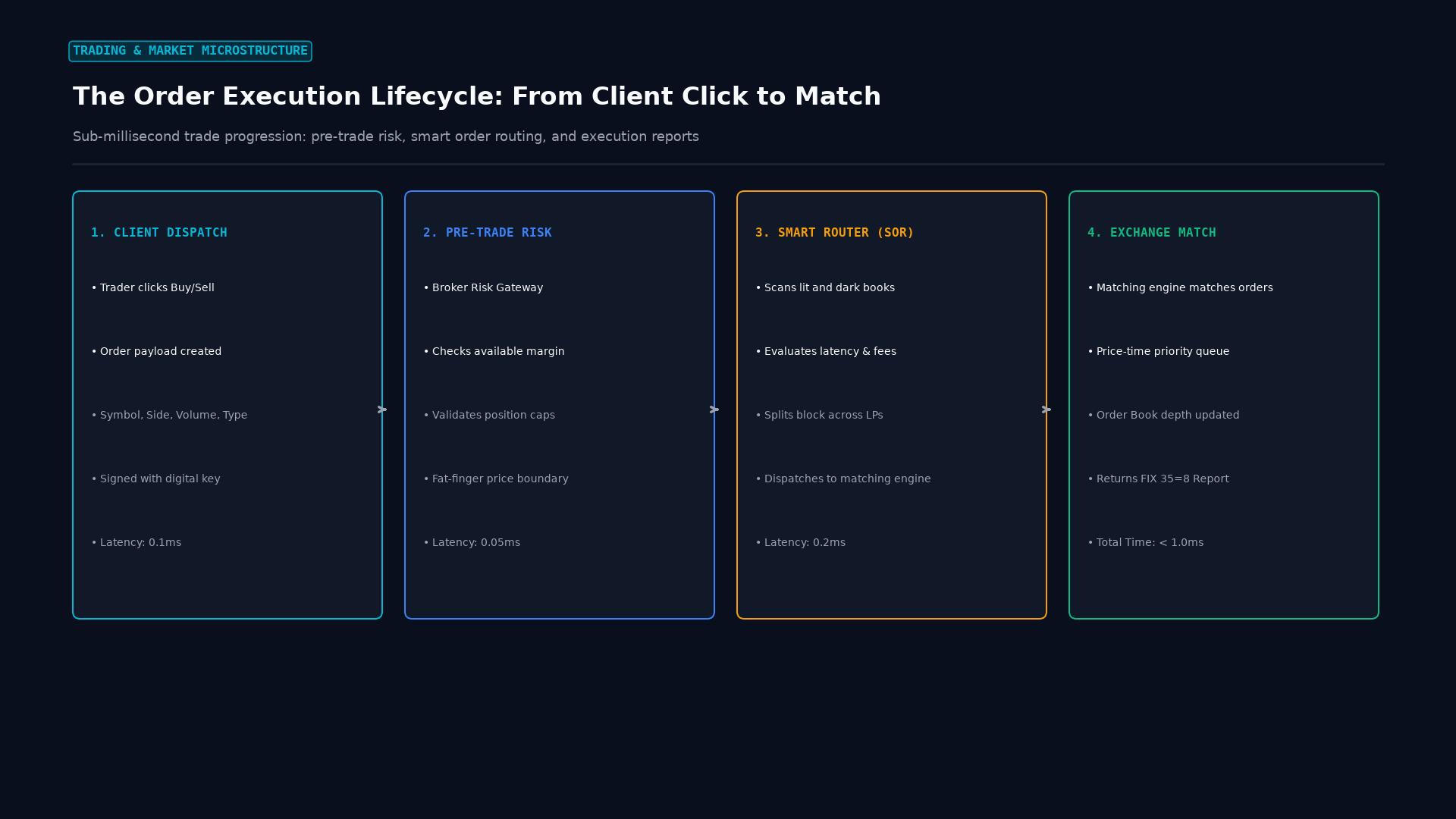 Figure: End-to-end electronic order flow: pre-trade broker risk filters, smart order routing venue selection, exchange matching engine execution, and FIX ExecutionReport confirmation.
Key Takeaways
- Fulfillment Milestone: Submitting an order does not constitute a trade; a trade only exists once execution takes place and a confirmation fill is returned.
- Latency Sensitivity: In modern high-frequency trading (HFT) and algorithmic FX markets, execution speed is measured in microseconds; delays can expose orders to front-running and adverse market movement.
- Slippage Dynamics: The difference between the price requested by the trader and the actual execution price filled by the market is known as slippage (which can be positive or negative).
- Regulatory Best Execution: Financial watchdogs (such as ESMA under MiFID II and the U.S. SEC) mandate that brokers take all sufficient steps to obtain the Best Execution for clients regarding price, speed, cost, and likelihood of execution.
Execution Routing Models: A-Book vs. B-Book
The architecture of a broker’s trading infrastructure determines how client orders are executed:
| Execution Model | Routing & Counterparty Mechanism | Conflict of Interest | Slippage & Execution Behavior |
|---|---|---|---|
| Straight-Through Processing (STP / A-Book) | Orders are routed directly and automatically to external Tier-1 liquidity providers (LPs) without manual intervention. | Low; broker profits purely from commission or spread markups. | Market execution; orders experience variable positive or negative slippage. |
| Electronic Communication Network (ECN) | Orders are routed to an electronic matching hub where participants (banks, hedge funds, retail) trade against each other. | None; pure peer-to-peer and bank liquidity matching. | Market execution with transparent Depth of Market (Level 2). |
| Market Maker (B-Book / Dealing Desk) | The brokerage acts as the direct counterparty to the trade, taking the other side of the client’s position without external hedging. | High; the broker profits when the client loses and loses when the client profits. | Instant execution with potential re-quotes or asymmetrical negative slippage. |
Core Execution Types
1. Market Execution
The order is executed immediately at the best price available in the order book when the request reaches the liquidity pool.
- Advantage: 100% fill probability; guaranteed execution.
- Disadvantage: Price is not guaranteed; subject to slippage during fast-moving news events.
2. Instant Execution
The broker attempts to fill the order at the exact price visible on the trader’s screen.
- Advantage: Price certainty.
- Disadvantage: If the market price moves before the order reaches the broker’s server, the order is rejected with a re-quote, forcing the trader to accept a worse price or cancel.
3. Request for Quote (RFQ)
Common in institutional wholesale block trades and exotic currency pairs. The trader requests an actionable two-sided quote from multiple dealers and has a few seconds to accept or reject the offered execution rate.
What Determines Execution Quality?
- Network Latency: The physical ping time between the trader’s terminal, the broker’s bridge, and the exchange servers (e.g., Equinix LD4 in London or NY4 in New Jersey). Traders minimize latency by hosting algorithms on co-located Virtual Private Servers (VPS).
- Order Book Liquidity Depth: If an institutional trader submits a 50-lot market order ($5,000,000 notional) during a quiet session, top-of-book liquidity may only satisfy 10 lots. The remaining 40 lots must sweep deeper levels of the order book, resulting in a higher average execution price.
- Fill Ratio & Partial Fills: High-quality brokers boast fill ratios exceeding 99.5%, executing large orders completely without rejecting legs or leaving unfilled partial balances.
Frequently Asked Questions
What is the difference between positive and negative slippage?
Negative slippage occurs when your buy order is filled at a higher price (or sell order at a lower price) than requested, causing an immediate financial loss. Positive slippage occurs when your order is filled at a better price than requested (e.g., buying EUR/USD at 1.0820 when you submitted at 1.0822), yielding an unexpected gain. Honest A-Book brokers pass positive slippage to clients.
What is a “re-quote”?
A re-quote happens exclusively under “Instant Execution” dealing desk models. When market prices change faster than the broker can process, the platform refuses to execute your trade at the requested price and presents a pop-up window asking if you accept the new, current market price.
How does MiFID II protect retail traders regarding execution?
Under the EU’s MiFID II framework, brokers are legally obligated to publish annual RTS 27 and RTS 28 reports detailing the top five execution venues they used, the percentage of orders that experienced slippage, and proof that they systematically achieved the best possible outcome for retail clients.
Ready to trade forex?
Open a free demo account with a regulated broker. Practice with virtual funds before risking real money.