MOP
MOP is the ISO 4217 currency code for the Macau Pataca (currency symbol: MOP$ or 圓), the legal tender of the Macau Special Administrative Region (SAR) of the People's Republic of China, administered under a statutory currency board system pegged to the Hong Kong Dollar.
The MOP (Macau Pataca, graphical symbol MOP$, Chinese: 澳門圓 or 葡幣) is the statutory currency of the Macau Special Administrative Region (SAR) of the People’s Republic of China. Governed under the regulatory oversight of the Monetary Authority of Macao (Autoridade Monetária de Macau, or AMCM), the pataca operates under a classical, orthodox Currency Board System (CBS).
The pataca is formally subdivided into 100 avos (Portuguese) or ho (Chinese: 毫, representing 10 avos). Banknotes are issued under government concession by two designated commercial issuing banks: Banco Nacional Ultramarino (BNU) and the Bank of China (Macau Branch). Despite the pataca’s status as the sole official legal tender of the territory, the economy of Macau operates under a dual-currency reality where the Hong Kong Dollar (HKD) circulates freely alongside the pataca, dominating the gaming, integrated resort, and luxury retail sectors.
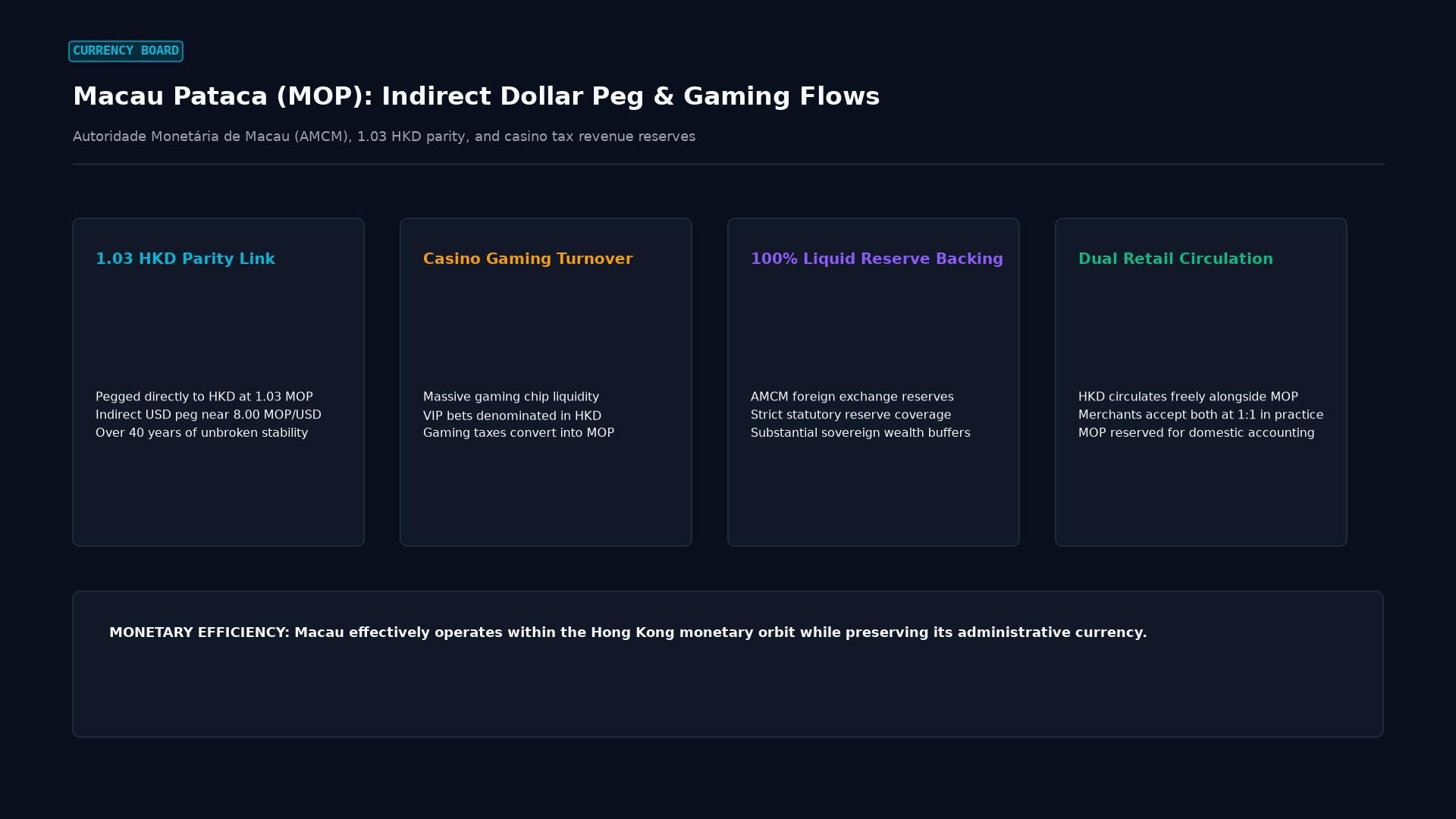 Figure: Autoridade Monetária de Macau (AMCM), 1.03 HKD parity, and casino tax revenue reserves
Historical Origins and Currency Development
Colonial Portuguese Administration and the 1894 Currency Reform
The term pataca derives from the Portuguese word for a silver coin previously circulated in the Lusophone maritime empire, which itself originated from the Italian patacca and the Arabic batāqa. Throughout the sixteenth to nineteenth centuries, maritime trade in Macau relied predominantly on silver Spanish and Mexican trade dollars (reales de a ocho) alongside Chinese silver sycees.
In 1894, the Portuguese colonial administration established the pataca as an independent unit of account in Macau and Portuguese Timor. In 1901, the Portuguese state granted an exclusive banknote issuance concession to the Banco Nacional Ultramarino (BNU), a colonial chartered bank headquartered in Lisbon. BNU issued the inaugural pataca banknotes in 1906, backed originally by Mexican silver dollars.
The 1977 Peg to the Hong Kong Dollar
For much of the early twentieth century, the pataca maintained a fluctuating link to the Portuguese Escudo (PTE) or the international price of physical silver. However, Macau’s geographical proximity to British Hong Kong and deep trade dependence on the British colony made the escudo link economically inefficient, as sudden shifts in the Portuguese balance of payments repeatedly destabilized Macanese price levels.
On April 9, 1977, the Macau Government enacted historic monetary legislation delinking the pataca from the Portuguese Escudo and establishing a formal fixed exchange rate peg to the Hong Kong Dollar: $$\text{Exchange Rate: } 1.00 \text{ HKD} = 1.03 \text{ MOP (Middle Rate)}$$ $$\text{Intervention Spread: } 1.00 \text{ HKD} = 1.0285 \text{ MOP (Bid)} \text{ to } 1.0315 \text{ MOP (Offer)}$$
This rate of 1.03 MOP per 1.00 HKD has remained virtually unchanged for nearly five decades, surviving the 1997 Asian Financial Crisis, the 1999 handover of sovereignty from Portugal to the People’s Republic of China, the 2008 global banking panic, and the COVID-19 pandemic.
The Architecture of the Macau Currency Board System (CBS)
The Macau Currency Board System represents an orthodox currency board mechanism designed to guarantee 100% convertibility of domestic legal tender into an external anchor asset.
                   MACAU CURRENCY BOARD TRIANGULAR MECHANISM

   +-----------------------------------------------------------------------+
   |                        US Dollar (USD)                                |
   +-----------------------------------------------------------------------+
        ^                                                               ^
        | HK Linked Exchange Rate                                       |
        | (7.75 - 7.85 HKD / USD)                                       | Indirect
        v                                                               | Peg
   +-----------------------------------------------------------------+  | (8.03 - 8.10)
   |                    Hong Kong Dollar (HKD)                       |  |
   +-----------------------------------------------------------------+  |
        ^                                                               |
        | Fixed CBS Exchange Rate (1 HKD = 1.03 MOP)                    |
        v                                                               v
   +-----------------------------------------------------------------------+
   |                       Macau Pataca (MOP)                              |
   +-----------------------------------------------------------------------+
1. The Statutory Backing Rule
Under Decree-Law no. 7/95/M and subsequent regulations, the AMCM enforces a strict statutory full-backing mandate.
When BNU or the Bank of China issues new pataca banknotes into circulation, the issuing bank must deliver an equivalent sum of Hong Kong Dollars to the AMCM at the fixed rate of 1 HKD = 1.03 MOP. In return, the AMCM issues non-interest-bearing Certificates of Indebtedness (CIs) to the bank. $$\Delta \text{Pataca Banknote Liabilities} = 1.03 \times \Delta \text{AMCM Hong Kong Dollar Assets}$$
Conversely, when an issuing bank withdraws worn banknotes from circulation or experiences net deposit outflows, it surrenders CIs back to the AMCM and receives Hong Kong Dollars at the statutory rate. This arrangement guarantees that every pataca circulating in the economy is 100% backed by liquid, foreign-currency assets held in the AMCM Foreign Exchange Reserve Portfolio.
2. Triangular Linkage to the US Dollar
Because the Hong Kong Dollar is itself pegged to the US Dollar under the Hong Kong Monetary Authority’s Linked Exchange Rate System (LERS) within a tight convertibility corridor of 7.75 to 7.85 HKD per USD, the Macau Pataca is indirectly anchored to the US Dollar: $$\text{USD/MOP} = \text{USD/HKD} \times 1.03$$
- At the strong-side convertibility band of the HKD ($7.7500$): $1 \text{ USD} = 7.7500 \times 1.03 = 7.9825 \text{ MOP}$.
- At the weak-side convertibility band of the HKD ($7.8500$): $1 \text{ USD} = 7.8500 \times 1.03 = 8.0855 \text{ MOP}$.
Consequently, the pataca imports the monetary policy of the United States Federal Reserve. The AMCM cannot independently set domestic interest rates to manage local output or employment. Instead, the AMCM’s Base Rate for discount window lending moves in lockstep with the HKMA Base Rate, which mirrors the US Federal Funds Target Range.
Dual Currency Dynamics and the Macroeconomic Landscape
The Co-Circulation of the Hong Kong Dollar
Although the Macau Basic Law and local statutes designate the pataca as the legal tender, Macau exhibits an extraordinary degree of domestic currency substitution:
+------------------------+-----------------------------+-----------------------------+
| Sector                 | Dominant Currency Used      | Economic Rationale          |
+------------------------+-----------------------------+-----------------------------+
| Casino Gaming & VIP    | Hong Kong Dollar (HKD)      | Eliminates FX risk for      |
| Tables                 | (>90% of gaming volume)     | HK and mainland high-rollers|
+------------------------+-----------------------------+-----------------------------+
| Government Taxes, Civil| Macau Pataca (MOP)          | Statutory legal tender      |
| Service Salaries, Util.| (100% statutory mandate)    | and fiscal denomination     |
+------------------------+-----------------------------+-----------------------------+
| Supermarkets & Local   | Macau Pataca (MOP)          | Daily transaction convenience|
| Small Businesses       | (HKD accepted at 1:1 parity)| and municipal retail        |
+------------------------+-----------------------------+-----------------------------+
| High-End Luxury Retail | Hong Kong Dollar &          | Direct alignment with       |
| & Integrated Resorts   | Renminbi (RMB)              | tourist spending power      |
+------------------------+-----------------------------+-----------------------------+
Because commercial vendors often accept HKD at a 1:1 nominal exchange rate with the MOP (ignoring the 3% premium of the HKD to save transaction time), consumers paying in HKD effectively incur a small convenience penalty known locally as sap ng (absorbing the discount).
The Integrated Resort Economy and Fiscal Surpluses
The Macau economy is heavily oriented toward tourism, entertainment, and integrated resort gaming concessions. Prior to the COVID-19 pandemic, gross gaming revenue (GGR) in Macau exceeded that of the Las Vegas Strip by more than three times. Gaming tax revenues, levied at approximately 39% of gross gaming receipts, generate immense fiscal surpluses for the Macau Government.
These structural fiscal surpluses have enabled the SAR government to:
- Accumulate Vast FX Reserves: The AMCM holds foreign exchange reserves that frequently cover between 15 and 20 months of total retained imports, exceeding international safety thresholds by a wide margin.
- Fund the Macau SAR Reserve Fund: An institutional sovereign wealth fund managed by the AMCM, investing in global sovereign bonds, international equities, and Greater Bay Area infrastructure assets.
- Finance the Wealth Partaking Scheme: An annual cash handout program distributing direct cash dividends to permanent and non-permanent Macau residents in patacas, boosting domestic consumption without requiring debt issuance.
Modern Structural Reforms and Strategic Initiatives
1. Hengqin and Greater Bay Area Financial Integration
Under the Outline Development Plan for the Guangdong-Hong Kong-Macao Greater Bay Area (GBA), Macau is expanding beyond its historic peninsula into the Guangdong-Macao In-Depth Cooperation Zone in Hengqin.
This initiative introduces innovative cross-border capital flow policies:
- Facilitation of multi-currency cross-border pooling for corporate treasuries.
- Integration of domestic Chinese Renminbi (CNY) clearing mechanisms alongside MOP and HKD.
- Development of a specialized offshore financial market focused on Portuguese-speaking countries (such as Brazil, Portugal, Angola, and Mozambique).
2. The Micro Connect Macao Financial Assets Exchange (MCEX)
In 2023, the Macau SAR Government licensed the Micro Connect Macao Financial Assets Exchange (MCEX), the world’s first licensed exchange for Daily Revenue Obligations (DROs). This exchange allows global institutional capital to connect directly with small and micro businesses across mainland China, settling financial asset transactions under Macau’s legal framework and AMCM financial oversight.
3. The Digital Pataca (e-MOP) Exploration
In alignment with global central bank digital currency (CBDC) trends and the People’s Bank of China’s Digital Renminbi (e-CNY), the AMCM has initiated technical research into a Digital Pataca (e-MOP). Designed as a digital representation of the physical currency board banknote, the e-MOP aims to:
- Modernize domestic retail payment infrastructure and lower transaction friction for merchants.
- Facilitate cross-border interoperability with the Digital Hong Kong Dollar (e-HKD) and the digital yuan (e-CNY).
- Maintain 100% full backing by foreign reserves within the AMCM digital balance sheet.
Trading and Risk Management Considerations for MOP
- Absence of a Speculative Trading Market: The Macau Pataca does not trade actively on global retail foreign exchange platforms or spot interbank matching engines. Because the 1.03 peg is maintained by full statutory reserve backing and credible fiscal surpluses, speculative arbitrage against the MOP is virtually non-existent.
- Direct Proxy Hedging via HKD/USD: Institutional investors, hotel chains, and infrastructure contractors operating in Macau manage their long-term MOP exchange rate risk by executing hedges directly in the USD/HKD forward and options market. Because MOP is tethered to HKD at 1.03, hedging HKD exposure completely neutralizes foreign exchange volatility for MOP assets.
- Negative Carry in Low US Rate Environments: In times of high US Federal Reserve interest rates, maintaining MOP bank deposits provides yields aligned with US money market benchmarks. However, during ZIRP (Zero Interest Rate Policy) regimes, deposit yields compress to near-zero levels.
- Legal Tender Restrictions: Under Decree-Law no. 16/95/M, all commercial businesses operating within Macau are legally obliged to accept patacas for payment of debts or goods. A business cannot refuse patacas in favor of Hong Kong Dollars or Chinese Yuan, protecting consumer access to the sovereign currency.
Frequently Asked Questions (FAQ)
What is the difference between the Macau Pataca (MOP) and the Hong Kong Dollar (HKD)?
The Macau Pataca (MOP) is the sole legal tender of Macau issued under the supervision of the Monetary Authority of Macao, while the Hong Kong Dollar (HKD) is the legal tender of Hong Kong issued under the Hong Kong Monetary Authority. Although they are distinct currencies with independent banknotes, the pataca is pegged directly to the Hong Kong Dollar at the statutory rate of 1 HKD = 1.03 MOP under a currency board system. The Hong Kong Dollar is widely accepted across Macau in casinos, retail stores, and hotels.
Can the Macau Government independently alter its interest rates?
No. Because Macau operates an orthodox Currency Board System with a fixed exchange rate to the Hong Kong Dollar, which is itself linked to the US Dollar, Macau cannot pursue an independent domestic monetary policy. In economic theory, this reflects the “Impossible Trinity” (Mundell-Fleming Trilemma), which states that an economy cannot simultaneously maintain a fixed exchange rate, free capital mobility, and sovereign monetary policy. As a result, the Monetary Authority of Macao automatically adjusts its base rate to match changes in the US Federal Reserve target range.
Which institutions are authorized to issue pataca banknotes?
Banknotes in Macau are issued under long-term government concessions by two commercial banks: Banco Nacional Ultramarino (BNU, a subsidiary of the Portuguese state-owned financial group Caixa Geral de Depósitos) and the Bank of China (Macau Branch). Each bank issues its own distinctive artistic series of pataca banknotes across denominations of 10, 20, 50, 100, 500, and 1,000 patacas. Both banks must deposit 100% equivalent Hong Kong Dollar reserves with the Monetary Authority of Macao before issuing any physical currency into circulation.
Ready to trade forex?
Open a free demo account with a regulated broker. Practice with virtual funds before risking real money.