MRO
MRO is the historical ISO 4217 currency code for the Mauritanian Ouguiya (superseded by MRU in 2018), the official legal tender of Mauritania issued by the Banque Centrale de Mauritanie. In European banking and central banking, MRO also serves as the acronym for Main Refinancing Operations, the key liquidity policy facility of the European Central Bank.
The acronym MRO possesses two prominent, distinct applications in global finance:
- The Mauritanian Ouguiya (ISO 4217 Code: MRO): The historical legal tender of the Islamic Republic of Mauritania from 1973 until December 31, 2017. Governed by the Banque Centrale de Mauritanie (BCM), the currency was famous for being one of only two non-decimal currencies in modern circulation (divided into five khoums). On January 1, 2018, Mauritania executed a structural currency redenomination, replacing the MRO with the new Ouguiya (MRU) at a ratio of $10 \text{ MRO} = 1 \text{ MRU}$.
- Main Refinancing Operations (ECB MRO): The primary liquidity-providing monetary policy instrument utilized by the European Central Bank (ECB) to steer Eurozone interbank interest rates, inject banking liquidity, and signal monetary policy stance across member states.
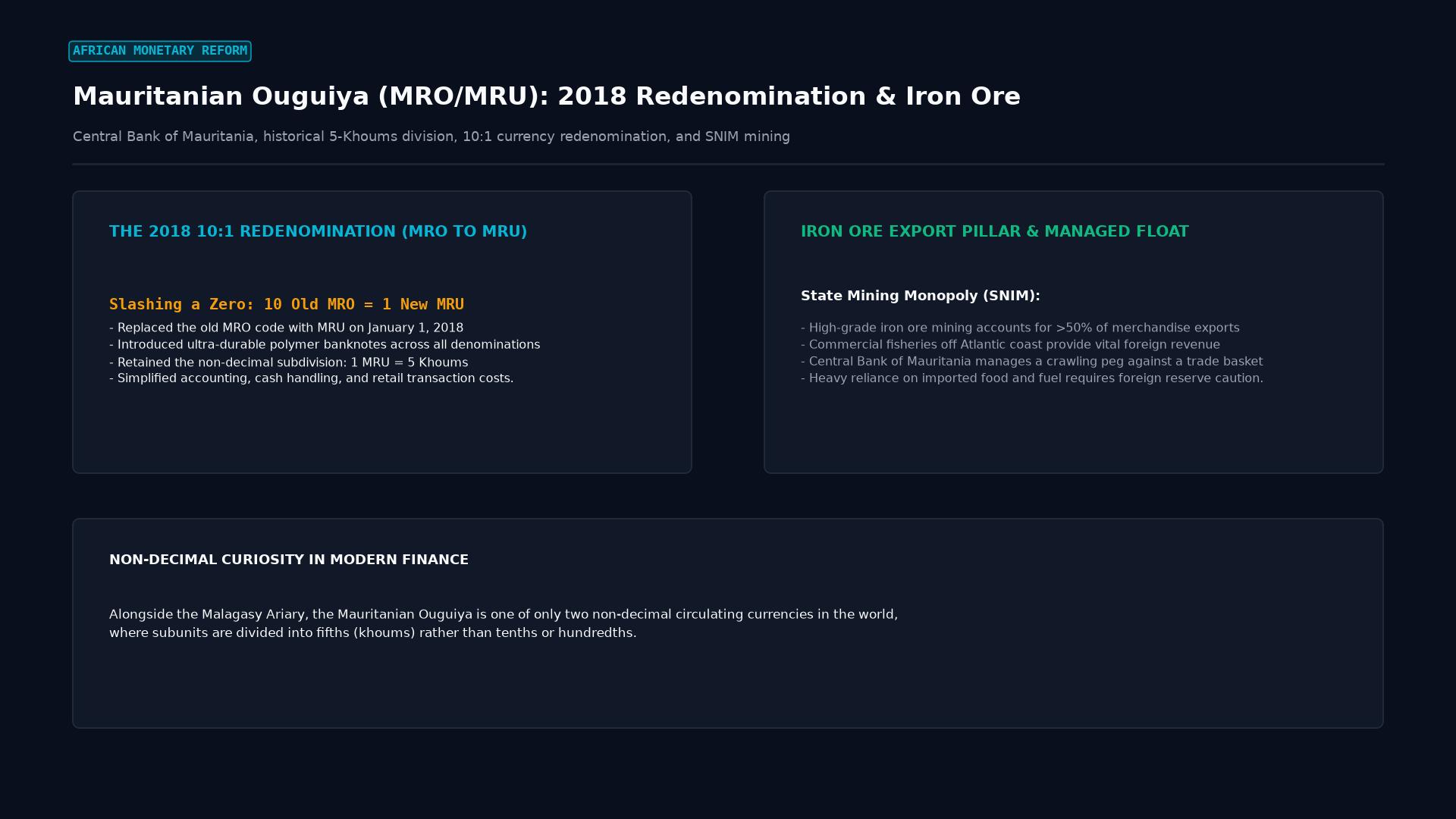 Figure: Central Bank of Mauritania, historical 5-Khoums division, 10:1 currency redenomination, and SNIM mining
1. The Mauritanian Ouguiya (MRO): Monetary History and Architecture
Departure from the CFA Zone (1973)
Following independence from France in 1960, Mauritania initially participated in the West African Monetary Union (UMOA), utilizing the CFA Franc (XOF). However, seeking complete economic independence, national political sovereignty, and autonomy over domestic credit allocation, President Moktar Ould Daddah enacted historic monetary legislation in 1973:
- Mauritania formally withdrew from the Franc Zone and the BCEAO.
- The Banque Centrale de Mauritanie (BCM) was established as the sovereign monetary authority.
- The Ouguiya (MRO) was introduced on June 28, 1973, replacing the CFA Franc at the statutory conversion rate of: $$1 \text{ MRO} = 5 \text{ CFA Francs (XOF)}$$
The Non-Decimal Subunit: The Khoums
Unlike standard fiat currencies that adhere to the decimal system (subdivided into 100 centimes, cents, or pennies), the Ouguiya was created with a base-5 non-decimal structure: $$1 \text{ Ouguiya} = 5 \text{ Khoums (خمس)}$$
The word khoums translates directly to “one-fifth” in classical Arabic. The only other modern currency retaining a non-decimal subunit is the Malagasy Ariary of Madagascar (divided into 5 iraimbilanja). While 1-khoums coins were initially minted, decades of domestic inflation gradually degraded their purchasing power, rendering the khoums practically obsolete in everyday cash commerce well before the 2018 currency overhaul.
                  THE 2018 MAURITANIAN REDENOMINATION (MRO TO MRU)

     Old Currency (MRO)                               New Currency (MRU)
  +-----------------------+                        +-----------------------+
  | 1,000 MRO Banknote    | ===== Ratio 10:1 ====> | 100 MRU Banknote      |
  | (Paper, Worn Cash)    |                        | (Polymer, High-Tech)  |
  +-----------------------+                        +-----------------------+
              |                                                |
              v                                                v
  - High carrying volume                           - Enhanced durability
  - Distorted retail prices                        - Modernized ATM usage
  - Complex ledger bookkeeping                     - Restored accounting ease
The 2018 Redenomination: Transition from MRO to MRU
By late 2017, cumulative monetary expansion and currency depreciation had resulted in bulky cash handling requirements, with commercial retail transactions requiring vast stacks of paper banknotes.
On November 28, 2017, President Mohamed Ould Abdel Aziz announced a comprehensive currency reform:
- Redenomination Factor: On January 1, 2018, one zero was dropped from all domestic prices, financial accounts, and physical currency. Ten old Ouguiyas (MRO) were converted into one new Ouguiya (MRU): $$1 \text{ MRU} = 10 \text{ MRO}$$
- ISO Code Evolution: The international standard ISO 4217 code was updated from MRO (numeric: 478) to MRU (numeric: 929).
- Polymer Substrate Transition: The BCM replaced paper banknotes with a durable, tear-resistant biaxially-oriented polypropylene (BOPP) polymer series across denominations of 20, 50, 100, 200, 500, and 1,000 MRU.
- Transition Period: A six-month dual-circulation window was permitted until June 30, 2018, during which commercial banks and post offices exchanged old MRO notes for new MRU without penalty, completing demonetization.
Macroeconomic Fundamentals and External Vulnerabilities
The external value of the Mauritanian currency is dictated by the structure of its resource-rich, export-dependent economy:
+------------------------+--------------------------------------------------+
| Export Sector          | Economic Contribution and Mechanism              |
+------------------------+--------------------------------------------------+
| Iron Ore Extraction    | Governed by SNIM; accounts for >50% of total     |
|                        | outbound merchandise export earnings.            |
+------------------------+--------------------------------------------------+
| Gold Mining            | High-grade production from the Tasiast open-pit  |
|                        | mine; primary source of foreign direct investment|
+------------------------+--------------------------------------------------+
| Atlantic Fisheries     | Highly productive coastal upwelling zones; yields|
|                        | licensing fees and hard-currency seafood exports.|
+------------------------+--------------------------------------------------+
| Offshore LNG (GTA)     | Grand Tortue Ahmeyim deepwater gas field shared  |
|                        | with Senegal; provides long-term export cashflow.|
+------------------------+--------------------------------------------------+
1. Iron Ore and the SNIM Driver
Mauritania is the second-largest producer of iron ore in Africa, dominated by the state-controlled mining conglomerate Société Nationale Industrielle et Minière (SNIM). Iron ore extracted from the Zouérat mines is transported across a dedicated 700-kilometer desert railway to the port of Nouadhibou for maritime export. Consequently, when global benchmark iron ore prices on the Dalian Commodity Exchange or Singapore Exchange rise, Mauritania accumulates foreign exchange reserves, easing pressure on the Ouguiya. When steel demand weakens, the central bank faces severe foreign currency shortages.
2. The Grand Tortue Ahmeyim (GTA) Gas Project
Developed jointly by BP, Kosmos Energy, Petrosen, and the Société Mauritanienne des Hydrocarbures (SMH), the offshore Grand Tortue Ahmeyim liquefied natural gas (LNG) project unlocks massive offshore gas reserves. This multi-billion-dollar infrastructure development is reshaping Mauritania’s current account, shifting the nation from a chronic energy importer to a major energy exporter to European and global markets.
2. Main Refinancing Operations (MRO) in European Central Banking
In the institutional architecture of the Eurozone, MRO denotes Main Refinancing Operations, the flagship liquidity instrument of the European Central Bank (ECB) and the Eurosystem.
                      ECB POLICY INTEREST RATE CORRIDOR

  Rate (%)
   ^
   |  +------------------------------------------------------------+
   |  | Marginal Lending Facility (MLF Rate) - Emergency Borrowing |
   |  +------------------------------------------------------------+
   |
   |  +------------------------------------------------------------+
   |  | Main Refinancing Operations (MRO Rate) - Regular Liquidity |
   |  +------------------------------------------------------------+
   |
   |  +------------------------------------------------------------+
   |  | Deposit Facility Rate (DFR) - Floor for Overnight Reserves |
   |  +------------------------------------------------------------+
   |
   +-------------------------------------------------------------------> Time
Structure and Function of ECB MROs
Under the Eurosystem monetary framework:
- Regular Weekly Tenor: Main Refinancing Operations are liquidity-providing reverse transactions executed once every week with a standard maturity of one week.
- Decentralized Execution: Although monetary policy decisions are determined by the ECB Governing Council in Frankfurt, the actual execution of MRO tenders is conducted by the 20 National Central Banks (such as the Deutsche Bundesbank, Banque de France, and Banca d’Italia).
- Collateralized Credit: European commercial banks cannot borrow under MRO on an unsecured basis; they must pledge eligible, high-grade collateral (sovereign bonds, covered bonds, asset-backed securities, or eligible corporate debt) subject to Eurosystem valuation haircuts.
Tender Procedures: From Variable Rate to Fixed Rate Full Allotment
- Pre-2008 (Variable Rate Tender): The ECB announced the volume of liquidity it intended to auction, and commercial banks submitted competitive bids specifying the amount they wished to borrow and the interest rate they were willing to pay (subject to a minimum MRO bid rate).
- Post-2008 (Fixed Rate Full Allotment, FRFA): Following the global financial crisis and the European sovereign debt crisis, interbank lending froze. To guarantee absolute liquidity certainty to solvent institutions, the ECB shifted to FRFA: commercial banks can borrow an unlimited volume of one-week liquidity at the fixed MRO rate, provided they pledge sufficient eligible collateral.
The Role of MRO in Policy Steering
The MRO Rate sits precisely between the ECB’s two standing facilities:
- Marginal Lending Facility (MLF): Offers overnight emergency liquidity to banks at an interest rate premium above the MRO rate (the ceiling of the policy corridor).
- Deposit Facility Rate (DFR): Determines the interest paid to banks for depositing surplus overnight liquidity with the central bank (the floor of the corridor).
During periods of massive excess liquidity caused by Quantitative Easing (the Asset Purchase Programme and Pandemic Emergency Purchase Programme), the Deposit Facility Rate effectively acts as the operational anchor for the Euro Short-Term Rate (€STR), but the MRO rate remains the central benchmark governing bank refinancing costs.
Comparative Matrix: Mauritanian Currency vs. ECB MRO
+------------------------+-----------------------------+-----------------------------+
| Feature                | Mauritanian Ouguiya (MRO)   | ECB Main Refinancing (MRO)  |
+------------------------+-----------------------------+-----------------------------+
| Category               | Sovereign Fiat Currency     | Central Bank Policy Tool    |
|                        | (Redenominated to MRU)      | (Collateralized Repo)       |
+------------------------+-----------------------------+-----------------------------+
| Institution            | Banque Centrale de          | European Central Bank (ECB) |
|                        | Mauritanie (BCM)            | & Eurosystem NCBs           |
+------------------------+-----------------------------+-----------------------------+
| Key Unit / Metric      | Khoums (1/5th) & Ouguiya    | Percentage Yield (MRO Rate) |
|                        | Cash Banknotes / Coins      | Weekly Auction Liquidity    |
+------------------------+-----------------------------+-----------------------------+
| Primary Objective      | Domestic medium of exchange,| Steering money market rates |
|                        | national legal tender       | and bank credit supply      |
+------------------------+-----------------------------+-----------------------------+
| Global Market Impact   | Local frontier FX; highly   | Global financial markets;   |
|                        | sensitive to iron ore prices| dictates EUR lending costs  |
+------------------------+-----------------------------+-----------------------------+
Professional Best Practices
- Verify Legacy ISO Codes in Financial Systems: When building financial databases or integrating payment gateways, do not confuse the obsolete code MRO with the active code MRU. Processing a transaction under MRO could cause severe accounting discrepancies due to the 10:1 redenomination factor.
- Monitor ECB Policy Announcements: Fixed income and forex traders must track the spread between the ECB MRO rate and the Deposit Facility Rate. Changes in the corridor width directly impact Euribor fixings, short-dated sovereign yields, and EUR/USD forward points.
- Track Extractive Commodity Swings for Mauritanian Exposure: Multilateral entities, mining suppliers, and trade finance desks operating in West Africa should track iron ore and LNG shipping volumes to gauge BCM foreign exchange reserves and local currency liquidity.
Frequently Asked Questions (FAQ)
Is the Mauritanian Ouguiya (MRO) still valid legal tender?
No. The historical currency designated by the ISO 4217 code MRO was completely demonetized on June 30, 2018, following a comprehensive national redenomination program. It was replaced by the new Ouguiya (ISO code: MRU) at a mandatory conversion ratio of 10 old MRO = 1 new MRU. All commercial contracts, bank accounts, and daily retail transactions in Mauritania are conducted exclusively in MRU.
Why is the Mauritanian Ouguiya divided into five subunits instead of one hundred?
When Mauritania gained monetary independence and introduced the Ouguiya in 1973, it replaced the CFA Franc at a rate of 1 Ouguiya = 5 CFA Francs. To maintain numerical convenience and preserve local purchasing habits, the central bank created a subunit called the khoums (meaning “one-fifth” in Arabic), making 1 Ouguiya equal to 5 khoums. Alongside Madagascar’s Ariary, Mauritania is one of only two nations in the world that chose a non-decimal subunit structure.
What occurs when the European Central Bank changes its MRO interest rate?
When the ECB alters its Main Refinancing Operations rate, it directly influences the cost at which European commercial banks borrow short-term liquidity from the central bank. A hike in the MRO rate raises borrowing costs for commercial banks, leading to higher mortgage rates, commercial loan interest, and interbank lending rates (such as Euribor), which dampens inflationary pressures and supports the Euro. Conversely, a rate cut reduces borrowing costs to stimulate economic investment.
Ready to trade forex?
Open a free demo account with a regulated broker. Practice with virtual funds before risking real money.