MVR
MVR is the ISO 4217 currency code for the Maldivian Rufiyaa (currency symbol: Rf or ރ.), the official legal tender of the Republic of Maldives, issued and managed by the Maldives Monetary Authority under a pegged horizontal band regime anchored to the US Dollar.
The MVR (Maldivian Rufiyaa, graphical symbol Rf or Dhivehi: ރ.) is the official national currency of the Republic of Maldives, an archipelagic nation comprising 1,192 coral islands in the Indian Ocean. Under the statutory authority of the Maldives Monetary Authority Act of 1981, the Maldives Monetary Authority (MMA) operates as the nation’s central bank, exercising exclusive control over currency issuance, foreign exchange licensing, and monetary policy.
The rufiyaa is nominally subdivided into 100 laari (ލާރި). Modern circulation consists of coins in denominations of 1, 2, 5, 10, 25, and 50 laari and 1 and 2 rufiyaa, alongside the Ran Dhihefaheh (Golden 50th Independence) polymer banknote series spanning 5, 10, 20, 50, 100, 500, and 1,000 rufiyaa. The currency operates under a horizontal exchange rate band pegged to the US Dollar, functioning within a dual-currency economic structure characterized by extensive domestic dollarization and acute foreign exchange rationing.
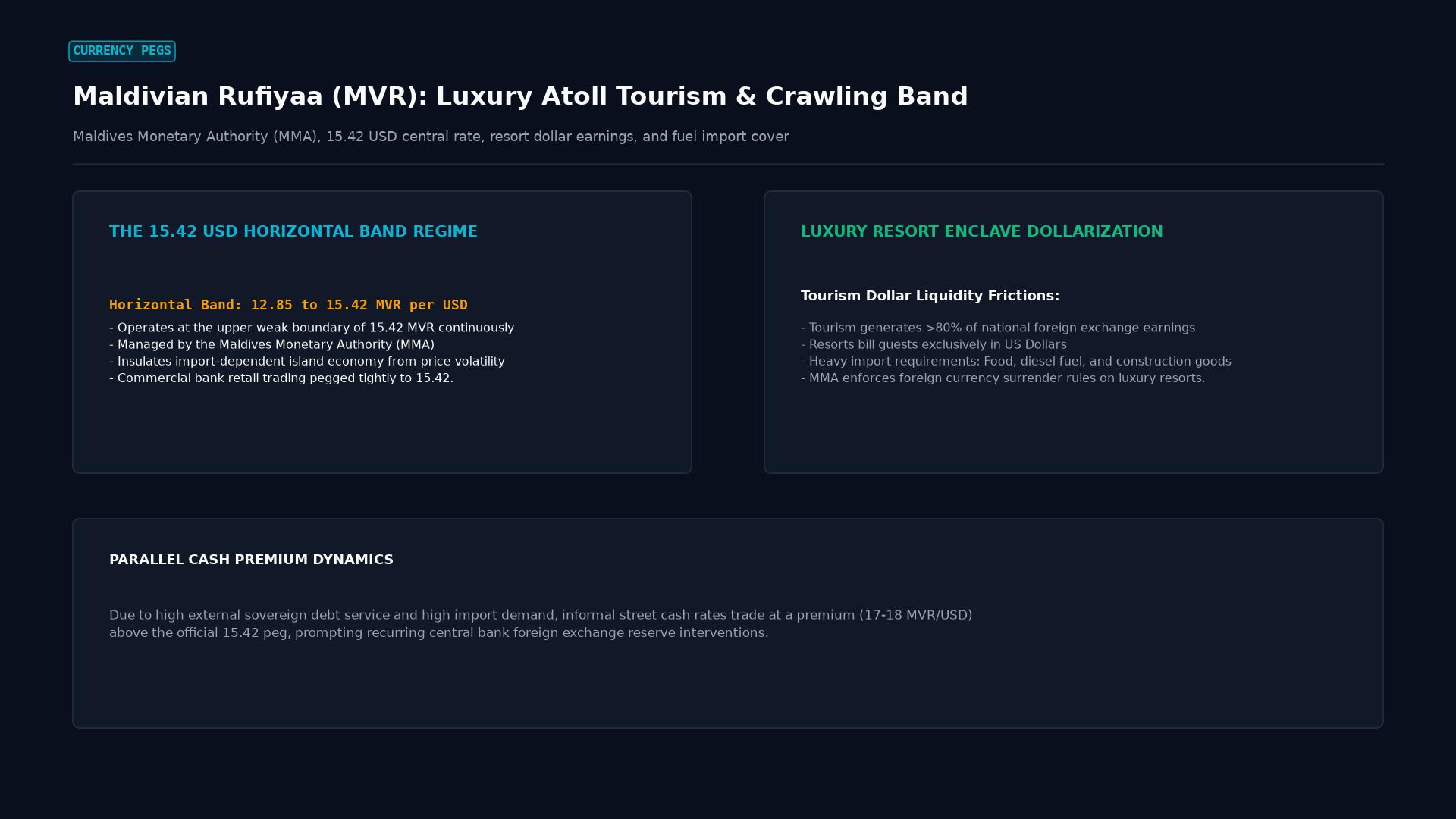 Figure: Maldives Monetary Authority (MMA), 15.42 USD central rate, resort dollar earnings, and fuel import cover
Historical Origins and Currency Evolution
Cowrie Shells and Ceylonese Rupee Origins
Historically, the Maldives was known throughout the Indian Ocean trade network as the primary supplier of money cowrie shells (Cypraea moneta), which served as currency across Asia and parts of Africa for centuries. In later eras, trade with Dutch and British Ceylon (Sri Lanka) brought silver coins into circulation.
In 1947, the Maldivian government under Sultan Abdul Majeed Didi issued the nation’s first paper currency notes, known originally as the Maldivian Rupee, pegged at parity with the Ceylonese Rupee. In 1960, the currency was officially rebranded into Dhivehi as the Rufiyaa (derived from the Sanskrit rupya, meaning wrought silver).
The Foundation of the Maldives Monetary Authority (1981)
Prior to 1981, the government operated without a formal central bank, leaving commercial banking and trade financing to foreign bank branches (predominantly the State Bank of India). On July 1, 1981, the Maldives Monetary Authority (MMA) commenced operations, assuming the statutory functions of:
- Issuing the sovereign currency and managing national cash logistics.
- Regulating commercial banks and non-bank financial intermediaries.
- Maintaining the external value of the rufiyaa and managing official foreign reserves.
The Exchange Rate Framework: Horizontal Band and De Facto Peg
The exchange rate mechanism of the Maldivian Rufiyaa has undergone major structural transformations to adapt to international tourism and import pressures:
                  THE EVOLUTION OF THE MVR/USD EXCHANGE REGIME

  Pre-2001: Devaluations           2001 - 2011: Fixed Peg         2011+: Horizontal Band Peg
  +----------------------+         +----------------------+       +-------------------------+
  | Periodic devaluations| ======> | Fixed rate of        | ====> | Horizontal band +/- 20% |
  | to reflect balance of|         | 1 USD = 12.85 MVR    |       | Floor: 10.28 MVR        |
  | payments deficits    |         | Strict MMA rationing |       | Ceiling: 15.42 MVR      |
  +----------------------+         +----------------------+       +-------------------------+
                                                                               |
                                                                               v
                                                                   Trades continuously at
                                                                   ceiling: 1 USD = 15.42 MVR
1. The 2001 Fixed Rate Peg
From July 2001 until April 2011, the MMA maintained a conventional fixed peg to the US Dollar at the rate of: $$1.00 \text{ USD} = 12.85 \text{ MVR}$$
Under this framework, commercial banks could theoretically buy and sell US Dollars within a tight spread around 12.85. However, expanding fiscal deficits and rising global commodity prices in the late 2000s drained MMA foreign exchange reserves, creating severe shortages of official dollars.
2. The 2011 Horizontal Band Reform
On April 11, 2011, facing unsustainable balance of payments deficits and advice from the International Monetary Fund (IMF), the MMA introduced a pegged exchange rate within a horizontal band:
- Central Parity: 12.85 MVR per US Dollar.
- Fluctuation Margin: $\pm 20%$ around the central rate.
- Permissible Trading Range: A floor of 10.28 MVR to a ceiling of 15.42 MVR per USD.
Immediately upon implementation, commercial market forces pushed the exchange rate directly to the weakest permissible boundary: 15.42 MVR per 1 USD.
The MMA has defended this 15.42 ceiling ever since, making the rufiyaa a de facto conventional fixed peg at 15.42 MVR per US Dollar.
Macroeconomic Reality: Dollarization and the Parallel Market
The Maldivian economy operates under a pronounced dual-currency system shaped by its luxury tourism architecture:
                   THE DUAL-CHANNEL MALDIVIAN FX STRUCTURE

                         Foreign Exchange Inflows
                     (Resorts, Airlines, Tourists)
                                   |
                   +---------------+---------------+
                   |                               |
                   v                               v
    OFFICIAL BANKING CHANNEL             INFORMAL PARALLEL CHANNEL
    (MMA Regulated Rate)                 (Unregulated Street Market)
  +-----------------------------+      +-------------------------------+
  | Fixed at: 1 USD = 15.42 MVR |      | Premium rate: 17.00 - 18.50+  |
  +-----------------------------+      +-------------------------------+
  | - Government debt service   |      | - Small retail importers      |
  | - Essential food (STC)      |      | - Outbound medical travel     |
  | - Fuel imports (STO)        |      | - Private dollar remittances  |
  | - Strict rationed quotas    |      | - Unmet merchant FX demand    |
  +-----------------------------+      +-------------------------------+
1. Deep Tourism Dollarization
The Maldivian luxury resort model (“one island, one resort”) operates almost entirely in foreign currency:
- Resort room rates, dining, excursions, and domestic seaplane transfers are quoted and billed directly in US Dollars.
- International resort operators and multinational hospitality chains hold their primary treasury accounts offshore or in domestic foreign currency accounts.
- While resorts pay specific local taxes (such as the Green Tax and Tourism Goods and Services Tax, TGST) in US Dollars, much of the tourism revenue never enters the domestic banking system for conversion into MVR.
2. Chronic Foreign Exchange Rationing and the Parallel Market
Because the Maldives imports more than 90% of its basic food staples (rice, flour, sugar), pharmaceuticals, construction materials, and refined petroleum, private sector demand for US Dollars consistently outstrips official supply.
To protect official reserves, the MMA allocates its available US Dollar liquidity via strict administrative priorities:
- Sovereign external debt servicing.
- The State Trading Organization (STO) for subsidized food and fuel imports.
- Limited statutory quotas for citizens traveling abroad for medical care or education.
Consequently, domestic private importers and small-to-medium enterprises (SMEs) cannot acquire sufficient US Dollars through commercial bank windows at the official rate of 15.42. They are forced to source dollars in the unregulated parallel market (kerb market), where the dollar commands a persistent premium, fluctuating between 17.00 and 18.50+ MVR per USD. This parallel market spread directly inflates the retail price of consumer goods in Male.
External Vulnerability, Sovereign Debt, and Central Bank Swaps
The stability of the Maldivian Rufiyaa faces severe macroprudential headwinds stemming from heavy infrastructure borrowing and climate change adaptation needs.
+------------------------+--------------------------------------------------+
| Vulnerability Factor   | Direct Transmission Mechanism to the MVR         |
+------------------------+--------------------------------------------------+
| Large Infrastructure   | Heavy external commercial borrowing for projects |
| Debt Servicing         | (Velana Airport, Sinamalé Bridge) creates multi- |
|                        | hundred-million-dollar annual debt service walls.|
+------------------------+--------------------------------------------------+
| Import Dependency      | High global crude oil and food commodity prices  |
|                        | expand the current account deficit rapidly.      |
+------------------------+--------------------------------------------------+
| Climate Vulnerability  | Low-lying island geography requires immense      |
|                        | capital expenditures for seawalls and dredging.  |
+------------------------+--------------------------------------------------+
| Sovereign Rating Press.| Downgrades by Fitch and Moody's increase external|
|                        | borrowing costs and limit international bond access|
+------------------------+--------------------------------------------------+
Bilateral Currency Swap Lines as a Sovereign Safety Valve
To prevent catastrophic default and shore up gross international reserves during peak debt amortization windows, the MMA relies on bilateral currency swap agreements with regional central banks:
- Reserve Bank of India (RBI) Swap Framework: The MMA maintains a recurring $400 million USD / ₹30 billion INR bilateral currency swap facility under the SAARC Framework. This provides emergency dollar liquidity to settle pressing import bills and backstop the 15.42 MVR/USD peg without depleting baseline foreign reserves.
- Bilateral Currency Settlement Deals: Ongoing initiatives with India and the People’s Bank of China to settle bilateral merchandise imports in Indian Rupees and Chinese Yuan, bypassing the US Dollar to preserve scarce greenback liquidity.
The Ran Dhihefaheh Polymer Banknote Innovation
In 2015, celebrating 50 years of national independence, the MMA launched a complete overhaul of the physical currency with the Ran Dhihefaheh Series:
- Polymer Substrate: Banknotes are printed on Guardian polymer substrate, providing high durability against the Maldives’ extreme humidity, salt spray, and oceanic conditions.
- Advanced Optical Security: Incorporates transparent clear windows, color-shifting metallic ink patches, and micro-embossed tactile dot clusters for visually impaired citizens.
- Introduction of the 1,000 Rufiyaa Note: Added to streamline large cash business transactions and reduce printing overhead.
Best Practices for Trading and Hedging MVR Exposure
- Distinguish Between Official and Parallel FX Rates: Corporate treasurers, resort suppliers, and international contractors must recognize that financial modeling based on the official 15.42 MVR/USD rate will distort local pricing if operational dollars must be acquired at parallel market rates.
- Structure Contracts in US Dollars: Under Maldivian contract law, commercial transactions with non-resident entities can be legally denominated and settled in US Dollars. Maintaining foreign currency receivables directly in USD accounts circumvents conversion bottlenecks and eliminates local currency devaluation risk.
- Monitor MMA Gross Usable Reserves: When analyzing sovereign risk in the Maldives, look past “Gross International Reserves” and focus on “Usable Reserves” (gross reserves minus short-term foreign liabilities, sovereign swaps, and commercial bank statutory reserve requirements). A drop in usable reserves below $100 million signals impending currency stress and tightening administrative controls.
- Hedge via Regional Bank Trade Financing: Because offshore deliverable and non-deliverable forward markets for MVR are virtually non-existent, international counterparties mitigate currency risk through confirmed, irrevocable documentary letters of credit (LCs) backed by top regional financial institutions.
Frequently Asked Questions (FAQ)
What is the official exchange rate of the Maldivian Rufiyaa against the US Dollar?
Under the Maldives Monetary Authority’s pegged horizontal band system, the official central exchange rate is 12.85 MVR per US Dollar with a $\pm 20%$ permissible band (10.28 to 15.42 MVR). In operational practice, the market trades continuously at the band’s upper ceiling of 15.42 MVR per 1 USD, which acts as the de facto fixed peg.
Can tourists use US Dollars in the Maldives instead of Rufiyaa?
Yes. The Maldives operates an extensively dollarized tourist economy. Resorts, domestic airlines, dive operators, and luxury excursions quote and accept US Dollars directly. In fact, many resort islands prefer US Dollar cash or international credit cards and rarely process cash payments in Maldivian Rufiyaa. Rufiyaa is primarily utilized for local commercial transactions in the capital island of Male and inhabited local atoll islands.
Why does a parallel currency market exist in the Maldives?
A parallel currency market exists because domestic demand for US Dollars to pay for merchandise imports, overseas education, and foreign medical care far exceeds the volume of foreign currency that the Maldives Monetary Authority and commercial banks can supply at the official rate of 15.42. Because the central bank must prioritize limited dollar reserves for sovereign debt payments and national fuel and food imports, private merchants purchase US Dollars from informal currency brokers at a premium above the official peg.
Ready to trade forex?
Open a free demo account with a regulated broker. Practice with virtual funds before risking real money.