MXN
MXN is the ISO 4217 currency code for the Mexican Peso (currency symbol: $), the official legal tender of the United Mexican States, issued and regulated by the autonomous central bank, Banco de México (Banxico).
The MXN (Mexican Peso, graphical symbol $, ISO 4217 code MXN) is the sovereign currency of the United Mexican States. Administered by Mexico’s constitutionally autonomous central bank, the Bank of Mexico (Banco de México, widely known as Banxico), the peso is the most liquid and actively traded currency in Latin America and ranks consistently among the top emerging market currencies globally by daily foreign exchange turnover.
The peso is subdivided into 100 centavos (symbol: ¢). The modern currency circulates in coins of 10, 20, and 50 centavos and 1, 2, 5, 10, and 20 pesos, alongside banknotes spanning 20, 50, 100, 200, 500, and 1,000 pesos. Operating under a clean free-floating exchange rate regime backed by deep financial markets, the Mexican Peso serves as an international benchmark for global emerging market risk sentiment, institutional carry trade strategies, and North American cross-border manufacturing integration.
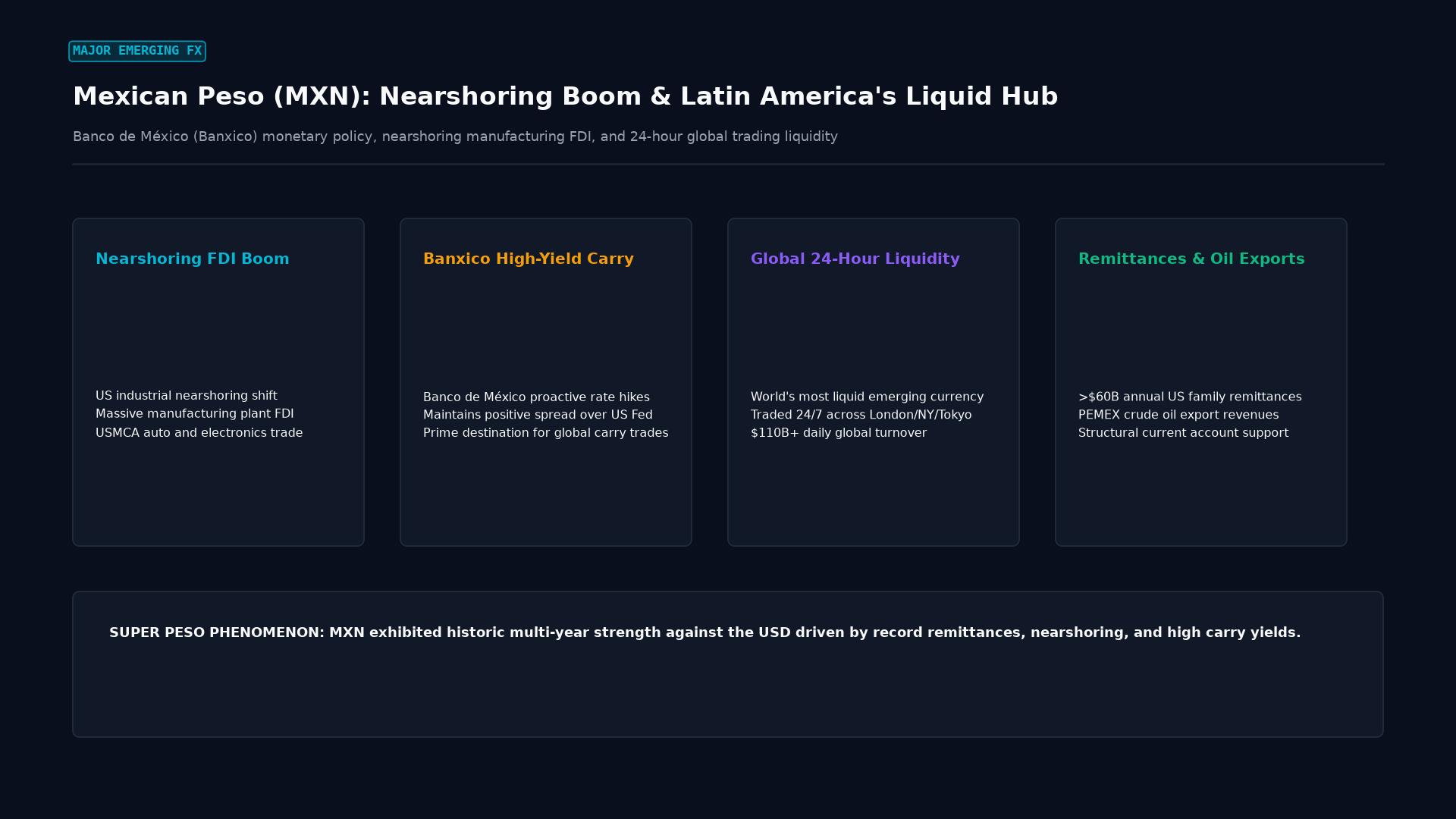 Figure: Banco de México (Banxico) monetary policy, nearshoring manufacturing FDI, and 24-hour global trading liquidity
Historical Origins and the Lineage of the Global Dollar Sign
The Spanish Empire and the “Piece of Eight”
The Mexican Peso possesses an extraordinary historical heritage that shaped modern global commerce. Following the Spanish conquest, the Mexico City Mint (Casa de Moneda de México) was established in 1535, making it the oldest operating mint in the Americas.
The mint struck the iconic silver Real de a Ocho (Spanish Eight-Real coin, or “Spanish Dollar”), minted from immense silver deposits extracted from Zacatecas and Guanajuato. Because of its strictly guaranteed weight and silver purity (0.903 fineness), the Mexican silver dollar became the world’s first global currency:
- It was accepted as legal tender across the Americas, Europe, and Asia.
- In China and the East Indies, merchants stamped the coins with distinctive “chop marks” to verify authenticity.
- In the early United States, the Spanish/Mexican silver dollar served as official legal tender under the Coinage Act of 1792 until the passage of the Coinage Act of 1857.
- The typographical symbol $ originated from the handwritten abbreviation of the Mexican peso (ps) and the Pillars of Hercules banner depicted on the Spanish-Mexican colonial silver coinage.
                    HISTORICAL LINEAGE OF THE PESO AND THE "$"

  1535 - 1821                  1792 - 1857               1993 - Present
  +-----------------------+    +--------------------+    +-----------------------+
  | Mexican Real de Ocho  | => | US Legal Tender    | => | Modern MXN            |
  | (Casa de Moneda)      |    | Inspired US Dollar |    | Free-Floating Global  |
  | Origin of "$" Symbol  |    | Currency System    |    | Emerging Market Anchor|
  +-----------------------+    +--------------------+    +-----------------------+
The 1993 Redenomination (Nuevo Peso)
Throughout the 1970s and 1980s, Mexico suffered severe macroeconomic instability, marked by the 1982 sovereign debt default, nationalization of commercial banks, and triple-digit inflation. By the early 1990s, the exchange rate had deteriorated to over 3,000 old pesos (MXP) per US Dollar.
On January 1, 1993, the Mexican government executed a structural currency redenomination:
- Three zeros were stripped from the currency.
- The Nuevo Peso (ISO code MXN) was introduced at a ratio of: $$1 \text{ MXN (Nuevo Peso)} = 1,000 \text{ MXP (Old Peso)}$$
- In 1996, the modifying word “Nuevo” was officially dropped from banknotes, restoring the traditional name Peso.
The 1994 Tequila Crisis and Free Float Transition
In 1994, Mexico entered into the North American Free Trade Agreement (NAFTA) and granted constitutional autonomy to Banco de México. However, political assassinations and growing current account deficits triggered massive capital flight.
The government had financed short-term debt using dollar-indexed treasury bills known as Tesobonos. When foreign investors refused to roll over maturing Tesobonos, Banxico exhausted its foreign exchange reserves attempting to defend an artificial crawling peg exchange band.
In December 1994, the newly inaugurated administration of President Ernesto Zedillo was forced to abandon the band, triggering the Tequila Crisis:
- The peso collapsed by over 50% within days.
- Mexico avoided sovereign default only through a historic $50 billion international rescue package coordinated by US Treasury Secretary Robert Rubin and the IMF.
- Following the crisis, Banxico adopted a permanent free-floating exchange rate regime and a disciplined inflation-targeting framework, which have governed Mexican monetary architecture ever since.
Macroeconomic Fundamentals: Nearshoring and Structural Drivers
The Mexican economy has evolved from a state-dominated petro-state in the twentieth century into an open, highly industrialized manufacturing powerhouse integrated into the North American supply chain:
                THE MODERN BALANCE OF PAYMENTS PILLARS FOR MXN

  +-------------------------------------------------------------------------+
  |                             INCOMING CAPITAL FLOWS                      |
  +--------------------+--------------------+-------------------------------+
                       |                    |
                       v                    v
  +--------------------+--+  +--------------+----+  +-----------------------+
  | Advanced Manufacturing|  | Diaspora Worker   |  | Institutional         |
  | & Nearshoring FDI     |  | Remittances       |  | Carry Trade Inflows   |
  +-----------------------+  +-------------------+  +-----------------------+
  | - Auto & EV Clusters  |  | - Exceeds $60B/yr |  | - Banxico-Fed Spread  |
  | - Aerospace & Medical |  | - Direct household|  | - High nominal TIIE   |
  | - USMCA Rules of Orig.|  |   spending support|  | - Deep 24-hr market   |
  +-----------------------+  +-------------------+  +-----------------------+
1. The Nearshoring Boom and USMCA Integration
Under the United States-Mexico-Canada Agreement (USMCA), Mexico overtook China to become the single largest trading partner of the United States. Geopolitical realignments, rising trans-Pacific shipping costs, and strict USMCA automotive rules of origin (requiring 75% North American regional value content) have accelerated the nearshoring megatrend:
- Multinational industrial conglomerates (such as Tesla, BMW, Foxconn, and Whirlpool) are relocating advanced production facilities to northern and central Mexico (Monterrey, Saltillo, Querétaro, and the Bajío corridor).
- Record Foreign Direct Investment (FDI) inflows generate sustained structural commercial demand for MXN to fund capital equipment purchases, industrial real estate construction, and local payrolls.
2. High-Yield Carry Trade and Banxico Independence
Banco de México enjoys constitutional autonomy, tasking it with a single statutory mandate: preserving the domestic purchasing power of the Mexican currency.
Historically, Banxico has maintained a proactive monetary policy stance, frequently initiating interest rate tightening cycles months ahead of the US Federal Reserve. Banxico’s target rate, the Overnight Interbank Funding Rate (linked to the 28-day TIIE, or Tasa de Interés Interbancaria de Equilibrio), has consistently offered a substantial spread over the US Federal Funds Target Rate: $$\text{Policy Rate Spread} = \text{Banxico Overnight Rate} - \text{US Fed Funds Rate} \approx 500 \text{ to } 600 \text{ bps}$$
This wide, credible interest rate premium attracts immense volumes of global institutional capital seeking carry trade returns (borrowing in low-yielding currencies such as the Japanese Yen or Swiss Franc to invest in high-yielding Mexican sovereign CETES bonds). This dynamic drove the historic appreciation of the currency in 2022–2023, widely termed by financial markets as the “Super Peso.”
3. Record Diaspora Remittances
Mexico receives over $60 billion annually in cross-border remittances sent by Mexican citizens working abroad, predominantly in the United States. Transferred directly via electronic wire networks into Mexican retail bank accounts and specialized retail chains, these non-debt-creating hard-currency inflows provide continuous, countercyclical support to household consumption and the national balance of payments.
Trading Microstructure of the Mexican Peso
The Mexican Peso is distinct among emerging market currencies due to its extraordinary global liquidity and continuous 24-hour trading depth:
+------------------------+--------------------------------------------------+
| Market Dimension       | MXN Operational Feature                          |
+------------------------+--------------------------------------------------+
| Primary Currency Pair  | USD/MXN (Quoted as Mexican Pesos per 1 US Dollar)|
| Secondary Pairs        | EUR/MXN, GBP/MXN, MXN/JPY (Retail carry trade)   |
| Liquidity Window       | 24 Hours continuous (London, NY, and Tokyo)     |
| Exchange-Traded Volume | CME Mexican Peso Futures (Code: 6M) & Options    |
| Standard Lot Size      | 500,000 MXN per CME futures contract             |
| Onshore Money Market   | CETES (Certificados de la Tesorería de la        |
|                        | Federación, zero-coupon sovereign bills)         |
| Settlement Standard    | Spot T+2 (Standard interbank clearing)           |
+------------------------+--------------------------------------------------+
1. Quotation Mechanics (USD/MXN)
In foreign exchange markets, the peso is quoted directly against the US Dollar as USD/MXN:
- A quote of
USD/MXN = 18.00means that 18.00 Mexican pesos purchase one US Dollar. - If the rate moves from
18.00to19.50, the peso has depreciated (it takes more pesos to acquire one dollar). - If the rate declines from
18.00to16.80, the peso has appreciated (strengthened).
2. The Global EM Proxy Hedge
Because the Mexican Peso is fully convertible, lacks capital controls, and trades with tight bid-ask spreads around the clock, global hedge funds, sovereign wealth managers, and institutional asset allocators frequently utilize USD/MXN as a liquid proxy hedge for general emerging market risk:
- During sudden geopolitical crises or broad emerging market panics (even those centered in Eastern Europe or Asia), macro funds often sell MXN short because it can be liquidated instantly in massive size without incurring catastrophic market impact costs.
- As a consequence, MXN often displays higher realized volatility during global risk-off shocks than its underlying domestic macroeconomic fundamentals would warrant.
Sovereign Debt Architecture and the CETES Market
Mexico possesses one of the deepest local-currency sovereign debt markets in the developing world, governed by the Ministry of Finance (Secretaría de Hacienda y Crédito Público, SHCP):
- CETES (Certificados de la Tesorería): Zero-coupon treasury bills issued across maturities of 28, 91, 182, 364, and 728 days. CETES are auctioned weekly, providing the baseline risk-free yield curve for the domestic banking sector.
- Bonos M (Bonos de Desarrollo del Gobierno Federal con Tasa de Interés Fija): Fixed-rate government bonds with maturities extending to 3, 5, 10, 20, and 30 years. Foreign institutional investors hold substantial allocations of Bonos M, which are fully integrated into global benchmark bond indices (such as the JPMorgan GBI-EM Global Diversified Index).
- Udibonos (Bonos de Desarrollo en UDIS): Inflation-linked bonds indexed to the UDI (Unidad de Inversión, an administrative unit of account reflecting the daily National Consumer Price Index), providing institutional pension funds (AFOREs) with a structural inflation hedge.
Best Practices for Trading and Hedging MXN
- Monitor the Banxico-Federal Reserve Policy Differential: The single most reliable quantitative driver of medium-term USD/MXN directional trend is the policy spread between Banxico’s overnight target and the US Fed Funds rate. A compression of this spread typically triggers carry trade unwinds, while a widening spread supports the peso.
- Account for Political and Electoral Risk Cycles: Mexican markets are sensitive to domestic and US election cycles. Shifts in trade policy, threats of US tariff impositions under USMCA review clauses, or proposed domestic constitutional reforms regarding regulatory agencies can trigger sharp spikes in implied options volatility.
- Analyze PEMEX Financial Health: While Mexico’s federal government maintains low fiscal deficits, the state oil company, Petróleos Mexicanos (PEMEX), is one of the world’s most indebted oil corporations. Substantial sovereign transfers to service PEMEX debt can expand public sector borrowing requirements, impacting sovereign credit default swap (CDS) spreads.
- Utilize CME 6M Futures for Cost-Effective Hedging: Corporate treasurers and algorithmic traders should leverage CME Mexican Peso futures contracts (ticker:
6M), which trade in standard lot sizes of 500,000 MXN. CME futures eliminate bilateral counterparty risk and offer tight bid-ask spreads across monthly and quarterly tenors.
Frequently Asked Questions (FAQ)
What is the meaning of the symbol “$” when used with Mexican currency?
The “$” symbol represents the Mexican Peso and was used in Mexico centuries before the United States established the US Dollar. The symbol originated from the Spanish-Mexican colonial silver real de a ocho, where financial clerks abbreviated the word “pesos” as “ps,” which eventually evolved into a “P” superimposed over an “S.” The US Dollar adopted the identical symbol when it established its currency system based on the Mexican silver dollar in the late eighteenth century.
What is the “Carry Trade,” and why does it frequently target the Mexican Peso?
The carry trade is an investment strategy where a market participant borrows capital in a currency with low interest rates (such as the Japanese Yen or Swiss Franc) and invests that capital in a currency offering significantly higher yields. The Mexican Peso is a prime destination for carry trades because Banco de México maintains high benchmark interest rates to combat inflation, while the country offers free capital mobility, deep market liquidity, and an investment-grade sovereign credit rating.
Why is the Mexican Peso considered a “proxy currency” for global emerging markets?
Because the Mexican Peso is fully convertible, lacks cross-border capital restrictions, and trades continuously 24 hours a day on global exchanges with tight spreads, institutional investors use it to manage broad risk. When an unexpected economic shock or market panic hits emerging markets, fund managers who hold illiquid assets in other developing countries will often sell the Mexican Peso to quickly hedge their overall portfolio risk, making the peso a barometer for global investor sentiment.
Ready to trade forex?
Open a free demo account with a regulated broker. Practice with virtual funds before risking real money.