Carry Trade
A carry trade is a forex strategy where a trader borrows in a low-interest-rate currency and invests in a higher-yielding one, profiting from the interest rate differential (the 'carry'). It is one of the most widely used strategies by hedge funds and institutional traders.
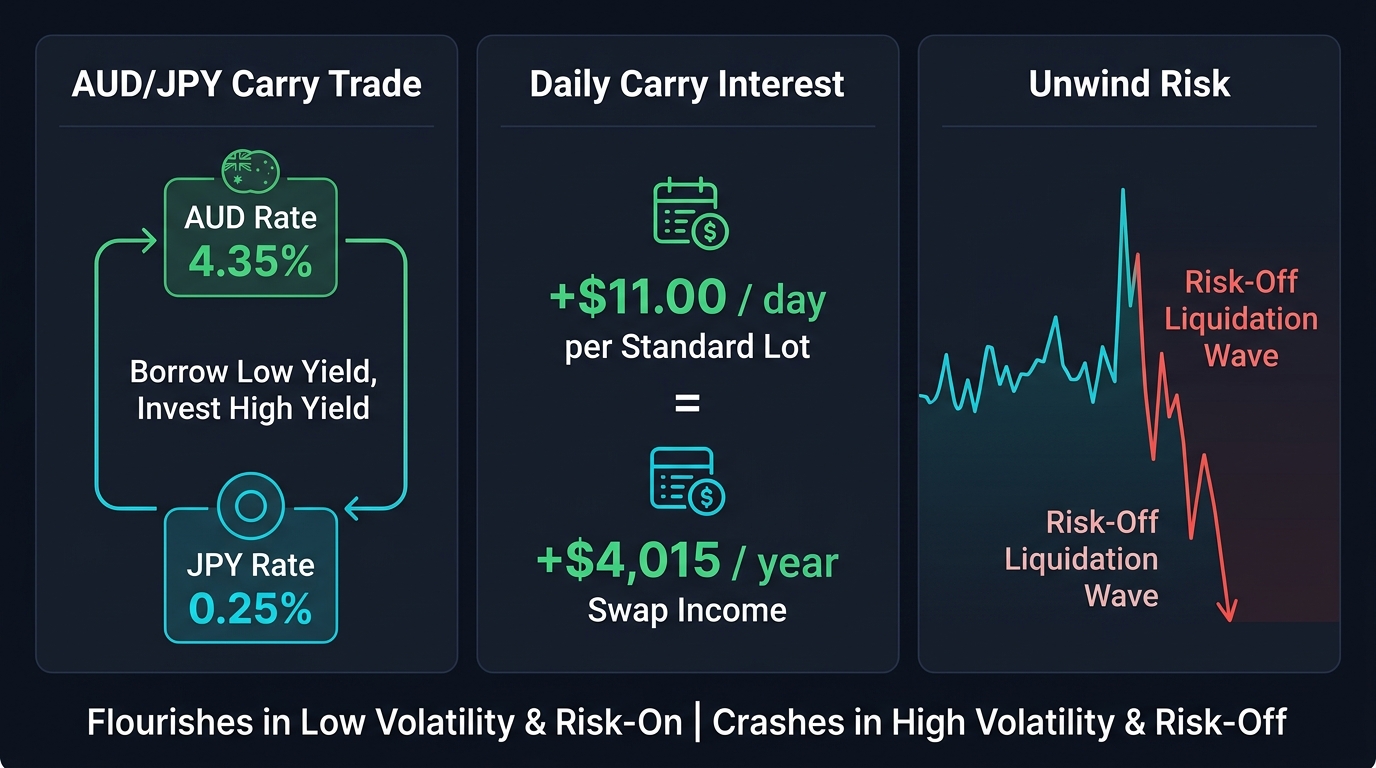
What Is a Carry Trade?
The carry trade is built on a simple premise: money flows toward yield. If you can borrow cheaply in one currency and earn a higher return by holding another, you pocket the difference every day the position stays open. It sounds elegant. And it is — until it isn’t.
At its core, a carry trade involves two simultaneous actions: selling (borrowing) a low-interest-rate currency and buying (investing in) a high-interest-rate currency. The profit comes from the daily interest differential, known as the rollover or swap rate, credited to your account each night the position remains open.
The Classic Example: AUD/JPY
The most famous carry trade pair has historically been AUD/JPY (Australian dollar vs. Japanese yen). Japan’s central bank, the Bank of Japan (BOJ), maintained near-zero or negative interest rates for over a decade. Australia’s Reserve Bank, by contrast, kept rates significantly higher — sometimes 4–5% — driven by commodity cycles and a growing economy.
A trader going long AUD/JPY in this environment:
- Borrows Japanese yen at near 0% interest
- Invests in Australian dollars at 4–5% interest
- Earns the differential (~4–5% annualized, paid daily as a swap credit)
On a standard lot ($100,000 equivalent), 4% annual carry translates to roughly $11 per day in swap credits. That’s free money — if the exchange rate cooperates.
How the Rollover Works in Practice
In forex, the interest rate differential shows up as the overnight swap rate, calculated by your broker and applied to any position held past the daily rollover cutoff (typically 5:00 PM New York time).
If you’re long the higher-yielding currency, you receive a credit. If you’re short it, you pay a debit. Brokers add a small markup to the interbank swap rate, so the rate you receive is slightly less favorable than the raw differential.
The calculation: Swap Rate = (Interest Rate Differential − Broker Markup) × Position Size × (1/365)
During periods of high interest rate divergence, swap income can become a meaningful component of total returns. Some traders specifically structure portfolios around this — holding multiple carry pairs to diversify the interest income stream.
Why Carry Trades Unwind Violently
Carry trades have a well-documented failure mode: they work steadily for months or years, then collapse suddenly. The 2008 financial crisis is the canonical example. AUD/JPY fell from 104.00 in July 2007 to 55.50 in October 2008 — a 47% collapse in 15 months, wiping out years of carry income in weeks.
The mechanism is straightforward. During risk-off episodes — recessions, financial crises, geopolitical shocks — investors rush back to “safe haven” currencies. The yen, despite having low rates, is a traditional safe haven. When global risk sentiment sours, yen demand surges, AUD/JPY falls, and all the traders who were long the carry trade suddenly face losses that dwarf their accumulated interest income. They sell in a panic, which accelerates the move.
This correlation between carry trades and global risk appetite means carry positions can suffer during any broad market selloff, even unrelated to the specific currencies you’re trading.
Carry Trades in a Higher-Rate World
The post-2022 rate hiking cycle shifted carry trade dynamics significantly. With the US Federal Reserve raising rates to 5.25–5.50% and many developed market central banks following, the dollar became an attractive carry currency against low-yielding alternatives. USD/JPY became the dominant carry pair, reaching 34-year highs above 160.00 in 2024 as the interest rate differential between the US and Japan exceeded 5 percentage points.
The subsequent BOJ rate hike in mid-2024 triggered a sharp carry trade unwind — USD/JPY fell nearly 15 big figures in weeks as the yen surged and leveraged carry positions were forcibly closed.
Managing Carry Trade Risk
Professional carry traders treat the interest income as supplementary — not the primary reason for the position. They use technical analysis to time entries, maintain disciplined stop-losses, and size positions conservatively to survive the drawdowns that periodically hit the strategy.
Two rules most experienced carry traders follow: never hold a large carry position into a major central bank announcement (rate surprises can cause immediate 200–400 pip gaps), and keep overall carry exposure diversified across multiple pairs rather than concentrated in a single position.
Key Takeaways
- Carry trades profit from interest rate differentials between two currencies, earned as daily swap credits
- Classic pairs: AUD/JPY (historical), USD/JPY (post-2022 cycle)
- The strategy works during risk-on periods and fails sharply during financial stress
- Carry income should be treated as a bonus, not the core rationale for a trade
FAQ
How do I know if a carry trade will be profitable? The interest differential must exceed the cost of carry (broker spread on entry, markup on swap rate) and the expected adverse price movement. High-carry pairs often have wider spreads and higher volatility — factor those into your calculation.
Can carry trades be applied to any currency pair? Technically yes, but the strategy only makes economic sense when there’s a meaningful interest rate differential. Pairs with similar rates offer negligible carry income that won’t compensate for transaction costs and currency risk.
Ready to trade forex?
Open a free demo account with a regulated broker. Practice with virtual funds before risking real money.