Negative Carry Pair
A negative carry pair is a currency pair position where the interest rate paid to borrow the short currency exceeds the interest rate earned on the long currency, resulting in a continuous net financing debit (negative rollover swap) charged to the trader's account.
What Is a Negative Carry Pair?
In foreign exchange (Forex) trading, a negative carry pair refers to an open position in a currency pair where the interest rate differential between the two currencies works against the trader. Whenever a spot forex position is held overnight past the daily 5:00 PM Eastern Standard Time (EST) interbank rollover cutoff, the trader is mathematically borrowing one currency to buy another.
If the interest rate on the currency being borrowed (short currency) is higher than the interest rate paid on the currency being purchased (long currency), the trader incurs a net interest expense known as negative carry. This financing cost is debited directly from the trading account’s cash balance as a negative rollover swap or financing charge.
While retail traders generally seek positive carry trades to collect daily interest, institutional macro funds and quantitative trend-followers frequently hold negative carry pairs intentionally when they anticipate that capital appreciation from a powerful directional trend will far exceed the daily drag of financing fees.
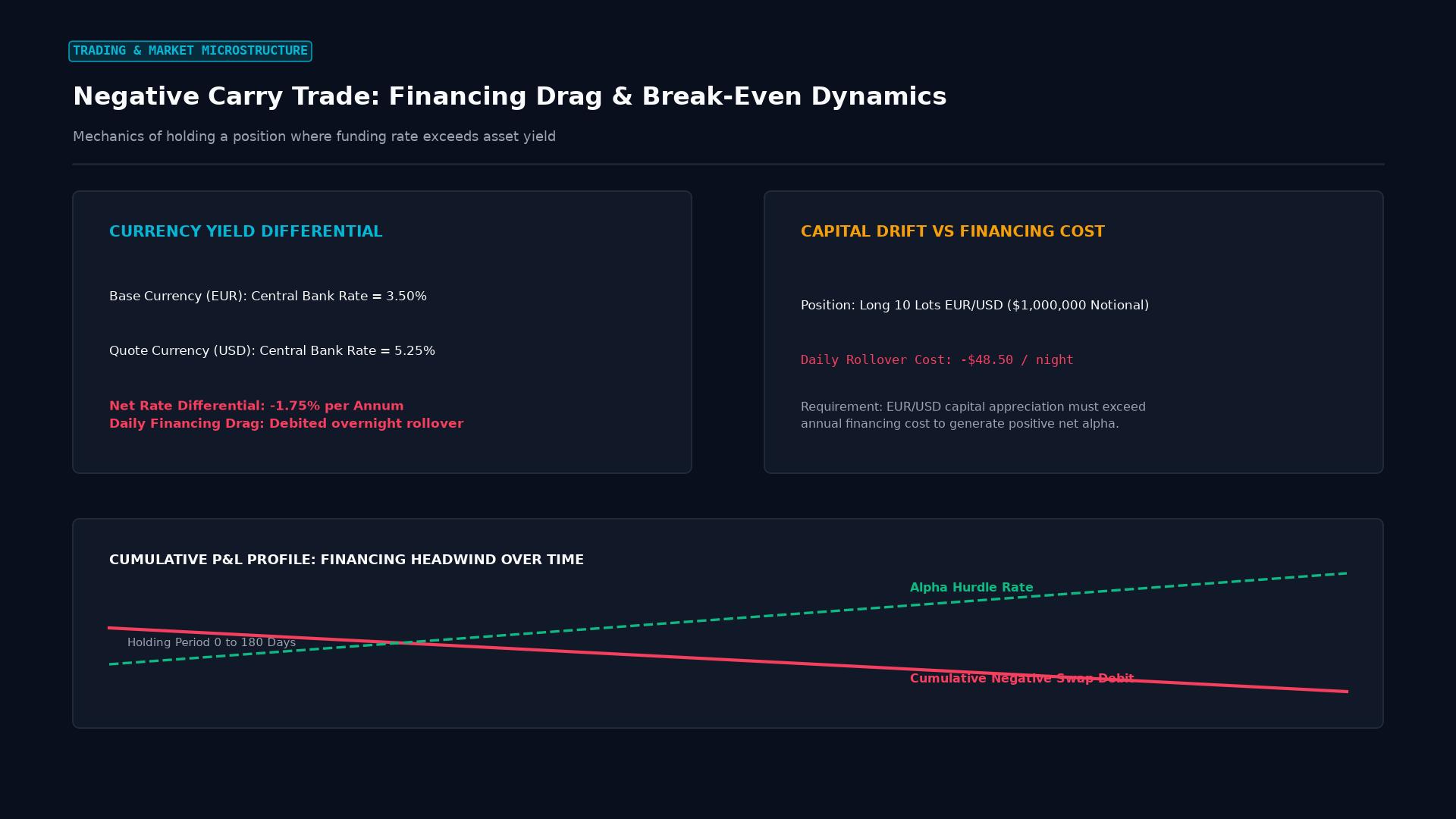 Figure: Financing drag mechanics: holding a position where funding costs exceed asset yields, requiring continuous capital gains to achieve breakeven.
Key Takeaways
- The Reverse Carry Trade: Holding a negative carry pair is the exact inverse of a classic carry trade; time works as an enemy rather than an ally.
- The Hurdle Rate Requirement: Any trade held with negative carry must generate sufficient capital appreciation to overcome the hurdle rate imposed by daily financing debits.
- Triple-Swap Acceleration: On Wednesday evenings (at 5:00 PM EST), positions with negative carry are debited three times the standard daily swap fee to cover Saturday and Sunday weekend settlement.
- Institutional Justifications: Professional traders accept negative carry under three conditions: powerful momentum trends, safe-haven tail-risk hedging, or exploiting structural central bank policy divergence.
- Margin Account Erosion: In low-volatility or consolidating markets, holding a high negative carry pair steadily drains account equity, increasing the effective leverage of the position and elevating stop-out risks.
Comparative Taxonomy: Carry Regimes in Forex
| Carry Classification | Interest Differential Condition | Daily Rollover Impact | Primary Objective | Strategic Risks |
|---|---|---|---|---|
| Positive Carry | Earned Rate > Borrowed Rate | Cash Credited to account | Long-term yield capture + trend | Sudden unwind panics / flash crashes |
| Negative Carry | Borrowed Rate > Earned Rate | Cash Debited from account | Strong capital gains / Macro hedges | Time decay in range-bound markets |
| Neutral Carry | Earned Rate $\approx$ Borrowed Rate | Minimal fee / Broker markup only | Pure directional speculation | Broker spread expansion at rollover |
The Mathematics of Negative Carry Calculation
In spot forex, daily rollover swaps are computed using the interbank Tomorrow-Next (Tom-Next) rate adjusted for commercial broker markups:
$$\text{Daily Swap Debit} = \text{Notional Volume} \times \frac{(r_{\text{borrowed}} - r_{\text{earned}}) + \text{Broker Markup}}{360} \times \text{Spot Rate}$$
Numerical Calculation Example:
A trader opens a 1.00 Standard Lot Short USD/JPY position ($100,000 notional) at an exchange rate of 155.00:
- Short Currency: USD (Borrowing cost = 5.25% per annum).
- Long Currency: JPY (Deposit yield = 0.25% per annum).
- Broker Financing Markup: 0.75% per annum.
- Total Net Annualized Financing Cost: $(5.25% - 0.25%) + 0.75% = \mathbf{5.75%}$.
$$\text{Daily Negative Carry Cost} = \frac{$100,000 \times 0.0575}{360} = \mathbf{$15.97 \text{ per day}}$$
- Monthly Cost (30 Days): $$15.97 \times 30 = \mathbf{$479.10}$.
- Annualized Cost (365 Days): $$15.97 \times 365 = \mathbf{$5,829.05}$.
Across one year, the trader loses over $5,800 (equivalent to 580 pips on a standard lot) solely in financing fees. Unless USD/JPY falls by more than 5.8% during that timeframe, the trade mathematically operates at a net loss.
Real-World Case Study: Shorting USD/JPY in the 2022–2024 Fed Tightening Cycle
Between 2022 and 2024, the widening interest rate chasm between the hawkish U.S. Federal Reserve (rates at 5.25%–5.50%) and the dovish Bank of Japan (rates at -0.10% to 0.10%) created the most aggressive negative carry environment in modern foreign exchange:
- The Speculative Impulse: Many retail contrarian traders repeatedly attempted to pick the absolute top of the USD/JPY rally, shorting the pair at 130.00, 140.00, and 150.00.
- The Carry Trap: Because the Fed funds rate exceeded BOJ rates by over 500 basis points, short USD/JPY positions suffered massive negative carry debits every single afternoon.
- The Grinding Loss: When USD/JPY consolidated sideways for weeks at a time (e.g., between 148.00 and 151.00 in late 2023), short sellers saw their account equity steadily depleted by daily swap fees.
- The Stop-Out Cascade: When U.S. economic data surprised to the upside, pushing USD/JPY to 160.00 in April 2024, undercapitalized short-sellers whose margin buffers had already been eroded by months of negative carry were forcibly liquidated via automated stop-outs.
When Is Holding a Negative Carry Pair Justified?
- High-Velocity Breakouts: If technical or macro triggers indicate an imminent 300-pip downward collapse over 48 hours, paying two days of negative carry ($30) to capture $3,000 in directional capital gains is entirely logical.
- Crisis Tail-Risk Hedging: Global macro hedge funds frequently hold long Swiss Franc (CHF) or Japanese Yen (JPY) positions against high-yielding emerging market currencies as an insurance policy against global equity crashes, accepting negative carry as an insurance premium.
- Anticipating Central Bank Pivots: Entering a negative carry trade weeks before an anticipated central bank rate cut cycle can secure prime structural entry prices before the broader market shifts.
Tactical Risk Management for Negative Carry Trades
- Limit Holding Horizons: Never hold a negative carry trade as a passive, open-ended swing position in a sideways market; establish a strict time-stop (e.g., exit if price does not break out within 5 trading days).
- Beware of Wednesday Rollovers: If you intend to take profits on an intraday short trade with negative carry, close the position before 4:59 PM EST on Wednesday to avoid being debited triple swap fees.
- Size Down to Preserve Margin: Compensate for ongoing financing debits by reducing lot sizes, ensuring that daily swap deductions do not push your Margin Level below 500%.
Frequently Asked Questions (FAQ)
Can a negative carry pair turn into a positive carry pair?
Yes. If the central bank of the currency you are long hikes interest rates while the central bank of the currency you are borrowing cuts rates, the net interest rate differential can flip. Once the earned rate exceeds the borrowed rate, your daily rollover swap transitions from a debit to a credit.
Do day traders have to worry about negative carry?
No. Carry swaps are applied exclusively to positions held open across the daily 5:00 PM EST market close. If you open and close a trade within the same trading session (an intraday position), zero swap fees are charged or credited.
Where can I check the exact negative carry swap rate for a pair?
In MetaTrader 4 or 5, right-click any currency pair in the Market Watch window, select “Specification”, and look for “Swap Long” and “Swap Short”. The values indicate the exact swap points credited or debited per lot at the 5:00 PM EST rollover.
Ready to trade forex?
Open a free demo account with a regulated broker. Practice with virtual funds before risking real money.