Swap
A swap is a derivative contract in which two counterparties agree to exchange streams of cash flows, interest payments, or currencies over a designated period according to pre-established contractual terms.
A swap is a bilateral over-the-counter (OTC) derivative agreement where two financial counterparties commit to exchange a series of cash flows over an agreed schedule. Swaps are the single largest derivative class in global finance, with hundreds of trillions of dollars in notional value outstanding.
In currency markets, the term “swap” appears in two distinct contexts:
- Institutional Foreign Exchange Swaps (FX Swaps): High-volume institutional transactions that combine a simultaneous spot currency exchange with an offsetting forward contract to manage cross-border corporate liquidity.
- Retail Rollover Swaps: Daily financing debits or credits applied to retail trading accounts when leveraged spot positions are held overnight past 5:00 PM Eastern Standard Time.
The Three Primary Varieties of Financial Swaps
Financial institutions utilize distinct swap architectures depending on their risk management and financing requirements:
| Swap Type | What is Exchanged | Primary Counterparties | Core Economic Objective |
|---|---|---|---|
| FX Swap (Forex Swap) | Spot exchange of two currencies paired with an opposite forward exchange | Commercial banks, multinational corporations, central banks | Raising foreign currency liquidity without taking directional currency risk |
| Interest Rate Swap (IRS) | Fixed interest rate payments exchanged for floating interest rate payments (e.g., SOFR, EURIBOR) | Banks, pension funds, government treasuries, real estate trusts | Hedging against rising interest rates or locking in fixed debt servicing |
| Cross-Currency Basis Swap | Periodic interest payments and principal amounts in two entirely different currencies | Global investment banks, sovereign funds | Long-term cross-border funding and debt restructuring |
How an Institutional FX Swap Operates
According to the Bank for International Settlements (BIS), FX swaps account for more than $3.8 trillion in daily turnover—more than 50% of the entire global foreign exchange market.
An institutional FX swap consists of two linked transactions executed simultaneously with the same counterparty:
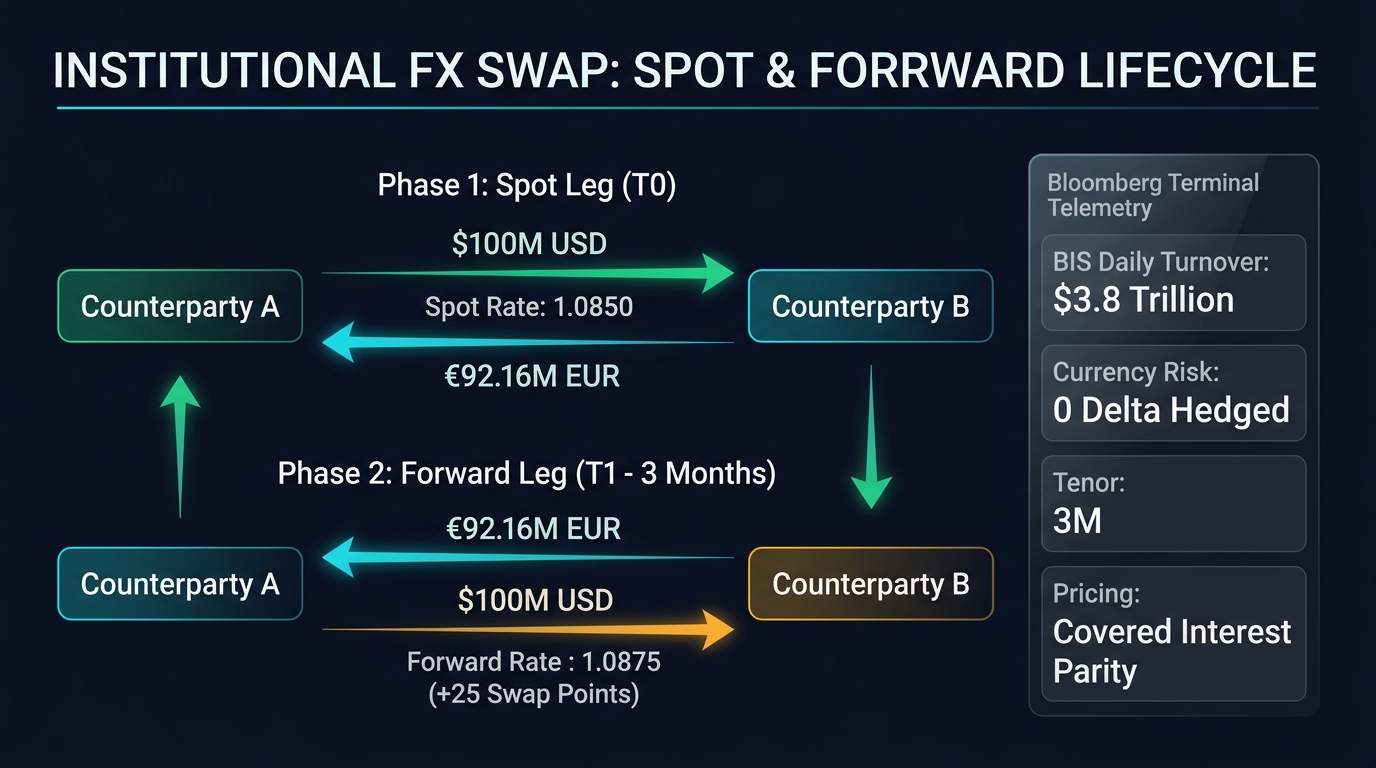
T0 (Today - Spot Leg):
Counterparty A sells $100M USD at spot (1.0850) ───► Counterparty B
Counterparty A receives €92.16M EUR             ◄─── Counterparty B

T1 (3 Months Later - Forward Leg):
Counterparty A repurchases $100M USD at forward (1.0875) ◄─── Counterparty B
Counterparty A returns €92.16M EUR ───► Counterparty B- The Spot Leg: A multinational corporation holding excess U.S. dollars sells $100 million USD to an investment bank at the spot exchange rate (1.0850), receiving €92.16 million euros to finance European factory operations today.
- The Forward Leg: At the exact same moment, both parties sign a forward contract to reverse the exchange three months later at a predetermined forward rate (1.0875).
- The Strategic Advantage: The corporation secured the euros it needed for three months without taking on directional currency risk. Because the repurchase rate is locked in at inception, fluctuations in the spot EUR/USD exchange rate over those 90 days have zero impact on the firm.
Retail Rollover Swaps: Positive vs. Negative Carry
In retail forex trading, a rollover swap is the daily interest adjustment applied to leveraged positions held past the end of the trading session (5:00 PM EST):
$$\text{Rollover Swap Rate} = \text{Interest Rate}{\text{Bought Currency}} - \text{Interest Rate}{\text{Sold Currency}} - \text{Broker Markup}$$
- Positive Carry (Credit): When you buy a currency with a high central bank interest rate (e.g., USD at 5.25%) by selling a currency with a low interest rate (e.g., JPY at 0.10%), you earn a daily net interest credit.
- Negative Carry (Debit): When you short the high-yielding currency and hold the low-yielding one, your account is charged an overnight financing fee.
- The Broker Markup: Because retail brokerages apply a financing spread or markup to both sides of the calculation, swaps on currency pairs with narrow interest rate differentials are often slightly negative for both long and short positions.
Practical Example: A Corporate Cross-Border Swap
Consider a European automotive manufacturer issuing bonds in the United States:
- The Financing Opportunity: Because the U.S. corporate bond market is vast, the European automaker can issue $500 million in USD-denominated 5-year bonds at an attractive interest rate of 4.5%.
- The Currency Mismatch: The company builds its electric vehicles in Germany; it needs euros, not dollars, and earning euro revenues to pay back dollar debt exposes the firm to severe currency risk if the USD appreciates.
- The Swap Solution: The automaker enters into a 5-year cross-currency swap with an investment bank:
- The automaker hands over the $500 million USD to the bank and receives the equivalent in euros (€460 million).
- Over the 5-year life of the bond, the bank pays the USD interest payments due to U.S. bondholders, while the automaker pays the bank in euros at a negotiated European rate.
- At maturity, the currencies are swapped back at the original parity.
- Result: The automaker obtained low-cost financing from the U.S. capital market with zero foreign exchange or interest rate risk.
Key Takeaways
- Cash Flow Exchange: A swap is an over-the-counter derivative contract exchanging financial obligations, interest payments, or currencies between counterparties.
- Dominant Forex Instrument: Institutional FX swaps process over $3.8 trillion daily, serving as the primary vehicle for short-term corporate liquidity.
- Two-Legged Structure: FX swaps combine a spot trade today with a pre-arranged offsetting forward trade in the future to eliminate exchange rate risk.
- Retail Financing Metric: In retail trading, swaps represent the daily overnight cost of carry reflecting central bank interest rate differentials.
- Hedging Versatility: Swaps allow global corporations to borrow in foreign capital markets without exposing balance sheets to currency fluctuations.
Frequently Asked Questions
Why do retail forex brokers charge triple swaps on Wednesdays?
Spot forex trades take two business days to settle (T+2). Positions held over Wednesday night roll into the following week, bridging across Saturday and Sunday when commercial interbank payment networks are closed. To account for the two weekend days, brokers apply three days of interest on Wednesday nights.
Is an FX swap the same as a cross-currency basis swap?
No. An FX swap is typically a short-term transaction (under one year) with no interim interest payments—only the spot exchange and the forward re-exchange. A cross-currency basis swap is a multi-year structural transaction where counterparties exchange regular quarterly or semiannual interest payments in different currencies alongside the principal.
Can I avoid paying swap fees in forex trading?
Yes. You can avoid swap fees by closing all open positions before the daily 5:00 PM EST market rollover (day trading). Alternatively, many brokers offer Islamic (Swap-Free) Accounts that comply with Sharia law by replacing overnight interest with fixed administrative holding fees.
Ready to trade forex?
Open a free demo account with a regulated broker. Practice with virtual funds before risking real money.