Net Asset Value (NAV)
Net Asset Value (NAV) is the net monetary value of an investment fund, trading account, or portfolio, calculated by subtracting total liabilities from total market assets, frequently expressed on a per-share basis.
What Is Net Asset Value (NAV)?
Net Asset Value (NAV) is the definitive valuation metric used across investment funds, hedge funds, exchange-traded funds (ETFs), and corporate balance sheets. In its simplest form, NAV represents the pure, net liquidation value of an entity—the cash that would theoretically remain if all holdings were sold at fair market value and all outstanding debts and operational obligations were settled:
$$\text{Net Asset Value (NAV)} = \text{Total Market Assets} - \text{Total Liabilities}$$
When applied to collective investment schemes—such as mutual funds, unit trusts, and alternative investment funds—NAV is almost universally expressed as NAV per Share (or per Unit). This figure dictates the exact transaction price at which new investors can deposit capital into the fund (subscription) or existing investors can withdraw their capital (redemption).
In foreign exchange (Forex) hedge funds and multi-account management structures (such as PAMM and MAM accounts), NAV functions as the master accounting metric: it aggregates cash balances, marks all open floating currency trades to market in real time, and deducts accrued financing swaps, broker commissions, and manager performance fees to establish the true, unencumbered value of client equity.
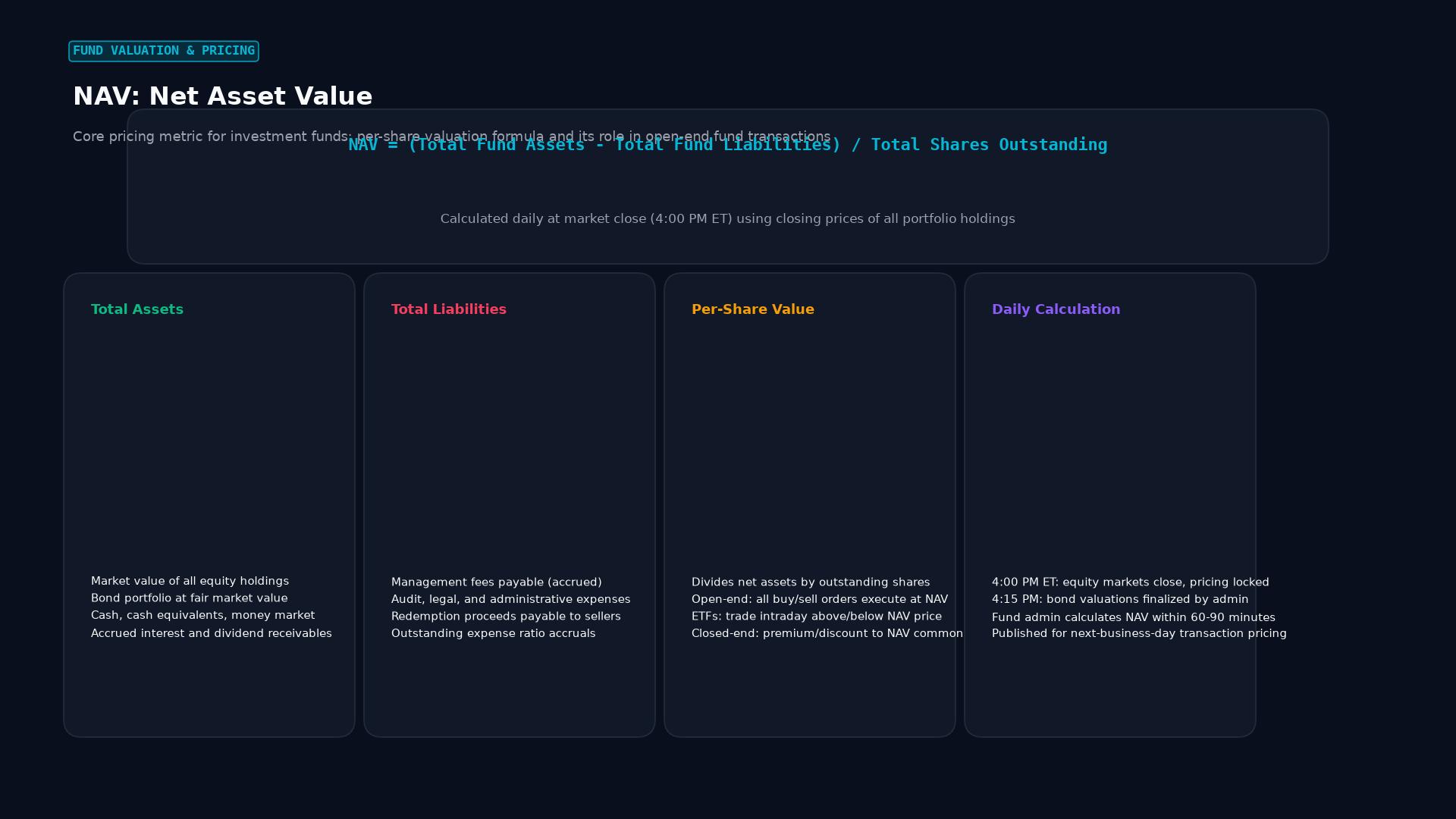 Figure: Core pricing metric for investment funds: per-share valuation formula and its role in open-end fund transactions
Key Takeaways
- The Fair Value Benchmark: NAV reflects the true, mark-to-market economic net worth of an investment vehicle after deducting all operational costs and leverage liabilities.
- The Execution Price for Mutual Funds: Open-end mutual funds execute investor subscriptions and redemptions exclusively at the daily official NAV per share calculated after the 4:00 PM EST market close.
- ETF Premiums and Discounts: While mutual funds trade strictly at NAV, Exchange-Traded Funds (ETFs) trade continuously on secondary stock exchanges, where market supply and demand can cause the ETF share price to trade at a slight premium (above NAV) or discount (below NAV).
- Core of Hedge Fund Reporting: Professional hedge funds calculate NAV monthly or weekly through an independent fund administrator (such as Citco or BNY Mellon) to verify high-water marks and distribute performance fees.
- Real-Time PAMM Tracking: In retail forex, PAMM broker servers recompute account NAV tick-by-tick to determine real-time equity splits across participating investors.
Comparative Taxonomy: NAV Across Investment Vehicles
| Vehicle Structure | Pricing Mechanism | Frequency of Calculation | Trading vs. NAV | Arbitrage Mechanism |
|---|---|---|---|---|
| Open-End Mutual Fund | Transacts strictly at NAV per share | Once daily (at market close) | Identical to NAV | None (Direct creation/redemption) |
| Exchange-Traded Fund (ETF) | Continuous market price on exchange | Real-time indicative (iNAV) + End-of-day official | Trades at slight premium or discount | Authorized Participants (APs) create/redeem units |
| Closed-End Fund (CEF) | Independent secondary market trading | Once daily or weekly | Trades at massive discounts/premiums (often $\pm 10%$) | None (Fixed share count) |
| Forex Hedge Fund / PAMM | Mark-to-market portfolio equity | Real-time tick stream to monthly audit | Master account equity | Liquidated directly against broker balance |
The Mathematics of NAV per Share and ETF Arbitrage
For collective funds, the NAV per share ($NAV_t$) is governed by:
$$NAV_t = \frac{\sum_{i=1}^{n} (Q_{i,t} \cdot P_{i,t}) + \text{Cash}_t + \text{Receivables}_t - \text{Liabilities}_t}{\text{Shares Outstanding}_t}$$
Where $Q_{i,t}$ is the quantity of asset $i$, and $P_{i,t}$ is its closing fair market price.
The ETF Arbitrage Equation:
When an ETF’s secondary market trading price ($P_{\text{ETF}}$) diverges from its underlying Net Asset Value ($NAV_{\text{underlying}}$):
$$\text{Basis Spread (%)} = \left( \frac{P_{\text{ETF}} - NAV}{NAV} \right) \times 100$$
- Trading at a Premium ($P_{\text{ETF}} > NAV$): Authorized Participants (institutional market makers) purchase the cheaper underlying securities in the open market, deliver them to the ETF issuer in exchange for newly created ETF creation units, and sell the ETF shares on the exchange, pocketing an arbitrage profit and driving the ETF market price back down to NAV.
- Trading at a Discount ($P_{\text{ETF}} < NAV$): Authorized Participants buy the discounted ETF shares on the exchange, redeem them with the issuer for the higher-valued underlying basket of securities, and sell those securities, driving the ETF price back up toward NAV.
Real-World Case Study: The Monthly NAV Calculation of a Currency Macro Fund
A global macro currency hedge fund based in London manages $250,000,000 in institutional client capital across G10 and emerging market foreign exchange forwards and swaps.
- Month-End Snapshot: On the final business day of the month at 5:00 PM EST, the independent fund administrator initiates the official NAV audit:
- Cash held at Custodian Bank: $$85,000,000$
- U.S. Treasury Bills (collateral): $$120,000,000$
- Open Spot FX & Forward Positions (Marked-to-Market replacement value): $+$52,500,000$
- Total Gross Assets: $257,500,000
- Deduction of Liabilities:
- Owed to Prime Brokers (variation margin & trade payables): $$4,200,000$
- Accrued Annual Management Fee (0.166% monthly): $$416,666$
- Accrued Operating Expenses (Legal, audit, Bloomberg data): $$83,334$
- Total Liabilities: $4,700,000
- Official Net Asset Value: $$\text{Fund Net Equity} = $257,500,000 - $4,700,000 = \mathbf{$252,800,000}$$
- Outcome: With 2,000,000 outstanding fund units, the official closing NAV per unit is $126.40. Because this exceeds the previous High-Water Mark of $120.00, the administrator authorizes the deduction of the performance fee, and outgoing investors redeeming capital are wired funds at exactly $126.40 per share.
Valuation Risks and Pitfalls with NAV
- Illiquid Asset Distortion (Mark-to-Model): If a fund holds illiquid OTC derivatives or distressed emerging market debt where no active trading market exists, the fund administrator must rely on mathematical models (Level 3 valuation) to calculate NAV. Biased or flawed models can significantly overstate reported NAV.
- Redemption Gating: During severe financial crises, a wave of investors demanding redemption at the published NAV can force the fund to sell assets into an illiquid market, realizing severe slippage. Fund managers may be forced to suspend redemptions (“gate the fund”) to protect remaining shareholders from artificial NAV collapse.
Frequently Asked Questions (FAQ)
Can NAV be negative?
For regulated open-end investment funds and mutual funds, no. Mutual fund shareholders enjoy limited liability; the NAV cannot drop below zero. In leveraged retail forex accounts, however, severe weekend price gaps can produce an account equity (personal NAV) below zero if negative balance protection is absent.
How often is NAV updated in a forex trading account?
In retail trading platforms (like MetaTrader or cTrader), your account equity—which is your personal account NAV—updates in real time on every incoming price tick, reflecting the instantaneous mark-to-market profit or loss of all open currency trades.
Why do closed-end funds trade at a persistent discount to NAV?
Closed-end funds have a fixed number of shares and do not allow ongoing share creation or redemption by the sponsor. If investors lose confidence in the management team, are burdened by high expense ratios, or fear illiquid underlying holdings, the market price of the shares can trade at a persistent 5% to 15% discount below the theoretical liquidation NAV.
Ready to trade forex?
Open a free demo account with a regulated broker. Practice with virtual funds before risking real money.