Netting
Netting is a core financial and legal mechanism that consolidates multiple reciprocal payments, derivative contracts, or cash flow obligations between trading parties into a single net payable or receivable amount, dramatically reducing counterparty and settlement risk.
What Is Netting?
Netting is one of the most critical structural mechanisms in modern international banking, corporate treasury management, and over-the-counter (OTC) derivatives trading. At its core, netting is the legal and operational process of aggregating multiple reciprocal financial obligations, trades, or cash flows between two or more parties and offsetting them against each other to produce a single net figure.
Instead of executing dozens or hundreds of gross wire transfers and carrying massive bilateral credit exposures across thousands of open contracts, counterparties settle only the net difference. In the multi-trillion-dollar foreign exchange market, netting reduces gross interbank payment obligations by over 90%, slashing liquidity requirements, minimizing transaction fees, and protecting the global financial system from catastrophic chain-reaction defaults.
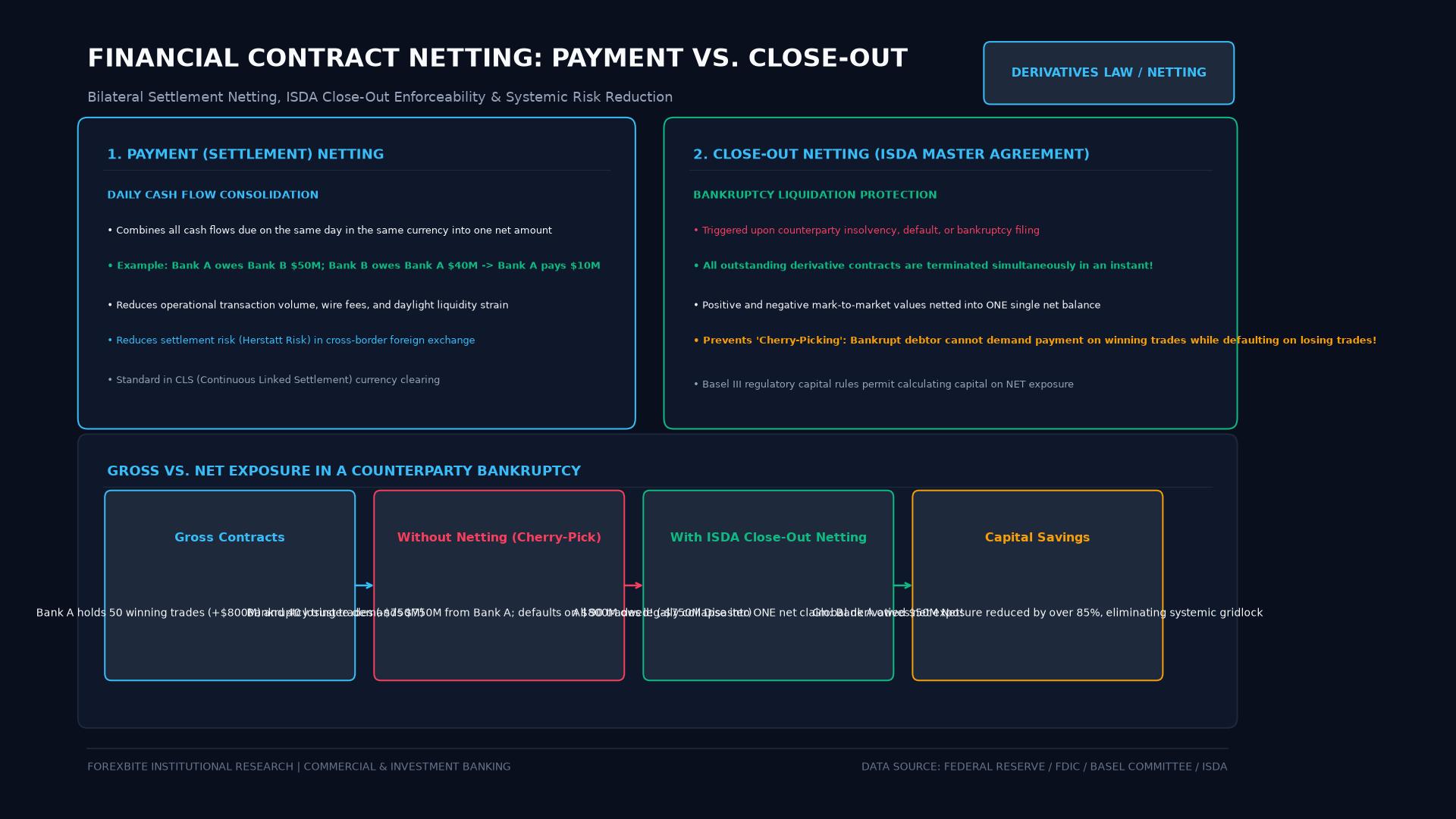 Figure: Counterparty credit risk reduction: daily bilateral settlement payment netting compared with insolvency close-out netting under ISDA Master Agreements.
Key Takeaways
- Massive Liquidity Optimization: Netting collapses billions of dollars in gross contractual promises into manageable net daily settlements, freeing up vast reserves of interbank capital.
- Mitigation of Settlement Risk: By reducing the total cash transferred across borders, netting drastically curtails Herstatt risk (the risk that one party fails after the counterparty has already wired its leg of the trade).
- Four Core Netting Frameworks: Operationalized across finance as Payment Netting, Novation Netting, Close-Out Netting, and Multilateral Netting.
- The Pillar of ISDA Documentation: Close-out netting under the ISDA Master Agreement ensures that upon a counterparty’s insolvency, a bankruptcy liquidator cannot “cherry-pick” profitable contracts while abandoning losing obligations.
- Continuous Linked Settlement (CLS): Modern foreign exchange stability relies on CLS Bank, which operates a multi-currency multilateral netting engine that settles the vast majority of the global $7.5 trillion daily FX turnover.
The Four Primary Netting Architectures
The financial industry implements netting across four distinct operational and legal frameworks:
1. Payment (Settlement) Netting
The simplest form: on any given settlement date, all gross cash flow transfers due between two counterparties in the identical currency are aggregated. A single net payment is transferred from the net debtor to the net creditor.
2. Novation Netting (Obligation Netting)
A legal restructuring where two existing contracts are legally canceled and replaced (novated) by a single new contract representing the net position. For example, if Firm A buys €10M from Firm B for delivery on December 15, and later sells €6M to Firm B for the same delivery date, novation merges them into a single binding contract for €4M.
3. Close-Out Netting (Insolvency Protection)
The bedrock of the global OTC derivatives market. Governed by the ISDA Master Agreement, close-out netting is triggered immediately upon a counterparty’s default, bankruptcy, or failure to pay. All outstanding trades across all tenors and asset classes are accelerated, marked to market, converted into a single base currency, and summed into a single net payable or receivable balance.
$$\text{Gross Exposure} = \sum_{i=1}^{n} \max(V_i, 0) \quad \gg \quad \text{Net Close-Out Exposure} = \max\left( \sum_{i=1}^{n} V_i, 0 \right)$$
4. Multilateral Netting
Conducted through a centralized clearinghouse (such as CME Clearing, LCH, or CLS Bank) involving three or more financial institutions. The clearinghouse acts as the central counterparty (CCP) through novation, netting the aggregate obligations of all participating member banks.
Comparative Taxonomy: Netting Paradigms
| Netting Mechanism | Parties Involved | Legal Timing Trigger | Primary Objective | Key Governing Document |
|---|---|---|---|---|
| Payment Netting | Bilateral (Two banks) | Standard daily settlement date | Reduce wire fees & daily cash drain | Operational Trade Confirmations |
| Novation Netting | Bilateral | Real-time / Trade execution | Simplify open contract administration | Master Agreement Schedule |
| Close-Out Netting | Bilateral | Event of Default / Insolvency | Prevent bankruptcy cherry-picking | ISDA Master Agreement |
| Multilateral Netting | Multilateral (Dozens of banks) | Continuous real-time / Daily | Systemic clearinghouse settlement | CCP Rulebook / CLS Protocol |
Real-World Case Study: Continuous Linked Settlement (CLS) in Forex
Prior to 1997, interbank foreign exchange settled bilaterally, creating immense systemic vulnerability: if a Tokyo bank settled Yen during Asian hours, it faced hours of unsecured credit risk before the New York counterparty opened to settle the U.S. Dollar leg.
- The Solution: In 2002, major global central banks and 70+ international financial institutions founded Continuous Linked Settlement (CLS Bank).
- Multilateral Payment-versus-Payment (PvP): CLS combines real-time Payment-versus-Payment with a massive multilateral netting engine covering 18 major convertible currencies.
- The Quantitative Impact: On an average trading day:
- Global banks submit over $6.5 trillion in gross transactions to CLS.
- The CLS multilateral netting engine compresses these transactions by over 95%.
- The entire global banking system settles the multi-trillion-dollar gross turnover by exchanging less than $300 billion in actual net cash wires.
- Outcome: Systemic Herstatt settlement risk was virtually eradicated from the primary currency markets.
Critical Legal and Jurisdictional Risks
- Non-Netting Jurisdictions: For close-out netting to function, local bankruptcy and insolvency laws must formally recognize that derivatives contracts are exempt from standard bankruptcy “automatic stay” rules. In jurisdictions that do not recognize close-out netting (certain emerging markets), a bankruptcy court can legally force a foreign bank to pay out on winning contracts while preventing the foreign bank from recovering losses on losing contracts.
- Operational Reconciliation Mismatch: If two banks maintain minor trade record discrepancies (e.g., mismatched settlement accounts or diverging interest conventions), payment netting can stall, forcing manual reconciliation before wires can be released.
Frequently Asked Questions (FAQ)
What is the difference between bilateral netting and multilateral netting?
Bilateral netting occurs directly between two individual parties (e.g., Bank A and Bank B offsetting their mutual trades). Multilateral netting involves a central clearinghouse (like CLS or LCH) that aggregates and offsets the obligations of dozens or hundreds of participating member banks into a single net position per bank.
What is “cherry-picking” in bankruptcy, and how does netting stop it?
In bankruptcy law, a court-appointed liquidator traditionally has the power to accept profitable contracts while rejecting unprofitable ones (“cherry-picking”). Close-out netting prevents this by legally binding all open derivative trades under a single master contract: the entire portfolio is terminated simultaneously, collapsing into a single net figure.
Does retail forex use netting?
Yes, in two ways. First, many modern retail platforms (like MT5 on “Netting” mode) aggregate multiple buy or sell orders in the same currency pair into a single net open position. Second, retail brokers rely on institutional prime brokers who utilize continuous netting to manage wholesale currency risk.
Ready to trade forex?
Open a free demo account with a regulated broker. Practice with virtual funds before risking real money.