NGN
NGN is the ISO 4217 currency code for the Nigerian Naira (currency symbol: ₦), the official legal tender of the Federal Republic of Nigeria, issued and administered by the Central Bank of Nigeria (CBN).
The NGN (Nigerian Naira, graphical symbol ₦, ISO 4217 code NGN) is the sovereign currency of the Federal Republic of Nigeria, the most populous nation and one of the largest economies on the African continent. Under the Central Bank of Nigeria Act of 2007 (originating from the foundational 1958 ordinance), the Central Bank of Nigeria (CBN) exercises statutory monopoly over the issuance, distribution, and monetary governance of the currency.
The naira is formally subdivided into 100 kobo. Historical coins spanned denominations of 1/2, 1, 5, 10, 25, and 50 kobo, as well as 1 and 2 naira. However, decades of chronic double-digit inflation have rendered kobo denominations obsolete, establishing paper and polymer banknotes in denominations of 5, 10, 20, 50, 100, 200, 500, and 1,000 naira as the circulating instruments of cash commerce. As a classic frontier petrocurrency, the value and macroeconomic stability of the NGN are intimately tied to international crude oil export receipts, domestic fiscal policy, and sweeping foreign exchange unification reforms.
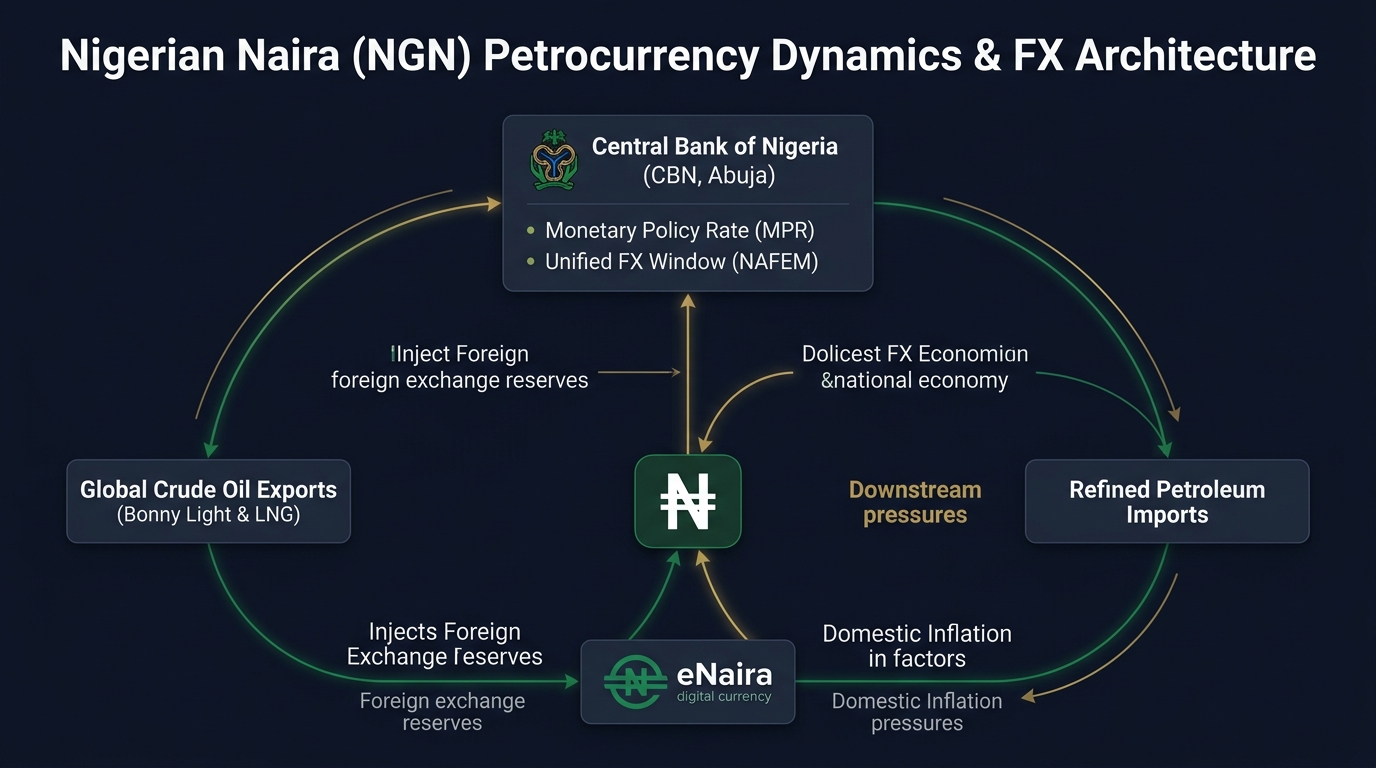
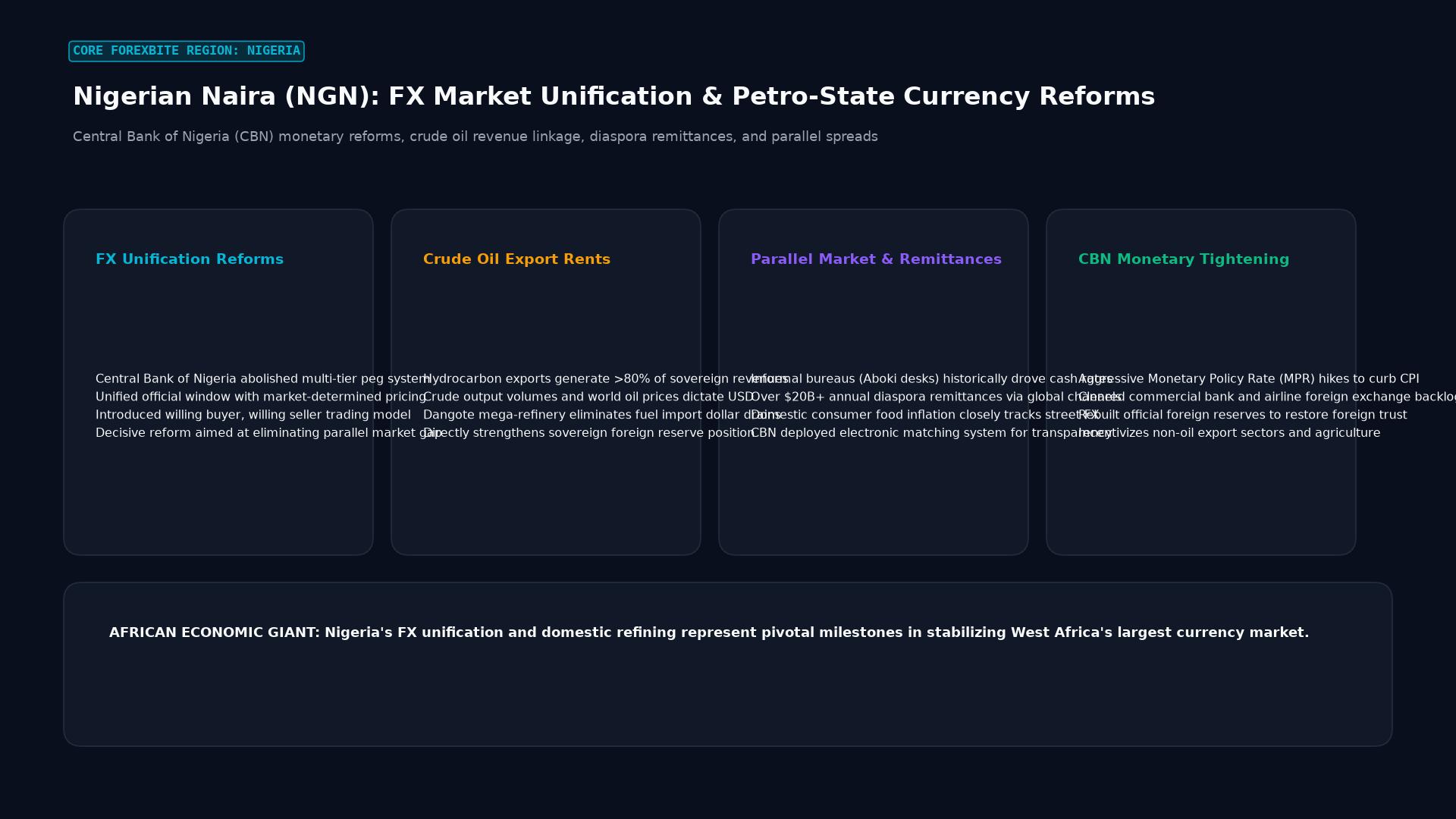 Figure: Central Bank of Nigeria (CBN) monetary reforms, crude oil revenue linkage, diaspora remittances, and parallel spreads
Historical Origins and Currency Development
Colonial Roots and the 1973 Decimalization
During the colonial era, Nigeria was part of the West African Currency Board (WACB), using the British West African Pound. Following national independence in 1960, Nigeria issued the sovereign Nigerian Pound, retaining the British colonial non-decimal system (divided into 20 shillings and 240 pence) at parity with Sterling.
On January 1, 1973, under the military administration of General Yakubu Gowon, Nigeria executed a major currency overhaul:
- Abandoned the colonial British monetary units in favor of a decimal system.
- Introduced the Naira (named as a contraction of “Nigeria”), replacing the pound at the rate of: $$1 \text{ Nigerian Pound} = 2 \text{ Naira (NGN)}$$ $$1 \text{ Naira} = 100 \text{ Kobo}$$
During the 1970s oil boom, high global petroleum prices supported a strong naira, which traded at an exchange rate stronger than the US Dollar (averaging roughly 0.60 to 0.70 NGN per 1.00 USD).
Structural Adjustment and Secular Depreciation (1986–2000s)
The collapse of global oil prices in the early 1980s exposed Nigeria’s underlying Dutch disease: domestic agriculture and manufacturing had withered under the shadow of the oil sector. In 1986, facing severe debt crises, Nigeria adopted an IMF-backed Structural Adjustment Program (SAP):
- Dismantled administrative exchange rate controls.
- Introduced the Second-Tier Foreign Exchange Market (SFEM).
- Allowed market forces to depreciate the naira from parity to over 9 NGN per USD by 1990, passing 100 NGN per USD in 2000, and trading near 150 NGN per USD by 2010.
The Petrocurrency Dynamics and Balance of Payments
The external purchasing power of the naira is governed by the structural concentration of the Nigerian economy:
                  NIGERIAN PETROCURRENCY TRANSMISSION LOOP

  Global Crude Oil Prices (Bonny Light Benchmark) & Domestic Output (NNPCL)
                                    |
                                    v
  Gross Export Revenues & Joint Venture Dividends (NLNG, Bonny Terminal)
                                    |
                                    v
  CBN Official Foreign Exchange Reserves & Sovereign Excess Crude Account
                                    |
                                    v
  Interbank Foreign Exchange Liquidity & NAFEM Market Settlement
                                    |
                                    v
  Naira Value vs. Imported Inflation in Refined Petroleum & Staple Foods
1. The Dutch Disease Paradox
Nigeria is consistently among the largest producers of petroleum in Africa. Crude oil and natural gas account for over 80% to 90% of Nigeria’s total merchandise export earnings and historically provided approximately half of total federal government fiscal revenues.
However, because Nigeria lacked sufficient domestic refining capacity for decades (due to dilapidated state-owned refineries in Port Harcourt, Warri, and Kaduna), the country was trapped in an economic paradox: exporting raw crude oil and spending billions of dollars in scarce foreign currency to re-import refined motor gasoline (PMS) and diesel. This created an ongoing drain on CBN reserves, transforming high global oil prices into a fiscal burden due to expansive domestic fuel consumption subsidies.
2. The Dangote Refinery Transformation
The commissioning of the 650,000-barrel-per-day Dangote Petroleum Refinery in the Lekki Free Trade Zone marks a generational pivot for the Nigerian balance of payments. By refining crude oil locally and selling petroleum products domestically in naira, the facility is designed to eliminate the single largest component of Nigeria’s foreign exchange demand, saving an estimated $10 billion to $15 billion annually in foreign currency outflows.
The Multi-Tier Era vs. The 2023–2024 Market Unification
Between 2015 and 2023, under former CBN Governor Godwin Emefiele, Nigeria maintained a highly complex, distortionary multi-tier exchange rate system designed to protect official reserves without raising interest rates:
                   THE DISSOLUTION OF THE MULTI-TIER SYSTEM

  The Pre-2023 Fragmented System              The Post-2023 Unified Architecture
  +-------------------------------------+     +-----------------------------------+
  | 1. Official CBN Window (~460 NGN)   |     |                                   |
  | 2. I&E / NAFEX Window (~465 NGN)    | ==> |   Nigerian Autonomous Foreign     |
  | 3. Bureau de Change (BDC) Window    |     |   Exchange Market (NAFEM)         |
  | 4. Unregulated Parallel Market      |     |   (Clean floating rate: 1,500+)   |
  |    (Black Market Rate ~750-900 NGN) |     |                                   |
  +-------------------------------------+     +-----------------------------------+
The Failures of the Multi-Tier Model
Under the pre-2023 regime:
- The CBN pegged the official exchange rate around 460 NGN per USD, allocating artificially cheap dollars to select government agencies and preferred importers.
- The CBN banned 43 broad categories of imported items (including rice, cement, fertilizer, and toothpicks) from accessing the official foreign exchange market.
- International airlines, foreign portfolio investors, and multinational energy corporations accumulated over $7 billion in trapped foreign exchange backlogs, unable to repatriate profits.
- The wide spread between the official rate (460) and the parallel street market rate (exceeding 800) generated massive incentives for “round-tripping” and currency arbitrage, draining central bank reserves.
The Historic Unification of 2023–2024
Upon taking office in May 2023, President Bola Ahmed Tinubu announced the immediate termination of the multi-decade fuel subsidy and the unification of all foreign exchange windows. Under newly appointed CBN Governor Olayemi Cardoso:
- Window Unification: The official and I&E windows were collapsed into the Nigerian Autonomous Foreign Exchange Market (NAFEM), allowing the exchange rate to be determined freely by market supply and demand.
- Sharp Currency Devaluation: The naira immediately adjusted from the artificial peg of 460 NGN/USD to market clearing levels above 1,400 to 1,600 NGN per USD, narrowing the spread with the parallel market.
- Lifting of the 43-Item Import Ban: The CBN restored full access to the official foreign exchange market for all legitimate economic goods.
- Liquidation of Trapped FX Backlogs: The CBN verified and cleared billions of dollars in outstanding foreign airline and banking obligations, restoring international investor credibility.
- Monetary Tightening: To combat the inflationary surge triggered by subsidy removal and naira depreciation, the CBN raised its benchmark Monetary Policy Rate (MPR) aggressively, exceeding 26% to attract foreign portfolio investment (FPI) into local-currency Open Market Operation (OMO) bills.
The eNaira: Africa’s First Sovereign Digital Currency
In October 2021, Nigeria became the first nation in Africa (and one of the first in the world) to launch a sovereign Central Bank Digital Currency (CBDC), known as the eNaira (code: eNGN):
+------------------------+--------------------------------------------------+
| Dimension              | eNaira (CBDC) Operational Feature                |
+------------------------+--------------------------------------------------+
| Issuing Authority      | Central Bank of Nigeria (Direct Liability)       |
| Statutory Legal Status | 1:1 Parity with Physical Cash Naira              |
| Technological Rails    | Enterprise Hyperledger Fabric Blockchain         |
| Primary Objectives     | Financial inclusion for unbanked populations;    |
|                        | reducing physical cash printing and transit cost;|
|                        | direct distribution of social welfare payments   |
| Adoption Challenges    | Low initial retail adoption due to competition   |
|                        | from established commercial bank mobile apps and |
|                        | private US-dollar-pegged stablecoins (USDT)      |
+------------------------+--------------------------------------------------+
Trading and Market Microstructure for NGN
Trading the Nigerian Naira requires an understanding of local institutional market infrastructure:
+------------------------+--------------------------------------------------+
| Feature                | NGN Market Structure                             |
+------------------------+--------------------------------------------------+
| Primary Pricing Venue  | Nigerian Autonomous Foreign Exchange Market      |
|                        | (NAFEM), operated via FMDQ Securities Exchange   |
| Benchmark Quote Pair   | USD/NGN (Naira per 1 US Dollar)                  |
| Secondary Pairs        | EUR/NGN, GBP/NGN, NGN/ZAR                        |
| Trading Platform       | FMDQ Thomson Reuters / Refinitiv Matching System |
| Market Operating Hours | 09:00 to 16:00 West Africa Time (UTC+1)          |
| Settlement Standard    | Spot T+2 (Interbank), Spot T+0 (Cash Bureaus)    |
| Cross-Border Hedging   | CBN Non-Deliverable Forwards (NDFs) via FMDQ     |
+------------------------+--------------------------------------------------+
1. Price Discovery on FMDQ Exchange
Spot market price discovery for USD/NGN occurs electronically on the FMDQ Securities Exchange, which aggregates order books from authorized dealer commercial banks. The daily NAFEM closing rate serves as the official reference rate for customs valuation, corporate accounting conversions, and multilateral debt calculations.
2. Diaspora Remittance Integration
Nigeria receives approximately $20 billion annually in non-debt diaspora remittances. Recent regulatory frameworks mandate that international money transfer operators (IMTOs) quote rates aligned directly with prevailing NAFEM market benchmarks, ensuring that diaspora dollars flow through regulated banking channels rather than the parallel black market.
Best Practices for Navigating NGN Exposure
- Model Costs Using Market-Determined Clearing Rates: With the formal unification of the NAFEM window, corporations must utilize real-time interbank closing rates for all balance sheet valuations, financial modeling, and tariff pricing.
- Monitor CBN Monetary Policy Committee (MPC) Cycles: The spread between domestic inflation and the Monetary Policy Rate (MPR) dictates whether the real interest rate is positive or negative. Positive real yields on short-dated Nigerian Treasury Bills (NTBs) are essential to prevent portfolio outflows.
- Track Gross Liquid FX Reserves at the CBN: When assessing currency depreciation risk, evaluate the liquid component of CBN foreign exchange reserves. An acceleration in reserve drawdowns signals that the central bank may struggle to support interbank liquidity.
- Utilize FMDQ-Listed Hedging Products: Multinational corporations with large capital expenditure programs in Nigeria should manage future dollar obligations through FMDQ-registered Non-Deliverable Forwards (NDFs), which allow locking in future exchange rates without requiring immediate cash physical settlement.
Frequently Asked Questions (FAQ)
What is the meaning of the symbol “₦” for the Nigerian Naira?
The symbol ₦ represents the Nigerian Naira, formed by crossing a capital letter N with two horizontal parallel bars. It was adopted in 1973 when Nigeria decimalized its currency, replacing the colonial British pound system. The symbol signifies national sovereignty and monetary identity.
Why did the Nigerian Naira depreciate significantly in 2023 and 2024?
The dramatic depreciation of the naira occurred because the Nigerian government and the Central Bank of Nigeria abandoned an artificial, multi-year fixed exchange rate peg. Prior to June 2023, the central bank administratively held the official rate around 460 NGN per USD, which exhausted foreign reserves and caused massive dollar shortages. When the government unified all currency windows and allowed the naira to float freely according to market demand, the exchange rate corrected to its true market-clearing equilibrium.
What is the difference between NAFEM and the parallel currency market in Nigeria?
NAFEM (the Nigerian Autonomous Foreign Exchange Market) is the official, transparent electronic interbank trading platform regulated by the Central Bank of Nigeria and operated by the FMDQ Exchange, where licensed banks and corporate entities trade foreign currency. The parallel market (often referred to as the black market) is an informal, cash-based network of street vendors and unregulated bureaus that cater to retail buyers and informal traders who lack formal documentation for banking transactions.
Ready to trade forex?
Open a free demo account with a regulated broker. Practice with virtual funds before risking real money.