Nickel
In financial markets, 'nickel' serves dual meanings: traditional trading floor slang for five basis points (0.05% or $0.0005), and an essential industrial base metal traded on the London Metal Exchange (LME) vital for stainless steel and electric vehicle batteries.
What Does “Nickel” Mean in Financial Markets?
In global finance, the term nickel carries two distinct, highly specialized applications depending on whether it is used in institutional trading jargon or physical commodity markets:
- Institutional Financial Slang: On North American trading floors, fixed-income desks, and foreign exchange options pits, a “nickel” is traditional market shorthand for five basis points (5 bps, 0.05%, or 0.0005) or five cents ($0.05). If an interbank bond dealer quotes a yield spread widening by “a nickel,” they mean 5 basis points. In equity and index options trading, a nickel refers to an option contract trading at a premium of $0.05 ($5.00 per standard 100-share contract).
- Physical Base Metal Commodity: In global commodities and futures markets, nickel is an essential industrial base metal traded under benchmark futures contracts on the London Metal Exchange (LME) and the Shanghai Futures Exchange (SHFE). Historically utilized predominantly in the manufacturing of corrosion-resistant stainless steel, nickel has transformed into a critical strategic energy-transition metal due to its indispensable role in the cathode chemistry of high-energy-density lithium-ion electric vehicle (EV) batteries.
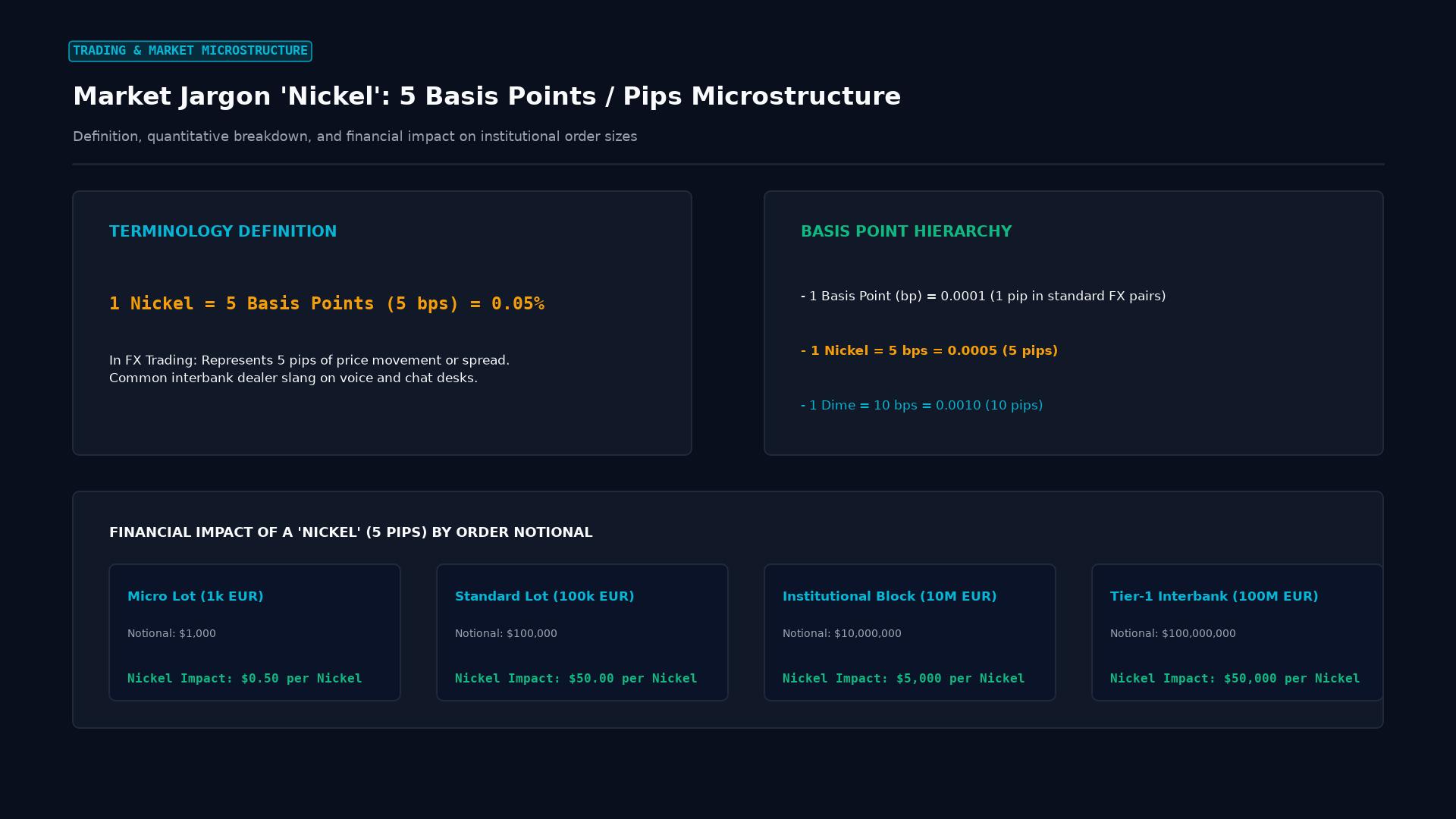 Figure: Institutional trading jargon: 1 Nickel equals 5 basis points (0.05% or 5 pips), illustrating dollar value impact across various lot sizes.
Key Takeaways
- Wall Street Jargon: In bond and derivatives pits, a nickel equals 5 basis points (0.05%), sitting alongside other floor terms like a “dime” (10 bps) and a “quarter” (25 bps).
- Critical Transition Metal: The physical commodity is categorized into Class 1 Nickel (high-purity $\ge 99.8%$ nickel briquettes and cathodes used for EV batteries) and Class 2 Nickel (nickel pig iron and ferronickel used for stainless steel).
- The Historic March 2022 LME Short Squeeze: Nickel experienced the most chaotic commodity short squeeze in modern history, when prices surged from $20,000 to over $100,000 per metric ton in 48 hours, prompting the LME to controversially halt trading and cancel billions in valid trades.
- Commodity Currency Correlation: As a major export commodity for nations like Indonesia, Australia, Canada, and the Philippines, nickel price cycles directly impact the terms of trade and exchange rates of commodity currencies (such as the Australian Dollar, AUD, and Indonesian Rupiah, IDR).
- Battery Supply Chain Bottlenecks: Geopolitical competition over nickel refining capacity makes it a key strategic focus of international critical mineral security policies.
Comparative Taxonomy: Institutional Floor Slang vs. Standard Notation
On verbal dealing desks and institutional squawk boxes, traders utilize numeric slang to communicate price increments with maximum speed and minimum phonetic ambiguity.
| Slang Term | Monetary Equivalent (Equities / FX Options) | Fixed-Income Yield / Spread Meaning | Percentage / Decimal Format |
|---|---|---|---|
| Nickel | $0.05 per share / contract | 5 Basis Points | 0.05% / 0.0005 |
| Dime | $0.10 per share / contract | 10 Basis Points | 0.10% / 0.0010 |
| Quarter | $0.25 per share / contract | 25 Basis Points | 0.25% / 0.0025 |
| Handle / Big Figure | Whole integer price level ($1.00 / 100 pips) | 100 Basis Points (1.00%) | 1.00% / 0.0100 |
| Buck | $1,000,000 in notional interbank trading | N/A | $1,000,000 USD |
| Yard | $1,000,000,000 in notional interbank trading | N/A | $1,000,000,000 USD |
The Physical Commodity: Class 1 vs. Class 2 Nickel
Understanding the commodity side of nickel requires separating high-purity battery-grade material from bulk industrial feedstocks:
| Characteristic | Class 1 Nickel (Deliverable on LME) | Class 2 Nickel (Non-LME Deliverable) |
|---|---|---|
| Purity Grade | $\ge 99.8%$ Pure Nickel | Under 99% (typically 8% to 30% Ni content) |
| Physical Forms | Pellets, briquettes, electrolytic cathodes, powder | Nickel Pig Iron (NPI), Ferronickel (FeNi) |
| Primary End Use | Electric Vehicle (EV) batteries, aerospace alloys | Stainless steel production |
| Exchange Delivery | Warrantable and deliverable into LME warehouses | Cannot be physically delivered against LME contracts |
| Major Producers | Russia (Nornickel), Canada, Australia (BHP) | Indonesia (Tsingshan, Harita), China |
Real-World Case Study: The LME Nickel Short Squeeze of March 2022
The physical and financial dimensions of nickel converged in dramatic fashion in March 2022 on the London Metal Exchange:
- The Massive Naked Short: Chinese stainless-steel titan Tsingshan Holding Group, controlled by tycoon Xiang Guangda, accumulated a massive short position of roughly 150,000 tons of nickel to hedge its production. However, Tsingshan produced Class 2 Nickel Pig Iron in Indonesia, which could not be physically delivered into LME warehouses to fulfill Class 1 futures obligations.
- The Catalyst: When geopolitical conflict broke out in Ukraine in February 2022, markets feared an immediate embargo on Russia’s Norilsk Nickel (the world’s largest Class 1 producer).
- The Squeeze: Institutional funds aggressively bought LME nickel contracts. With physical warehouse inventories near historic lows, Tsingshan was trapped in a catastrophic short squeeze.
- The Parabolic Spike: On Monday, March 7, nickel jumped from $29,000 to $50,000/ton. On Tuesday morning, March 8, panic buying caused prices to go vertical, surging past $100,000 per ton.
- The Unprecedented Exchange Intervention: Facing multi-billion-dollar margin defaults that threatened the solvency of major clearing banks, the LME suspended all trading and retroactively canceled $12 billion in valid trades executed that morning, resetting the price to $48,000. The decision sparked international regulatory probes, lawsuits from global hedge funds (like Elliott Management), and permanently damaged the LME’s reputation.
Strategic Significance for Forex Traders
For currency macro traders, monitoring nickel provides valuable leading insights into sovereign trade balances:
- The Australian Dollar (AUD): Australia holds the world’s second-largest nickel reserves. Surging global nickel prices boost Australian mining export earnings, supporting the current account balance and strengthening the Australian Dollar.
- The Indonesian Rupiah (IDR): Indonesia holds the world’s largest nickel reserves and enforced an export ban on raw ore to force foreign companies to build domestic processing smelters. The resulting multi-billion-dollar FDI boom transformed Indonesia’s trade balance from a chronic deficit into a surplus, structurally supporting the Rupiah.
Frequently Asked Questions (FAQ)
What does a bond trader mean when they say “the 10-year yield is up a nickel”?
It means the yield on the 10-Year U.S. Treasury note has risen by five basis points (0.05%)—for example, moving from 4.20% to 4.25%.
Why can’t all nickel be traded on the London Metal Exchange?
The LME enforces strict chemical purity specifications: only Class 1 Nickel with a purity of 99.8% or higher is eligible for exchange delivery warrants. Lower-purity forms like Nickel Pig Iron (NPI) cannot be delivered against LME futures contracts.
How does nickel affect electric vehicle (EV) stocks?
Nickel is the primary element determining energy density in NMC (Nickel Manganese Cobalt) and NCA (Nickel Cobalt Aluminum) lithium-ion battery cells. When nickel prices explode, battery pack production costs increase significantly, compressing operating margins for EV manufacturers like Tesla and BYD.
Ready to trade forex?
Open a free demo account with a regulated broker. Practice with virtual funds before risking real money.