Short Squeeze
A violent and rapid price surge in an asset triggered when heavily crowded short sellers are forced to repurchase their positions to cover mounting losses or meet margin calls, creating an explosive positive feedback loop of buying pressure.
What Is a Short Squeeze?
A short squeeze is an aggressive market phenomenon characterized by a sudden, exponential spike in an asset’s price, fueled primarily by the forced liquidation of short sellers. When an asset with heavy short interest experiences an unexpected positive catalyst or an influx of aggressive buying, short sellers incur rapid mark-to-market losses.
To prevent total capital depletion or comply with mandatory broker margin calls, short sellers must execute buy-to-cover orders. Because buying to cover is mechanically identical to purchasing the asset on the open market, this panic covering injects massive buy volume into the order book. The surging demand absorbs available sell liquidity, forcing prices even higher and triggering stop-loss orders from higher-tier short positions, setting off a self-reinforcing buying spiral.
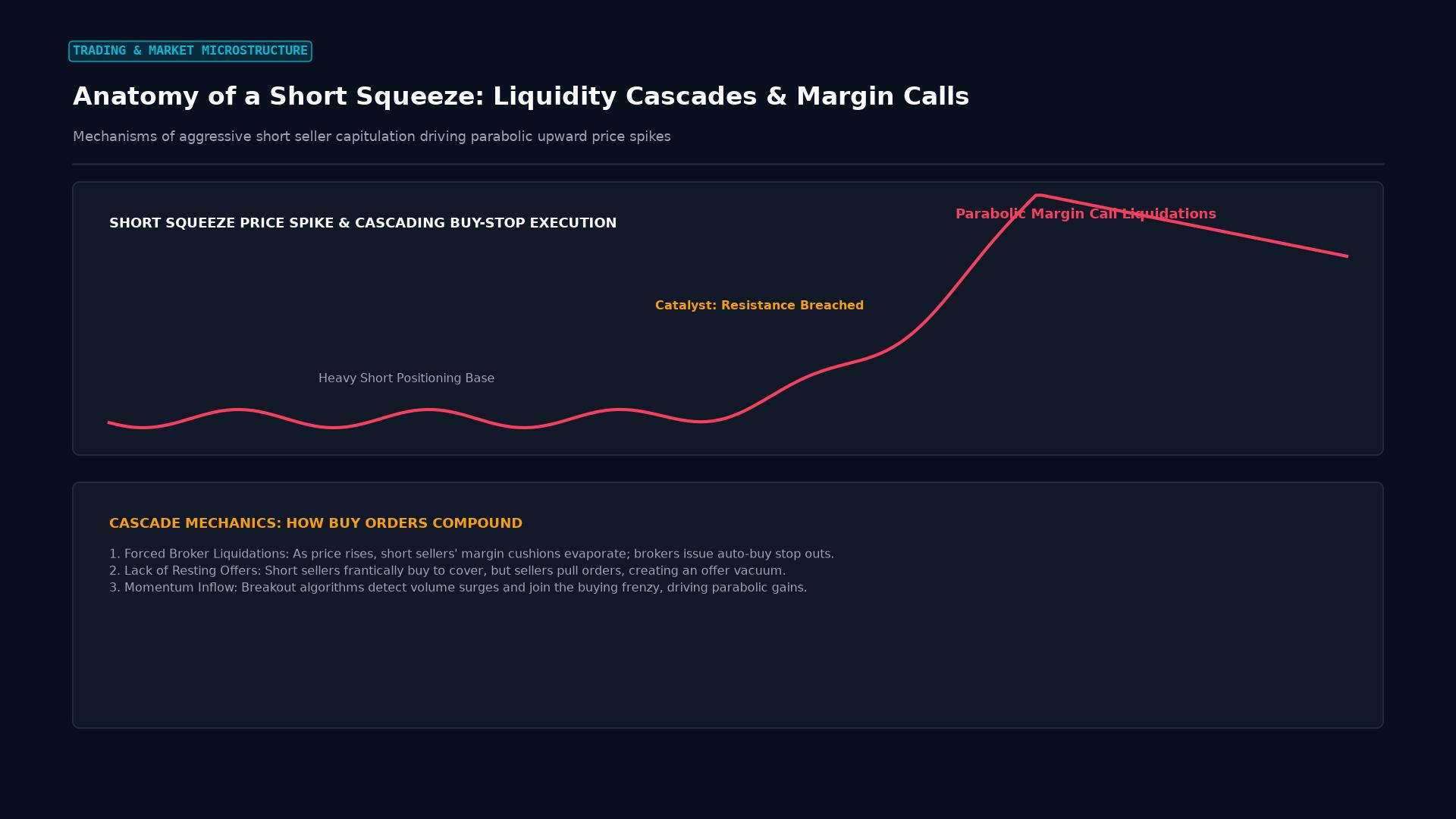 Figure: Short squeeze mechanics: resistance breach triggering automatic margin call liquidations and forced buy-stops, driving parabolic upward spikes.
Quantitative Metrics: Measuring Short Squeeze Potential
Institutional quantitative desks and hedge funds monitor specific metrics to assess squeeze vulnerability:
1. Short Interest as a Percentage of Float
This metric calculates the proportion of publicly tradable shares currently sold short:
$$\text{Short Interest % of Float} = \left( \frac{\text{Total Shares Shorted}}{\text{Public Float}} \right) \times 100$$
- Normal Range: Under 5% reflects neutral sentiment.
- Elevated Risk: 10% to 20% signals substantial bearish consensus.
- Extreme Squeeze Zone: Above 20% to 30% indicates dangerous crowding, where any upward price shock can ignite an uncontrollable run.
2. Days to Cover (Short Interest Ratio)
This formula calculates how many trading days it would take all short sellers to cover their positions based on normal trading volume:
$$\text{Days to Cover} = \frac{\text{Total Shares Shorted}}{\text{Average Daily Volume (ADV)}}$$
A Days-to-Cover ratio exceeding 5 to 8 days implies that should shorts attempt to exit simultaneously, available market liquidity would be completely overwhelmed, guaranteeing severe upward price slippage.
Short Squeeze vs. Bull Market Rally vs. Gamma Squeeze
| Characteristic | Short Squeeze | Organic Bull Rally | Gamma Squeeze |
|---|---|---|---|
| Primary Driver | Forced covering and stop-out buying | Fundamental economic growth and institutional accumulation | Market makers dynamically hedging out-of-the-money call options |
| Price Trajectory | Vertical, parabolic spike | Measured, stair-stepping higher highs and higher lows | Hyperbolic acceleration near option strike expirations |
| Volume Signature | Massive, erratic volume spikes on low floating supply | Steady, sustained accumulation volume | Overwhelming call option contract turnover |
| Sustainability | Short-lived; usually collapses 50% to 80% once shorts are wiped out | Durable across multi-month or multi-year business cycles | Dissipates rapidly following monthly or quarterly options expiration |
Real-World Institutional Case Studies
1. The October 2008 Volkswagen Short Squeeze
The most legendary institutional short squeeze in modern history unfolded in October 2008. Global hedge funds heavily shorted German automaker Volkswagen AG (VW) as part of an arbitrage trade against Porsche SE.
       VOLKSWAGEN AG (VW) SHARE PRICE - OCTOBER 2008

 €1,000 ──┐                                         ┌─── Peak: €1,005
          │                                         │
   €800 ──┼                                        /│
          │                                       / │
   €600 ──┼                                      /  │
          │                                     /   │
   €400 ──┼                                    /    │
          │                             _..-''`     │
   €200 ──┼─-.._                     _.-'           │
          └─────`'------------------'───────────────┴─────────────────
Oct 20 Oct 22 Oct 24 Oct 26 Oct 28 Oct 30- The Trap: On Sunday, October 26, Porsche unexpectedly revealed that through cash-settled call options, it controlled 74.1% of VW voting stock. With the German state of Lower Saxony holding an untouchable 20%, only 5.9% of VW shares remained as free float in the open market.
- The Deficit: Hedge funds held short positions totaling 12.8% of VW stock—more than double the entire available supply.
- The Explosion: When markets opened on Monday, desperate hedge funds rushed to buy shares that did not exist. VW shares skyrocketed from €210 to a peak of €1,005 in two sessions. For several hours, Volkswagen was briefly the most valuable publicly traded corporation on Earth, inflicting over $30 billion in collective losses on institutional hedge funds.
2. Foreign Exchange Short Squeezes: The 2015 Swiss Franc De-Pegging
While common in single stocks, short squeezes also strike foreign exchange markets. On January 15, 2015, the Swiss National Bank (SNB) abruptly abandoned its 1.20 floor on EUR/CHF.
Global banks and retail speculators had established tens of billions of dollars in short CHF (long EUR/CHF) carry positions. When the floor was removed, an instantaneous short squeeze unfolded: EUR/CHF collapsed from 1.2000 to below 0.8500 in minutes as participants desperately bid for Swiss Francs to cover short liabilities, bankrupting several major retail brokerages and institutional funds.
Tactical Risk Management: Surviving and Trading Squeezes
For traders and risk managers, short squeezes require specialized defensive rules:
- Never Average Down on a Short Position: The single deadliest mistake is adding capital to a losing short position as it moves higher. Because an asset can appreciate several hundred percent, averaging down on short trades often leads to total account liquidation.
- Utilize Defined-Risk Bearish Strategies: Rather than maintaining naked short exposure in heavily shorted assets, utilize long put options or bear put spreads. If a squeeze occurs, maximum losses are strictly capped at the upfront option premium paid.
- Fade the Climax (Post-Squeeze Shorting): Squeezes invariably end in violent downward collapses once the last short seller is capitulated. Experienced momentum traders wait for a clear market structure breakdown (e.g., a massive blow-off topping tail with declining volume) to short the subsequent return to fundamental fair value.
Frequently Asked Questions
What officially causes a short squeeze to end?
A short squeeze exhausts itself when all existing short sellers have been completely bought out or liquidated by their brokers, and fresh speculative buyers refuse to purchase the asset at grossly inflated, unrealistic valuations. With buy-to-cover volume evaporating, the bid book empties, and prices crash back toward their fundamental fair values.
Can a short squeeze happen in the foreign exchange market?
Yes. Although foreign exchange lacks the “hard-to-borrow” share constraint of equity markets, foreign exchange short squeezes occur when one currency is heavily shorted in institutional carry trades (such as the Japanese Yen or Swiss Franc). If unexpected central bank intervention or macro shocks occur, crowded carry unwindings trigger violent short-covering surges.
How does high borrowing cost (fee rate) trigger a squeeze?
When short interest is intense, prime brokers charge high annualized borrow fees (often 50% to 100%+). These ongoing fees drain a short seller’s capital every day the position is held. Even if the asset’s price remains flat, mounting borrowing costs force weaker short sellers to cover, igniting early upward momentum.
Ready to trade forex?
Open a free demo account with a regulated broker. Practice with virtual funds before risking real money.