Non-Client Order
A non-client order—commonly termed a proprietary or house order—is a trade executed by a broker-dealer, financial institution, or exchange member for its own corporate account rather than on behalf of an external customer.
What Is a Non-Client Order?
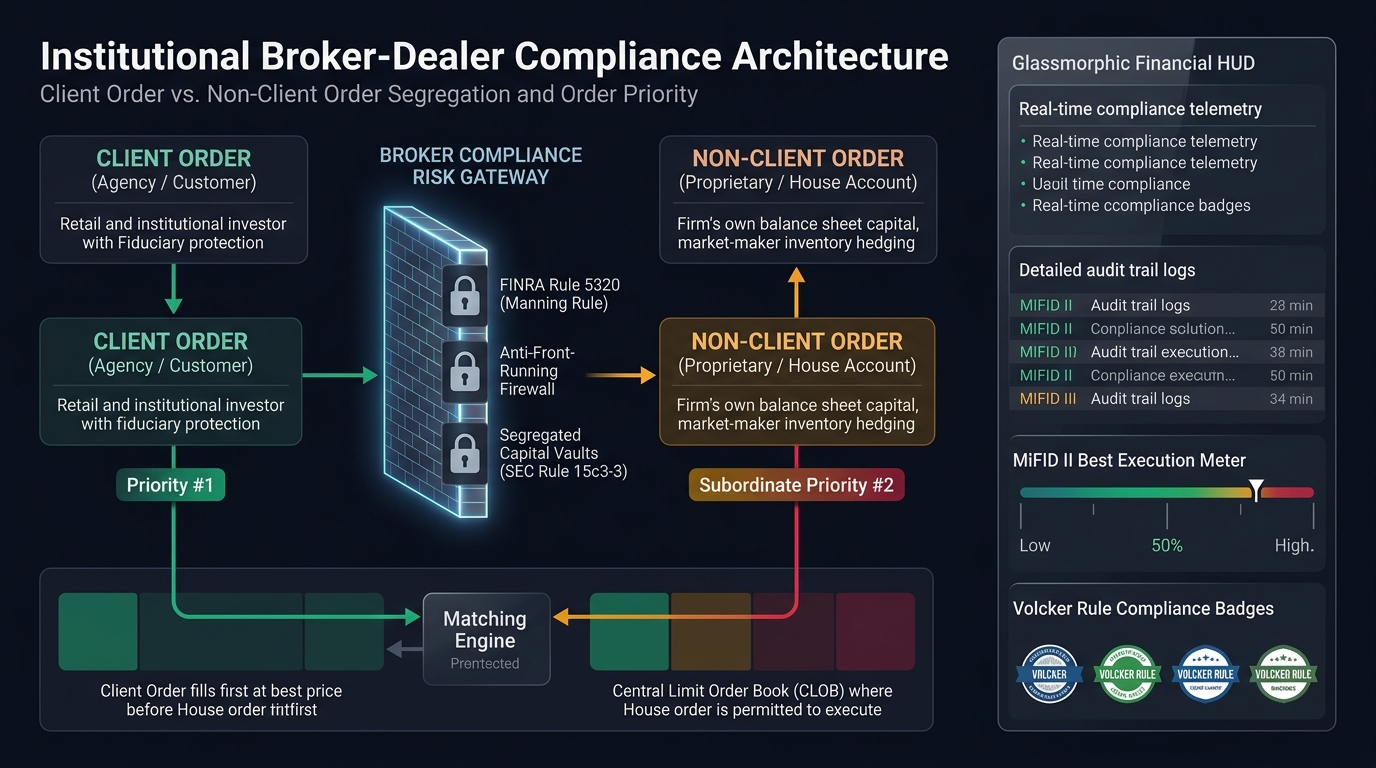
In securities regulation, exchange compliance, and institutional foreign exchange trading, a non-client order (widely designated as a proprietary order, principal order, or house order) is any financial transaction initiated by a licensed brokerage firm, investment bank, or exchange member for its own balance sheet. Unlike a client order—where the broker acts as a fiduciary or agent representing the interests of an external retail or institutional investor—a non-client order is funded by the firm’s own capital to extract proprietary trading profits, hedge balance-sheet inventory, or maintain two-way market-making liquidity.
Because brokerage firms possess structural advantages over external customers—including real-time visibility into the institutional order book, direct exchange colocation, and sub-millisecond execution speeds—financial regulators enforce strict legal boundaries between client orders and non-client house orders. Supervisory bodies mandate strict Order Priority rules to prevent illegal practices such as front-running, ensuring that non-client proprietary trades never disadvantage incoming customer orders.
Key Takeaways
- Ownership of Risk: Non-client orders trade corporate capital; all trading profits or balance-sheet losses belong entirely to the broker-dealer firm.
- Client Order Priority (Manning Rule): Under FINRA Rule 5320 and international equivalents (such as MiFID II in Europe), a broker-dealer cannot trade a non-client proprietary order at the same or better price than an unexecuted client limit order.
- The Volcker Rule Impact: Dodd-Frank Section 619 (the Volcker Rule) prohibited federally insured U.S. commercial banks from executing speculative non-client proprietary trades, prompting the spin-off of internal bank prop desks into independent proprietary firms (e.g., Jane Street, Citadel Securities).
- Principal Dealing (B-Book Internalization): In retail forex, when a dealing desk broker takes the opposite side of a client’s trade without routing it to the interbank market, the broker’s counter-trade is structurally executed as a non-client principal transaction.
- Strict Capital Segregation: Regulators mandate that customer margin deposits and proprietary non-client funds be held in completely segregated bank accounts, preventing the illegal commingling of customer assets.
Comparative Taxonomy: Order Classifications in Financial Markets
| Order Classification | Capital Source | Legal Capacity of Broker | Execution Priority | Primary Regulatory Scrutiny |
|---|---|---|---|---|
| Client Order (Agency) | External customer funds | Agent / Fiduciary | Highest Priority | Best Execution, suitability, no markup |
| Non-Client Order (Prop) | Broker-dealer corporate capital | Principal | Subordinated to clients | Front-running, market manipulation |
| Market-Making Quote | Liquidity provider balance sheet | Principal (Two-way) | Equal in queue priority | Quote continuity, spread fairness |
| Employee Personal Order | Broker employee personal cash | Individual Account | Subordinated to house/client | Insider trading, conflict of interest |
The Legal Safeguard: The Manning Rule and Order Protection
The bedrock regulatory mechanism governing non-client orders in the United States is FINRA Rule 5320 (historically established by the landmark Manning vs. Hazekamp legal case):
$$\text{If Client Limit Order Resting at: } P_{\text{client}} = $50.00$$
$$\text{Broker Non-Client Proprietary Desk CANNOT buy at } P_{\text{house}} \le $50.00 \text{ for its own book}$$
If the broker’s proprietary desk chooses to execute a non-client buy order at $50.00 or lower, the broker is legally obligated to fill the customer’s resting limit order at that same price simultaneously. This rule completely eliminates the incentive for brokerages to use non-client orders to step in front of client order flow.
Real-World Case Study: The SEC Enforcement Against Proprietary Front-Running
In a landmark multi-million-dollar enforcement action, the U.S. Securities and Exchange Commission (SEC) and the UK Financial Conduct Authority (FCA) penalized a major global investment bank for violating non-client trading protocols:
- The Scheme: A multi-billion-dollar sovereign wealth fund submitted a massive institutional client order to convert $3.5 billion USD into British Pounds (GBP) at the 4:00 PM London fix.
- The Non-Client Abuse: The bank’s senior currency traders recognized that this colossal client buy order would inevitably cause the British Pound to surge by dozens of pips. Before routing the client’s order, traders entered massive non-client proprietary buy orders across the bank’s house accounts.
- The Market Distortion: The bank’s non-client buying drove the GBP exchange rate significantly higher. The bank then filled the sovereign client’s order at the inflated rate, dumping its proprietary holdings for millions in illicit trading profits.
- The Penalty: International regulators identified the proprietary trades through voice logger audits and algorithmic timestamps. Regulators levied over $100 million in fines, dismissed the traders, and reinforced mandatory automated compliance firewalls between institutional sales desks and proprietary non-client execution systems.
Compliance Firewalls and Information Barriers
To maintain regulatory integrity, modern financial institutions enforce strict structural safeguards:
- Chinese Walls (Information Barriers): Physical, electronic, and organizational firewalls separating client-facing sales desks from non-client trading operations. A non-client algorithmic desk is legally prohibited from accessing incoming client order queues.
- Automated Timestamping: Every order entered into an exchange or ECN must be flagged with a machine-generated tag—such as “C” (Client) or “P” (Principal / Non-Client)—with microsecond synchronization to enable regulatory audit trails.
Frequently Asked Questions (FAQ)
Can a broker trade against their own clients using non-client orders?
In agency ECN brokerages, no; the broker merely routes client orders to external third-party liquidity providers. In “Market Maker” or “Dealing Desk” (B-Book) brokerages, however, the broker acts as the direct counterparty to the trade, taking on principal risk through non-client house positions.
Why do trading firms execute non-client orders?
Proprietary trading firms and broker-dealers execute non-client orders to generate corporate revenue from quantitative market making, capture bid-ask spreads, arbitrage pricing inefficiencies across global exchanges, and hedge balance-sheet inventory.
What is the penalty for front-running client orders with non-client trades?
Front-running is a severe civil and criminal violation of securities laws. Penalties include multi-million-dollar corporate fines, disgorgement of illicit trading profits, revocation of broker-dealer licenses, and federal prison sentences for the individual traders involved.
Ready to trade forex?
Open a free demo account with a regulated broker. Practice with virtual funds before risking real money.