Note
A note is an intermediate-term debt security or legal promissory instrument issued by a government or corporation that obligates the issuer to pay regular interest coupons and repay principal capital, typically within two to ten years.
What Is a Note?
In fixed-income markets, corporate finance, and sovereign debt issuance, a note is a formal, legally binding debt instrument in which the issuer (a national government, municipality, or corporation) promises to repay the invested principal amount (face or par value) to the investor at a specified future date, while distributing periodic interest payments (coupons) over the life of the loan.
Across the global debt hierarchy, a note occupies the intermediate maturity tier—traditionally possessing an original maturity ranging between two and ten years. This positions notes directly between short-term money market instruments (such as Treasury Bills with maturities of one year or less) and long-term debt (such as Treasury Bonds or debentures with maturities extending up to 30 years).
In global macroeconomics and foreign exchange (Forex), sovereign government notes—most notably the 10-Year U.S. Treasury Note—function as the foundational financial anchor of modern capitalism. The yield demanded by investors on intermediate sovereign notes establishes the risk-free rate used to price mortgage loans, corporate credit, equity valuation multiples, and cross-border currency carry trade flows.
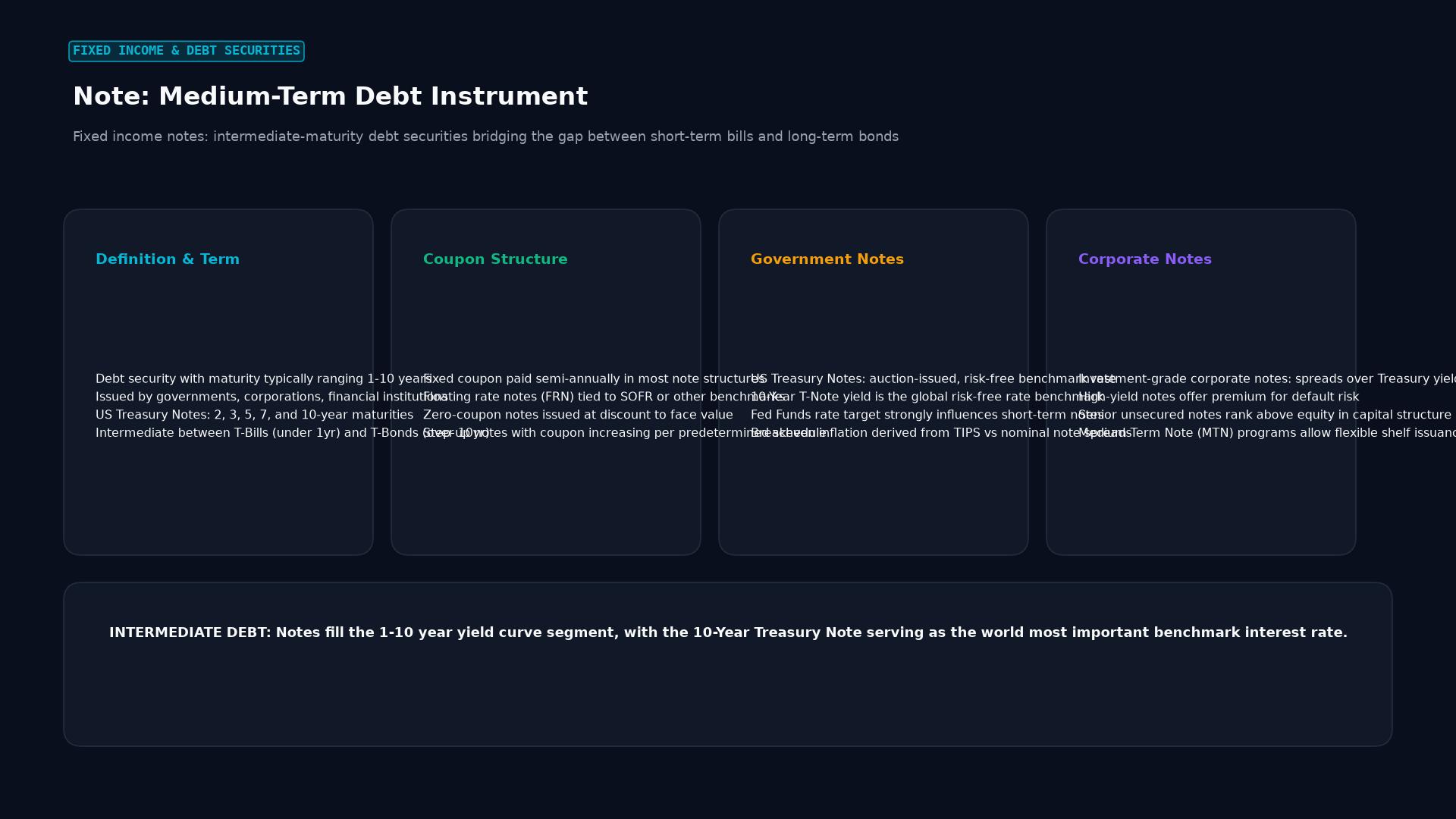 Figure: Fixed income notes: intermediate-maturity debt securities bridging the gap between short-term bills and long-term bonds
Key Takeaways
- Intermediate Maturity Profile: Standard notes carry maturities of 2, 3, 5, 7, and 10 years, balancing income yield with moderate interest rate price volatility.
- Semi-Annual Coupon Income: Unlike Treasury Bills (which are zero-coupon discount notes), sovereign Treasury Notes distribute fixed coupon interest payments every six months.
- The Global Reference Rate: The yield on the 10-Year U.S. Treasury Note is the universally recognized reference rate for global capital markets; when 10-year yields surge, sovereign borrowing costs explode worldwide.
- Corporate Notes & MTNs: Corporations issue Senior Notes and Medium-Term Notes (MTNs) to fund capital expenditures and acquisitions without surrendering equity control.
- Currency Valuation Catalyst: Sovereign yield spreads on 2-year and 10-year notes are the primary fundamental driver of foreign exchange exchange rates: widening yield advantages attract massive cross-border capital inflows into the higher-yielding currency.
Comparative Taxonomy: Sovereign Fixed-Income Instruments
| Debt Instrument | Original Maturity | Coupon Structure | Price Sensitivity (Duration) | Primary Institutional Role |
|---|---|---|---|---|
| Treasury Bill (T-Bill) | 4 weeks to 52 weeks | Zero-Coupon (Sold at discount) | Negligible (<1.0 year) | Cash liquidity, bank reserve buffers |
| Treasury Note (T-Note) | 2 to 10 Years | Fixed Semi-Annual Coupons | Moderate (1.8 to 8.5 years) | Global risk-free benchmark, mortgage pricing |
| Treasury Bond (T-Bond) | 20 to 30 Years | Fixed Semi-Annual Coupons | Extreme (15 to 22 years) | Long-duration matching for pension funds |
| Floating-Rate Note (FRN) | 2 Years | Variable (Indexed to SOFR) | Minimal interest rate risk | Inflation / tightening protection |
The Mathematics of Treasury Note Pricing and Yield
The fair market price of a fixed-rate note is computed as the present value of its future semi-annual coupon cash flows plus the present value of the face value ($F = $1,000$) repaid at maturity:
$$P_{\text{Note}} = \sum_{t=1}^{2n} \frac{\frac{C}{2}}{\left(1 + \frac{y}{2}\right)^t} + \frac{F}{\left(1 + \frac{y}{2}\right)^{2n}}$$
Where:
- $C$ is the annual coupon payment in dollars ($\text{Coupon Rate} \times F$).
- $y$ is the Yield to Maturity (YTM) demanded by the market.
- $n$ is the number of years remaining until maturity ($2n$ semi-annual periods).
Price and Yield Inverse Relationship:
- When market interest rates fall below the note’s coupon rate ($y < C$), the note trades at a premium ($P > $1,000$).
- When market interest rates rise above the note’s coupon rate ($y > C$), the note trades at a discount ($P < $1,000$).
Real-World Case Study: The 10-Year Note Yield Surge to 5.0% (October 2023)
In October 2023, the global financial system experienced a severe fixed-income dislocation:
- The Catalyst: Persistent U.S. economic resilience, massive federal fiscal deficit issuance, and the Federal Reserve’s “higher-for-longer” monetary policy guidance triggered heavy institutional bond selling.
- The Surge: The yield on the benchmark 10-Year U.S. Treasury Note crossed 5.00% for the first time since July 2007 (having risen from 0.50% during 2020).
- The Ripple Effect Across Markets:
- Mortgage Rates: U.S. 30-year fixed home mortgage rates jumped to 7.8%, freezing residential housing turnover.
- Equity Valuations: Higher discount rates compressed price-to-earnings (P/E) multiples; the S&P 500 corrected by 10% between August and October 2023.
- Forex Dominance: High nominal yields on intermediate U.S. notes sparked massive global capital flight into the U.S. Dollar. The U.S. Dollar Index (DXY) staged a relentless 11-week rally, pushing USD/JPY above 150.00 and driving EUR/USD down toward 1.0500.
Investor Risks Associated with Notes
- Interest Rate Risk: Because notes carry multi-year tenors, their market value drops when benchmark rates rise. Holding a 10-year note exposes the investor to an average duration of roughly 8 years, meaning a 100-basis-point rate hike destroys roughly 8% of the note’s market price.
- Inflation Purchasing Power Erosion: A fixed-rate note paying a 3% coupon during an economic cycle where inflation averages 5% delivers a negative real return, eroding the true purchasing power of the invested principal.
Frequently Asked Questions (FAQ)
What is the difference between a note and a bond?
The primary distinction is maturity length. In sovereign and corporate finance, a “note” typically has an intermediate original maturity of two to ten years, whereas a “bond” has a long-term original maturity exceeding ten years (up to 30 years or more).
Why is the 10-Year U.S. Treasury Note so important for forex traders?
The 10-Year Note yield represents the global benchmark for risk-free dollar returns. When the yield on the 10-Year Note widens relative to foreign sovereign benchmark bonds (such as the 10-Year German Bund or Japanese JGB), global institutional capital flows into U.S. Treasuries, driving upward pressure on the U.S. Dollar.
What is a Structured Note?
A Structured Note is a hybrid debt security issued by an investment bank that combines a traditional note with an embedded derivative. Instead of paying a fixed coupon, its returns are tied to the performance of an underlying equity index, commodity basket, or foreign exchange rate (such as a EUR/USD-linked coupon note).
Ready to trade forex?
Open a free demo account with a regulated broker. Practice with virtual funds before risking real money.