Notional Amount
The notional amount—or notional value—is the total nominal or face value of an underlying financial contract upon which derivative cash flows, exchange rate settlements, and leverage calculations are based, without requiring full upfront cash payment.
What Is a Notional Amount?
In financial derivatives, foreign exchange (Forex), and structured credit markets, the notional amount (also termed notional value or notional principal) is the total nominal or face value of the underlying asset upon which contractual obligations, interest rate calculations, and profit-and-loss distributions are determined.
The word “notional” stems from the concept of a theoretical or hypothetical figure. In the vast majority of derivative contracts, the full notional amount is never actually exchanged or transferred between the trading parties. Instead, the notional amount functions as a mathematical multiplier: counterparties use it to calculate the periodic interest payments in a swap, the price of an option, or the cash variation margin required on a leveraged currency trade.
In retail and institutional foreign exchange, notional amount represents the true size of your market exposure: when you open a standard lot of EUR/USD, you are controlling a €100,000 notional amount, regardless of whether your broker only required a $1,000 cash margin deposit to open the position.
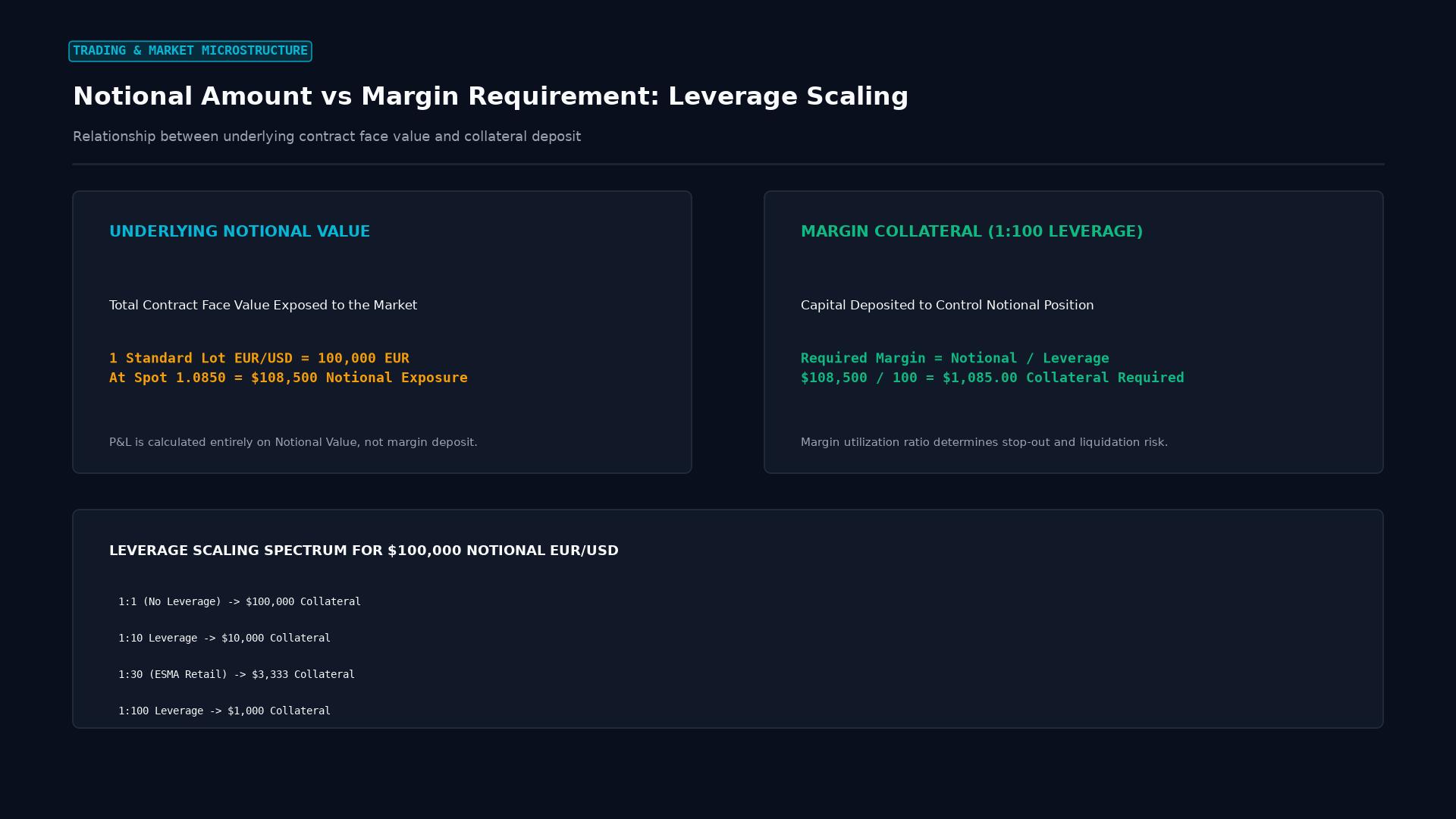 Figure: Underlying contract face value versus required collateral deposit across varying leverage tiers for standard currency contracts.
Key Takeaways
- The Mathematical Base: The notional amount is the underlying scale factor used to determine dollar profits, losses, and financing fees in derivative contracts.
- Notional vs. Market Value: In the global OTC derivatives market, the Gross Notional Amount exceeds $600 trillion (according to the Bank for International Settlements), whereas the actual Gross Market Value (replacement cost) is a small fraction—roughly $15 to $20 trillion.
- Core of Contract Lot Sizing: In spot forex, contract sizes correspond to standard notional amounts: Standard Lot = 100,000 units, Mini Lot = 10,000 units, and Micro Lot = 1,000 units of the base currency.
- Pip Value Multiplier: The monetary value of each pip is directly proportional to the notional amount of the trade: $\text{Pip Value} = \text{Notional Amount} \times 0.0001$.
- Interest Rate Swaps (IRS): In multi-billion-dollar interbank interest rate swaps, the notional principal is never paid; banks merely exchange the net difference between fixed and floating interest applied to that notional figure.
Comparative Taxonomy: Notional vs. Realized Capital Metrics
| Financial Metric | Conceptual Definition | Physical Capital Transferred? | Example on 1.00 Lot EUR/USD |
|---|---|---|---|
| Notional Amount | Face value of the underlying contract | No (Hypothetical reference) | €100,000 ($108,500) |
| Required Margin | Collateral locked by broker to hold trade | Yes (Locked from cash balance) | $1,085 (at 1:100 leverage) |
| Account Equity | Real cash balance + Floating mark-to-market P&L | Realizable upon liquidation | $10,000 total balance |
| Gross Market Value | Replacement cost to close contract today | Settled via daily variation margin | $500 floating gain/loss |
The Mathematics of Notional Exposure in Forex
In leveraged margin trading, misunderstanding the notional amount is the primary cause of rapid retail trader ruin. Traders often focus on their small deposited margin while forgetting the colossal notional liability they command:
$$\text{Notional Amount} = \text{Lot Volume} \times \text{Contract Size of Base Currency}$$
$$\text{Effective Leverage} = \frac{\text{Total Notional Exposure in Account Currency}}{\text{Account Equity}}$$
$$\text{Dollar P&L} = \text{Notional Amount} \times (\text{Exit Price} - \text{Entry Price})$$
Practical Numerical Example:
A trader deposits $5,000 into a brokerage account offering 1:200 leverage:
- The trader opens 5 standard lots of EUR/USD at 1.0850.
- Notional Exposure: $5 \times €100,000 = \mathbf{€500,000}$ ($\mathbf{$542,500 \text{ USD}}$).
- Used Margin: $\frac{$542,500}{200} = \mathbf{$2,712.50}$.
- Effective Account Leverage: $\frac{$542,500}{$5,000} = \mathbf{108.5 \text{ to } 1}$.
Across a $542,500 notional exposure, every pip movement is worth $50.00. If EUR/USD drops by just 50 pips ($-$2,500$ loss), the trader loses 50% of their entire account balance in minutes. The trader was blinded by the $2,712 margin requirement, failing to respect the lethal reality of commanding a half-million-dollar notional commitment.
Real-World Case Study: The Multi-Trillion-Dollar Interest Rate Swap Market
The concept of notional amount is most vividly displayed in the institutional Interest Rate Swap (IRS) market:
- The Transaction: Bank A agrees to pay a fixed interest rate of 4.0% to Bank B for five years, while Bank B agrees to pay Bank A a floating interest rate (SOFR) on a $500,000,000 Notional Amount.
- The Operational Reality: Neither bank ever wires $500,000,000 to the other; doing so would bankrupt interbank liquidity.
- The Net Settlement:
- At the end of Year 1, floating SOFR fixes at 4.5%.
- Bank A owes Bank B: $$500,000,000 \times 4.0% = $20,000,000$.
- Bank B owes Bank A: $$500,000,000 \times 4.5% = $22,500,000$.
- Through payment netting, Bank B simply wires the net difference of $2,500,000 to Bank A.
- Conclusion: A multi-million-dollar cash flow was generated, priced, and settled using a half-billion-dollar notional amount that existed solely as an abstract mathematical reference point.
Systemic Risks of Runaway Notional Exposure
- The Illusion of Low Margin: When financial institutions build astronomical notional exposure on small margin collateral (such as AIG’s multi-billion-dollar Credit Default Swap notional books in 2008 or Archegos Capital’s total return equity swaps in 2021), a minor 2% adverse market move results in billions of dollars in actual cash margin deficits, threatening systemic clearinghouse insolvency.
- Cross-Currency Notional Mismatches: Multinational corporations that hedge foreign operations must ensure that derivative notional amounts match incoming physical commercial revenues; over-hedging creates speculative currency risk rather than insurance.
Frequently Asked Questions (FAQ)
Is notional value the amount of money I can lose?
In unleveraged derivatives or physical spot trading, your maximum loss is capped at the full notional value (if the underlying asset drops to zero). However, in options contracts where you buy puts or calls, your maximum loss is limited to the option premium paid, which is a tiny fraction of the contract’s total notional amount.
What is the notional amount of 1 micro lot in forex?
One micro lot (0.01 lot) represents a notional amount of 1,000 units of the base currency. For example, 1 micro lot of EUR/USD has a notional value of €1,000; 1 micro lot of GBP/USD has a notional value of £1,000.
Why do central banks track the notional value of OTC derivatives?
Central banks (via the Bank for International Settlements) monitor gross notional amounts to assess the total scale of interconnected commitments, systemic leverage, and potential contagion risk across global financial institutions during a market crisis.
Ready to trade forex?
Open a free demo account with a regulated broker. Practice with virtual funds before risking real money.