Derivative
A derivative is a financial contract whose economic value and cash flows are derived from the performance of an underlying reference asset, such as a currency pair, commodity, stock, bond, or interest rate benchmark. The four primary derivative families are forwards, futures, options, and swaps.
What Is a Derivative?
In modern financial markets, a derivative is a legally binding contractual agreement whose market price, settlement value, and cash flows are not generated independently, but are derived directly from the price fluctuations of an underlying reference entity—termed the underlying asset.
The underlying asset can take virtually any quantifiable financial or economic form:
- Currencies: Foreign exchange spot rates (e.g., EUR/USD, USD/JPY, GBP/USD).
- Commodities: Physical raw materials such as crude oil, natural gas, gold, copper, or wheat.
- Equities and Indices: Individual corporate shares or broad benchmarks like the S&P 500.
- Debt and Interest Rates: Sovereign treasury yields, corporate bonds, or benchmark interbank rates (such as SOFR or EURIBOR).
- Credit and Volatility: Corporate default risk (Credit Default Swaps) or market volatility (CBOE VIX futures).
The Bank for International Settlements (BIS) estimates that the global derivatives market encompasses over $600 trillion in gross notional contract value, dwarfing the size of global annual Gross Domestic Product and making derivatives the largest single financial complex in human history.
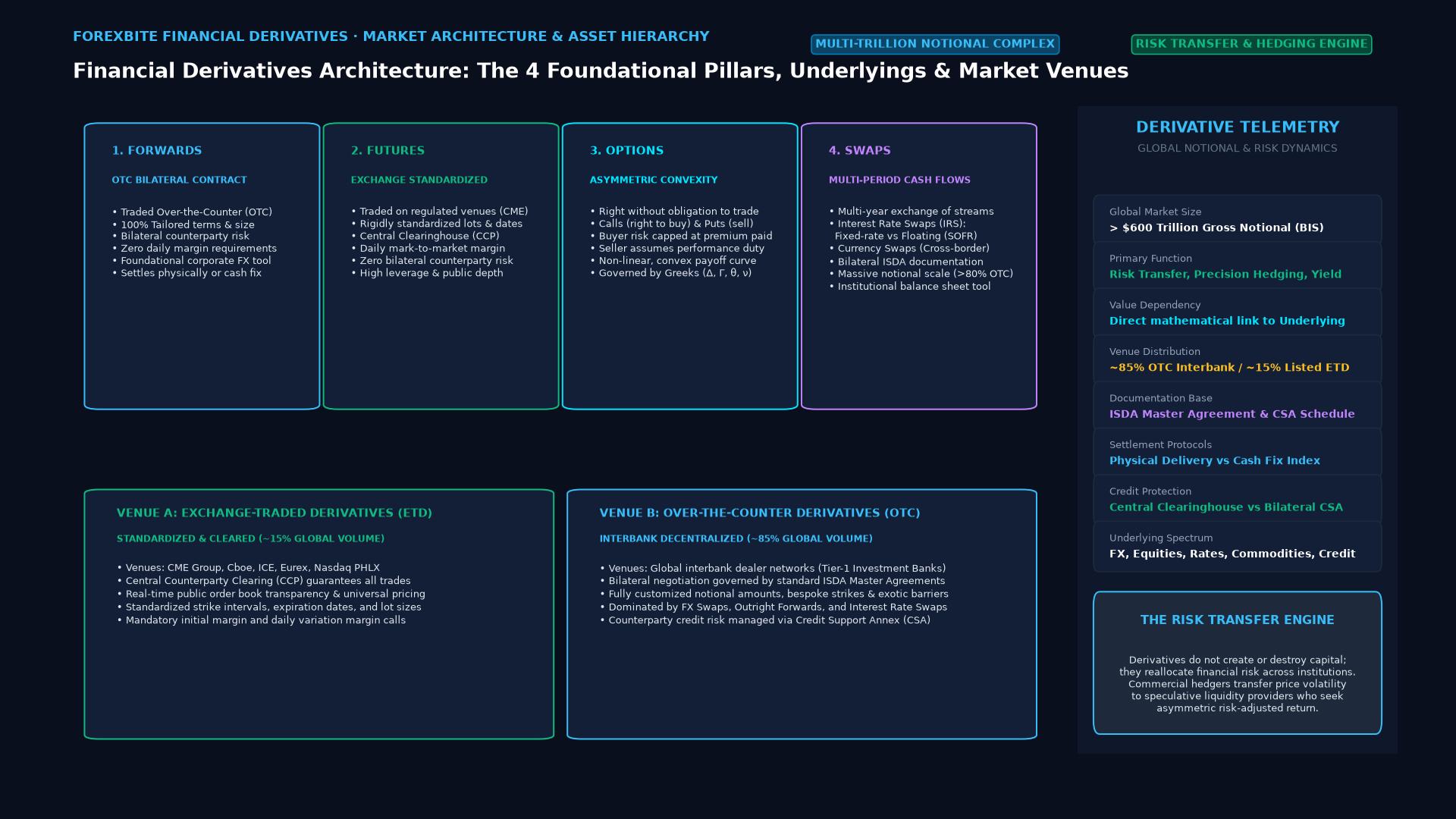
The Four Foundational Pillars of Derivatives
While thousands of specialized and exotic derivative structures exist, every financial derivative is constructed upon four primary structural families:
1. Forwards
A forward contract is a customized, private bilateral agreement between two commercial counterparties to buy or sell an asset at an agreed price (the forward price) on a specified date in the future.
- Characteristics: Traded exclusively over-the-counter (OTC); terms (contract size, delivery date, settlement mechanism) are 100% tailored to the participants’ specific commercial needs.
- Risk: Carries counterparty credit risk (the risk that one party defaults before the future delivery date arrives).
2. Futures
A futures contract is an exchange-traded, standardized version of a forward contract.
- Characteristics: Traded on public, regulated derivative exchanges like the Chicago Mercantile Exchange (CME) or Intercontinental Exchange (ICE). Contract quantities, tick sizes, and expiration dates are completely standardized.
- The Clearinghouse: Counterparty credit risk is eliminated through a central clearinghouse that acts as the buyer to every seller and the seller to every buyer, enforcing daily cash mark-to-market variation margin settlements.
3. Options
An option is a derivative contract that grants the buyer the legal right, but not the legal obligation, to buy (a call option) or sell (a put option) the underlying asset at a specified strike price on or before an expiration date.
- Asymmetric Risk: The option buyer’s loss is strictly capped at the upfront premium paid, while the seller (writer) assumes significant, often unlimited market risk in exchange for collecting the cash premium.
4. Swaps
A swap is an over-the-counter contract through which two counterparties agree to exchange series of future cash flows over an extended multi-year horizon (typically 1 to 30 years).
- Common Forms: Interest Rate Swaps (exchanging fixed-rate interest payments for floating-rate debt) and Currency Swaps (exchanging debt principal and interest in two different currencies).
Exchange-Traded (ETD) vs. Over-the-Counter (OTC)
Derivatives are transacted through two radically different market architectures:
| Feature | Exchange-Traded Derivatives (ETD) | Over-the-Counter Derivatives (OTC) |
|---|---|---|
| Trading Venue | Centralized Exchanges (CME, Eurex, ICE) | Decentralized Interbank Dealer Networks |
| Contract Terms | Rigidly Standardized | Completely Customized between Parties |
| Counterparty Risk | Zero (Guaranteed by Clearinghouse) | Exists (Managed via ISDA Agreements) |
| Price Transparency | High (Public live order books) | Opaque (Private dealer quotes) |
| Market Share | ~15% of global derivative volume | ~85% of global derivative volume |
In the foreign exchange market, the overwhelming majority of daily currency turnover is conducted over-the-counter through institutional banks executing spot trades, FX swaps, outright forwards, and vanilla options.
Core Economic Functions: Hedging vs. Speculation
Market participants deploy derivatives for three primary economic purposes:
1. Risk Management and Corporate Hedging
Derivatives allow corporations and asset managers to isolate and transfer unwanted financial risks to participants who are willing to bear them. An airline company uses crude oil futures to lock in jet fuel prices a year in advance; a German industrial exporter uses EUR/USD forward contracts to guarantee that a $50 million export invoice will not lose value if the US Dollar depreciates before payment arrives.
2. Speculation and Capital Efficiency
Because derivatives require only a fraction of the total contract value to be posted as initial margin collateral (often 1% to 5%), speculators achieve tremendous capital leverage. A retail trader can control a 100,000 EUR position ($108,500 notional value) with just $1,085 of account capital.
3. Price Discovery and Global Arbitrage
Derivative markets frequently react faster to breaking news than underlying physical spot markets due to superior liquidity and lower transaction costs. Trading in CME currency futures and interbank forwards provides the primary price discovery mechanism that guides global spot exchange rates.
Systemic Risks: Leverage and Contagion
Despite their immense economic utility, derivatives introduce profound systemic vulnerabilities when improperly managed.
Billionaire investor Warren Buffett famously characterized derivatives as “financial weapons of mass destruction” in his 2002 Berkshire Hathaway annual letter, highlighting how interconnected derivative webs can trigger systemic contagion.
The primary systemic dangers include:
- Excessive Hidden Leverage: Derivatives permit institutions to accumulate gigantic financial exposures with minimal upfront cash, masking catastrophic balance sheet vulnerabilities.
- Interconnected Counterparty Failures: During the 2008 global financial crisis, the near-collapse of insurance giant American International Group (AIG) stemmed not from traditional insurance policies, but from writing unhedged Credit Default Swaps (CDS) backing subprime mortgage debt. Had the US government not bailed out AIG, its failure would have instantly bankrupted dozens of major international investment banks across Wall Street and Europe.
Practical Forex Example: The Importer’s Forward Derivative
Consider a British retail chain that purchases €1,000,000 worth of electronic goods from a French supplier, with invoice payment due in six months:
- Current Spot Rate: EUR/GBP = 0.8500 (£850,000 cost).
- The Fear: The British Pound might weaken to EUR/GBP = 0.9000 over the next six months, which would increase the retailer’s inventory cost to £900,000, causing a £50,000 loss.
- The Derivative Solution: The retailer contacts its commercial bank and enters a 6-month EUR/GBP Forward Contract locking in a rate of 0.8530.
- Six Months Later: Geopolitical turmoil breaks out and Sterling plunges; the spot market rate jumps to 0.8950.
- The Outcome: The retailer settles the forward contract at the locked-in rate of 0.8530, purchasing the required €1,000,000 for £853,000.
- By utilizing a simple derivative, the retailer avoided paying £895,000 on the open spot market, saving £42,000 in cash and preserving its commercial retail profit margin.
Key Takeaways
- A derivative is a financial contract whose value is linked to an underlying asset, index, or reference benchmark.
- The four primary derivative types are Forwards (custom OTC), Futures (standardized exchange-traded), Options (asymmetric rights), and Swaps (multi-year cash flow exchanges).
- The global derivatives market exceeds $600 trillion in gross notional value, with OTC trading dominating the sector.
- Derivatives serve vital economic functions: corporate risk hedging, leveraged speculation, and international price discovery.
- High leverage and counterparty opacity in OTC derivatives can create systemic contagion during macroeconomic crises.
FAQ
Are retail forex CFDs considered derivatives? Yes. Contracts for Difference (CFDs) are cash-settled OTC derivative contracts between a retail trader and a broker, where the parties agree to exchange the difference between the opening and closing price of an underlying currency pair without physically delivering the underlying currency.
Why are futures safer than forwards? Futures are traded on centralized public exchanges with a clearinghouse guaranteeing trade settlement. Daily mark-to-market variation margin requirements prevent counterparty credit losses from accumulating, whereas private forward contracts carry the direct default risk of the opposing counterparty.
What is the difference between notional value and market value? The notional value is the total nominal face value of the underlying assets controlled by the contract (e.g., $100,000 in a standard EUR/USD contract). The market value (or replacement value) is the actual dollar amount the derivative is worth today based on current market prices (e.g., $1,500 of floating profit).
Ready to trade forex?
Open a free demo account with a regulated broker. Practice with virtual funds before risking real money.