Margin
Margin in forex trading is the portion of a trader's account equity set aside and locked by the broker as collateral to open and maintain a leveraged currency position, functioning as a good-faith performance bond rather than a fee.
In foreign exchange trading, margin is the required collateral that a trader must deposit with their broker to open and maintain a leveraged position. Margin is not a fee, an interest charge, or a payment for purchasing currency units. Instead, it serves as a good-faith performance bond held in escrow by the brokerage while a trade remains active.
Because retail forex allows traders to control contract sizes far larger than their cash balance, margin protects both the brokerage and the interbank liquidity providers against potential market default if adverse price swings generate steep floating losses.
The Direct Link Between Margin and Leverage
Margin requirement and financial leverage are two sides of the same mathematical coin. The margin requirement defines the percentage of the full notional contract value that must be held as cash collateral. The relationship is governed by a simple inverse formula:
$$\text{Margin Requirement (%)} = \frac{1}{\text{Leverage Ratio}} \times 100$$
$$\text{Leverage Ratio} = \frac{100}{\text{Margin Requirement (%)}} : 1$$
| Leverage Ratio | Regulatory Context | Margin Requirement (%) | Collateral per 1 Standard Lot ($100,000) |
|---|---|---|---|
| 1:30 | EU (ESMA), UK (FCA), Australia (ASIC) | 3.33% | $3,333 |
| 1:50 | United States (CFTC / NFA) | 2.00% | $2,000 |
| 1:100 | Common International / Offshore | 1.00% | $1,000 |
| 1:200 | High-leverage professional accounts | 0.50% | $500 |
| 1:500 | Extreme retail offshore accounts | 0.20% | $200 |
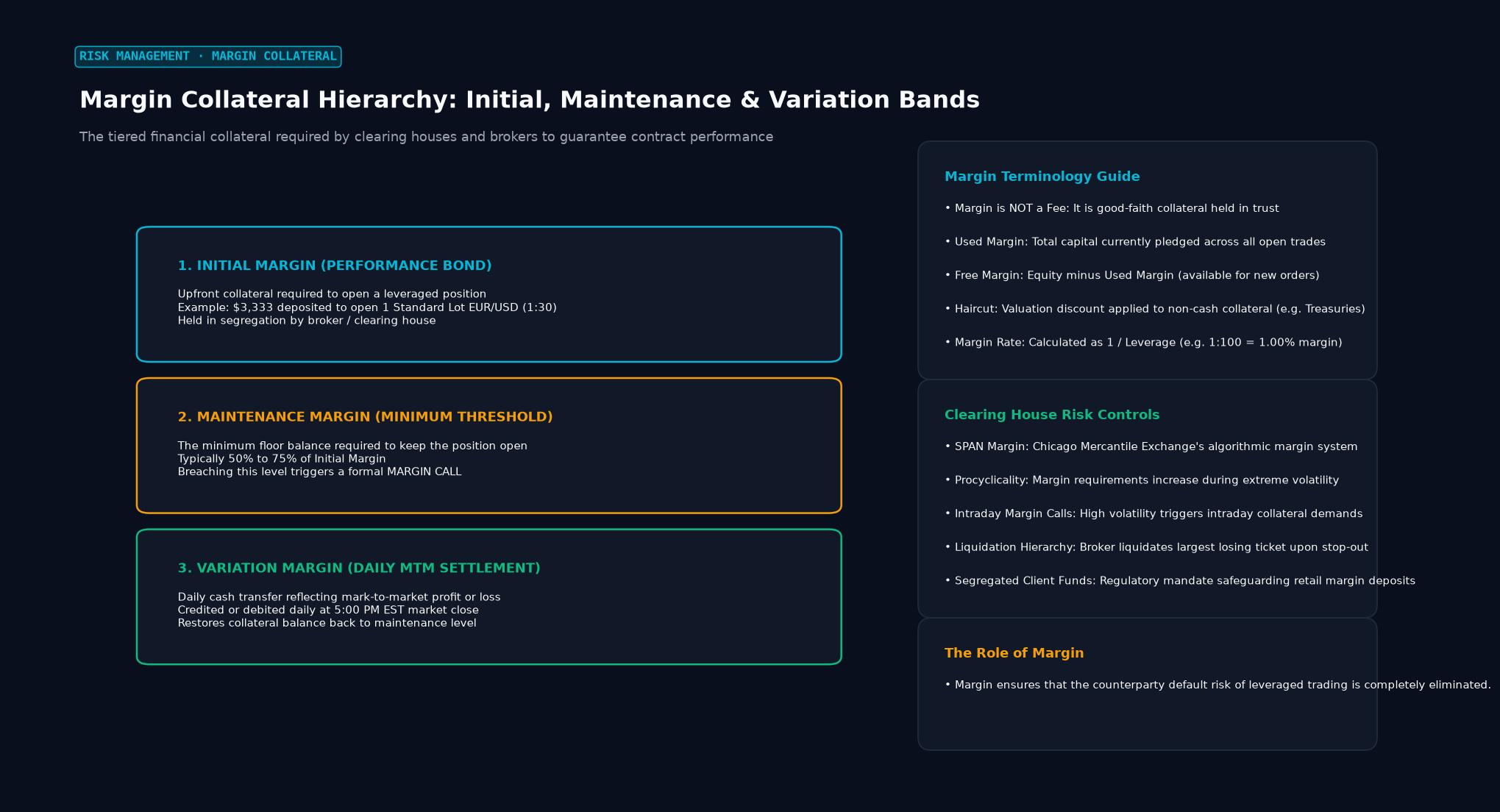 Figure: The tiered financial collateral required by clearing houses and brokers to guarantee contract performance
Essential Margin Metrics in a Trading Terminal
Every MetaTrader or modern institutional terminal displays five interconnected margin figures that fluctuate continuously as currency prices change:
- Balance: The realized cash in the trading account, excluding any open floating profits or losses.
- Equity: The true real-time cash liquidation value of the account: $$\text{Equity} = \text{Balance} + \text{Floating Profit / Loss}$$
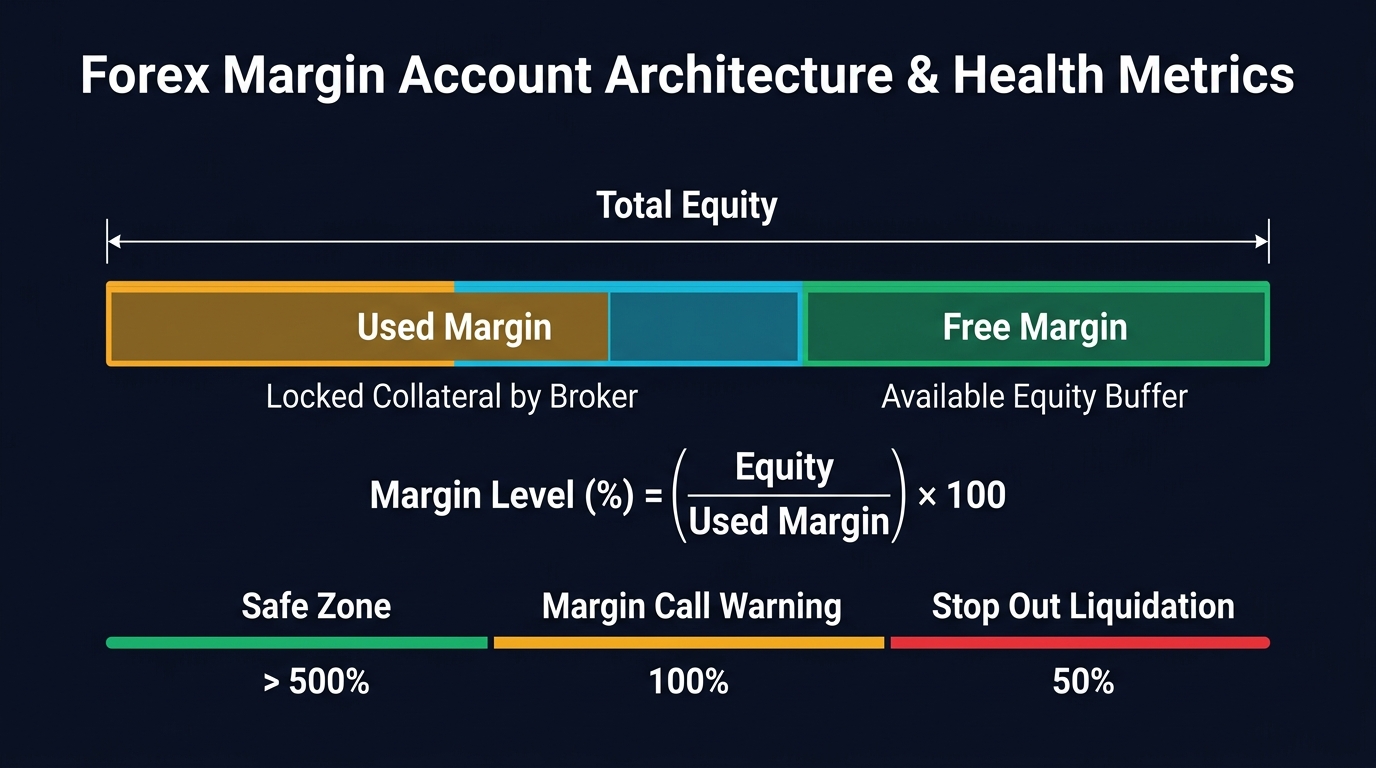
- Used Margin: The total aggregate collateral currently locked by the broker to support all open trades across all pairs.
- Free Margin: The remaining unencumbered equity available to either absorb market drawdowns or open fresh positions: $$\text{Free Margin} = \text{Equity} - \text{Used Margin}$$
- Margin Level (%): The primary health metric of the trading account, measuring the ratio of equity to used margin: $$\text{Margin Level (%)} = \left(\frac{\text{Equity}}{\text{Used Margin}}\right) \times 100$$
Calculating Forex Margin: A Concrete Mathematical Example
When calculating margin, the collateral is always assessed based on the base currency (the first currency listed in the pair) and then converted into the account’s deposit currency.
$$\text{Required Margin} = \text{Notional Contract Value} \times \text{Exchange Rate} \times \text{Margin Percentage}$$
Trade Setup Scenario
- Account Currency: USD
- Account Balance: $10,000
- Broker Leverage: 1:100 (1% margin requirement)
- Position: Long 2.0 standard lots of EUR/USD ($200,000 EUR base value)
- Entry Price: 1.0850
Step-by-Step Margin Calculation
- Total Notional Exposure: $2.0 \text{ lots} \times 100,000 \text{ EUR} = 200,000 \text{ EUR}$.
- Convert Base to Account Currency: $200,000 \text{ EUR} \times 1.0850 = $217,000 \text{ USD}$.
- Locked Used Margin: $$217,000 \times 1% = $2,170 \text{ USD}$.
- Free Margin at Inception: $$10,000 - $2,170 = $7,830 \text{ USD}$.
- Starting Margin Level: $($10,000 / $2,170) \times 100 = 460.8%$.
Drawdown Stress Test
Suppose an unexpected geopolitical event pushes EUR/USD down 150 pips from 1.0850 to 1.0700:
- On 2 standard lots, each pip is worth $20. A 150-pip adverse move equals an unrealized floating loss of $$3,000$ ($150 \times $20$).
- Updated Equity: $$10,000 - $3,000 = $7,000$.
- Updated Free Margin: $$7,000 - $2,170 = $4,830$.
- Updated Margin Level: $($7,000 / $2,170) \times 100 = 322.6%$.
Although the account suffered a 30% drawdown, the margin level of 322.6% remains well clear of liquidation thresholds.
Margin Call vs. Stop-Out Thresholds
Brokers enforce two strict protective barriers to ensure an account cannot trade into negative debt:
- Margin Call (Warning Tier): Typically triggered when the Margin Level drops to 100%. At this stage, equity exactly equals used margin; free margin is $0. The broker blocks the trader from opening new positions and may issue a notification to deposit funds or cut losing trades.
- Stop-Out (Liquidation Tier): Triggered when the Margin Level drops to a critical threshold—commonly 50% or 20% depending on broker jurisdiction. The broker’s automated risk engine immediately closes out the largest losing positions at prevailing market prices until the Margin Level climbs back above the minimum safety buffer.
Key Takeaways
- Collateral, Not a Cost: Margin is a temporary cash deposit frozen by your broker to secure leveraged trading exposure.
- Inverse to Leverage: Higher leverage ratios reduce the required margin deposit, allowing smaller accounts to open larger positions.
- Free Margin is the Buffer: The safety cushion protecting open positions from liquidation is Free Margin, not the initial account balance.
- Margin Level Health Gauge: A Margin Level falling toward 100% signals danger, while a drop to 50% or 20% triggers automatic forced liquidations.
- Base Currency Driven: Margin calculations depend on the base currency contract value and must be converted into the account’s denomination currency.
Frequently Asked Questions
Can I lose more money than my initial margin deposit?
Under modern retail regulations in major jurisdictions (such as the UK FCA, European ESMA, and Australian ASIC), retail traders have mandatory Negative Balance Protection. If an extreme market gap occurs, the broker absorbs negative balances, ensuring you cannot lose more than your deposited account equity.
What happens to used margin when a trade closes?
When a trade is closed, the locked used margin is instantly released back into your account’s unencumbered free balance, adjusted by the finalized net profit or loss of the trade.
Does margin vary between different currency pairs?
Yes. Major currency pairs like EUR/USD typically require lower margin (e.g., 3.33% in regulated regimes) because of their immense liquidity. Exotic or highly volatile currency pairs (such as USD/TRY or USD/ZAR) carry higher margin requirements (often 10% to 20%) to safeguard against violent price swings.
Ready to trade forex?
Open a free demo account with a regulated broker. Practice with virtual funds before risking real money.