Odd lotter
An odd lotter is an individual investor or trading entity that executes transactions in odd lots (orders containing fewer than the standardized 100-share round lot). Historically synonymous with the unsophisticated retail investor, the term now encompasses algorithmic execution child orders.
An odd lotter is an equity market participant who purchases or sells securities in quantities below the standardized trading unit established by stock exchanges. Throughout the history of the New York Stock Exchange (NYSE) and major global bourses, the standard exchange trading unit (known as a round lot) was fixed at 100 shares (or multiples thereof). Any trader submitting an order for 1 to 99 shares was classified as an “odd lotter.”
In classical financial literature and twentieth-century market microstructure, the odd lotter was universally synonymous with the small individual retail investor. Because institutional asset allocators and corporate syndicates traded in thousands or tens of thousands of shares, the odd lotter represented the everyday citizen investing modest personal savings into the stock market. However, the rise of electronic execution platforms, commission-free trading, fractional share investing, and high-frequency algorithmic child-order slicing has completely transformed the identity and economic role of the odd lotter in modern capital markets.
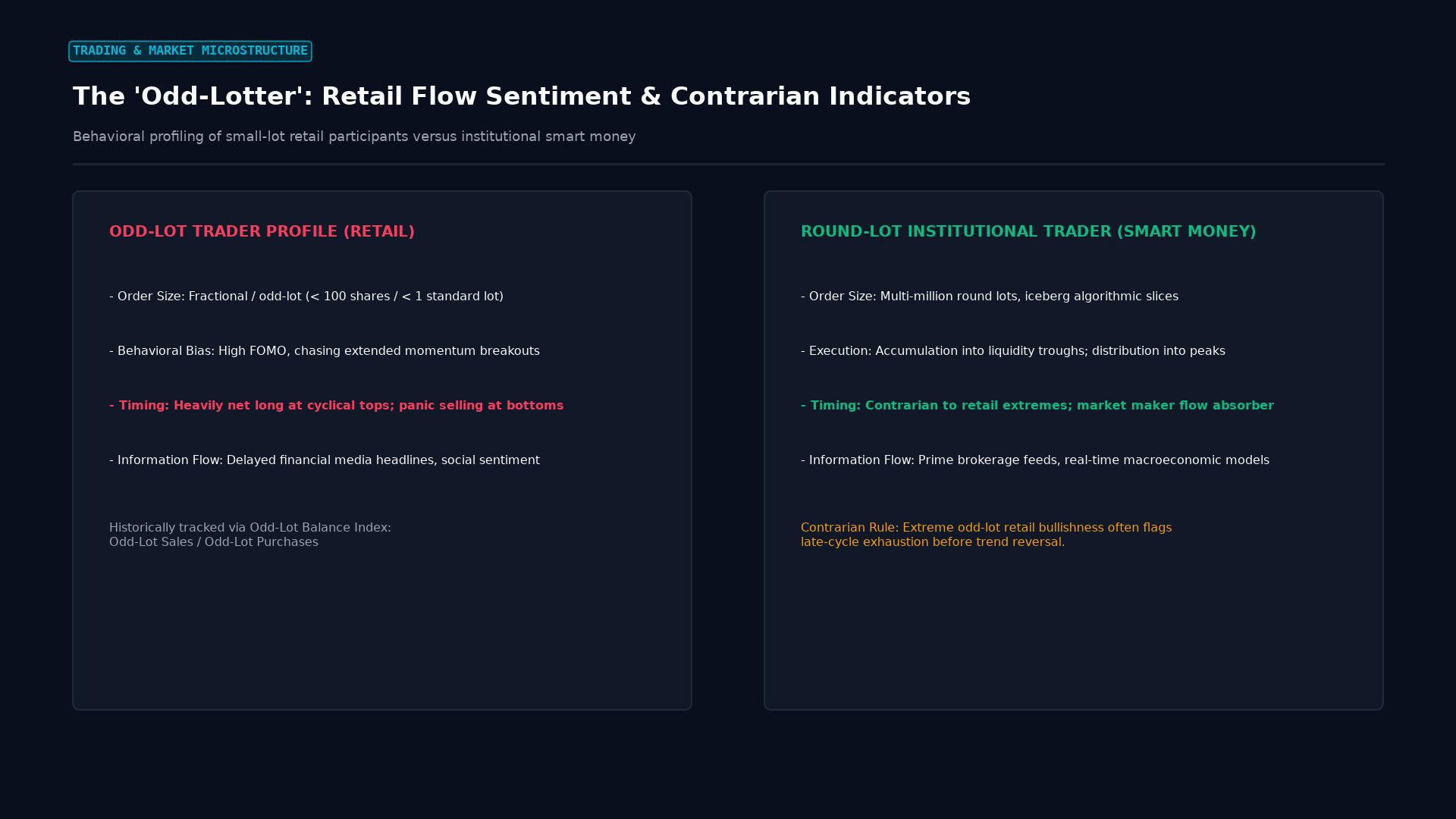 Figure: Retail vs institutional positioning: retail odd-lot sentiment extremes serving as contrarian indicators against smart money round-lot accumulation.
The Historical Role and Economics of the Odd-Lot Dealer
The Specialist Floor Ecosystem
Prior to electronic order matching networks, trading on the floor of the New York Stock Exchange was physically constrained. Floor specialists assigned to specific stock posts could not efficiently manage orders for individual odd-lot quantities (such as 7 shares of General Motors or 13 shares of US Steel) alongside massive 5,000-share institutional blocks.
To solve this physical matching friction, the exchange relied on specialized Odd-Lot Dealer Firms (such as Carlisle & Jacquelin and DeCoppet & Doremus, which merged in 1969 to form Carlisle DeCoppet & Co.):
- The Inventory Function: Odd-lot dealers acted as principal market intermediaries, maintaining substantial round-lot inventories on their own balance sheets.
- Order Aggregation: When retail brokerage firms (such as Merrill Lynch or E.F. Hutton) received customer orders for 25 shares, they routed them to the odd-lot dealer post.
- The Odd-Lot Differential (Fee Penalty): Odd-lot dealers did not provide execution for free. They levied a mandatory surcharge known as the odd-lot differential:
- For stocks trading at or below $55 per share, the dealer added an extra 1/8th of a point ($0.125) per share to purchases and deducted 1/8th from sales.
- For stocks trading above $55, the differential rose to 1/4th of a point ($0.25) per share.
- This differential represented a heavy percentage transaction drag on small investors, making frequent retail trading prohibitively expensive.
                    HISTORICAL ODD-LOT EXECUTION POST

  Retail Investor (Wishes to buy 15 shares of AT&T)
         |
         v
  Retail Brokerage Commission House (Merrill Lynch)
         |
         | Pneumatic tube message to floor post
         v
  Odd-Lot Dealer Firm (Carlisle DeCoppet & Co.)
         |
         +--> Breaks down a 100-share round lot from inventory
         +--> Executes 15 shares at Round-Lot Price + $0.125 Differential
         +--> Confirms execution back to retail investor
Regulatory Milestones Transforming Odd-Lot Trading
A succession of federal regulatory reforms dismantled the barriers historically separating the odd lotter from the broader capital markets:
+------------------------+--------------------------------------------------+
| Regulatory Event       | Direct Impact on the Odd Lotter                  |
+------------------------+--------------------------------------------------+
| May Day 1975           | SEC deregulated fixed brokerage commission rates,|
| (Securities Acts Amend)| giving birth to discount brokerages (Charles     |
|                        | Schwab) and lowering retail trading overhead.    |
+------------------------+--------------------------------------------------+
| Decimalization (2001)  | US exchanges transitioned from fractions (1/8ths,|
|                        | 1/16ths) to decimals, collapsing bid-ask spreads |
|                        | and permanently eliminating the odd-lot penalty. |
+------------------------+--------------------------------------------------+
| Regulation NMS (2005)  | Rule 611 protected round lots on the public tape |
|                        | but left odd lots unshielded, accelerating their |
|                        | migration into off-exchange dark pools.          |
+------------------------+--------------------------------------------------+
| Market Data Infra.     | SEC redefined round lots into dynamic price tiers|
| Rules (MDIR 2020)      | (100, 40, 10, or 1 share), pulling high-priced   |
|                        | odd lots directly onto the public protected tape.|
+------------------------+--------------------------------------------------+
1. The May Day 1975 Revolution
On May 1, 1975, the Securities and Exchange Commission formally abolished fixed minimum commission schedules on American stock exchanges. This unlocked intense price competition, allowing discount brokerages to emerge and reducing the transaction penalty imposed on odd-lot retail orders.
2. The Reg NMS Blind Spot
Under the SEC’s Regulation National Market System (Reg NMS) enacted in 2005:
- Rule 611 (The Order Protection Rule): Legally mandated that trading venues cannot execute an order at a price inferior to the National Best Bid or Offer (NBBO) displayed across any registered exchange.
- The Odd-Lot Exclusion: Crucially, Rule 611 defined protected quotes strictly as round lots (100 shares). Odd-lot limit orders placed by traders inside the prevailing NBBO were completely excluded from the public Securities Information Processor (SIP) consolidated tape.
- As institutional share prices soared (e.g., Berkshire Hathaway Class A trading over $500,000 per share, and tech stocks trading at $1,000+), an increasing volume of superior prices posted as odd lots became invisible to public investors, prompting SEC intervention in 2020 to redefine round lots dynamically.
The Modern Odd Lotter: Retail Wholesaling vs. Algorithmic Shredding
Today, the concept of the odd lotter has split into two completely separate market phenomena:
                     TWO FACES OF THE MODERN "ODD LOT"

  THE RETAIL INVESTOR                       THE INSTITUTIONAL ALGORITHM
  +------------------------------------+    +------------------------------------+
  | - Routes via mobile app            |    | - Executes 100,000-share parent    |
  | - Wholesaled via PFOF              |    | - Smart Order Router (SOR / TWAP)  |
  | - Executed off-exchange (SDP/TRF)  |    | - Shredded into tiny odd-lot childs|
  | - Sub-penny price improvement      |    | - Hit lit books across 16 exchanges|
  | - Fractional shares supported      |    | - Minimizes institutional footprint|
  +------------------------------------+    +------------------------------------+
1. The Retail Odd Lotter and Payment for Order Flow (PFOF)
Modern individual retail investors rarely have their odd-lot orders routed directly to the physical order books of the New York Stock Exchange or Nasdaq. Instead, retail brokers (such as Robinhood, Charles Schwab, and E*TRADE) utilize Payment for Order Flow (PFOF):
- Retail odd-lot orders are routed off-exchange directly to wholesale market makers (such as Citadel Securities, Virtu Financial, and Two Sigma).
- Because retail orders represent non-institutional, non-toxic flow, wholesalers execute them against their own internal balance sheets, providing retail investors with sub-penny price improvement relative to the National Best Bid and Offer (NBBO).
- The executed trades are reported to the Trade Reporting Facility (TRF), keeping retail odd lots largely separated from the public displayed order books.
2. The Algorithmic Slicer: Institutional Odd Lotting
Simultaneously, institutional asset managers executing multi-million-dollar parent orders have become the largest generators of odd lots in modern financial history.
To execute an order to purchase 40,000 shares of an equity without triggering market impact or tipping off predatory algorithms, an institutional algorithmic execution engine (such as an Iceberg or VWAP algorithm) systematically slices the block into hundreds of tiny child orders: $$\text{Parent Order: } 40,000 \text{ Shares} \Longrightarrow \sum_{i=1}^{1,800} \text{Child Orders of } 12, 17, 23, \text{ and } 38 \text{ Shares}$$
Because these child orders are posted as odd lots across multiple fragmented exchanges, odd-lot trades now account for over 60% of all executed trades on major US exchanges. Consequently, modern market data analysts cannot assume that an odd lot reflects an uninformed retail investor.
The Rise of Fractional Share Investing
The latest evolution of odd-lot trading is the emergence of fractional share investing, which extends the odd-lot concept below single whole shares:
- Rather than purchasing a full share of a stock priced at $500, a retail investor can purchase $10 worth, receiving 0.02 shares.
- Broker Omnibus Architecture: Because stock exchanges do not clear fractional shares, the brokerage firm purchases a standard whole share in its own omnibus clearing account and tracks the fractional ledger entries internally for the benefit of individual account holders.
- This innovation has democratized equity ownership, allowing small investors with modest capital to construct diversified, multi-stock portfolios regardless of nominal stock prices.
Comparative Matrix: The Changing Landscape of Odd-Lot Execution
+------------------------+-----------------------------+-----------------------------+
| Feature                | Classical Odd Lotter (1970) | Modern Odd Lotter (2020s)   |
+------------------------+-----------------------------+-----------------------------+
| Primary Identity       | Individual retail citizen   | Institutional algorithm or  |
|                        | investing personal savings  | retail app user / micro-fund|
+------------------------+-----------------------------+-----------------------------+
| Order Size             | 1 to 99 whole shares        | 1 to 99 shares, or          |
|                        |                             | fractional (0.01 shares)    |
+------------------------+-----------------------------+-----------------------------+
| Execution Venue        | Specialized NYSE floor post | Off-exchange wholesaler     |
|                        | (Odd-Lot Dealer inventory)  | (PFOF) or lit exchange SOR  |
+------------------------+-----------------------------+-----------------------------+
| Transaction Cost       | Fixed broker commission +   | Zero commission +           |
|                        | 1/8th or 1/4th penalty diff.| sub-penny price improvement |
+------------------------+-----------------------------+-----------------------------+
| Market Data Status     | Reported separately on      | Formally integrated into    |
|                        | specialized odd-lot ticker  | public SIP under MDIR rules |
+------------------------+-----------------------------+-----------------------------+
Best Practices for Trading Odd Lots in Modern Markets
- Leverage Price Improvement from Wholesalers: Retail traders executing odd lots should select brokers that report strong execution quality under SEC Rule 605 disclosures. Top wholesale internalizers frequently execute retail odd lots at prices better than the displayed NBBO.
- Beware of Hidden Odd-Lot Liquidity: Institutional execution traders must access proprietary exchange direct depth-of-book data feeds (such as Nasdaq TotalView or NYSE OpenBook) rather than relying solely on basic consolidated SIP data. Significant liquidity resting between the bid and ask is frequently composed of odd-lot limit orders.
- Use Limit Orders for High-Priced Stocks: When trading high-nominal-value equities (over $500 per share) where a 10-share trade represents an odd lot of substantial dollar value, always submit limit orders rather than market orders to prevent sudden slippage caused by thin resting odd-lot depth.
Frequently Asked Questions (FAQ)
What is an odd lotter in financial markets?
An odd lotter is an investor or trader who executes orders for quantities of shares that are fewer than the standardized 100-share round lot (that is, between 1 and 99 shares). In the past, odd lotters were almost exclusively small individual retail investors. In modern markets, the term also encompasses institutional algorithms that shred large parent orders into small child-lot pieces.
Did odd lotters pay extra fees in the past?
Yes. Prior to the automation and decimalization of stock exchanges, odd-lot orders could not be handled directly by regular floor specialists. They were routed to specialized odd-lot dealers who charged an extra fee known as the “odd-lot differential” (typically 1/8th or 1/4th of a dollar per share added to purchases or subtracted from sales). This penalty was permanently eliminated by modern electronic trading networks and decimalization.
Can odd lots set the National Best Bid and Offer (NBBO)?
Historically, under Regulation NMS, odd lots could not be included in the official protected NBBO, which displayed only round lots of 100 shares. However, under the SEC’s Market Data Infrastructure Rules (MDIR) approved in 2020, the definition of a round lot was modernized into smaller tiers (ranging from 100 shares down to 1 share for stocks priced over $10,000). This reform allows high-priced odd-lot quotes to be included directly in the consolidated market data tape.
Ready to trade forex?
Open a free demo account with a regulated broker. Practice with virtual funds before risking real money.