OECD
The OECD (Organisation for Economic Co-operation and Development) is an intergovernmental economic organisation of 38 member countries founded in 1961 to stimulate economic progress, foster global trade, set international taxation benchmarks, and coordinate evidence-based public policy.
The OECD (Organisation for Economic Co-operation and Development, French: Organisation de coopération et de développement économiques, OCDE) is an international, intergovernmental economic organization headquartered at the Château de la Muette in Paris, France. Founded on September 30, 1961, as the successor to the post-World War II Marshall Plan reconstruction body, the OECD encompasses 38 democratic, market-oriented member countries across North America, Europe, Latin America, and the Asia-Pacific region.
Often referred to in global financial media as a policy think tank for developed market economies, the OECD operates as a high-level multilateral forum where sovereign governments compare policy experiences, analyze empirical economic datasets, identify international best practices, and coordinate legally binding international conventions. In global capital markets, the OECD is renowned for producing vital macroeconomic indicators (including the Composite Leading Indicators), setting the Transfer Pricing Guidelines governing multinational taxation, and architecting the historic 15% Global Minimum Corporate Tax framework.
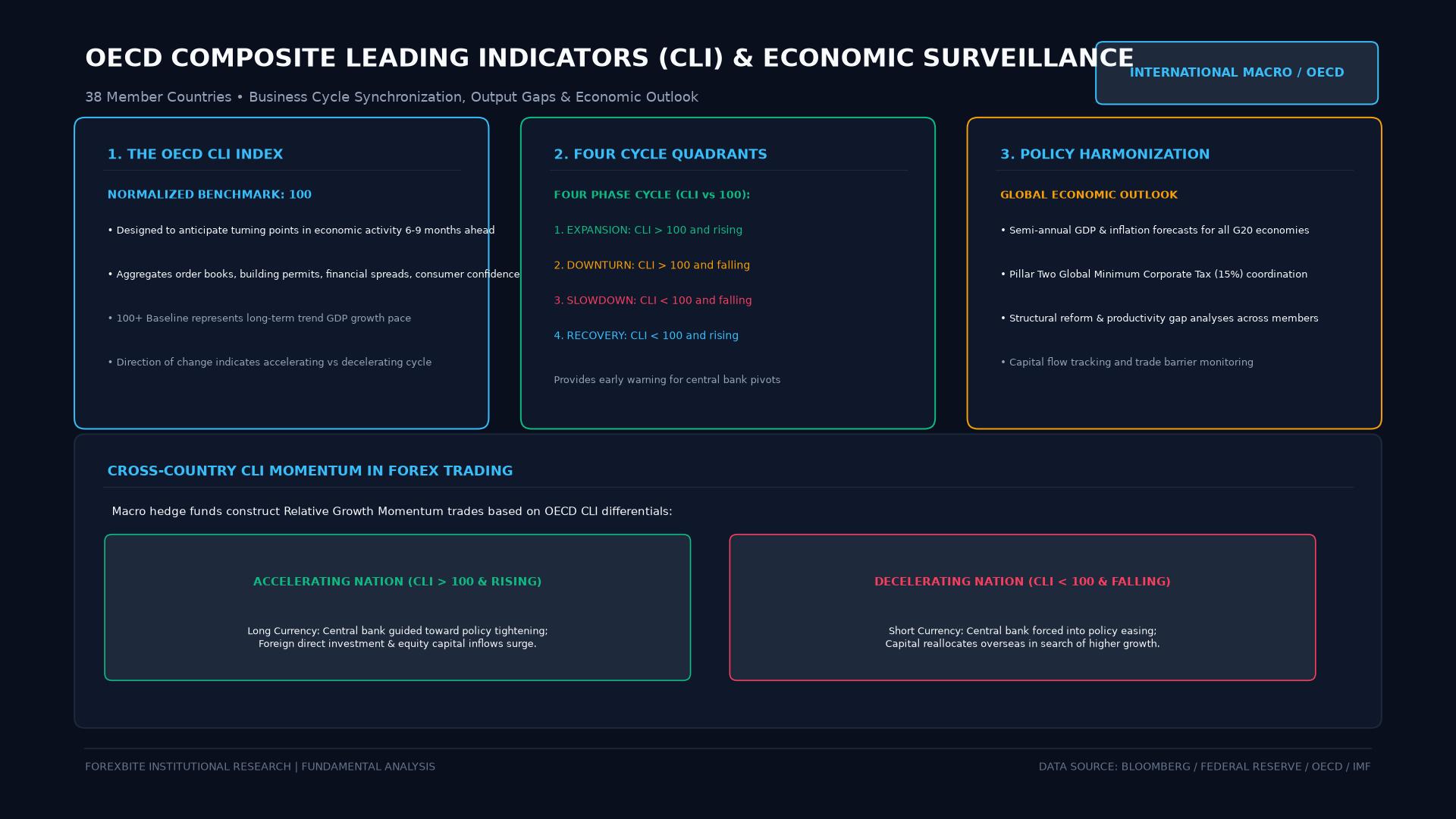 Figure: Institutional framework of the OECD Composite Leading Indicators (CLI), featuring the 4-phase business cycle model, semi-annual macroeconomic outlooks, and relative growth momentum trading strategies.
Historical Origins: From the Marshall Plan to Global Governance
The OEEC and Post-War European Reconstruction (1948)
The direct historical ancestor of the OECD was the Organisation for European Economic Co-operation (OEEC), established on April 16, 1948.
The OEEC was created for a single urgent mission:
- Administering the distribution of American and Canadian financial aid under the Marshall Plan (the European Recovery Program).
- Coordinating European trade liberalization and eliminating bilateral import quotas.
- Facilitating monetary convertibility across war-torn Western European states through the European Payments Union (EPU).
The 1960 Convention and the Rebirth as OECD
By the late 1950s, the post-war European reconstruction was successfully accomplished: industrial production had exceeded pre-war levels, and currencies had restored external convertibility.
Recognizing that international economic interdependence now extended across the Atlantic and Pacific, representatives of eighteen European nations, along with the United States and Canada, convened in Paris to draft the Convention on the Organisation for Economic Co-operation and Development on December 14, 1960.
On September 30, 1961, the convention formally entered into force, transforming the regional OEEC into the global OECD:
- Expanded membership beyond Europe, admitting Japan (1964), Finland (1969), Australia (1971), and New Zealand (1973).
- Broadened the institutional mandate from reconstruction aid distribution to fostering long-term economic growth, financial stability, high employment, and expanding world trade on a multilateral, non-discriminatory basis.
Membership Criteria and Global Influence
Today, the OECD includes 38 sovereign member states representing approximately three-fifths of global Gross Domestic Product (GDP) and three-quarters of global merchandise trade:
+------------------------+--------------------------------------------------+
| Geographic Region      | OECD Sovereign Member Nations                    |
+------------------------+--------------------------------------------------+
| North America          | United States, Canada, Mexico                    |
+------------------------+--------------------------------------------------+
| Europe                 | Austria, Belgium, Czech Republic, Denmark,       |
| (28 Nations)           | Estonia, Finland, France, Germany, Greece,       |
|                        | Hungary, Iceland, Ireland, Italy, Latvia,        |
|                        | Lithuania, Luxembourg, Netherlands, Norway,      |
|                        | Poland, Portugal, Slovak Republic, Slovenia,     |
|                        | Spain, Sweden, Switzerland, Turkey, UK           |
+------------------------+--------------------------------------------------+
| Asia-Pacific           | Japan, South Korea, Australia, New Zealand       |
+------------------------+--------------------------------------------------+
| Middle East & LatAm    | Israel, Chile, Colombia, Costa Rica              |
+------------------------+--------------------------------------------------+
The Accession Process
Accession to the OECD is not automatic. Prospective candidate nations undergo an exhaustive, multi-year legislative audit conducted by more than twenty technical committees:
- Candidates must demonstrate adherence to open-market economic principles, democratic institutions, the rule of law, and human rights.
- Candidates must eliminate cross-border capital restrictions, adopt the OECD Codes of Liberalisation of Capital Movements, enforce rigorous environmental safeguards, and align anti-corruption statutes with the OECD Anti-Bribery Convention.
Macroeconomic Data, Surveillance, and Market Indicators
Global macroeconomic investors, sovereign bond desks, and quantitative hedge funds rely heavily on analytical datasets published by the OECD Economics Department:
                    THE OECD COMPOSITE LEADING INDICATOR (CLI)

  Economic Output (GDP)
   ^
   |                     [CLI Signals Peak 6-9 Months Early]
   |                             * (CLI Peak)
   |                            / \
   |                           /   \
   |                          /     * (Actual GDP Peak)
   |                         /       \
   |                        /         \
   |      (CLI Trough) *   /           \
   |                  \   /             \
   |                   \ /               * (Actual GDP Trough)
   |                    *
   +------------------------------------------------------------------------> Time
1. Composite Leading Indicators (CLI)
The OECD Composite Leading Indicator (CLI) is a premier early-warning metric designed to anticipate cyclical turning points (peaks and troughs) in economic activity six to nine months ahead of actual GDP data:
- Component Variables: The CLI aggregates high-frequency forward-looking components tailored to each individual economy, including order book backlogs, construction permits, consumer sentiment indices, long-to-short yield curve spreads, and manufacturing workweek hours.
- De-Trending Methodology: The indicator is normalized around a long-term trend value of 100:
- A CLI value above 100 and rising signals economic expansion.
- A CLI value above 100 but declining signals a growth slowdown.
- A CLI value below 100 and declining signals economic contraction / recession risk.
- A CLI value below 100 and rising signals an early cyclical recovery.
2. The OECD Economic Outlook
Published bi-annually (with interim updates), the OECD Economic Outlook provides comprehensive econometric projections for global real GDP growth, consumer price inflation, sovereign fiscal balances, and current account balances across all member nations and major G20 non-member economies (including China, India, and Brazil). These forecasts serve as inputs for multilateral institutional asset allocation models.
Global Tax Architecture and the Historic BEPS Framework
The OECD exercises immense global influence through its Centre for Tax Policy and Administration, establishing international tax standards that prevent double taxation and eliminate cross-border tax evasion:
                     THE OECD TWO-PILLAR GLOBAL TAX REFORM

  PILLAR ONE: Reallocation of Taxing Rights       PILLAR TWO: Global Minimum Corporate Tax
  +--------------------------------------+       +-------------------------------------+
  | - Targets largest multinational MNEs |       | - Targets MNEs with €750M+ revenues |
  | - Reallocates 25% of residual profit | =====>| - Establishes a 15% MINIMUM TAX rate|
  |   to end-market consumer countries   |       | - Enforced via GloBE (IIR & UTPR)   |
  | - Eliminates physical presence nexus |       | - Ends global "Race to the Bottom"  |
  +--------------------------------------+       +-------------------------------------+
1. The OECD Model Tax Convention and Transfer Pricing
The OECD Model Tax Convention on Income and on Capital serves as the template for more than 3,000 bilateral Double Taxation Avoidance Agreements (DTAAs) worldwide.
Under Article 9 of the Model Convention, the OECD established the Arm’s Length Principle (ALP), requiring commercial and financial transactions between related entities within a multinational enterprise (MNE) to be priced as if they were independent third parties under comparable market circumstances: $$\text{Transfer Price (Related Parties)} \equiv \text{Fair Market Price (Unrelated Parties)}$$
The OECD Transfer Pricing Guidelines define the five approved economic pricing methodologies:
- Comparable Uncontrolled Price (CUP) Method.
- Resale Price Method (RPM).
- Cost Plus Method (CPM).
- Transactional Net Margin Method (TNMM).
- Transactional Profit Split Method (TPSM).
2. The Base Erosion and Profit Shifting (BEPS) Initiative
In the early 2010s, public investigations revealed that multinational technology and pharmaceutical giants (such as Apple, Google, and Pfizer) were utilizing sophisticated tax structures (such as the “Double Irish with a Dutch Sandwich”) to shift taxable corporate profits from high-tax operating nations to zero-tax offshore havens without substantive economic activity.
In response, the G20 mandated the OECD to launch the BEPS Action Plan (comprising 15 structural action points):
- Implemented Country-by-Country (CbC) Reporting, requiring MNEs to disclose revenues, profits, taxes paid, and employee headcounts on an individual jurisdiction basis.
- Restricted artificial treaty shopping through the Multilateral Convention to Implement Tax Treaty Related Measures to Prevent BEPS (MLI).
3. The Landmark Two-Pillar Solution (2021)
In October 2021, the OECD brokered a historic consensus joined by over 140 sovereign jurisdictions within the OECD/G20 Inclusive Framework:
- Pillar One: Reallocates taxing rights over a portion of the residual super-profits (profits exceeding 10% of revenue) earned by the world’s largest, most profitable multinational enterprises directly to the market jurisdictions where goods and services are consumed, regardless of physical corporate nexus.
- Pillar Two: Enforces a 15% Global Minimum Corporate Tax through the Global Anti-Base Erosion (GloBE) Rules:
- Applies to corporate groups with annual consolidated revenues of €750 million or more.
- If a multinational pays an effective tax rate (ETR) below 15% in an offshore subsidiary jurisdiction, its parent jurisdiction has the legal right to impose a top-up tax under the Income Inclusion Rule (IIR) or Under-Taxed Profits Rule (UTPR) to ensure a minimum 15% tax floor.
Anti-Corruption: The OECD Anti-Bribery Convention
On February 15, 1999, the OECD Convention on Combating Bribery of Foreign Public Officials in International Business Transactions entered into force.
The convention legally requires signatory nations to criminalize the bribery of foreign public officials in cross-border business dealings:
- Dismantled historical European tax provisions that previously permitted corporate bribes paid to foreign officials to be deducted as legitimate business expenses.
- Established an aggressive peer-review monitoring mechanism that scrutinizes national enforcement, serving as the international counterpart to the US Foreign Corrupt Practices Act (FCPA) and the UK Bribery Act.
Comparative Matrix: OECD vs. Peer Multilateral Institutions
+------------------------+-----------------------------+-----------------------------+-----------------------------+
| Feature                | OECD                        | International Monetary Fund | World Bank Group            |
+------------------------+-----------------------------+-----------------------------+-----------------------------+
| Primary Mission        | Public policy, taxation,    | Macroeconomic stability,    | Poverty reduction, economic |
|                        | trade standards, statistics | balance of payments loans   | developmental project loans |
+------------------------+-----------------------------+-----------------------------+-----------------------------+
| Financial Operations   | Zero lending facilities;    | Multi-billion-dollar credit | Direct infrastructure loans |
|                        | non-lending organization    | facilities (SBA, EFF, ECF)  | and development guarantees  |
+------------------------+-----------------------------+-----------------------------+-----------------------------+
| Governance Model       | Consensus-based Council of  | Quota-based voting weighted | Capital-share voting        |
|                        | democratic market nations   | by economic size (US veto)  | weighted by contributions   |
+------------------------+-----------------------------+-----------------------------+-----------------------------+
| Flagship Outputs       | CLI Indicators, BEPS Tax,   | World Economic Outlook,     | World Development Report,   |
|                        | Transfer Pricing Guidelines | Article IV Consultations    | Ease of Doing Business (hist)|
+------------------------+-----------------------------+-----------------------------+-----------------------------+
Best Practices for Analyzing OECD Policy and Data
- Track CLI Divergences Across Economic Regions: Quantitative macro traders should analyze spreads between national OECD Composite Leading Indicators (e.g., US CLI versus Euro Area CLI). Historical regressions demonstrate that widening CLI differentials serve as reliable leading indicators for cyclical trends in currency crosses like EUR/USD.
- Audit Corporate Tax Structures for Pillar Two Compliance: Equity research analysts and corporate treasurers must evaluate the impact of GloBE 15% top-up taxes on multinational corporate effective tax rates (ETRs). Companies that historically relied on zero-tax patent boxes or tax holidays will experience cash flow compression as Pillar Two rules take effect.
- Utilize OECD Stat Database for Cross-Border Research: The OECD Stat data portal provides harmonized, standardized statistical datasets spanning sovereign debt-to-GDP ratios, unit labor costs, pension replacement ratios, and foreign direct investment flows, ensuring reliable comparative cross-border financial analysis.
Frequently Asked Questions (FAQ)
What is the OECD, and how many countries belong to it?
The OECD (Organisation for Economic Co-operation and Development) is an intergovernmental economic organization founded in 1961 to promote policies that foster sustainable economic growth, employment, and international trade. It is composed of 38 member countries spanning North America, Europe, Latin America, and the Asia-Pacific region, all of which are committed to democratic governance and free-market economic systems.
Does the OECD lend money like the IMF or the World Bank?
No. The OECD is not a lending institution and does not maintain financing facilities. While the International Monetary Fund (IMF) provides emergency balance-of-payments loans and the World Bank finances developing infrastructure projects, the OECD functions as an economic policy coordinator, research institution, and standard-setting body that establishes international guidelines on taxation, corporate governance, and economic policy.
What is the OECD’s 15% Global Minimum Tax?
The 15% Global Minimum Tax is part of the OECD/G20 Two-Pillar Solution to address the tax challenges of economic digitalization. Under Pillar Two (the GloBE rules), multinational enterprises with annual consolidated revenues of €750 million or more are subject to an effective tax rate of at least 15% on their profits in every jurisdiction where they operate. If a company pays less than 15% in a low-tax jurisdiction, other participating nations are legally authorized to levy top-up taxes, eliminating corporate tax havens.
Ready to trade forex?
Open a free demo account with a regulated broker. Practice with virtual funds before risking real money.