OFEX
OFEX was a pioneering United Kingdom multilateral trading facility established in 1995 to provide secondary market liquidity and capital-raising mechanisms for unquoted small-and-medium enterprises (SMEs). The market subsequently evolved into PLUS Markets and modern Aquis Stock Exchange (AQSE).
OFEX was a specialized, market-maker-driven multilateral trading facility founded in London in 1995 to provide an organized secondary trading venue for shares of unquoted small-and-medium enterprises (SMEs) and growth-stage companies. Established at a time when the London Stock Exchange (LSE) was restructuring its secondary markets, OFEX functioned as a vital bridge between unlisted private equity and public stock exchange listings.
Across its operational evolution, OFEX democratized retail investor access to early-stage corporate ventures, providing a public quotation mechanism for legendary British enterprises, football clubs, and regional craft breweries. Over three decades of capital markets consolidation, regulatory formalization, and technological modernization, OFEX transformed successively into PLUS Markets, the ICAP Securities & Derivatives Exchange (ISDX), and ultimately the modern Aquis Stock Exchange (AQSE).
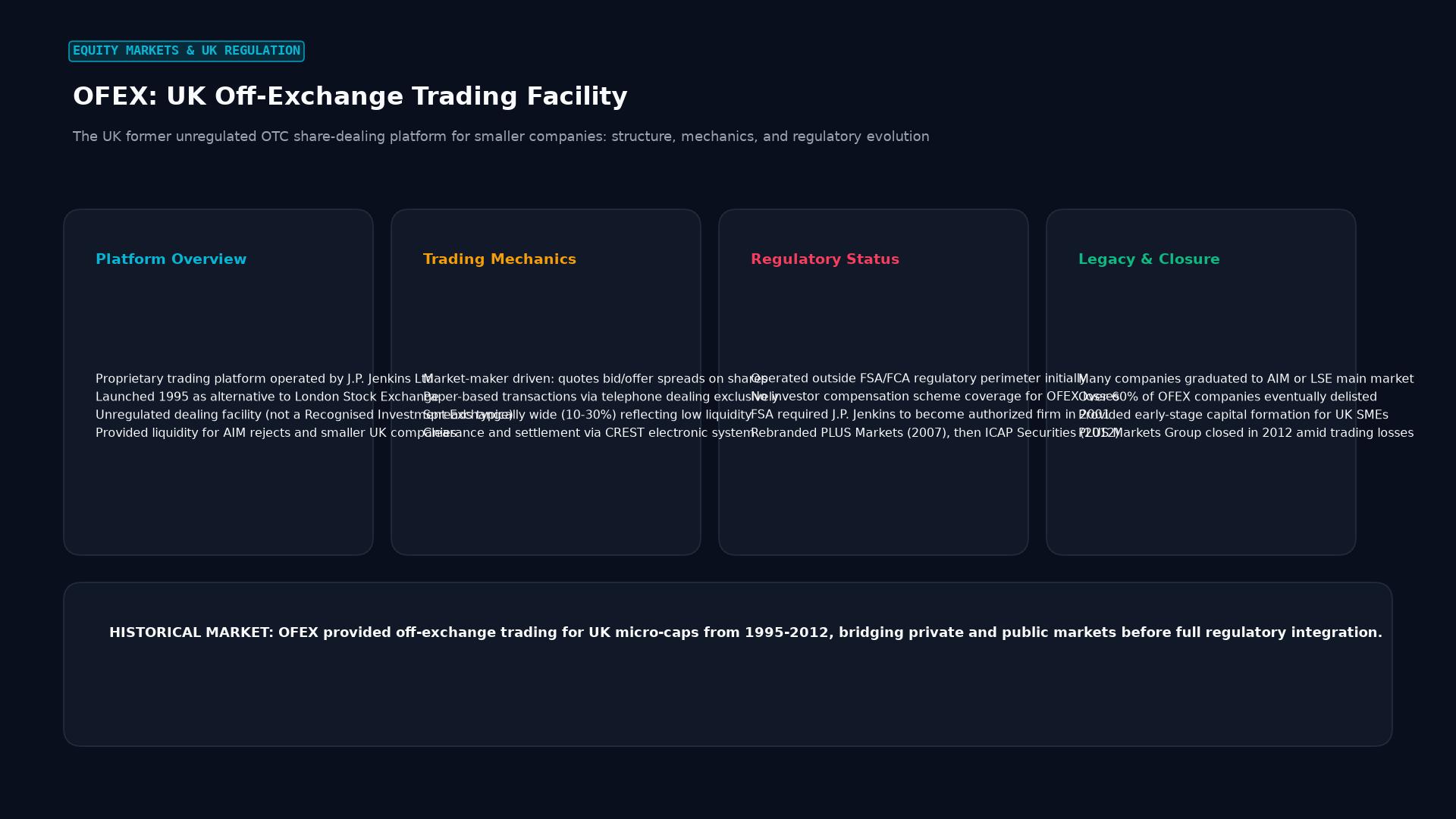 Figure: The UK former unregulated OTC share-dealing platform for smaller companies: structure, mechanics, and regulatory evolution
Historical Origins and the Genesis of the Market (1995)
The Abolition of LSE Rule 535(2)
Prior to 1995, trading in unlisted, unquoted British corporate shares was conducted informally under Rule 535(2) of the London Stock Exchange. This regulatory exemption allowed registered LSE stockbrokers to execute ad-hoc, off-exchange transactions in unlisted companies on behalf of clients on a case-by-case basis.
In June 1995, the London Stock Exchange executed two structural decisions:
- It established the Alternative Investment Market (AIM) as its flagship junior growth market to replace the obsolete Unlisted Securities Market (USM).
- It abolished Rule 535(2), withdrawing official administrative support for ad-hoc unquoted trading.
The Innovation of J.P. Jenkins
The creation of AIM was widely celebrated, but its regulatory admission standards (mandating the appointment of a Nominated Adviser and Nominated Broker, alongside substantial annual listing fees) placed it out of reach for hundreds of small, emerging British businesses seeking modest expansion capital (£500,000 to £3 million).
Recognizing this market failure, John Jenkins, founder of independent London market-making brokerage firm J.P. Jenkins Limited, launched OFEX in October 1995:
- It was engineered as an off-exchange, matched-bargain electronic quotation facility.
- Admission standards were streamlined: companies required two years of audited accounts, a basic admission document, and a commitment to release material corporate announcements to shareholders.
- Listing costs were a fraction of an AIM or Main Market flotation, offering a cost-effective incubator for growth enterprises.
                    COMPARISON OF UK CAPITAL-RAISING TIERS (1990s)

  LSE Main Market                AIM (Alternative Investment)   OFEX (Unquoted Facility)
  +-----------------------+      +---------------------------+  +-----------------------+
  | - Minimum 3-yr track  |      | - No minimum track record |  | - Designed for SMEs   |
  | - Minimum 25% float   | ===> | - Mandatory Nomad & Broker|=>| - No mandatory Nomad  |
  | - High listing costs  |      | - Tailored for mid-market |  | - Lowest cost barrier |
  | - Institutional focus |      |   growth capital          |  | - Matched-bargain pool|
  +-----------------------+      +---------------------------+  +-----------------------+
Legendary Alumni and the Culture of OFEX
In its heyday during the late 1990s and early 2000s, OFEX captured the imagination of British retail investors by listing prominent, culturally significant, consumer-facing businesses that lacked the scale for full LSE admission:
+------------------------+--------------------------------------------------+
| OFEX Listed Enterprise | Corporate Profile and Historical Significance    |
+------------------------+--------------------------------------------------+
| Arsenal Holdings plc   | Holding company of Arsenal Football Club; traded |
|                        | on OFEX for years, enabling passionate fans to   |
|                        | purchase physical shares in the sports club.     |
+------------------------+--------------------------------------------------+
| Weetabix Limited       | Iconic British breakfast cereal manufacturer;    |
|                        | used OFEX to provide liquidity for employee and  |
|                        | family shareholder blocks before its buyout.     |
+------------------------+--------------------------------------------------+
| Adnams, Shepherd Neame,| Historic independent British regional breweries  |
| Wadworth & Co.         | listed on OFEX to maintain family independence   |
|                        | while offering tradeable equity to local patrons.|
+------------------------+--------------------------------------------------+
| Early Internet & Tech  | Early dot-com startups and junior mineral explora-|
| Speculative Startups   | tion firms utilizing OFEX for seed IPO financing.|
+------------------------+--------------------------------------------------+
Shareholders received physical share certificates, attended lively annual general meetings, and frequently enjoyed unique retail perks (such as shareholder discounts on hotel stays or brewery products).
Market Microstructure: Matched Bargains vs. Quote-Driven Trading
Trading on OFEX differed substantially from trading liquid equities on the London Stock Exchange’s electronic limit order book (SETS):
                     THE OFEX MATCHED-BARGAIN PIPELINE

  Buyer (Places Bid for 1,000 Shares)       Seller (Places Ask for 1,000 Shares)
                 \                                     /
                  \                                   /
                   v                                 v
          +---------------------------------------------------+
          |     OFFICIAL OFEX MARKET MAKER (J.P. Jenkins)     |
          | - Acts as crossing broker / matched-bargain desk  |
          | - Holds modest principal risk inventory           |
          | - Matches buyer and seller when liquidity aligns  |
          +---------------------------------------------------+
                                   |
                                   v
             Execution Confirmed (Settled via CREST or Paper)
1. The Matched-Bargain Mechanism
Because shares of microcap enterprises suffered from low daily trading velocity, continuous two-sided liquidity could not be guaranteed by traditional market makers without quoting astronomical bid-ask spreads.
To overcome this, OFEX operated predominantly as a matched-bargain trading facility:
- Market makers collected customer orders, matching buyers and sellers sequentially as offsetting volume arrived.
- Trades were negotiated manually over the telephone or via proprietary bulletin boards.
- Settlements were processed through the CREST electronic settlement system or through manual paper share transfer forms (Stock Transfer Forms) stamped by company registrars.
2. Illiquidity Risk and Extreme Bid-Ask Spreads
Investors in OFEX securities faced severe liquidity risk:
- Spreads between the bid price (what dealers were willing to pay) and the ask price (what dealers charged buyers) frequently reached 10% to 25% of the underlying share price.
- In severe market downturns or corporate distress, trading in a stock could freeze entirely for weeks, leaving shareholders unable to liquidate positions at any price.
Tax Advantages: EIS, SEIS, and Inheritance Tax Relief
A major economic driver of investor participation on OFEX was the United Kingdom’s generous statutory tax incentives designed to channel private risk capital into unquoted trading enterprises:
+------------------------+--------------------------------------------------+
| UK Tax Incentive       | Statutory Mechanism for OFEX/AQSE Investors      |
+------------------------+--------------------------------------------------+
| Enterprise Investment  | 30% upfront income tax relief on invested capital|
| Scheme (EIS)           | alongside complete exemption from Capital Gains  |
|                        | Tax (CGT) on profits held for at least 3 years.  |
+------------------------+--------------------------------------------------+
| Seed EIS (SEIS)        | 50% upfront income tax relief for investments in |
|                        | early-stage seed ventures meeting statutory caps.|
+------------------------+--------------------------------------------------+
| Business Property      | 100% exemption from UK Inheritance Tax (IHT) for |
| Relief (BPR)           | qualifying unquoted trading shares held for a    |
|                        | minimum qualifying period of two years.          |
+------------------------+--------------------------------------------------+
| Loss Relief Against    | Capital losses realized on qualifying shares can |
| Income                 | be offset directly against employment income.    |
+------------------------+--------------------------------------------------+
Because HM Revenue & Customs (HMRC) classified OFEX securities as unquoted for tax purposes (even though they were traded on an organized bulletin board), high-net-worth investors constructed dedicated OFEX portfolios specifically to shelter estates from UK inheritance tax liabilities via Business Property Relief.
The Succession Path: From PLUS Markets to Aquis Stock Exchange
The institutional transformation of OFEX occurred across four distinct corporate chapters:
1. PLUS Markets Group (2005–2012)
In 2005, OFEX rebranded as PLUS Markets Group plc. The enterprise secured regulatory authorization from the UK Financial Services Authority (FSA) as a Recognised Investment Exchange (RIE):
- Launched advanced electronic trading software.
- Attempted to challenge the London Stock Exchange directly by offering secondary quote trading on major FTSE 100 and AIM shares alongside its primary unquoted market.
- Despite gaining significant quote volume, the global financial crisis of 2008 depleted junior market listings, leading to terminal corporate restructuring.
2. ISDX - ICAP Securities & Derivatives Exchange (2012–2019)
In 2012, interdealer brokerage giant ICAP plc (founded by Michael Spencer) acquired the market-operating assets of PLUS Markets, rebranding the platform as the ICAP Securities & Derivatives Exchange (ISDX). ICAP restructured the venue into an institutional corporate bond and equity growth exchange.
3. Aquis Stock Exchange (AQSE) (2020–Present)
In 2020, European pan-European exchange operator Aquis Exchange PLC acquired the business, formally launching the Aquis Stock Exchange (AQSE):
- Divided the primary growth market into two transparent regulatory segments:
- AQSE Access: Tailored for early-stage growth companies seeking growth capital.
- AQSE Apex: Designed for larger, more mature growth companies committed to higher standards of corporate governance, float minimums, and institutional market making.
- Introduced modern subscription-based exchange pricing and low-latency electronic central counterparty clearing, finalizing the technological evolution of the historic OFEX bulletin board into a premier European growth bourse.
Best Practices for Evaluating Unquoted Microcap Securities
- Audit Free Float and Controlling Shareholder Stakes: In junior unquoted markets, founder families or venture capitalists frequently control 70% to 80% of outstanding voting equity. A tiny public float amplifies share price volatility and increases the risk of minority shareholder oppression.
- Scrutinize Cash Burn and Runway: Microcap growth companies listed on junior exchanges rarely possess recurring operating profitability. Equity analysts must divide cash and cash equivalents by monthly operational cash burn to establish the exact number of months remaining before the company must execute dilutive equity placings.
- Verify HMRC Tax Relief Eligibility: Never assume a company qualifies for EIS or Business Property Relief automatically. Consult verified tax opinions, as subsequent corporate acquisitions or shifts into non-qualifying activities (such as property investment) can retroactively invalidate statutory tax exemptions.
Frequently Asked Questions (FAQ)
What was OFEX in UK financial history?
OFEX was a pioneering multilateral trading facility established in London in 1995 by brokerage firm J.P. Jenkins. It provided an organized electronic quotation and matched-bargain trading venue for shares of small-and-medium enterprises (SMEs) that were not officially quoted on the London Stock Exchange or the Alternative Investment Market (AIM).
What happened to the companies that originally traded on OFEX?
Over the past three decades, OFEX underwent successive corporate transformations. In 2005, it became PLUS Markets, which was acquired by ICAP in 2012 to become ISDX, and subsequently purchased by Aquis Exchange PLC in 2020 to become the Aquis Stock Exchange (AQSE). Many original OFEX companies matured and graduated to AIM or the LSE Main Market, while others continue trading today on AQSE.
Did shares traded on OFEX qualify for inheritance tax relief?
Yes. Under UK tax law, HM Revenue & Customs (HMRC) treated shares traded on OFEX as “unquoted” securities for tax purposes. Consequently, investors who held qualifying shares in trading businesses for at least two years could claim 100% Business Property Relief (BPR), exempting those assets entirely from UK Inheritance Tax upon death.
Ready to trade forex?
Open a free demo account with a regulated broker. Practice with virtual funds before risking real money.