Opening Price
The opening price is the initial transaction price at which a security, currency pair, commodity, or financial contract trades upon the official commencement of a daily trading session, electronic cross auction, or specific chart interval.
What Is the Opening Price?
The opening price (often referred to simply as the open) is the first recorded execution price of a financial instrument at the start of a specified trading period. In technical analysis, the opening price represents the critical first coordinate of the standard OHLC (Open, High, Low, Close) pricing bar and forms the base boundary of a Japanese candlestick body.
While the opening price in decentralized, 24-hour over-the-counter (OTC) markets like spot foreign exchange is continuous—defined primarily by the first interbank tick printed after the 5:00 PM EST daily rollover—centralized equity and futures exchanges (such as the NYSE, Nasdaq, and CME) utilize specialized non-continuous computerized opening cross auctions to establish the official opening price.
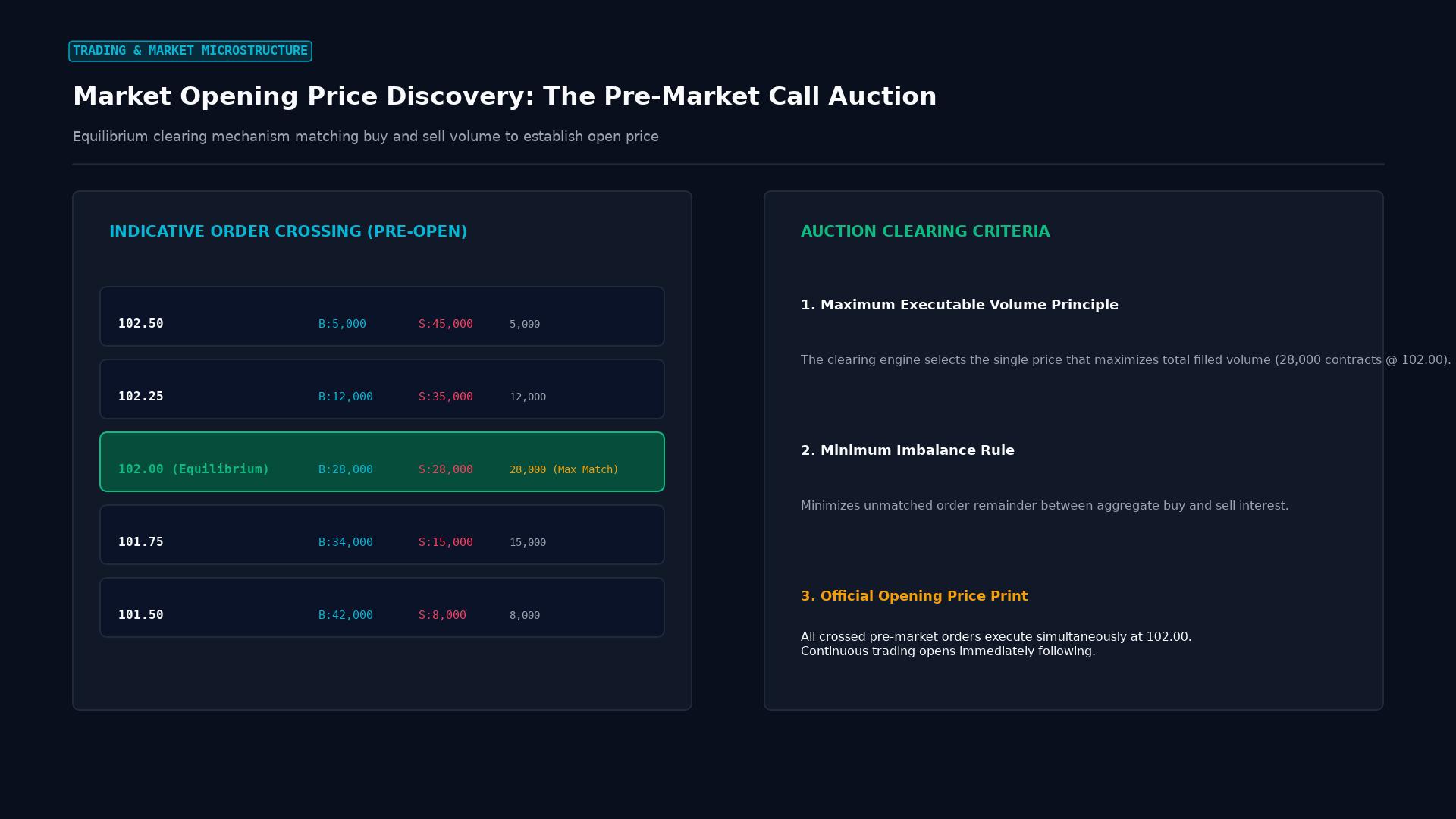 Figure: Pre-market opening auction discovery: crossing indicative buy and sell orders to find the equilibrium price that maximizes executable volume.
Determination of Opening Prices Across Exchanges
The mechanism used to determine an instrument’s opening price depends heavily on the market structure:
1. Centralized Equities: The Opening Cross Auction
On physical and electronic stock exchanges (like the New York Stock Exchange and Nasdaq), the official opening price is not determined by the first random market order received at 9:30 AM EST. Instead, exchanges conduct a multilateral algorithmic auction:
- Pre-market limit orders, market-on-open (MOO) orders, and limit-on-open (LOO) orders are aggregated in an auction order book.
- The exchange matching engine computes the Indicative Opening Price (IOP) that maximizes trading volume while minimizing order imbalance.
- At exactly 9:30:00 AM EST, all matched auction orders execute simultaneously in a single, massive liquidity event at that single calculated Opening Cross Price.
2. Spot Foreign Exchange: 24/5 Continuous Rolling Open
The global FX market does not feature a single centralized opening bell. Instead, spot currency trading operates continuously from the Asian-Pacific session open in Wellington and Sydney (Sunday at 5:00 PM EST) through the New York close (Friday at 5:00 PM EST).
- Each individual 24-hour trading day technically resets at 5:00 PM EST (22:00 UTC). The opening price of the new trading day is the first interbank bid/ask midpoint transaction completed immediately following the daily rollover.
- Intraday bar opens (such as the open of a 1-hour or 15-minute candle) simply inherit the price of the first traded tick within that time bucket.
Opening Gaps: Types and Market Psychology
When overnight news, macroeconomic data, or corporate earnings occur outside of trading hours, the new opening price frequently diverges significantly from the previous session’s closing price, creating an opening gap:
| Gap Classification | Opening Price Behavior | Market Context & Strategy |
|---|---|---|
| Common Gap | Opens slightly above or below the previous close during low-volume sessions. | Rapidly filled during early morning trading; reflects normal noise. |
| Breakaway Gap | Opens far outside a multi-week consolidation range or key technical chart pattern. | Accompanied by massive institutional volume; rarely fills quickly; initiates major trends. |
| Runaway (Measuring) Gap | Opens aggressively in the direction of an already powerful, established trend. | Driven by panic buying or selling; signals continuation toward a projected price target. |
| Exhaustion Gap | Opens with an extreme jump after an extended multi-month rally or sell-off. | Rapidly fades and closes lower on the day; signals reversal and buyer/seller exhaustion. |
                     OPENING GAP-UP PRICE DYNAMICS

  [Session 1 Close: $150.00] ---> Overnight Positive Earnings Shock
                                              |
                                              v
                               [Session 2 Open: $158.00] (+$8.00 Gap)
                                              |
                     +------------------------+------------------------+
                     |                                                 |
                     v                                                 v
           [Bullish Continuation]                              [Gap Fill Retracement]
       Price expands higher to $165                        Sellers drive price down
       (Breakaway / Runaway Gap)                           to touch $150 prior close
Technical Trading Significance of the Open
Professional quantitative and discretionary traders prioritize the opening price for several critical strategic reasons:
- Initial Balance (Market Profile): The price range established during the first 30 to 60 minutes after the opening price forms the “Initial Balance.” Whether subsequent price action trades above or below this opening range guides institutional directional bias for the remainder of the session.
- Open-High-Low-Close Pivot Points: Standard daily Floor Trader Pivots calculate key support and resistance levels using the formula: $$\text{Pivot (P)} = \frac{\text{High} + \text{Low} + \text{Close}}{3}$$ However, advanced intraday indicators (such as the Camarilla and DeMark pivot frameworks) explicitly integrate the relationship between the Open and Close to project daily volatility envelopes.
- Daily Bias (The Open as a Benchmark): For day traders, if the current price is trading above the daily opening price, intraday sentiment is classified as net bullish; trading below the daily open signals bearish control.
Real-World Case Study: The Sunday Evening Forex Opening Gap
On Sunday, April 23, 2017, global currency markets prepared for the weekly open following the first round of the French presidential election.
- Friday Close: On Friday afternoon at 5:00 PM EST, EUR/USD closed trading at 1.0725.
- Overnight Outcome: Centrist candidate Emmanuel Macron defeated far-right nationalist Marine Le Pen in the first round, drastically lowering perceived systemic Eurozone breakup risks.
- Sunday Open: When New Zealand and Australian interbank desks opened liquidity lines on Sunday at 5:15 PM EST, the opening price for EUR/USD exploded higher to 1.0880—an immediate 155-pip bullish opening gap.
- Market Action: Rather than filling the gap, institutional algorithmic buying lifted quotes throughout the Asian and European sessions, driving EUR/USD past 1.0930 without ever returning to the Friday close of 1.0725 for months.
Frequently Asked Questions
Can the opening price be identical to the previous session’s closing price?
In continuous 24-hour electronic markets (like spot forex during normal weekdays), the opening price of a new hourly candle is almost always identical or separated by only a fraction of a pip from the prior candle’s closing price. However, on weekend opens or after market halts, overnight fundamental news almost always creates a gap between the close and the next open.
How does the opening cross auction prevent market manipulation on stock exchanges?
Exchanges like the NYSE and Nasdaq utilize strict order cut-off times (e.g., 9:28 AM EST) after which market participants cannot cancel or alter On-Open orders without specialized regulatory reasons. Continuous dissemination of the Net Order Imbalance Indicator (NOII) allows the broader market to supply counter-liquidity if an imbalance threatens to distort the opening price artificially.
What is an Opening Range Breakout (ORB) strategy?
An Opening Range Breakout is a popular intraday trading strategy where a trader measures the high and low prices printed within the first 15 or 30 minutes following the market open. A buy trade is triggered if the price breaks above the morning high, while a short trade is entered if the price breaks below the morning low, anticipating that early institutional momentum will dictate the session trend.
Ready to trade forex?
Open a free demo account with a regulated broker. Practice with virtual funds before risking real money.