Order
An order is an explicit, binding instruction transmitted by a trader, investor, or automated trading algorithm to a broker, exchange, or liquidity provider specifying the purchase or sale of a designated quantity of a financial instrument under defined price, volume, and execution conditions.
What Is an Order?
In financial market microstructure, an order is the fundamental communication unit through which participants convey their trading intentions to the broader market. When an investor desires to buy or sell a foreign currency pair, equity share, commodity futures contract, or debt instrument, they submit an order specifying parameters such as ticker symbol, transaction direction (buy or sell), contract size or volume, price constraints, and duration of validity.
The processing and execution of an order are governed by strict pre-trade credit checks, regulatory best execution standards (such as MiFID II in Europe and Regulation NMS in the United States), and matching engine algorithms operating within electronic communication networks (ECNs) and centralized limit order books (CLOBs).
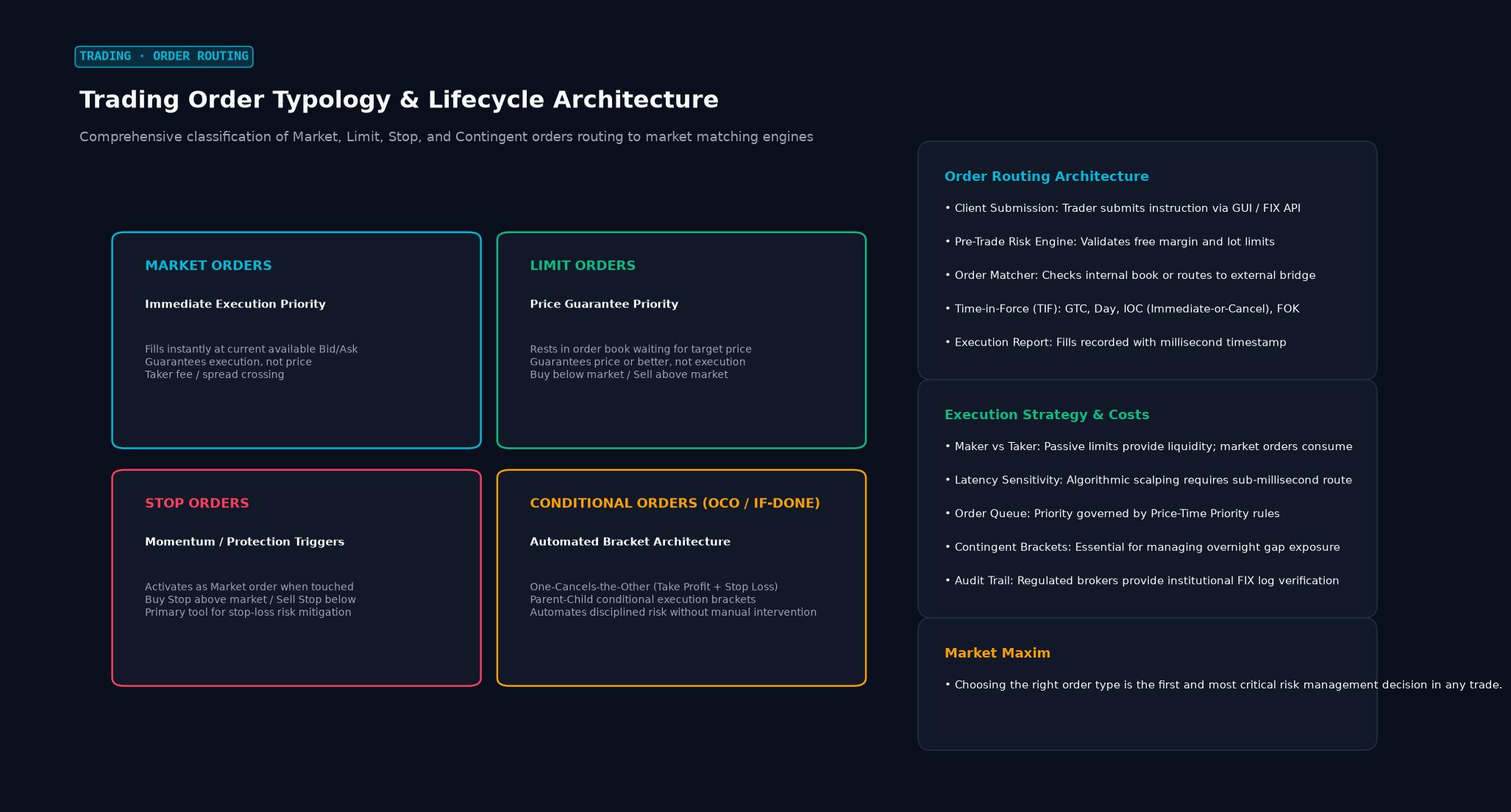 Figure: Comprehensive classification of Market, Limit, Stop, and Contingent orders routing to market matching engines
Primary Order Classifications
Modern electronic trading platforms accommodate a broad spectrum of order types designed to balance two competing priorities: speed of execution versus price certainty.
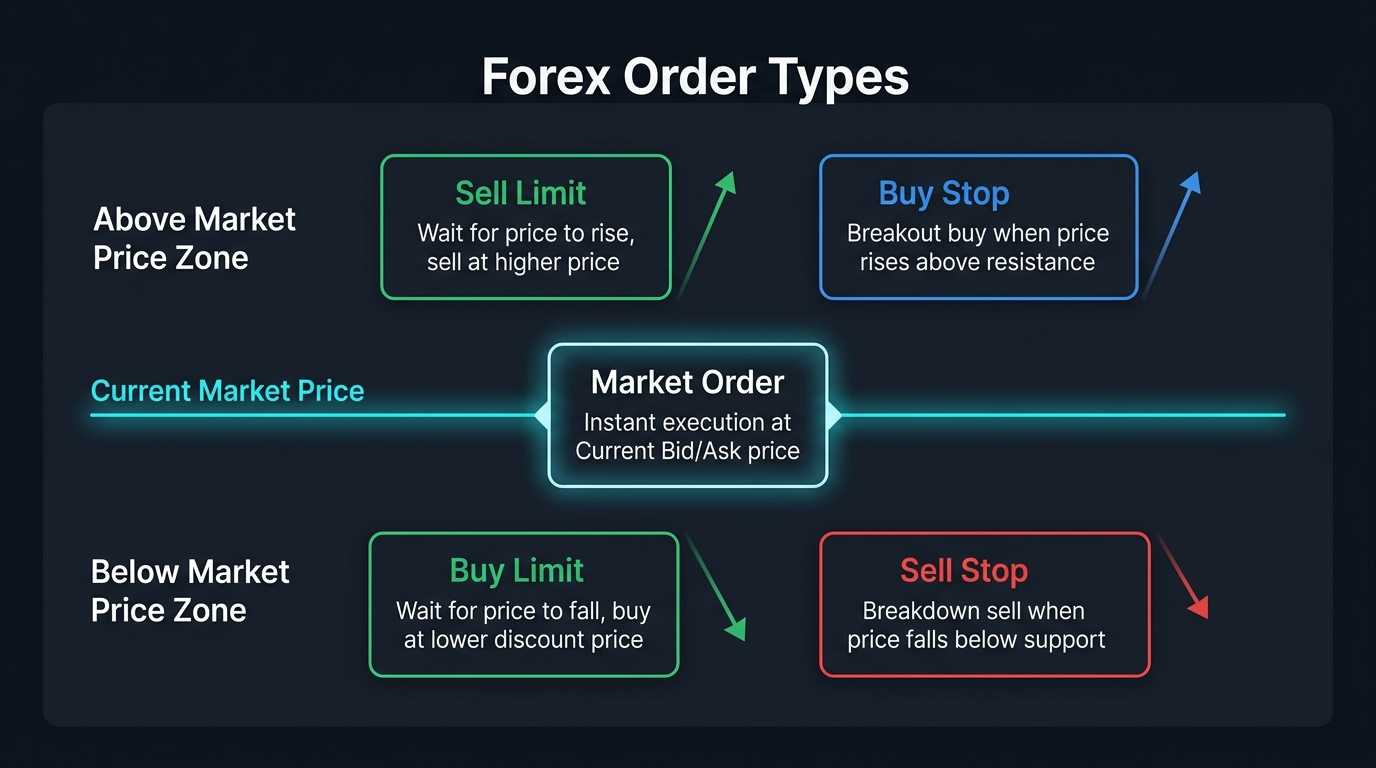
1. Market Orders (Priority: Speed)
A market order is an instruction to buy or sell immediately at the best available prevailing market price.
- Advantage: Virtually guaranteed execution speed.
- Disadvantage: Zero price protection. In fast-moving or thinly traded markets, market orders can suffer substantial slippage as they sweep multiple tiers of the limit order book.
2. Limit Orders (Priority: Price Protection)
A limit order sets an absolute threshold on acceptable execution price:
- Buy Limit: Can only be executed at the specified limit price or lower (better). Placed below the current market price.
- Sell Limit: Can only be executed at the specified limit price or higher (better). Placed above the current market price.
- Advantage: Guaranteed price control.
- Disadvantage: No guarantee of execution if the market never trades at the limit level.
3. Stop Orders (Priority: Conditional Activation)
A stop order remains dormant until the market trades at or through a designated trigger price (the stop price):
- Stop-Loss: Deployed to automatically cap losses on an existing open position if the market moves adversely.
- Stop-Entry: Placed above the current market to buy into an upside breakout, or below the current market to short into a downward breakdown.
- Once triggered, a standard stop order instantly converts into a market order.
4. Stop-Limit Orders (Hybrid Risk Control)
A stop-limit order specifies two distinct price points: a Stop Trigger Price and a Limit Execution Price. When the market touches the stop trigger, the order converts into a resting limit order rather than an aggressive market order. This prevents catastrophic execution fills during illiquid flash crashes, but risks non-execution if the price gaps completely past the limit threshold.
Comprehensive Order Types Taxonomy
The following matrix compares common exchange-supported order types across execution behavior, liquidity impact, and trader use cases:
| Order Type | Trigger Condition | Execution Behavior | Liquidity Role | Primary Use Case |
|---|---|---|---|---|
| Market | Immediate upon arrival | Fills at best available Bid/Ask | Taker (Consumes liquidity) | Urgent entry or emergency position liquidation. |
| Limit | Price $\le$ Limit (Buy) / $\ge$ Limit (Sell) | Fills only at limit price or better | Maker (Provides liquidity) | Fading extremes, pullback entries, take-profit targets. |
| Stop (Loss) | Market price touches Stop price | Converts to aggressive Market order | Taker upon trigger | Downside capital preservation, breakout entries. |
| Stop-Limit | Market price touches Stop price | Converts to passive Limit order | Maker upon trigger | Controlled breakout trading without slippage risk. |
| Trailing Stop | Market moves by fixed pips or % | Stop price ratchets behind favorable price | Taker upon trigger | Locking in floating trend profits while letting winners run. |
| OCO (One-Cancels-Other) | Dual orders linked together | Execution of one automatically cancels other | Mixed | Setting simultaneous Take-Profit and Stop-Loss brackets. |
Time-in-Force (TIF) and Routing Instructions
An order instruction is incomplete without defining how long the order should persist in the market:
- Day Order: Automatically expires at the end of the local exchange trading session if unfilled.
- Good ’Til Cancelled (GTC): Remains active across sessions until either executed or explicitly cancelled by the trader.
- Immediate or Cancel (IOC): Requires all or part of the order to execute immediately; any unfilled fraction is cancelled.
- Fill or Kill (FOK): Requires the entire order quantity to fill immediately in a single transaction; if impossible, the entire order is rejected.
- Iceberg / Hidden Orders: An algorithmic instruction that breaks a massive block order into small visible portions on the public order book (e.g., showing 10,000 units while resting 500,000 units in reserve) to avoid signaling market depth.
Real-World Case Study: The Danger of Market Orders in Low-Liquidity Rollover
At 4:59 PM Eastern Standard Time (the daily interbank rollover window), a retail swing trader held an open long position of 20 standard lots ($2,000,000 notional) of GBP/NZD.
- Market Condition: Major bank liquidity providers temporarily widen their spreads and pull top-of-book quotes for two to three minutes around 5:00 PM EST to reconcile daily accounts.
- The Error: An automated script triggered an unconditional Market Sell Order at 5:00:15 PM EST to exit the position.
- Execution Realized:
- Normal spread on GBP/NZD: 2.5 pips.
- Rollover spread on the electronic feed: 45 pips wide (Bid: 2.0520, Ask: 2.0565).
- The market sell order hit the thinned bid at 2.0520, suffering 42 pips of avoidable transaction cost on 20 lots.
- Loss Calculated: $$\text{Excess Slippage Cost} = 20 \ \text{lots} \times 42 \ \text{pips} \approx $5{,}200 \ \text{USD}$$
- Lesson: Professional desks utilize time-gated execution algorithms or resting limit orders to prevent aggressive market orders from hitting wide spreads during daily rollover windows.
Frequently Asked Questions
What is the difference between an order and a trade?
An order is an unexecuted instruction or offer to transact submitted by a participant. A trade (or execution) occurs only when that order is successfully matched against a counterparty’s opposing order in the matching engine.
Can a broker reject an order?
Yes. A broker’s risk gateway can reject an order for several regulatory or financial reasons, including insufficient free margin, exceeding maximum lot size restrictions, attempting to trade outside market hours, or violating pre-trade wash-sale compliance rules.
What is order slippage and how can it be minimized?
Slippage is the difference between the expected price of an order and the actual price at which it executes. It occurs with market orders during high volatility or low market depth. Slippage can be minimized by using limit orders, setting maximum slippage tolerance filters on trading platforms, and avoiding market orders during major economic news releases.
Ready to trade forex?
Open a free demo account with a regulated broker. Practice with virtual funds before risking real money.