PAB
PAB is the ISO 4217 currency code for the Panamanian Balboa (currency symbol: B/.), the official legal tender of the Republic of Panama, maintained at permanent 1:1 parity with the US Dollar in a fully dollarized monetary regime.
The PAB (Panamanian Balboa, graphical symbol B/., ISO 4217 code PAB) is the official sovereign currency of the Republic of Panama. Named in honor of the Spanish explorer Vasco Núñez de Balboa (the first European to lead an expedition to reach the Pacific Ocean from the New World in 1513), the balboa has operated in complete monetary symbiosis with the United States Dollar (USD) since Panama achieved independence in 1904.
Under the Constitution of the Republic of Panama and foundational monetary agreements, the balboa is maintained at an unshakeable, legally mandated exchange rate of: $$1.00 \text{ PAB} \equiv 1.00 \text{ USD}$$
Panama represents one of the world’s oldest and most successful examples of official dollarization. The nation operates without a sovereign central bank and prints zero paper banknotes. While the balboa exists as physical metallic coins for retail transactions and functions as the official statutory unit of account for government accounting, legal contracts, and tax filings, all paper currency in circulation consists exclusively of US Dollar Federal Reserve notes.
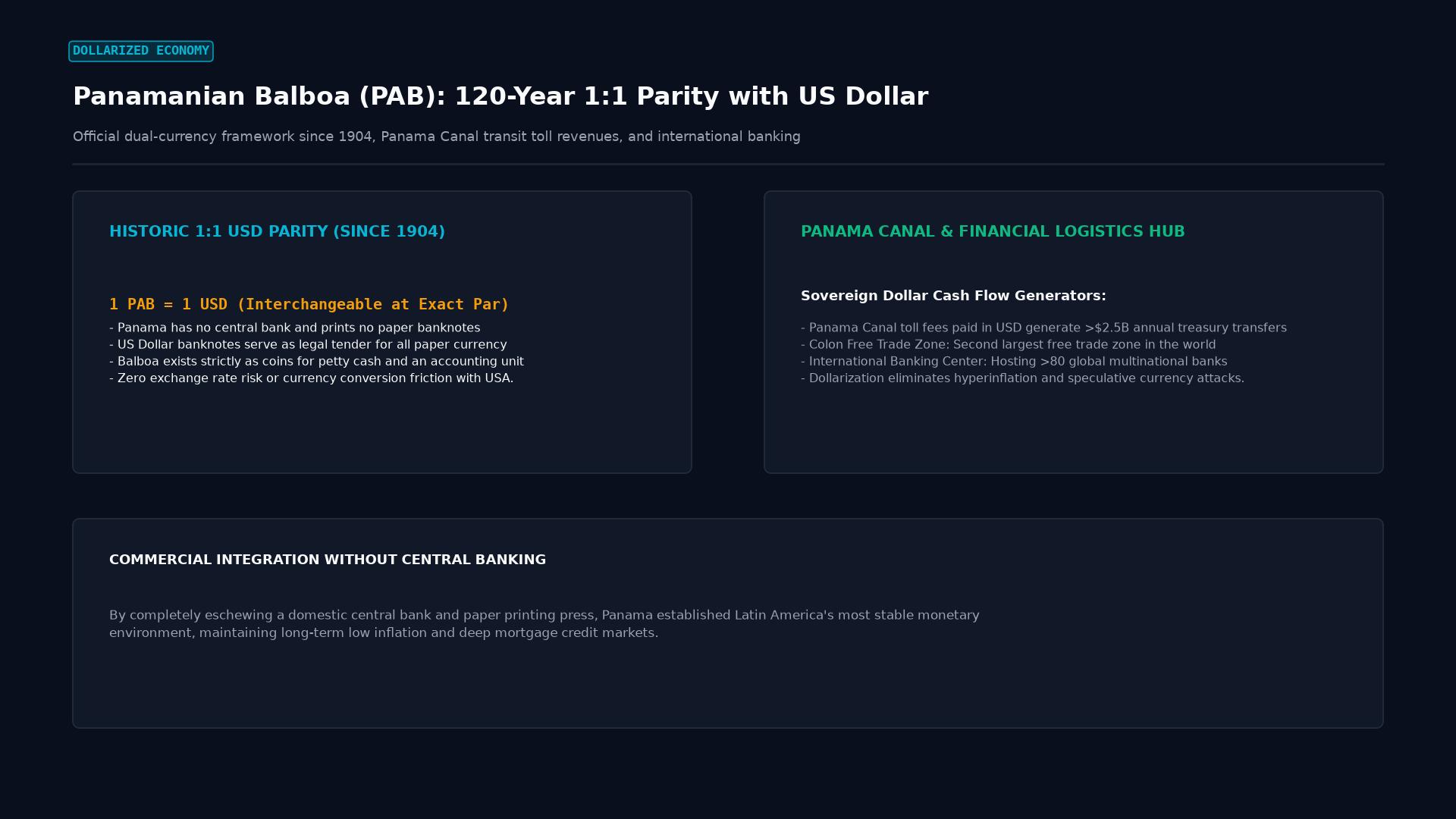 Figure: Official dual-currency framework since 1904, Panama Canal transit toll revenues, and international banking
Historical Origins and the 1904 Monetary Convention
Independence and the Taft Agreement
Following Panama’s separation from the Republic of Colombia on November 3, 1903, and the signing of the Hay-Bunau-Varilla Treaty granting the United States the rights to construct the Panama Canal, the newly established republic required a stable monetary foundation to support canal construction.
On June 20, 1904, Panamanian commissioners and US Secretary of War William Howard Taft signed the historic Monetary Agreement of 1904 (the Taft Agreement), codified under Law 84 of June 28, 1904:
- Introduction of the Balboa: The balboa replaced the depreciated Colombian silver peso as the official national unit of account.
- Gold Parity Standard: The balboa was established with a gold content of 1.5048 grams of pure gold, matching the gold content of the US Gold Dollar.
- Statutory Legal Tender of the US Dollar: The US Dollar was declared legal tender in Panama for all private and public transactions, creating a seamless currency environment for the thousands of American engineers, workers, and military personnel operating in the Panama Canal Zone.
                    PANAMANIAN MONETARY CONVENTION TIMELINE

  1903                     June 1904                   1941                    2011+
  +------------------+     +--------------------+      +---------------+      +-------------------+
  | Independence     | ==> | Taft Agreement     | ===> | 7-Day Balboa  | ===> | "Martinelli"      |
  | from Colombia;   |     | Law 84 established |      | Note Issuance |      | 1 Balboa Coins    |
  | Canal Treaty     |     | 1:1 Parity with USD|      | Quick Burn    |      | Modern Bimetallic |
  +------------------+     +--------------------+      +---------------+      +-------------------+
The Seven-Day Banknote Episode of 1941
Panama has issued paper balboa banknotes on only one brief occasion in modern history. In 1941, nationalist President Arnulfo Arias created the Banco Central de Emisión de la República de Panamá and issued roughly 2.7 million balboas in paper banknotes (across denominations of 1, 5, 10, and 20 balboas).
However, precisely seven days after the banknotes entered public circulation, President Arias was deposed in a bloodless coup d’état. The successor government immediately closed the fledgling central bank, withdrew all newly minted banknotes from circulation, and incinerated them in public bonfires. Since that event, the Panamanian state has never attempted to issue paper fiat currency, leaving the US Dollar as the exclusive paper currency.
The Mechanics of Dollarization in Panama
Panama’s monetary architecture is unique because it did not adopt the US Dollar in response to hyperinflation (unlike Ecuador in 2000 or El Salvador in 2001), but rather incorporated the dollar at the birth of the republic.
                   PANAMA'S DUAL-CURRENCY OPERATIONAL MODEL

  Paper Cash & High-Value Clearing              Retail Cash & Daily Small Commerce
  +------------------------------------+        +-----------------------------------+
  | - 100% US Dollar Banknotes         |        | - Panamanian Metallic Coins       |
  | - $1, $5, $10, $20, $50, $100 bills|        | - 1, 5, 10, 25, 50 Centésimos     |
  | - Interbank electronic settlements |        | - 1 Balboa Bimetallic Coins       |
  | - Cross-border capital flows       |        | - Identical size/weight to US coin|
  +------------------------------------+        +-----------------------------------+
                   \                                /
                    \                              /
                     v                            v
               Total Fungibility: 1.00 PAB ≡ 1.00 USD in All Domestic Commerce
1. Coinage Dimensions and the “Martinelli” Coins
Panama mints its own sovereign coinage through international authorized mints (such as the Royal Canadian Mint or the United States Mint):
- Identical Physical Dimensions: Panamanian coins (1, 5, 10, 25, and 50 centésimos) are manufactured with the exact dimensions, metallurgical compositions, and weights as corresponding US coins (pennies, nickels, dimes, quarters, and half-dollars). US coins and Panamanian coins circulate interchangeably across retail cash registers and vending machines nationwide.
- The “Martinelli” Coins: In 2011, under the administration of President Ricardo Martinelli, the government minted 40 million bimetallic 1 Balboa coins to replace paper one-dollar bills in domestic retail circulation, generating substantial seigniorage profits for the national treasury. Citizens affectionately nicknamed these coins Martinellis.
2. Absence of a Central Bank and Lender of Last Resort
Panama possesses no sovereign central bank:
- Banco Nacional de Panamá (BNP): Functions as the state-owned commercial bank and fiscal agent of the government, managing public payroll and collecting canal toll revenues. BNP holds zero regulatory authority over other commercial banks and cannot issue paper money.
- Superintendencia de Bancos de Panamá (SBP): Operates as the administrative supervisory regulator, overseeing banking licenses, capital adequacy rules, and anti-money laundering (AML) compliance.
- Zero Lender of Last Resort: If a commercial bank operating in Panama experiences a run on its deposits, there is no domestic central bank to print liquidity or bail it out. Commercial banks must maintain rigorous balance sheet liquidity, holding contingent credit lines with international money-center banks in New York, London, or Tokyo.
Macroeconomic Pillars Supporting the Dollarized System
Panama’s monetary stability is underpinned by structural balance of payments engines that ensure continuous, massive inflows of US Dollars:
+------------------------+--------------------------------------------------+
| Economic Engine        | Mechanism Supplying Hard US Dollar Liquidity     |
+------------------------+--------------------------------------------------+
| The Panama Canal       | Generates over $4 billion annually in mandatory  |
| (ACP Authority)        | maritime transit tolls paid directly in USD.     |
+------------------------+--------------------------------------------------+
| International Banking  | Over 60 local and international banks managing   |
| Center (CBI)           | over $140 billion in regional assets.            |
+------------------------+--------------------------------------------------+
| Colon Free Trade Zone  | The second-largest freeport in the world, re-    |
| (Zona Libre de Colón)  | exporting billions in manufactured consumer goods|
+------------------------+--------------------------------------------------+
| Logistics & Aviation   | Tocumen International Airport (Hub of the        |
| (Copa Airlines Hub)    | Americas) and deepwater transshipment ports.     |
+------------------------+--------------------------------------------------+
| Copper Mining Exports  | Cobre Panamá (First Quantum Minerals), generating|
|                        | massive mineral royalties and export revenues.   |
+------------------------+--------------------------------------------------+
1. The Panama Canal Toll Engine
The Panama Canal Authority (Autoridad del Canal de Panamá, ACP) charges transit tolls to global container fleets, bulk carriers, and LNG tankers. Under maritime regulations, all canal fees are calculated and settled strictly in US Dollars. This provides the national treasury with a perpetual, non-debt-creating stream of foreign exchange revenue, insulating the public budget from balance of payments constraints.
2. The International Banking Center (CBI)
Established under the Banking Law of 1970, Panama City developed into a premier offshore and regional banking hub. The absence of foreign exchange controls, complete capital mobility, and the dollar standard attracted global institutions (such as Citibank, Scotiabank, and BNP Paribas). The CBI operates on pure market discipline: because banks cannot rely on central bank discount window bailouts, the banking system maintains average liquidity ratios exceeding 55% to 60%, more than double the international Basel III regulatory minimums.
Macroeconomic Trade-Offs of Full Dollarization
Operating on the US Dollar standard provides extraordinary stability, but imposes macroeconomic constraints:
+------------------------------------+-------------------------------------+
| Structural Advantages              | Institutional Constraints           |
+------------------------------------+-------------------------------------+
| - ZERO Currency Risk:              | - Complete Loss of Monetary Policy: |
|   Eliminates risk of currency      |   Cannot adjust interest rates or   |
|   crises or devaluations.          |   devalue currency during shocks.   |
+------------------------------------+-------------------------------------+
| - Low Structural Inflation:        | - US Federal Reserve Transmission:  |
|   Domestic price levels track US   |   Fed rate hikes increase borrowing |
|   CPI; eliminates hyperinflation.  |   costs across the Panamanian economy|
+------------------------------------+-------------------------------------+
| - Deep Long-Term Mortgages:        | - Pure Fiscal Risk:                 |
|   30-year fixed mortgages available|   Government cannot monetize debt;  |
|   to ordinary retail consumers.    |   fiscal deficits require debt.     |
+------------------------------------+-------------------------------------+
| - International Investment Anchor: | - Export Pricing Rigidity:          |
|   FDI flows directly without     |   Cannot devalue currency to boost  |
|   hedging or conversion overhead.  |   competitiveness during downturns. |
+------------------------------------+-------------------------------------+
1. The Disappearance of Sovereign Spread Devaluation
Unlike peer Latin American nations (such as Argentina or Colombia) that historically suffered from violent currency devaluations, Panama has never experienced an exchange rate crisis. Retail consumers and corporate enterprises negotiate 30-year residential mortgages and corporate debt at interest rates comparable to US regional standards, without paying currency risk premiums.
2. The Fed Shock Transmission
Panama imports the monetary policy stance of the US Federal Reserve. When the Federal Open Market Committee (FOMC) rapidly raises the Federal Funds rate to cool the US domestic economy, interest rates across Panamanian commercial banks rise in tandem, tightening domestic liquidity and slowing construction activity, regardless of whether Panama requires economic cooling.
Sovereign Debt and Fiscal Governance
Because the Government of Panama cannot instruct a central bank to print money to finance public spending (monetization of deficits), sovereign fiscal discipline is paramount:
- Global Bond Issuance: The Ministry of Economy and Finance (MEF) issues sovereign Eurobonds directly in US Dollars on the New York and Luxembourg markets. These bonds trade with high liquidity and are held by global institutional pension funds and sovereign wealth managers.
- Fiscal Responsibility Law: To maintain investment-grade credit ratings and ensure fiscal sustainability, Panama enforces the Social and Fiscal Responsibility Law (LRSF), which establishes statutory ceilings on non-financial public sector fiscal deficits (typically targeted between 1.5% and 3.0% of GDP).
Best Practices for Navigating Financial Operations in PAB
- Treat PAB and USD as Operationally Interchangeable: In commercial accounting software, enterprise resource planning (ERP) platforms, and legal documentation, the Balboa (PAB) and the US Dollar (USD) are mathematically identical ($1:1$). Entering a financial transaction in PAB or USD involves zero currency conversion calculation.
- Account for Lack of Deposit Insurance: Panama does not maintain a statutory government deposit insurance corporation (like the FDIC in the US). Depositors manage credit risk by diversifying funds across well-capitalized Tier-1 commercial banks possessing high liquidity ratios.
- Verify Physical Cash Acceptance: While 1-balboa coins and centésimos circulate universally within the borders of Panama, they are not accepted outside national territory. Travelers and international traders should convert excess metallic coinage into paper US Dollar banknotes prior to departing the country.
Frequently Asked Questions (FAQ)
What is the relationship between the Panamanian Balboa and the US Dollar?
The Panamanian Balboa is pegged to the US Dollar at a permanent, legally binding exchange rate of 1:1 ($1.00 \text{ PAB} = 1.00 \text{ USD}$). The US Dollar is official legal tender in Panama and serves as the sole paper currency in circulation. The balboa exists as physical coins for small transactions and as an official unit of account for government legal and financial ledgers.
Does Panama have its own paper banknotes?
No. Panama does not print or issue paper balboa banknotes. All paper currency circulating in Panama consists of standard US Dollar Federal Reserve notes ($1, $5, $10, $20, $50, and $100 bills). The only physical Panamanian currency consists of metallic coins (1, 5, 10, 25, and 50 centésimos, and the 1-balboa bimetallic coin), which match the dimensions, weights, and values of corresponding US coins.
Why doesn’t Panama have a central bank?
Panama chose not to establish a central bank when it became an independent republic in 1904. By adopting the US Dollar as legal tender and relying on private commercial banks and market discipline, Panama avoided the hyperinflation, currency debasement, and fiscal mismanagement experienced by many other Latin American nations. Commercial bank regulation is managed by the Superintendency of Banks of Panama, while the state-owned Banco Nacional de Panamá acts solely as the government fiscal agent.
Ready to trade forex?
Open a free demo account with a regulated broker. Practice with virtual funds before risking real money.