Package loan
A package loan is a specialized real estate credit facility that finances both real property (land and permanent buildings) and personal property (chattel, appliances, and fixtures) under a single consolidated promissory note and dual security instruments.
A package loan (frequently termed a package mortgage) is an integrated commercial or residential credit facility that finances the acquisition of real property (the parcel of land and its permanent architectural structures) alongside specified personal property (tangible chattel, furniture, fixtures, and operational equipment) under a single consolidated debt contract.
In traditional real estate lending, a standard mortgage or deed of trust encumbers strictly the realty, legally excluding personal property, which must be financed separately through short-term personal loans, equipment leases, or revolving credit lines. A package loan eliminates this fragmentation by allowing the borrower to bundle both asset classes into a single monthly installment payment, spreading the financing cost of essential personalty over the long-term amortization horizon of the real estate loan.
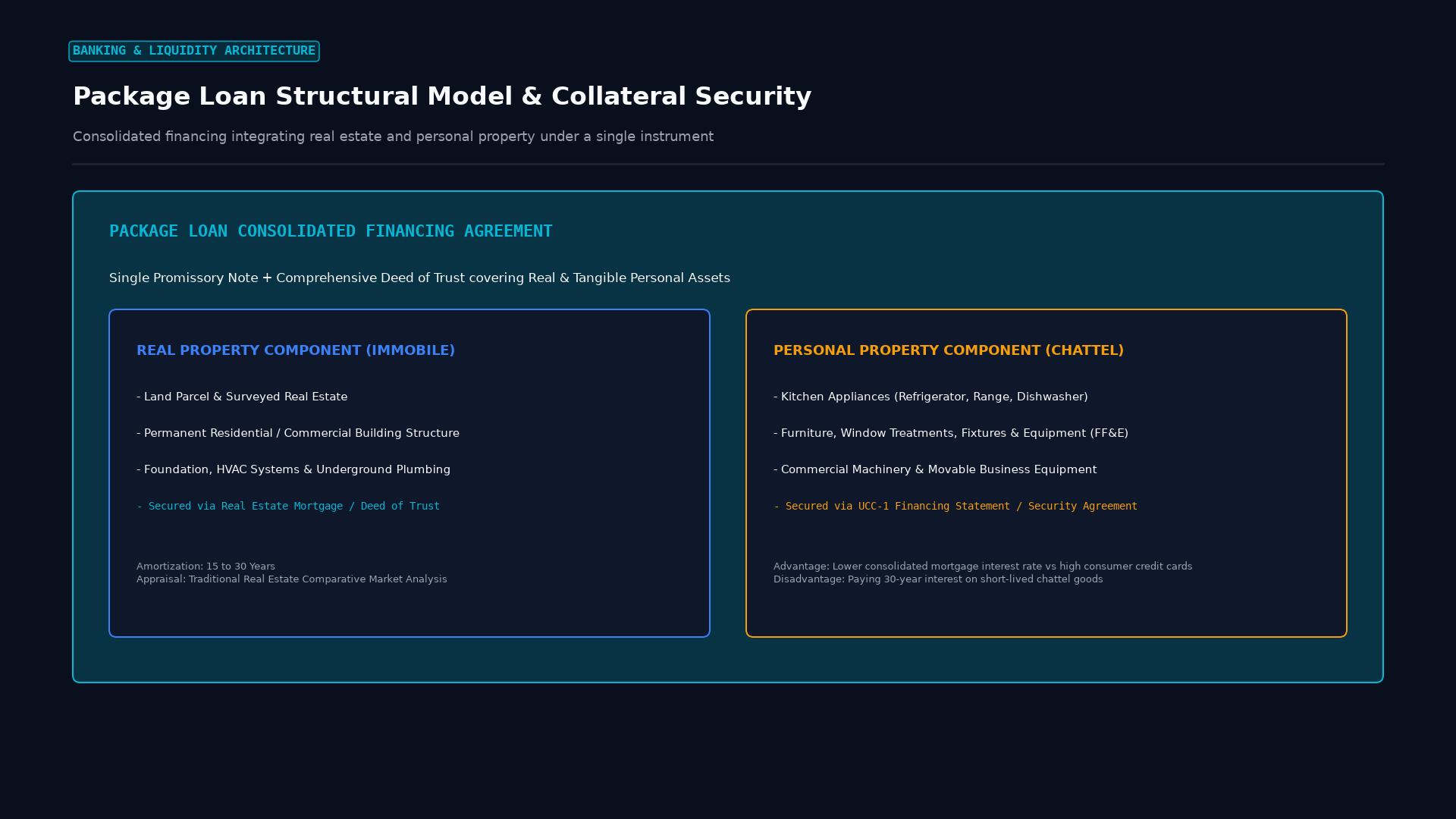 Figure: Consolidated debt financing structure: integrating real estate mortgage liens and personal property chattel agreements into a single unified payment schedule.
Primary Applications: Residential and Commercial
Package loans are deployed across specialized sectors where real property requires immediate, functional personal equipment to generate economic utility or rental revenue:
+------------------------+--------------------------------------------------+
| Market Sector          | Typical Personal Property Included in Financing  |
+------------------------+--------------------------------------------------+
| Turnkey Residential    | Newly constructed single-family homes or luxury  |
| Housing                | condominiums bundled with high-end kitchen       |
|                        | appliances, laundry units, and window drapery.   |
+------------------------+--------------------------------------------------+
| Furnished Vacation     | Short-term beachfront or ski resort rental homes |
| Rentals (STRs)         | sold fully furnished with living room furniture, |
|                        | bedding, entertainment systems, and patio sets.  |
+------------------------+--------------------------------------------------+
| Hospitality and Hotels | Commercial hotels, motels, and luxury resorts    |
| (FF&E Financing)       | financing building real estate alongside all     |
|                        | Furniture, Fixtures, and Equipment (FF&E).       |
+------------------------+--------------------------------------------------+
| Commercial Restaurants | Dining establishments financing the physical     |
| and Food Service       | commercial building alongside industrial ovens,  |
|                        | walk-in refrigeration freezers, and dining booths|
+------------------------+--------------------------------------------------+
| Medical and Dental     | Professional healthcare buildings bundled with   |
| Clinics                | specialized diagnostic chairs, X-ray machinery,  |
|                        | and integrated sterilization suites.             |
+------------------------+--------------------------------------------------+
Legal Mechanics: The Dual Perfection Framework
Because a package loan secures two legally distinct classes of property, real estate governed by state real property statutes, and personal property governed by commercial code, the lender cannot rely on a single filing to protect its collateral:
                  THE DUAL PERFECTION OF PACKAGE LOAN LIENS

  Real Property Collateral                      Personal Property Collateral
  +-------------------------------------+       +-----------------------------------+
  | - Mortgage Deed or Deed of Trust    |       | - Security Agreement              |
  | - Formal legal property description |       | - Detailed chattel inventory list |
  | - Signed and notarized by mortgagor |       | - UCC-1 Financing Statement       |
  +-------------------------------------+       +-----------------------------------+
                     \                                     /
                      \                                   /
                       v                                 v
  +-------------------------------------+       +-----------------------------------+
  | Recorded in County Land Registry    |       | Filed with Secretary of State     |
  | (Creates recorded real estate lien) |       | (Article 9 UCC Central Registry)  |
  +-------------------------------------+       +-----------------------------------+
1. Real Property Lien Perfection
The lender perfects its security interest in the land and permanent building structures by recording a standard Mortgage Deed or Deed of Trust in the public land records of the county where the physical real estate is situated. This establishes the lender’s senior mortgage priority against subsequent judgment creditors or secondary lienholders.
2. Personal Property Perfection Under UCC Article 9
Personal property cannot be encumbered through a county real estate deed. Under the Uniform Commercial Code (UCC) Article 9, the lender must execute a two-step perfection process:
- The Security Agreement: A contract in which the debtor formally grants the lender a security interest in specified personal chattel (including exact serial numbers, manufacturer names, and descriptions of all financed equipment, furniture, and appliances).
- The UCC-1 Financing Statement: A standardized public notice filed with the Secretary of State’s central commercial registry. The filing puts third-party creditors and prospective buyers on notice that the personal property is encumbered by a senior security interest.
3. The UCC Fixture Filing (§ 9-502)
A critical legal conflict occurs when personal property becomes physically attached to the real estate (transforming into a fixture, such as a central HVAC compressor or custom commercial lighting):
- To ensure that its lien on fixtures takes priority over competing personal property financiers or prior mortgage holders, the lender files a UCC Fixture Filing directly in the local county land records.
- Under UCC § 9-334, a perfected fixture filing establishes priority over subsequent purchasers of the real estate and prevents conflicting claims.
Underwriting Economics: The Depreciation Mismatch Dilemma
While package loans offer convenience, they introduce an economic dilemma for mortgage underwriters: the useful life asset-liability mismatch.
                   THE ASSET DEPRECIATION DURATION MISMATCH

  Asset Value ($)
   ^
   |  Real Estate Asset (Land & Building Shell)
   |  ----------------------------------------------------> Appreciates / Retains
   |                                                        Value over 30 Years
   |
   |  Personal Property (Appliances, Furniture, Electronics)
   |   \
   |    \
   |     \
   |      \-----------------------------------------------> Depreciates to Zero
   |                                                        within 5 to 7 Years
   +------------------------------------------------------------------------> Time
      Year 0            Year 5                Year 10             Year 30
1. The Risk of Long-Term Amortization on Short-Lived Assets
Consider a homeowner who finances $25,000 worth of furniture, television sets, and kitchen appliances inside a 30-year fixed package mortgage at an interest rate of 7.0%:
- Useful Economic Life: The personal property will suffer physical wear, tear, and technological obsolescence within five to seven years, at which point its resale liquidation value drops to near zero.
- Financing Horizon: The borrower continues paying principal and interest on that long-discarded furniture for thirty years. Over the full 30-year term, financing $25,000 of personal property at 7% costs $34,877 in interest alone, resulting in a total cost of $59,877 for appliances that were replaced decades earlier.
- Collateral Erosion: From the lender’s perspective, once the personal property fully depreciates, that portion of the loan balance is no longer supported by tangible collateral, artificially inflating the true loan-to-value (LTV) ratio.
2. Secondary Market Restrictions: Fannie Mae and Freddie Mac
Because of this depreciation asymmetry, the Government-Sponsored Enterprises (GSEs) enforce strict underwriting guidelines regarding package loans:
- Exclusion from Appraised Value: Under Fannie Mae and Freddie Mac single-family selling guides, personal property items (such as freestanding refrigerators, portable washers, dryers, and furniture) cannot be included in the appraised value of the property when determining the loan-to-value (LTV) ratio for conforming mortgages.
- If a home sales contract for $450,000 includes $20,000 in personal furniture, the certified real estate appraiser must deduct the value of the personal property, certifying the real property value at $430,000. The conforming mortgage loan amount must be calculated based strictly on the $430,000 realty value, requiring the buyer to fund the personal property through separate cash reserves or subordinate financing.
Default and Foreclosure: Dual Enforcement Remedies
If a borrower defaults on a package loan, the lender must pursue enforcement across two distinct legal channels:
+------------------------+--------------------------------------------------+
| Property Dimension     | Statutory Enforcement and Foreclosure Procedure  |
+------------------------+--------------------------------------------------+
| Real Property          | Governed by state real estate foreclosure law.   |
| (Realty)               | Requires judicial foreclosure lawsuit (in lien   |
|                        | theory states) or non-judicial trustee power-of- |
|                        | sale auction (in title theory states).           |
+------------------------+--------------------------------------------------+
| Personal Property      | Governed by Uniform Commercial Code (UCC)        |
| (Personalty)           | Article 9 Part 6. The lender may take self-help  |
|                        | repossession of equipment without breaching the  |
|                        | peace, or sell chattel at a commercial auction.  |
+------------------------+--------------------------------------------------+
The Integrated Commercial Foreclosure
In commercial package loans (such as a defaulted boutique hotel), the lender often exercises UCC § 9-604(a):
- Under UCC Section 9-604, when a security agreement covers both real and personal property, the secured party may elect to proceed against both the real property and the personal property in a single, unified judicial real estate foreclosure proceeding.
- This statutory provision allows the lender to auction the operating hotel as an intact, fully functioning business (building plus beds, kitchen equipment, and software systems), preserving enterprise value and preventing piecemeal asset liquidation.
Comparative Matrix: Package Loan vs. Separate Financing Lines
+------------------------+-----------------------------+-----------------------------+
| Feature                | Consolidated Package Loan   | Separate Realty Mortgage +  |
|                        |                             | Equipment Line / Loan       |
+------------------------+-----------------------------+-----------------------------+
| Payment Administration | Single consolidated monthly | Multiple payments across    |
|                        | installment to one servicer | different lenders/servicers |
+------------------------+-----------------------------+-----------------------------+
| Interest Rate          | Real estate mortgage rate   | Realty: Mortgage rate;      |
|                        | (typically lower long-term) | Equipment: Higher short-term|
+------------------------+-----------------------------+-----------------------------+
| Repayment Term         | Long-term (15 to 30 years)  | Realty: 15–30 years;        |
|                        |                             | Equipment: 3–7 years        |
+------------------------+-----------------------------+-----------------------------+
| Total Lifetime Interest| High (interest compounds on | Lower (rapid payoff of short|
| Paid on Personal Asset | chattel over 30 years)      | term equipment balances)    |
+------------------------+-----------------------------+-----------------------------+
| Collateral Paperwork   | Complex dual perfection     | Separate, standardized      |
|                        | (Mortgage Deed + UCC-1)     | standalone documentation    |
+------------------------+-----------------------------+-----------------------------+
Best Practices for Evaluating Package Loans
- Calculate the Full Lifetime Interest Cost of Personalty: Borrowers must evaluate whether bundling personal property into a 30-year package mortgage is financially rational. While it lowers the immediate monthly cash outflow compared to a short-term 5-year equipment loan, the cumulative interest paid over three decades often triples the effective purchase price of the items.
- Conduct Complete Inventory Serial Audits: Commercial lenders originating package loans must require an itemized personal property exhibit attached to the Security Agreement, detailing exact serial numbers and replacement cost valuations to prevent debtors from substituting lower-grade equipment post-closing.
- Renew UCC-1 Financing Statements Every Five Years: Under UCC Article 9 rules, a filed UCC-1 financing statement lapses after five years unless a timely Continuation Statement is filed within the six-month window prior to expiration. Failure to file a continuation statement causes the lender to lose its perfected security interest in the personal property.
Frequently Asked Questions (FAQ)
What items are typically included in a residential package loan?
In residential real estate, a package loan typically includes large kitchen appliances (refrigerators, stoves, ovens, dishwashers), laundry equipment (washers and dryers), custom window treatments, built-in entertainment units, and in some turnkey vacation properties, complete living room and bedroom furniture sets.
Can a buyer obtain a conforming Fannie Mae loan using a package loan?
No, not directly for the full purchase price if personal property is included in the valuation. Under Fannie Mae and Freddie Mac underwriting rules, personal property cannot be included in the appraised value of the home when calculating the loan-to-value (LTV) ratio for conforming mortgages. The appraiser must deduct the value of the personal property, and the buyer must either pay for the personal property in cash or finance it separately.
What happens to the personal property if a package loan defaults?
If a package loan goes into default, the lender holds perfected security interests in both the real estate and the personal property. The lender can initiate real estate foreclosure on the building and land while simultaneously exercising its rights under Article 9 of the Uniform Commercial Code (UCC) to repossess and liquidate the personal property (furniture, appliances, or commercial equipment) to pay off the outstanding debt.
Ready to trade forex?
Open a free demo account with a regulated broker. Practice with virtual funds before risking real money.