Package mortgage
A package mortgage is an encumbrance on real property that simultaneously covers personal property items, such as appliances and furniture, securing both realty and chattel under a single legal instrument and repayment schedule.
A package mortgage is a specialized real estate security instrument that legally encumbers both real property (land, structural improvements, and permanent fixtures) and specified items of personal property (movable chattel, household appliances, furniture, and trade equipment) as consolidated collateral for a debt.
Under classical common law property doctrine, a real estate mortgage attaches strictly to real property (realty), whereas movable personal items (personalty) are encumbered separately through a chattel mortgage or personal security agreement. A package mortgage bridges this statutory division by incorporating express contractual covenants, security agreements, and Uniform Commercial Code (UCC) financing statements directly into the mortgage conveyance, binding both asset classes to the lender’s lien until the underlying promissory note is satisfied.
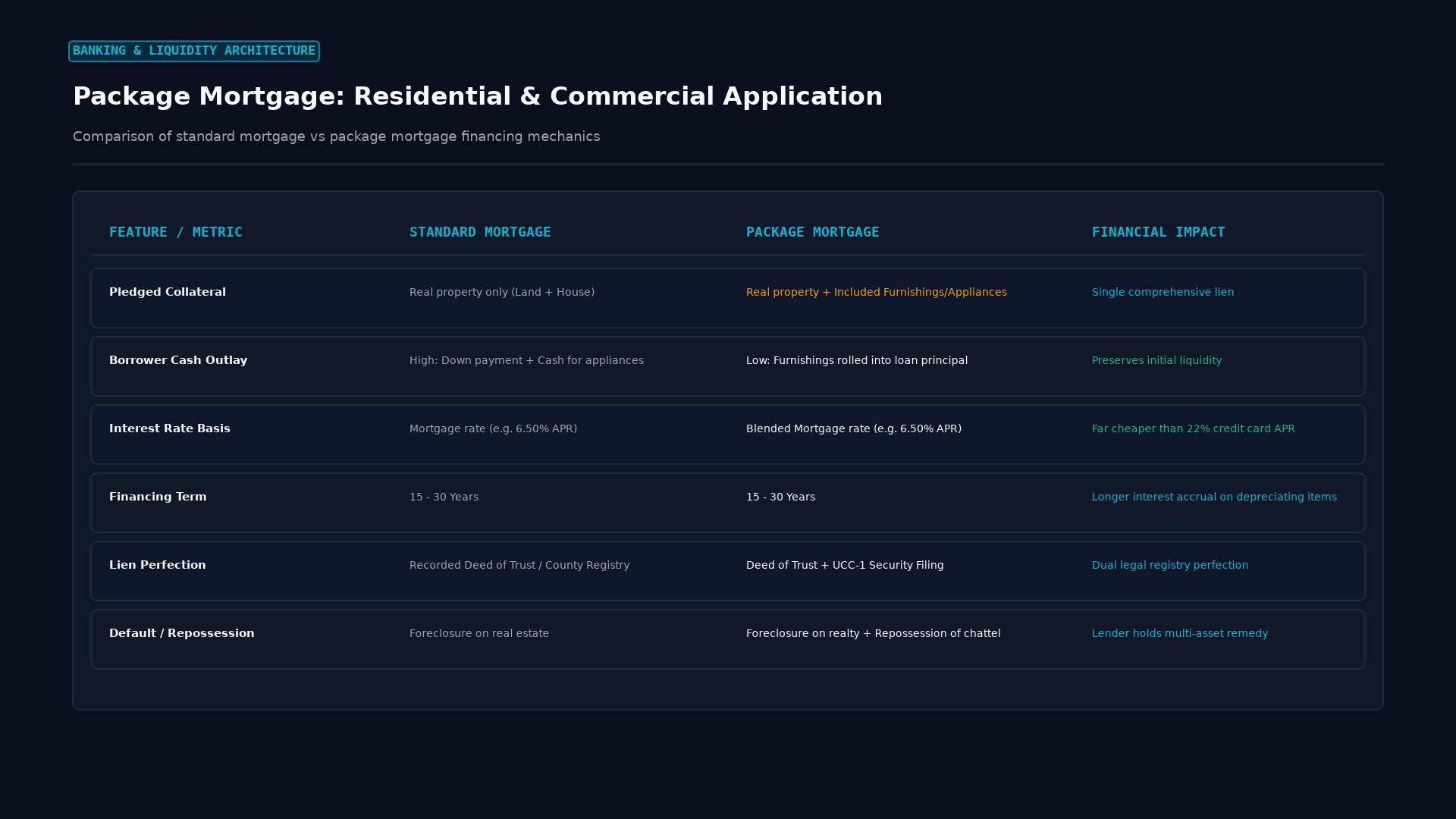 Figure: Comprehensive mortgage comparison: financing real property along with included major appliances and equipment under a single recorded mortgage lien.
Contractual Anatomy: Specialized Package Mortgage Covenants
A package mortgage contains specialized covenants not present in standard residential or commercial mortgage indentures:
+------------------------+--------------------------------------------------+
| Specialized Clause     | Legal Function and Lender Protection             |
+------------------------+--------------------------------------------------+
| Extended Property      | Formally incorporates all listed personal items, |
| Conveyance Clause      | appliances, and furnishings into the definition  |
|                        | of the "Mortgaged Property."                     |
+------------------------+--------------------------------------------------+
| Maintenance and        | Mandates that the mortgagor maintain all personal|
| Replacement Covenant   | property in working order and replace worn-out   |
|                        | items with chattel of equal or greater value.    |
+------------------------+--------------------------------------------------+
| After-Acquired         | Stipulates that any replacement appliances or    |
| Chattel Provision      | furniture automatically become subject to the    |
|                        | lender's senior mortgage security interest.      |
+------------------------+--------------------------------------------------+
| Prohibition of Removal | Prohibits the borrower from selling, gifting,    |
| and Waste Clause       | or removing the encumbered personal property     |
|                        | from the premises without written lender consent.|
+------------------------+--------------------------------------------------+
1. The Maintenance and Replacement Covenant
Because personal property items (such as a kitchen refrigerator or a commercial hotel HVAC unit) undergo physical deterioration significantly faster than real estate, the package mortgage imposes an affirmative Replacement Covenant:
- The mortgagor is legally required to service, repair, and maintain the chattel in good operating condition.
- If an appliance fails mechanically, the borrower must purchase a functional replacement of equal quality.
- Under the After-Acquired Chattel Provision, the replacement unit automatically falls under the lender’s lien without requiring an amended mortgage document, preventing collateral erosion over time.
2. The Negative Covenant Against Waste and Alienation
If a homeowner holding a standard mortgage sells their refrigerator or living room couch on the secondary market, no legal breach occurs because the chattel was never pledged as collateral.
In contrast, under a package mortgage:
- Removing or selling encumbered personal property without the mortgagee’s express written authorization constitutes tortious waste and a formal event of contractual default.
- In commercial hospitality package mortgages, unauthorized removal of hotel furniture, fixtures, and equipment (FF&E) can trigger the loan’s acceleration clause, making the entire unpaid principal balance immediately due and payable.
Tax and Accounting Dynamics: Cost Segregation and Depreciation
From an accounting and corporate tax perspective, package mortgages require meticulous financial bifurcation between real property and personal chattel:
                  TAX ACCELERATION VIA COST SEGREGATION

  Total Package Mortgage Allocation ($1,000,000 Real Estate + FF&E)
                                   |
                   +---------------+---------------+
                   |                               |
                   v                               v
    REAL PROPERTY (Realty: $800,000)      PERSONAL CHATTEL (Personalty: $200,000)
  +---------------------------------+   +------------------------------------+
  | - Residential: 27.5-Year MACRS  |   | - 5-Year or 7-Year MACRS Asset Life|
  | - Commercial: 39-Year MACRS     |   | - Eligible for Section 179 Expense |
  | - Straight-Line Depreciation    |   | - Eligible for Bonus Depreciation  |
  | - Slow, long-term tax shield    |   | - Massive upfront tax shield       |
  +---------------------------------+   +------------------------------------+
1. The Power of Cost Segregation Studies
In commercial real estate (such as rental apartment communities, hotels, and medical office buildings), combining real and personal property inside a package mortgage allows property investors to execute a formal Cost Segregation Study:
- Under US Internal Revenue Code (IRC) regulations, real property building structures must be depreciated on a straight-line basis over 27.5 years for residential rental property or 39 years for commercial buildings.
- However, personal property items (such as specialty decorative lighting, removable carpeting, commercial kitchen equipment, and security systems) qualify as Section 1245 property, eligible for accelerated 5-year or 7-year MACRS depreciation schedules.
- Under IRC Section 179 and Bonus Depreciation rules, commercial borrowers can deduct up to 100% of the cost of qualifying personal property in the very first tax year, generating massive upfront tax savings that dramatically enhance the net internal rate of return (IRR) of the project.
2. Ad Valorem Property Taxes vs. Sales and Use Taxes
Tax jurisdictions maintain strict boundaries between real and personal property taxation:
- Local Ad Valorem Property Taxes: Municipal tax assessors levy real estate taxes on the assessed value of the land and permanent fixtures.
- Personal Property Taxes: In many states, commercial enterprises must file an annual Business Personal Property Tax Declaration (such as Form 571-L in California), reporting the acquisition cost and depreciation of all equipment, furniture, and movable chattel financed under the package mortgage.
- Retail Sales Tax: While the transfer of real estate is subject to county deed documentary transfer taxes, the personal property portion of a package sale may be subject to state retail sales or use tax at the time of purchase, requiring separate line-item invoice attribution.
Practical Complexities in Secondary Markets and Resale
While package mortgages provide marketing convenience for homebuilders selling turnkey homes, they introduce structural frictions throughout the lifecycle of the loan:
+------------------------+--------------------------------------------------+
| Lifecycle Stage        | Operational Challenge and Friction               |
+------------------------+--------------------------------------------------+
| Loan Origination       | Conforming GSE underwriting exclusion: Fannie    |
|                        | Mae and Freddie Mac do not allow personal items  |
|                        | to count toward conforming LTV limits.           |
+------------------------+--------------------------------------------------+
| Mid-Term Refinancing   | Original chattel may be fully depreciated or     |
|                        | discarded, creating uncollateralized balances.   |
+------------------------+--------------------------------------------------+
| Property Resale        | Disagreements between buyer and seller regarding |
|                        | which appliances stay and how remaining debt     |
|                        | is apportioned between realty and chattel.       |
+------------------------+--------------------------------------------------+
| Title Search & Closing | Title companies must verify termination of both  |
|                        | the recorded mortgage and state UCC-1 filings.   |
+------------------------+--------------------------------------------------+
1. The Resale Dilemma
Consider a homeowner who purchased a newly constructed suburban home using a 30-year package mortgage that financed $15,000 of high-end kitchen appliances. Ten years later, the homeowner decides to sell the home:
- The original appliances are now ten years old, showing heavy wear and tear, and may have been partially replaced with different brands.
- If the incoming homebuyer finances the purchase through a conventional conforming loan, the buyer’s lender will not finance the aging personal property.
- The seller’s existing package mortgage must be completely paid off and satisfied at closing, requiring the escrow officer to obtain formal reconveyance of the real estate deed and file a UCC-3 Termination Statement to release the personal property lien.
2. Title Insurance Complications
Standard American Land Title Association (ALTA) title insurance policies insure title strictly to real property. ALTA policies explicitly exclude personal property and movable chattel from coverage.
To obtain title protection on the personal property component of a commercial package mortgage:
- The lender must purchase a specialized UCC Insurance Policy (issued by specialty title underwriters like First American or Fidelity National).
- The UCC policy insures that the lender’s security interest in the personal property is properly created, perfected, and holds senior priority over competing commercial creditors.
Default Enforcement: Dual Real Estate and UCC Remedies
If a borrower defaults under a package mortgage, the lender possesses powerful, multi-channel legal remedies:
                  REMEDIES UPON PACKAGE MORTGAGE DEFAULT

                       Event of Default Occurs (Non-Payment)
                                         |
                                         v
  +-------------------------------------------------------------------------+
  |              LENDER EXERCISES ELECTION OF REMEDIES                      |
  +-------------------------------------------------------------------------+
                   |                                           |
                   v                                           v
  REAL ESTATE FORECLOSURE ACTION              UCC ARTICLE 9 REPOSSESSION
  - Judicial foreclosure or Trustee Sale      - Self-help repossession of chattel
  - Public auction of land and structure      - Notice of commercial public sale
  - Sheriff's deed issued to buyer            - Private liquidation of equipment
                   |                                           |
                   +---------------------+---------------------+
                                         |
                                         v
            Unified Commercial Foreclosure under UCC § 9-604
(Auctioning the property and equipment as an intact business)- Unified Foreclosure (UCC § 9-604): Under Section 9-604 of the Uniform Commercial Code, the lender is legally permitted to consolidate the personal property into the real estate foreclosure proceeding. This allows a bank foreclosing on a restaurant to auction the building, the industrial ovens, and the dining furniture together in a single transaction, preserving commercial going-concern value.
- Independent Repossession: Alternatively, if the real estate foreclosure process is delayed by local court backlogs, the lender can immediately repossess high-value movable equipment under UCC Article 9 rules without waiting for the real estate foreclosure auction to conclude.
Best Practices for Structuring Package Mortgages
- Maintain an Itemized Chattel Schedule: The package mortgage document must incorporate a detailed, itemized exhibit listing every piece of personal property encumbered, complete with make, model, year, and serial numbers. Generic descriptions (such as “all furniture”) create legal ambiguity during bankruptcy proceedings.
- File UCC-1 Financing Statements Simultaneously: Never assume that recording the mortgage deed in the county land records perfects the lien on personal property. A separate UCC-1 financing statement must be filed with the Secretary of State’s central commercial registry at the time of closing.
- Execute Comprehensive Cost Segregation: Commercial property buyers utilizing package mortgages should commission a professional engineering-based cost segregation study immediately upon acquisition to maximize 5-year and 7-year accelerated depreciation deductions.
Frequently Asked Questions (FAQ)
What distinguishes a package mortgage from a conventional mortgage?
A conventional mortgage secures only real property (the land, building foundations, and permanent structures). In contrast, a package mortgage secures both the real estate and specified items of personal property (such as kitchen appliances, laundry units, furniture, and operational equipment) under a single consolidated loan agreement.
Are package mortgages commonly used in commercial real estate?
Yes, package mortgages are widely used in commercial real estate, particularly in the hospitality, restaurant, and healthcare sectors. In these industries, the business cannot operate without extensive furniture, fixtures, and equipment (FF&E). Bundling the building and the operational equipment into a single package mortgage provides business owners with long-term financing and enables powerful tax acceleration through cost segregation.
What is the purpose of an after-acquired chattel clause in a package mortgage?
An after-acquired chattel clause is a protective provision in a package mortgage stating that any new personal property or appliances purchased to replace old, worn-out equipment automatically become subject to the lender’s original mortgage lien. This prevents the lender’s collateral value from eroding over time as original appliances break down and are replaced.
Ready to trade forex?
Open a free demo account with a regulated broker. Practice with virtual funds before risking real money.