PEN
PEN (Peruvian Sol) is the official currency of Peru, denoted by the symbol S/ and regulated by the Banco Central de Reserva del Perú (BCRP).
What is the Peruvian Sol (PEN)?
The Peruvian Sol (ISO code: PEN, symbol: S/) is the legal tender of Peru. It is issued and administered by the nation’s central bank, the Banco Central de Reserva del Perú (BCRP). Subdivided into 100 céntimos, the currency circulates in coins of 10, 20, and 50 céntimos, 1, 2, and 5 soles, along with banknotes of 10, 20, 50, 100, and 200 soles.
Known historically as the Nuevo Sol between 1991 and 2015, the currency was officially renamed the Sol by the Peruvian Congress under Law No. 30381 in December 2015. This change reflected decades of economic stabilization and sustained macroeconomic credibility.
In global foreign exchange markets, the PEN is recognized as one of the most stable emerging market currencies in Latin America. Its stability is anchored by Peru’s disciplined monetary policy, massive foreign exchange reserve buffers, and a systematic central bank strategy of foreign exchange intervention designed to curb excessive volatility without altering fundamental market trends.
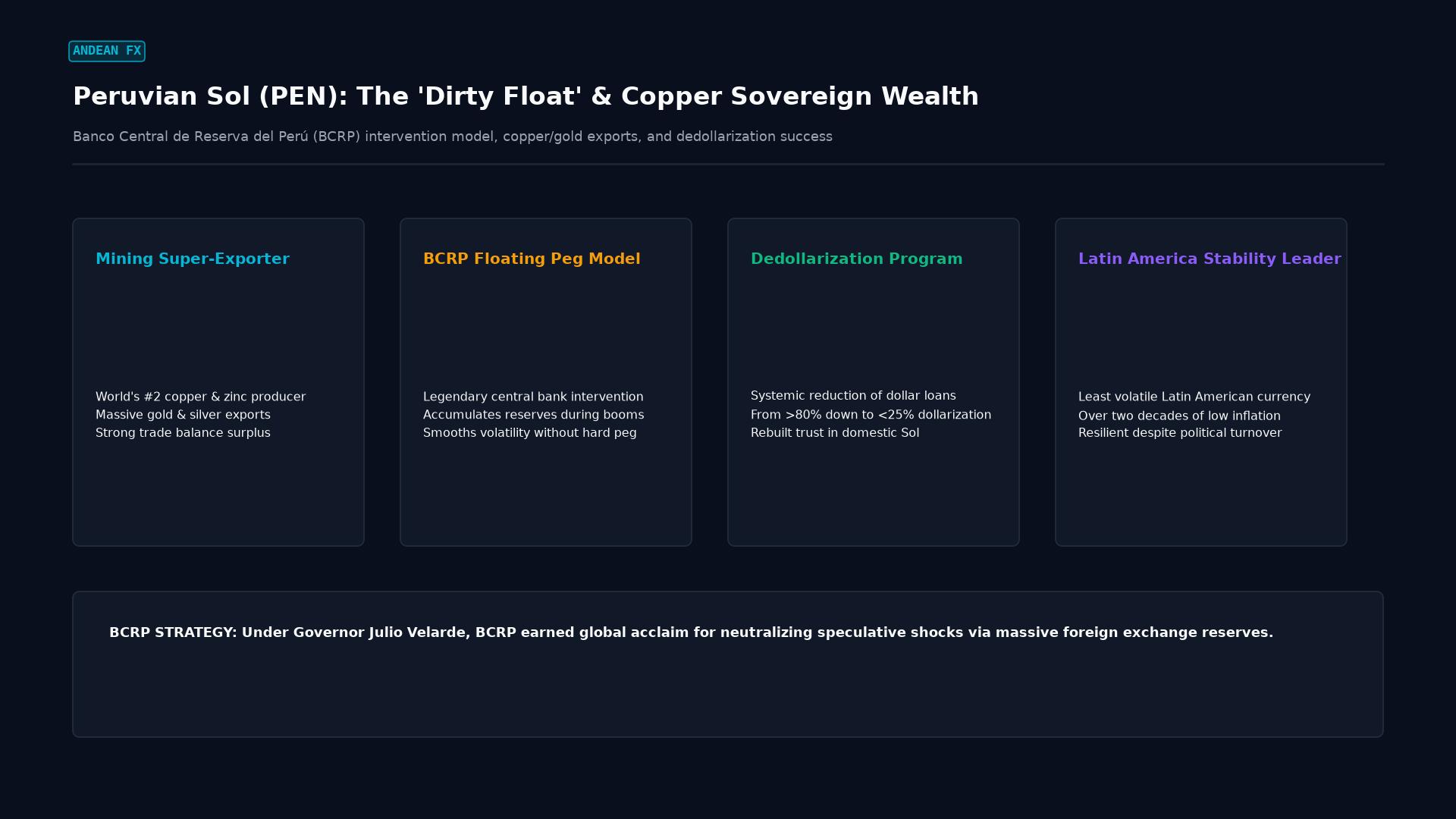 Figure: Banco Central de Reserva del Perú (BCRP) intervention model, copper/gold exports, and dedollarization success
Historical Context: From Hyperinflation to Monetary Stature
Understanding the Peruvian Sol requires examining the catastrophic economic environment that preceded its birth in 1991.
The Hyperinflationary Collapse of the Inti (1985 to 1990)
During the late 1980s, Peru suffered one of the most severe hyperinflationary episodes in modern Latin American history under the administration of President Alan García. Between 1985 and 1990:
- Cumulative inflation exceeded 2,000,000 percent.
- The monetary unit of the time, the Inti (introduced in 1985 to replace the original devalued sol at 1,000 to 1), became essentially worthless.
- Economic activity contracted sharply, and citizens completely abandoned the national currency for pricing, contracts, and savings, adopting the United States Dollar (USD) as an unofficial currency.
       Hyperinflationary Spiral (1988-1990)
           Annual Inflation > 7,000%
                       │
                       ▼
       August 1990: Structural Shock Therapy
           "El Fujishock" Price Liberalization
                       │
                       ▼
       July 1991: Law No. 25295
           Introduction of Nuevo Sol (S/.)
           Conversion: 1 Nuevo Sol = 1,000,000 Intis
                       │
                       ▼
       1993 Constitutional Autonomy
           BCRP granted total political independence
           Strict ban on printing money to finance fiscal deficits
The Birth of the Nuevo Sol and Constitutional Autonomy
In 1991, the Peruvian government enacted aggressive stabilization policies. In July 1991, Law No. 25295 introduced the Nuevo Sol at a conversion rate of:
$$\text{1 Nuevo Sol} = 1,000,000 \text{ Intis}$$
Crucially, the 1993 Peruvian Constitution established institutional independence for the BCRP. The central bank was given a singular, constitutional mandate: preserve monetary stability. Article 84 of the Constitution explicitly prohibited the central bank from financing public spending, establishing reserve caps, or forcing credit allocation.
The 2015 Modernization: Dropping the “Nuevo”
By 2015, after nearly a quarter-century of single-digit inflation and strong economic growth driven by mining investments, the term “Nuevo” (New) was anachronistic. Congress enacted Law No. 30381, removing “Nuevo” and officially establishing the name as the Sol (symbolized as S/ rather than the older S/.).
Macroeconomic Drivers of the PEN
The exchange rate of the Peruvian Sol against major world currencies, particularly the US dollar (USD/PEN), is shaped by domestic monetary policy, commodity cycles, trade flows, and foreign capital.
1. Copper and Metal Export Dynamics
Peru is the world’s second-largest producer of copper and zinc, and a leading global producer of silver, gold, and tin. Mineral commodities represent approximately 60% of Peru’s total merchandise exports.
Rising Global Copper Prices (LME/COMEX)
          │
          ├─► Surging Dollar Export Revenues for Peruvian Miners
          ├─► Corporate Tax Revenues Collected in Local Currency
          ├─► Commercial Banks Sell USD to Buy PEN for Tax Payments
          │
          ▼
Upward Pressure on Peruvian Sol (PEN Appreciates)
When global copper demand expands, mining multinationals convert foreign currency revenues into soles to pay local operational costs, mining royalties, and corporate income taxes. This influx creates structural upward pressure on the PEN. Conversely, sharp declines in industrial metals prices weaken Peru’s terms of trade, putting downward pressure on the currency.
2. BCRP Inflation-Targeting Framework
Since 2002, the BCRP has operated an explicit inflation-targeting framework. The central bank establishes a target band for annual consumer price inflation:
$$\text{Inflation Target Range} = 2.0% \pm 1.0% \quad (1.0% \text{ to } 3.0%)$$
By adjusting its benchmark reference interest rate (Tasa de Interés de Referencia), the BCRP maintains real interest rate differentials against the US Federal Reserve. This defends the purchasing power of the sol and discourages speculative capital flight.
3. The Structural De-Dollarization Process
In the early 1990s, financial dollarization in Peru was extreme. More than 80% of total commercial bank deposits and private sector loans were denominated in US dollars. This created massive balance sheet vulnerability: any sharp depreciation of the domestic currency risked bankrupting businesses and households whose earnings were in soles while their debts were in dollars.
The BCRP implemented a multi-decade de-dollarization strategy:
- Differentiated Reserve Requirements: Imposing much higher legal reserve requirements on US dollar deposits than on Peruvian sol deposits, raising the cost for banks to hold foreign currency liabilities.
- Capital Penalties: Requiring commercial banks to hold extra regulatory capital against unhedged foreign currency loans.
- Deepening Local Currency Debt Markets: The Ministry of Economy and Finance (MEF) systematically issued long-term sovereign bonds (Bonos Soberanos) denominated in soles with maturities extending up to 30 and 40 years.
+--------------------------------------------------------------------------+
|                  PERUVIAN DE-DOLLARIZATION TRAJECTORY                     |
+------------------------------------+------------------+------------------+
| Metric                             | Year 2000        | Year 2024        |
+------------------------------------+------------------+------------------+
| Private Sector Credit in USD       | ~82%             | ~23%             |
| Total Banking Deposits in USD      | ~75%             | ~32%             |
| Sovereign Debt Denominated in PEN  | ~15%             | ~65%             |
| Sovereign Sol Bond Max Maturity    | 2 to 5 Years     | 30 to 40 Years   |
+------------------------------------+------------------+------------------+
BCRP Foreign Exchange Intervention Framework
Unlike central banks that enforce a rigid currency peg or those that practice pure free-floating neglect, the BCRP uses a managed floating regime (flotación administrada).
The BCRP does not defend a specific price level for USD/PEN. Instead, its objective is to smooth out excessive exchange rate volatility, accumulate defensive reserves during capital inflow booms, and inject liquidity during stress events.
+------------------------------------------------------------------------------------+
|                         BCRP INTERVENTION TOOLKIT                                  |
+-----------------------------------+------------------------------------------------+
| TOOL                              | MECHANISM & MARKET IMPACT                      |
+-----------------------------------+------------------------------------------------+
| Direct Spot Interventions         | BCRP buys or sells spot USD directly in the    |
| (Mesa de Dinero)                  | Lima interbank FX market against cash soles.   |
+-----------------------------------+------------------------------------------------+
| CD BCRP (Certificados de          | Sol-denominated sterilization bills issued to  |
| Depósito del BCRP)                | absorb excess liquidity created by USD buys.   |
+-----------------------------------+------------------------------------------------+
| CDR BCRP (Certificados de         | Sol-settled notes indexed to the USD exchange  |
| Depósito Reajustables)            | rate, offering exchange hedge without cash USD.|
+-----------------------------------+------------------------------------------------+
| Swap Cambiario BCRP               | Currency swaps where BCRP pays sol interest    |
| (Sales & Purchases)               | and receives USD flow, providing hedging.      |
+-----------------------------------+------------------------------------------------+
Direct Interbank Spot Interventions
The central bank actively participates in the Lima interbank market through its open-market operations desk (Mesa de Dinero):
- When capital inflows threaten to appreciate the sol too rapidly, the BCRP purchases US dollars and places them into its official international reserves (Reservas Internacionales Netas, or RIN).
- When global risk aversion causes capital flight, the BCRP sells US dollars from its reserves to supply foreign currency liquidity to commercial banks.
Derivative and Sterilization Instruments
To avoid depleting physical cash reserves or causing unwanted swings in the domestic money supply, the BCRP developed specialized financial instruments:
- CD BCRP (Certificados de Depósito del BCRP): Tradable monetary absorption paper issued to commercial banks to mop up excess soles injected during foreign exchange purchases.
- Swap Cambiario BCRP: Synthetic derivatives through which the BCRP provides foreign exchange hedges to financial institutions without transferring physical US dollars, mitigating speculative pressure on the spot market.
Trading the PEN: Practical FX Market Mechanics
In institutional and retail foreign exchange trading, the sol is quoted against the US dollar as USD/PEN, expressing how many soles are required to purchase one US dollar.
Direct Quote Example:
USD/PEN = 3.7550

Interpretation:
1 US Dollar = 3.7550 Peruvian Soles
A rise from 3.7550 to 3.8200 represents USD appreciation and PEN depreciation.
A decline from 3.7550 to 3.7000 represents USD depreciation and PEN appreciation.
Onshore vs. Offshore (NDF) Markets
Because the Peruvian Sol is not fully convertible on international clearing networks like CLS (Continuous Linked Settlement), trading takes place across two distinct environments:
-
Onshore Interbank Market (Datatec):
- Operated within Peru through electronic interbank trading platforms (such as Datatec / Bolsa de Valores de Lima).
- Transactions settle in gross physical currency (USD vs. PEN) via the BCRP’s real-time gross settlement system (LBTR - Liquidación Bruta en Tiempo Real).
- Standard market trading hours run from 9:00 AM to 1:30 PM local Lima time (PET).
-
Offshore Non-Deliverable Forward (NDF) Market:
- Global institutional investors, macro hedge funds, and multinational corporations manage PEN exposure through USD-settled NDFs, primarily governed under standard ISDA master agreements.
- At contract maturity, no physical Peruvian soles are exchanged. The parties settle the net difference between the contracted NDF forward rate and the fixing spot rate published by the Superintendencia de Banca, Seguros y AFP (SBS) or BCRP.
NDF Cash Settlement Calculation:
Settlement Amount (USD) = Notional Amount x [(Spot Rate - NDF Rate) / Spot Rate]
Typical Bid-Ask Spreads and Liquidity
During active Lima interbank trading hours, USD/PEN spot spreads are tight, typically between 5 to 15 pips (e.g., 3.7540 / 3.7555). Outside Lima trading hours, offshore liquidity thins, and spreads widen.
Key Takeaways
- Official Currency of Peru: The Peruvian Sol (ISO: PEN, symbol: S/) replaced the hyperinflated Inti in 1991 and was formerly known as the Nuevo Sol until 2015.
- Constitutional Central Bank Autonomy: The Banco Central de Reserva del Perú (BCRP) has an explicit mandate for price stability and is constitutionally barred from financing fiscal deficits.
- Managed Float Regime: The BCRP actively intervenes in spot and derivative markets (Swaps, CD BCRP) to dampen exchange rate volatility without opposing long-term economic trends.
- Commodity Anchor: Mineral exports, particularly copper and zinc, constitute over half of Peru’s foreign trade earnings, linking PEN valuation to global industrial metal cycles.
- Successful De-Dollarization: Multi-decade structural reforms pushed domestic credit dollarization from above 80% in the 1990s down to below 25%, shielding the domestic banking sector from currency mismatch shocks.
- Two-Tier Market Structure: Physical cash transactions clear onshore via the Lima interbank market, while global macro traders primarily access the currency through offshore Non-Deliverable Forwards (NDFs).
Frequently Asked Questions (FAQ)
What is the difference between the Nuevo Sol and the Sol?
The Nuevo Sol was introduced on July 1, 1991, to replace the hyperinflation-ravaged Inti at a ratio of 1 Nuevo Sol to 1,000,000 Intis. In December 2015, the Peruvian Congress passed Law No. 30381, which dropped the word “Nuevo” (New) and established the currency’s official legal name as the Sol. The official currency symbol was simultaneously updated from S/. to S/. The currency retained its ISO code (PEN), and all older Nuevo Sol banknotes and coins remain valid legal tender alongside newly minted Sol currency.
How does the price of copper affect the value of the Peruvian Sol?
Peru is one of the world’s leading exporters of copper. When global copper prices rise, Peruvian mining companies earn higher foreign currency revenues from overseas sales. To satisfy domestic financial obligations, such as corporate tax payments, supplier invoices, and local payrolls, these exporters must convert substantial volumes of US dollars into soles. This concentrated demand for local currency supports and appreciates the PEN. Conversely, when global industrial activity slows and copper prices fall, export earnings decline, reducing dollar supply in the domestic market and putting downward pressure on the sol.
Why is the Peruvian Sol considered one of Latin America’s most stable currencies?
The stability of the Peruvian Sol stems from three structural pillars established after the 1990s reforms:
- Constitutional Central Bank Independence: The BCRP cannot print money to fund government deficits, isolating monetary policy from political spending cycles.
- Defensive Reserve Accumulation: The BCRP holds massive net international reserves, frequently exceeding 30% of Peru’s gross domestic product. This reserve buffer gives the central bank credibility when intervening against currency runs.
- De-Dollarization and Fiscal Discipline: Decades of low fiscal deficits and policies disincentivizing dollar lending have reduced domestic balance sheet mismatches, enabling the central bank to manage market fluctuations without inducing domestic banking instability.
Ready to trade forex?
Open a free demo account with a regulated broker. Practice with virtual funds before risking real money.