PIPE
A PIPE (Private Investment in Public Equity) is a financing mechanism where institutional investors purchase restricted equity or equity-linked securities directly from an exchange-listed company at a negotiated discount.
What is a PIPE (Private Investment in Public Equity)?
A PIPE (Private Investment in Public Equity) is a capital-raising mechanism through which an already publicly traded company issues shares of common stock, preferred equity, or convertible debt directly to a select group of accredited institutional investors. These transactions occur outside of traditional underwritten public offerings and are completed at a negotiated discount to the current market price.
Unlike initial public offerings (IPOs) or traditional secondary follow-on offerings that require prolonged SEC registration and retail syndication, PIPEs are executed as private placements. They are typically conducted under statutory exemptions such as Regulation D or Section 4(a)(2) of the US Securities Act of 1933.
Because the securities issued in a PIPE are initially unregistered and “restricted,” the issuing company enters into a legally binding Registration Rights Agreement (RRA). Under this agreement, the company promises to file a resale registration statement (typically on Form S-3 or Form S-1) with the SEC within a specified timeframe, enabling investors to resell their shares into public secondary markets.
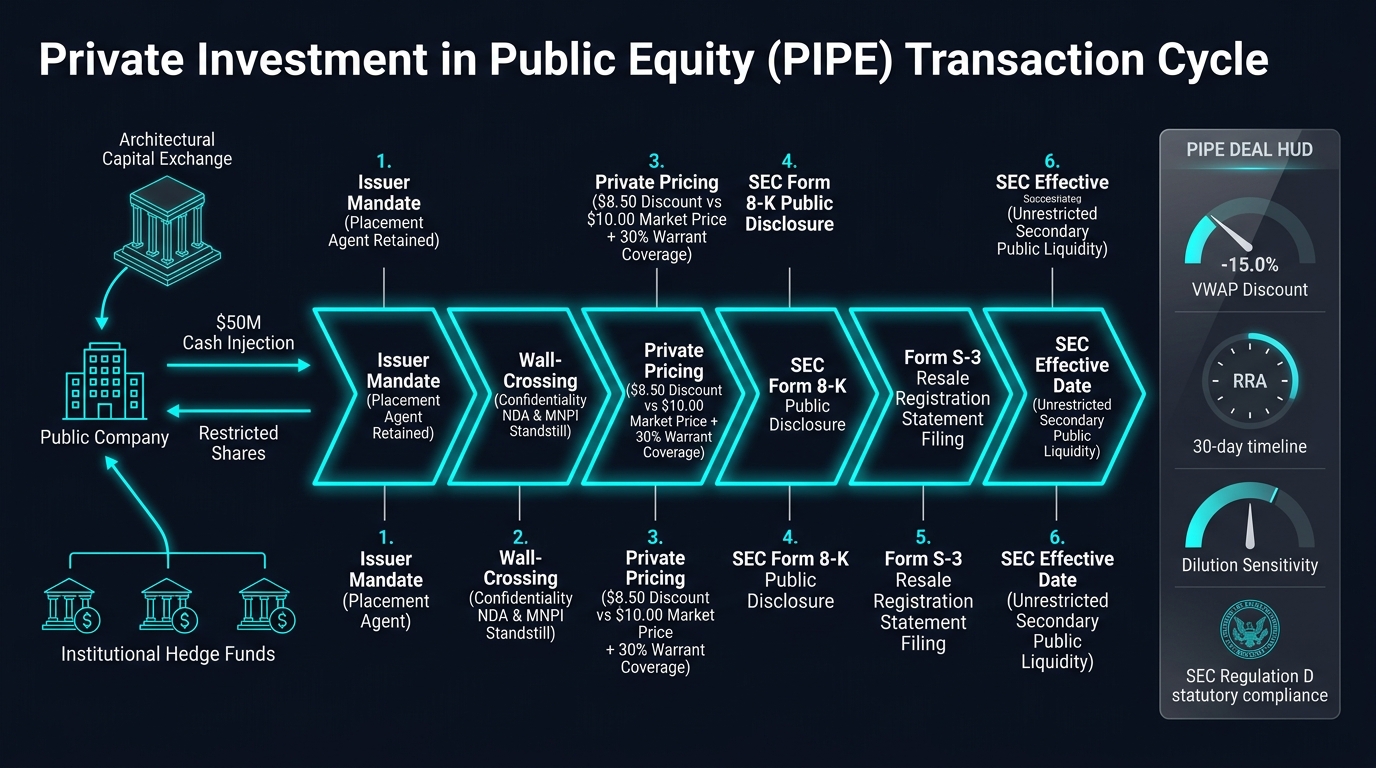
The Mechanics of a PIPE Transaction
Executing a PIPE involves a structured corporate finance sequence designed to balance speed of execution with regulatory compliance.
1. Wall-Crossing and Confidential Marketing
When a public company decides to execute a PIPE, it retains an investment bank to act as a placement agent. The placement agent approaches targeted institutional investors (such as hedge funds, private equity funds, sovereign wealth managers, or specialized family offices):
- Wall-Crossing: Before receiving any presentation materials, prospective investors must agree to be “brought over the wall” by signing a confidentiality and standstill agreement.
- Handling MNPI: The prospective investors receive Material Non-Public Information (MNPI) regarding the proposed transaction and the company’s financial status.
- Trading Blackout: From the second an investor signs the non-disclosure agreement (NDA) until the transaction is publicly announced, the investor is legally prohibited from trading the issuer’s public stock or derivatives under insider trading statutes.
Public Company Needs $50M Capital Rapidly
                    │
                    ▼
Placement Agent Contacts Institutional Funds
Funds Sign NDAs ("Cross the Wall")
                    │
                    ▼
Term Sheet Agreed: $10.00 Market Price Discounted to $8.50
Includes 30% Warrant Coverage at $11.00 Strike
                    │
                    ▼
Contracts Signed & Capital Funded (Private Closing)
                    │
                    ▼
Company Files SEC Form 8-K (Public Disclosure)
Information Asymmetry Erased; Trading Restrictions Lifted
2. The Definitive Documentation
Once terms are finalized, the parties execute two core legal documents:
- Securities Purchase Agreement (SPA): Dictates the purchase price, volume of shares, representations and warranties, closing conditions, and covenants.
- Registration Rights Agreement (RRA): Obligates the issuing company to prepare, submit, and secure SEC effectiveness for a resale registration statement within a strict timeline (e.g., filing within 30 days of closing and securing effectiveness within 60 to 90 days). If the issuer misses these regulatory deadlines, financial penalties (liquidated damages) are paid to the PIPE investors.
Types of PIPE Structures
PIPE transactions fall into two distinct structural categories: Traditional and Structured.
+------------------------------------------------------------------------------------+
|                         TRADITIONAL VS. STRUCTURED PIPES                           |
+------------------------------------+-----------------------------------------------+
| CHARACTERISTIC                     | TRADITIONAL PIPE                              |
+------------------------------------+-----------------------------------------------+
| Securities Issued                  | Common stock or fixed-price preferred shares. |
| Valuation Formula                  | Fixed price per share, discounted to market.  |
| Derivative Sweeteners              | Common warrants (e.g., 20% to 50% coverage).  |
| Downside Repricing                 | None; investors absorb equity risk directly.  |
| Dilution Predictability            | High; exact share count known at closing.     |
+------------------------------------+-----------------------------------------------+
| CHARACTERISTIC                     | STRUCTURED PIPE                               |
+------------------------------------+-----------------------------------------------+
| Securities Issued                  | Convertible preferred debt or debentures.     |
| Valuation Formula                  | Floating conversion price tied to future VWAP.|
| Derivative Sweeteners              | Reset provisions, ratchet clauses, anti-dilution|
| Downside Repricing                 | Aggressive; conversion ratio expands if stock falls.|
| Dilution Predictability            | Low; potential for exponential share dilution.|
+------------------------------------+-----------------------------------------------+
Traditional PIPEs
In a traditional PIPE, the company issues straight common stock or fixed-rate preferred stock convertible at a predetermined, permanent ratio.
To compensate investors for illiquidity while waiting for SEC resale registration, shares are priced at a discount to the trailing Volume-Weighted Average Price (VWAP), typically ranging between 5% and 15%. To enhance expected returns, traditional PIPEs frequently include warrant coverage, granting investors the right to purchase additional common stock at an above-market strike price over a 3- to 5-year period.
Structured PIPEs and “Death Spiral” Financing
Structured PIPEs involve convertible debt, convertible preferred stock, or instruments containing variable reset clauses (often termed “toxic” or “death spiral” convertibles).
In a structured PIPE with a variable conversion price, the debt converts into common stock based on a floating discount to future trading prices:
$$\text{Conversion Price} = \text{Discount Factor (e.g., 80%)} \times \text{Future 10-Day VWAP}$$
This mechanism creates a perverse incentive for aggressive short-selling:
- Short sellers sell the issuer’s common stock in the open market, depressing the share price.
- A lower stock price forces the issuer to issue an exponentially higher number of common shares to satisfy the conversion ratio of the note.
- The massive influx of newly issued shares floods the public float, driving the stock price down further.
- The cycle repeats until the issuer’s common equity is diluted to near-zero value.
    Hedge Fund Shorts Common Stock in Open Market
                        │
                        ▼
            Stock Price Drops from $5.00 to $2.50
                        │
                        ▼
    Fund Converts $1,000,000 Note at 80% of Market Price
    Conversion Price Drops: $4.00 ──► $2.00
    Shares Received Expands: 250,000 ──► 500,000 Shares
                        │
                        ▼
    Fund Delivers Newly Issued Shares to Cover Short Position
    Massive Influx of Floated Shares Depresses Stock Further
Strategic Uses of PIPEs: The SPAC Era
Between 2020 and 2022, PIPEs experienced historic growth as a central financing component for Special Purpose Acquisition Companies (SPACs).
In a SPAC business combination (a de-SPAC transaction), a public shell company acquires a private operating target. Public shareholders in the SPAC have the legal right to redeem their shares for their pro-rata cash balance held in trust (usually $10.00 per share plus interest) if they do not wish to own the merged company.
+------------------------------------------------------------------------------------+
|                         PIPE IN A DE-SPAC TRANSACTION                              |
+------------------------------------------------------------------------------------+
|  1. Private Target Agrees to Merge with SPAC at $1 Billion Valuation               |
|  2. Public SPAC Holds $250M in Trust Account                                       |
|  3. PIPE Syndicate Commits $150M at $10.00/share to Backstop Redemptions           |
|  4. Vote Occurs: 80% of Public SPAC Shareholders Redeem ($200M exits trust)        |
|  5. Result: PIPE Capital ($150M) Guarantees Target Receives Needed Operating Cash  |
+------------------------------------------------------------------------------------+
The PIPE served as an institutional anchor. It validated the target company’s private valuation and ensured that even if 90% of public SPAC investors redeemed their shares, the operating company received the minimum cash balance required to close the transaction.
Regulatory and Listing Exchange Constraints
To protect public retail shareholders from predatory dilution, capital markets regulators and national stock exchanges enforce strict boundaries on PIPE transactions.
The 20% Exchange Rule (Nasdaq and NYSE)
Both the Nasdaq (Rule 5635(d)) and the New York Stock Exchange (Rule 312.03) enforce the 20% Rule.
Under these listing standards, a listed corporation cannot issue common stock (or securities convertible into common stock) equal to 20% or more of its outstanding shares or voting power at a discount to the Minimum Price without first securing prior approval from its common shareholders.
Issuer Common Shares Outstanding: 10,000,000 Shares
Max Issuable Without Shareholder Vote at Discount: 1,999,999 Shares (<20%)

If Proposed PIPE Requires Issuing 2,500,000 Discounted Shares:
- The issuer MUST prepare a proxy statement.
- The issuer MUST convene a formal shareholder meeting.
- A majority of voting shareholders must approve the deal before closing.
To avoid the multi-month delay of holding a shareholder vote, many corporate issuers structure PIPEs specifically at 19.99% of outstanding equity, or price the private placement at or above the official exchange Minimum Price.
SEC Rule 144 Resale Restrictions
Securities purchased in a PIPE are defined as restricted securities under Rule 144 of the Securities Act. Investors cannot freely trade these shares on an exchange until either:
- The issuer’s registration statement on Form S-3 (or S-1) is declared effective by the SEC.
- The holding period requirements of Rule 144 are met (minimum 6 months for SEC reporting companies, provided adequate public information is current).
Comparison: PIPE vs. Rights Offering vs. Follow-On
+------------------------------------------------------------------------------------+
|                        EQUITY CAPITAL RAISING ALTERNATIVES                         |
+---------------------+-------------------+---------------------+--------------------+
| FEATURE             | PIPE TRANSACTION  | RIGHTS OFFERING     | PUBLIC FOLLOW-ON   |
+---------------------+-------------------+---------------------+--------------------+
| Target Investors    | Accredited Inst.  | Existing Common     | Broad Public       |
|                     | Funds & Offices   | Shareholders Only   | (Retail & Inst.)   |
+---------------------+-------------------+---------------------+--------------------+
| Regulatory Delay    | Minimal (Days)    | Moderate (Weeks)    | High (Full SEC     |
| Prior to Capital    | Closed privately  | Registration first  | Prospectus Review) |
+---------------------+-------------------+---------------------+--------------------+
| Execution Certainty | Guaranteed by SPA | Uncertain (Depends  | Subject to Market  |
|                     | commitment        | on take-up rate)    | Price Fluctuations |
+---------------------+-------------------+---------------------+--------------------+
| Shareholder Vote    | Not required if   | Rarely required;    | Not required if    |
|                     | <20% threshold    | pro-rata offering   | on shelf filing    |
+---------------------+-------------------+---------------------+--------------------+
| Pricing             | Discounted to     | Discounted to       | Priced at prevailing|
|                     | prevailing VWAP   | encourage exercise  | market price       |
+---------------------+-------------------+---------------------+--------------------+
Key Takeaways
- Private Equity in Public Issuers: A PIPE allows public companies to secure rapid equity capital directly from accredited institutional investors through private placement exemptions.
- Fast Execution Speed: PIPEs bypass the initial public SEC review cycle, providing issuers with funded cash in days or weeks rather than months.
- Resale Registration Requirement: Investors receive restricted securities and rely on a Registration Rights Agreement requiring the issuer to file an SEC Form S-3 resale statement for public liquidity.
- Traditional vs. Toxic Structures: Traditional PIPEs utilize fixed share pricing with standard warrants, whereas structured floating-rate convertibles risk causing downward death-spiral dilution.
- Exchange Safeguards: The Nasdaq and NYSE 20% rules prohibit companies from issuing 20% or more of their common equity at a discount without prior shareholder approval.
- SPAC Financing Pillar: PIPEs served as the primary institutional funding backstop during the 2020-2022 SPAC boom, replacing capital lost through public trust redemptions.
Frequently Asked Questions (FAQ)
Why would a public company choose a PIPE over a public secondary offering?
A public company typically chooses a PIPE when it needs capital quickly, when its stock is experiencing high volatility, or when general macroeconomic market conditions make an underwritten public offering difficult to price. A traditional public secondary offering requires a formal prospectus, extensive roadshows, and public disclosures that can drive down the stock price before the deal closes. A PIPE is negotiated confidentially under non-disclosure agreements, locks in committed funding without immediate market leakage, and closes in a fraction of the time.
What is the purpose of warrant coverage in a PIPE deal?
Warrant coverage gives institutional investors an incentive to provide capital. A warrant gives the investor the legal option to purchase additional common shares in the future at a pre-set exercise price (typically set above the stock price at the time of the deal). If the company uses the capital successfully and its share price rises, investors exercise their warrants to purchase shares below market value, realizing substantial additional profits while injecting secondary capital into the issuing company.
How does a PIPE announcement typically affect a company’s share price?
When a PIPE is announced via Form 8-K, the company’s common stock price frequently declines in the short term. This downward adjustment reflects two factors: the new shares are sold at a discount to the previous market closing price, and the issuance increases the total number of common shares outstanding, diluting existing earnings per share (EPS). However, if the market views the capital infusion as vital for paying down distressed debt, funding a accretive acquisition, or completing a breakthrough clinical trial, the stock price may rebound strongly once the immediate dilution is absorbed.
Ready to trade forex?
Open a free demo account with a regulated broker. Practice with virtual funds before risking real money.