Warrant
A warrant is a long-term derivative security issued directly by a corporation that grants the holder the right, but not the obligation, to purchase newly issued shares of stock at a specified exercise price before expiration.
What Is a Warrant?
A warrant is an equity derivative issued directly by a corporation that gives the holder the legal right, but not the obligation, to purchase a specific number of shares of the company’s common stock at a predetermined strike price (exercise price) within a defined timeframe—often spanning three to ten years.
While warrants share structural similarities with standard exchange-traded call options, their institutional mechanics differ fundamentally:
- Exchange-traded call options are standardized contracts written and traded between secondary market participants; their exercise transfers existing shares from one investor to another without corporate involvement.
- Warrants are created directly by the issuing corporation. When a warrant is exercised, the company issues brand new shares of stock and receives the cash exercise proceeds directly into its corporate treasury, diluting existing shareholders’ equity ownership percentage.
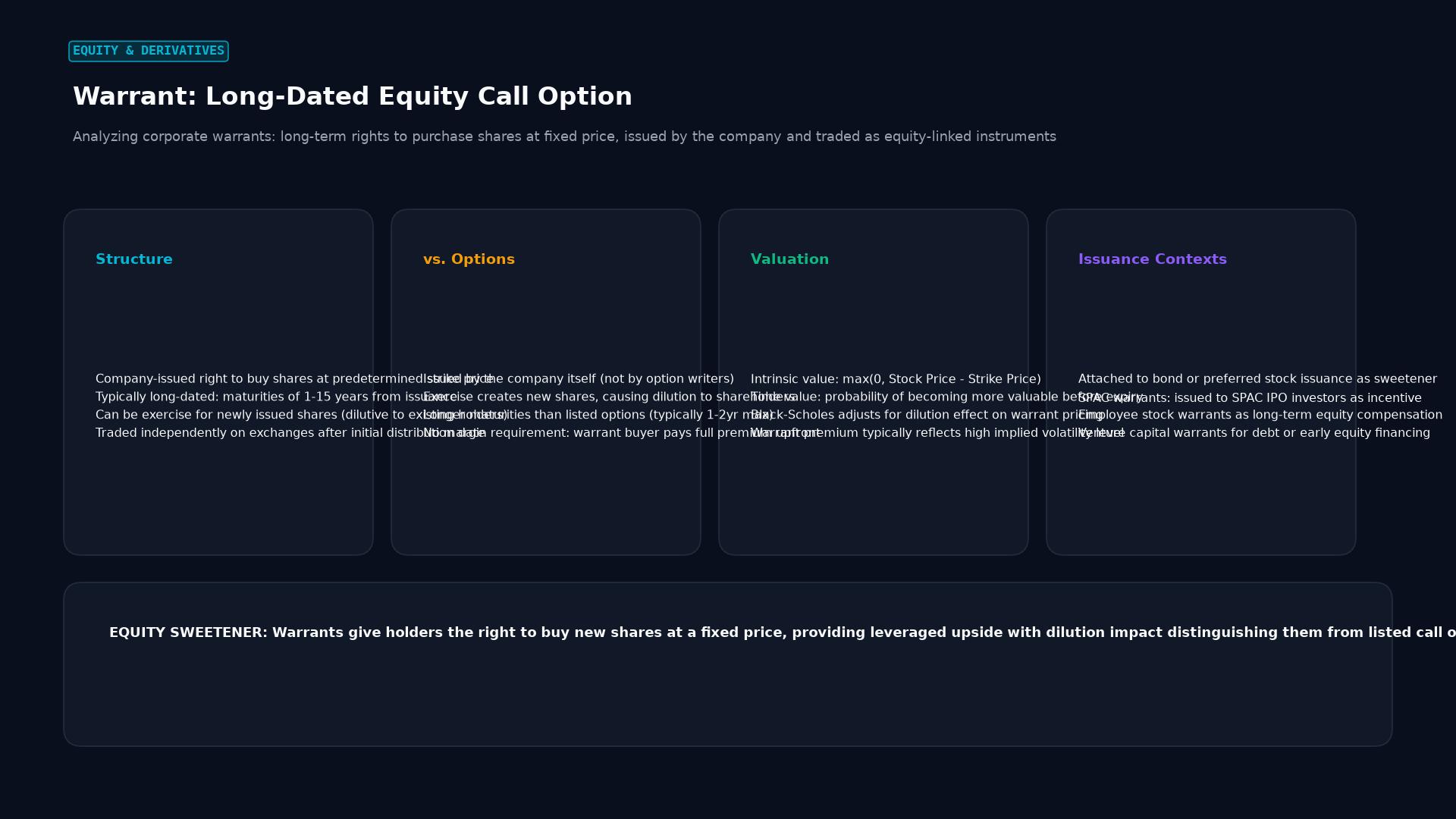 Figure: Analyzing corporate warrants: long-term rights to purchase shares at fixed price, issued by the company and traded as equity-linked instruments
Quantitative Mechanics: Black-Scholes Dilution Adjustment
Because warrant exercise expands the total share count, standard Black-Scholes-Merton option pricing overstates a warrant’s theoretical fair value unless adjusted for dilution.
Adjusted Warrant Pricing Formula
If a company has $N$ common shares outstanding and issues $M$ warrants, where each warrant converts into $c$ common shares, the post-exercise share count becomes $N + c M$. The fair value of a warrant ($W$) is mathematically derived from the unadjusted call option price ($C_{\text{BSM}}$):
$$W = \left( \frac{N}{N + c M} \right) C_{\text{BSM}}\left( S_0, K, T, r, \sigma \right)$$
Where:
- $N$: Number of existing common shares outstanding.
- $M$: Number of outstanding warrants.
- $c$: Conversion ratio (shares per warrant, typically $1.0$).
- $S_0$: Current spot price of the underlying equity.
- $K$: Exercise (strike) price of the warrant.
- $T$: Time to expiration in years.
- $\sigma$: Annualized volatility of the underlying equity.
As the number of outstanding warrants ($M$) grows relative to existing shares ($N$), the dilution factor $\frac{N}{N + c M}$ declines, pulling the market value of the warrant below an equivalent secondary market call option.
Comparative Matrix: Warrants vs. Related Equity Instruments
| Characteristic | Corporate Warrant | Exchange Call Option | Stock Right | Convertible Bond |
|---|---|---|---|---|
| Issuer | The underlying corporation | Clearing house / Exchange traders | The underlying corporation | The underlying corporation |
| Typical Tenor | 3 to 10 years | 1 month to 2 years | 2 to 6 weeks | 5 to 30 years |
| Capital Impact | Influx of new cash upon exercise | None (inter-trader transfer) | Influx of new cash upon exercise | Debt extinguishment $\to$ equity |
| Dilution Effect | Yes (New shares created) | No (Existing shares transferred) | Yes (New shares created) | Yes (Upon debt conversion) |
| Primary Purpose | Financing sweetener to lower bond coupons | Speculation and portfolio hedging | Anti-dilution pre-emptive rights | Lower-coupon hybrid corporate debt |
Real-World Case Study: The US Treasury TARP Warrant Auctions (2009–2014)
During the height of the 2008 Global Financial Crisis, the United States Department of the Treasury injected billions of dollars into major financial institutions through the Troubled Asset Relief Program (TARP).
To ensure taxpayers shared in the eventual financial recovery, the US government required participating banks to issue equity warrants alongside preferred stock.
- Capital Infusion (2008): In exchange for preferred capital injections, the Treasury received 10-year warrants to purchase shares in institutions including JPMorgan Chase, Goldman Sachs, Morgan Stanley, and Bank of America.
- Economic Recovery & Auctions (2009–2010): As banking solvency stabilized and share prices rebounded far above the warrant strike prices, the Treasury held competitive public auctions to liquidate the warrants.
- Taxpayer Return: The Treasury recovered $11 billion in pure profit from the warrant auctions alone, demonstrating how warrants allow capital providers to capture asymmetric equity upside while extending distressed debt financing.
Frequently Asked Questions (FAQ)
Why do corporations issue warrants attached to corporate debt?
Corporations issue warrants attached to debt offerings as “equity sweeteners” (kickers). By attaching warrants that allow bondholders to participate in future share price appreciation, the company can successfully market its bonds at a significantly lower cash coupon interest rate. This reduces annual debt service expenses, preserving cash flow for research, development, and capital expenditures.
What is the difference between an equity warrant and a covered warrant?
An equity warrant is issued by the underlying company itself, resulting in share dilution and new capital injection upon exercise. A covered warrant is issued by an independent financial institution (such as an investment bank like Deutsche Bank or BNP Paribas). The issuing bank covers its obligation by holding the underlying shares or equivalent derivatives; exercising a covered warrant results in a cash settlement or transfer of existing shares without creating new shares or diluting the underlying company.
What happens to a warrant if it expires out-of-the-money?
If the market price of the underlying common stock remains below the warrant’s exercise price ($S_T < K$) upon the final expiration date, the warrant expires completely worthless. The warrant holder loses the entire premium paid to acquire the instrument, and the issuing corporation retains any initial capital received without issuing additional shares or incurring future liabilities.
Ready to trade forex?
Open a free demo account with a regulated broker. Practice with virtual funds before risking real money.