Qualified Domestic Institutional Investor
A Qualified Domestic Institutional Investor (QDII) is a licensed institutional entity in mainland China permitted under quota by SAFE to invest domestic capital into offshore securities.
What is a Qualified Domestic Institutional Investor (QDII)?
A Qualified Domestic Institutional Investor (QDII) is a financial institution domiciled in mainland China that has been officially licensed by domestic financial regulators and granted a foreign exchange quota by the State Administration of Foreign Exchange (SAFE) to invest domestic Chinese capital into overseas financial markets.
Introduced in 2006, the QDII scheme serves as an institutional bridge across China’s capital account controls. Because the Chinese Yuan (Renminbi, CNY) is not fully convertible on the capital account, mainland Chinese citizens and institutional corporations are legally restricted from directly transferring domestic currency abroad to purchase foreign stocks, bonds, or commodities.
The QDII framework enables domestic investors to convert RMB into foreign currencies (primarily US Dollars and Hong Kong Dollars) within controlled regulatory pipelines. By pooling domestic retail and corporate savings into mutual funds, trusts, commercial bank wealth management products, and insurance asset portfolios, QDII managers purchase offshore assets, providing domestic savers with international asset diversification.
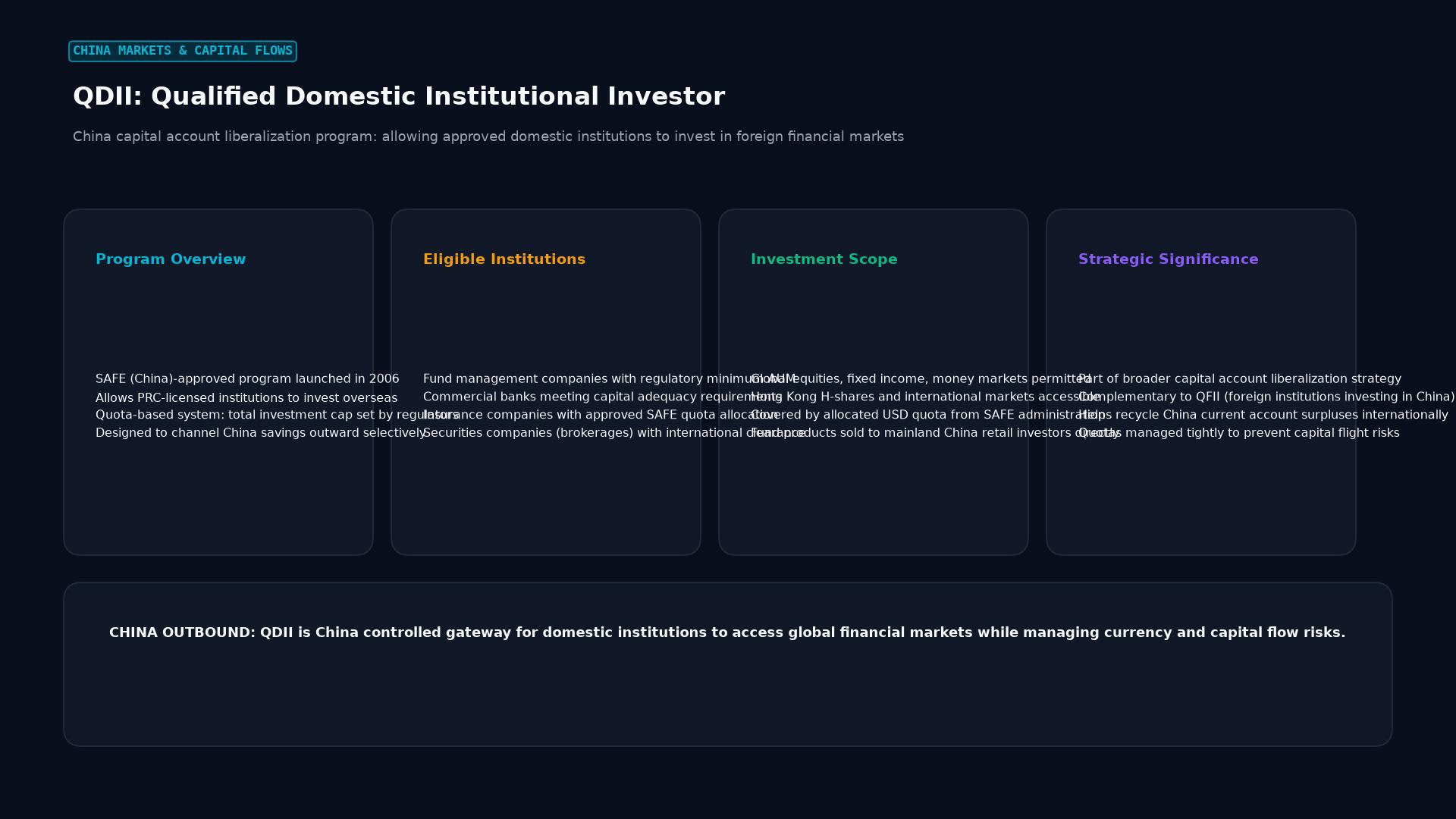 Figure: China capital account liberalization program: allowing approved domestic institutions to invest in foreign financial markets
Historical Origins and Strategic Purpose
The creation of the QDII scheme reflected China’s evolving macroeconomic posture following its 2001 accession to the World Trade Organization (WTO).
The Inbound Predecessor: QFII (2002)
In 2002, China launched the Qualified Foreign Institutional Investor (QFII) program. QFII was designed as a controlled “inbound” conduit, allowing select foreign institutional asset managers (such as UBS, Morgan Stanley, and sovereign wealth funds) to convert foreign currency into RMB to invest directly in mainland Chinese domestic A-shares and government bonds.
                    CROSS-BORDER CAPITAL REGULATORY PIPELINES

      FOREIGN CAPITAL                                    CHINESE CAPITAL
             │                                                  │
             ▼                                                  ▼
     QFII / RQFII Scheme                                   QDII Scheme
    (Launched in 2002)                                  (Launched in 2006)
             │                                                  │
   INBOUND CONDUIT:                                    OUTBOUND CONDUIT:
   Foreign Funds ──► Converted to RMB                  Domestic RMB ──► Converted to USD/HKD
   Invested in Mainland A-Shares                       Invested in Offshore Global Markets
   (Shanghai / Shenzhen)                               (Hong Kong, US, Europe)
The Birth of QDII (2006)
By 2006, China’s massive trade surpluses were creating historic macroeconomic challenges for the central bank, the People’s Bank of China (PBOC):
- China’s foreign exchange reserves were surging past $1 trillion USD, generating unwanted domestic liquidity that fueled domestic real estate speculation.
- Sterilizing these capital inflows required aggressive central bank bill issuance.
- To balance cross-border foreign exchange flows and encourage domestic capital to seek offshore returns, the Chinese government established the QDII regime.
Jointly governed by the PBOC, the China Securities Regulatory Commission (CSRC), the National Financial Regulatory Administration (NFRA, formerly the CBIRC), and SAFE, the program officially opened global capital markets to domestic Chinese institutional capital.
Regulatory Architecture: The Dual-Approval System
To operate as a QDII and deploy capital into offshore exchanges, an institutional applicant must complete a two-tier regulatory screening process:
Mainland Financial Institution (Fund Manager, Bank, Insurer, Trust)
                               │
                               ▼
        Tier 1: Qualification Approval (CSRC / NFRA)
        - Net capital and asset under management hurdles
        - Experienced overseas investment team
        - Sound risk management and custodial frameworks
                               │
                               ▼
        Tier 2: Foreign Exchange Quota Allocation (SAFE)
        - SAFE issues specific dollar investment quota (e.g. $500M)
        - Governed by broader PBOC balance-of-payments objectives
                               │
                               ▼
        Execution & Deployment via Offshore Sub-Custodian
        Domestic retail/institutional capital pooled in RMB;
        Converted to USD/HKD and invested in international securities
1. Qualification Licensing (CSRC or NFRA)
The institution must first apply to its primary industry regulator:
- Securities Firms and Mutual Fund Managers: Regulated by the China Securities Regulatory Commission (CSRC).
- Commercial Banks, Trust Companies, and Insurance Firms: Regulated by the National Financial Regulatory Administration (NFRA).
Regulators evaluate the institution’s net capital, operational track record, compliance history, and whether the firm employs specialized investment personnel with international portfolio management credentials.
2. SAFE Quota Allocation
Securing regulatory qualification does not allow the manager to send money abroad immediately. The institution must apply to the State Administration of Foreign Exchange (SAFE) for an official QDII Quota.
SAFE allocates quotas denominated in US dollars. The institution can only convert domestic RMB into foreign currency up to the exact dollar ceiling granted in its quota allocation.
Macroeconomic Role: Balancing China’s Capital Account
The QDII quota allocation mechanism serves as a valve for managing China’s balance of payments and defending the exchange rate of the Renminbi.
+------------------------------------------------------------------------------------+
|                         SAFE MACROPRUDENTIAL QUOTA LEVERS                          |
+-------------------+----------------------------------------------------------------+
| CURRENCY STRESS   | SAFE QUOTA REGULATORY ACTION                                   |
+-------------------+----------------------------------------------------------------+
| RMB Depreciation  | SAFE slows or freezes new QDII quota issuances. Restricting    |
| & Capital Outflows| outbound currency conversion limits downward pressure on the   |
|                   | onshore Renminbi (USD/CNY).                                    |
+-------------------+----------------------------------------------------------------+
| RMB Appreciation  | SAFE expands and accelerates new QDII quota approvals.         |
| & Capital Inflows | Encouraging domestic capital to move offshore absorbs excess   |
|                   | foreign exchange reserves and moderates RMB appreciation.      |
+-------------------+----------------------------------------------------------------+
Strategic Pauses and Re-Activations
Throughout its operational history, SAFE has adjusted quota allocations in response to currency volatility:
- Following the August 2015 “RMB Shock” and capital outflow pressures, SAFE froze new QDII quota approvals for nearly three years (from March 2015 to April 2018) to preserve foreign exchange reserves.
- In 2020 and 2021, when China’s export manufacturing boom generated large trade surpluses and RMB strength, SAFE resumed aggressive quota allocations, expanding total approved quotas beyond $150 billion to $165 billion USD.
Evolution of Outbound Regimes: QDII, QDLP, and Stock Connect
As China’s capital markets modernized, authorities developed alternative outbound channels to complement the traditional QDII system:
+------------------------------------------------------------------------------------+
|                         CHINESE OUTBOUND CAPITAL CHANNELS                          |
+---------------------+-------------------+---------------------+--------------------+
| ATTRIBUTE           | QDII PROGRAM      | QDLP / QDIE         | SOUTHBOUND CONNECT |
+---------------------+-------------------+---------------------+--------------------+
| Target Investors    | Broad Public      | High-Net-Worth &    | Qualified Retail   |
|                     | (Retail & Inst.)  | Institutional Funds | (≥ 500k RMB)       |
+---------------------+-------------------+---------------------+--------------------+
| Eligible Assets     | Public equities,  | Offshore PE, Hedge  | Eligible equities  |
|                     | bonds, index ETFs | Funds, Real Estate  | listed on SEHK     |
+---------------------+-------------------+---------------------+--------------------+
| Quota Level         | National (SAFE)   | Municipal Pilot     | Daily Net Balance  |
|                     |                   | (Shanghai, Shenzhen)| Caps (Closed Loop) |
+---------------------+-------------------+---------------------+--------------------+
| Capital Flow Model  | Converted to hard | Converted to hard   | Settled in RMB via |
|                     | currency offshore | currency offshore   | ChinaClear (Loop)  |
+---------------------+-------------------+---------------------+--------------------+
1. QDLP and QDIE Programs
Launched as municipal pilot programs in Shanghai (Qualified Domestic Limited Partner - QDLP) and Shenzhen (Qualified Domestic Investment Enterprise - QDIE):
- Unlike QDII, which focuses primarily on public exchange-traded securities and mutual funds, QDLP allows domestic capital to invest in offshore alternative assets, including private equity funds, venture capital, distressed debt, and hedge funds.
2. Southbound Stock Connect
The launch of the Shanghai-Hong Kong Stock Connect (2014) and Shenzhen-Hong Kong Stock Connect (2016) created a parallel outbound channel:
- The Closed-Loop Model: Unlike QDII, which permits capital to settle abroad in foreign currencies, Stock Connect operates as a closed loop. Mainland investors buy Hong Kong-listed shares in RMB, and when shares are sold, the proceeds return to mainland banking accounts in RMB through ChinaClear, preventing capital flight.
Market Realities: QDII Fund Premiums and Retail Demand
Because mainland Chinese investors have access to limited options for foreign wealth diversification, domestic demand for QDII funds frequently outstrips available regulatory quotas.
       Surging Retail Demand to Diversify into US Equities (Nasdaq 100)
                                     │
                                     ▼
       Domestic Fund Manager Reaches 100% of SAFE Quota Allocation
                                     │
                                     ▼
       Fund Manager Suspends New Creation of Primary QDII Units
                                     │
                                     ▼
       Secondary Market Bidding Continues on Shanghai/Shenzhen Exchanges
                                     │
                                     ▼
       QDII ETF Trades at 10% to 20% Premium over Underlying Net Asset Value (NAV)
When international markets rally or domestic Chinese markets experience volatility, retail investors bid up exchange-traded QDII funds on domestic exchanges.
If a fund manager has exhausted its SAFE-allocated quota, it cannot issue new creation units to satisfy demand. Consequently, arbitrageurs cannot execute cash-and-carry arbitrage to eliminate the spread, resulting in domestic QDII ETFs trading at premiums of 10% to 25% above their actual underlying Net Asset Value (NAV).
Key Takeaways
- Outbound Regulatory Gateway: The Qualified Domestic Institutional Investor (QDII) program, established in 2006, allows licensed Chinese financial institutions to invest domestic capital in offshore securities under state supervision.
- Capital Account Bridge: QDII bypasses China’s capital account controls, enabling domestic savers to convert RMB into foreign currency assets while preserving state oversight.
- Dual-Approval Governance: Institutions require operational licensing from the CSRC or NFRA, combined with an explicit foreign currency investment quota granted by SAFE.
- Macroeconomic Valve: SAFE uses quota allocation speeds to balance the national balance of payments, freezing quotas during periods of RMB depreciation and expanding them during capital inflow booms.
- Complementary Outbound Conduits: The QDII framework operates alongside alternative channels, including QDLP/QDIE for offshore private equity and Southbound Stock Connect for direct Hong Kong equity trading.
- Structural Fund Premiums: Quota caps frequently lead to secondary market dislocations, causing domestic QDII ETFs to trade at substantial premiums over their underlying net asset values.
Frequently Asked Questions (FAQ)
What is the difference between QFII and QDII?
The primary difference lies in the direction of capital flow. QFII (Qualified Foreign Institutional Investor) is an inbound program launched in 2002 that allows qualified foreign institutional investors (such as international asset managers and pension funds) to bring foreign currency into China, convert it to RMB, and invest in domestic mainland Chinese A-shares and bonds. QDII (Qualified Domestic Institutional Investor) is an outbound program launched in 2006 that allows licensed domestic Chinese financial institutions to pool domestic RMB savings, convert them into foreign exchange, and invest in international capital markets like Hong Kong, New York, and London.
How does an individual retail investor in China buy QDII assets?
An individual retail investor in mainland China does not apply directly for a QDII license or quota. Instead, retail individuals purchase shares of publicly offered QDII mutual funds or exchange-traded funds (ETFs) offered by licensed domestic asset managers (such as ChinaAMC, E Fund, or Harvest Fund Management). These funds are traded in local currency (RMB) on domestic bank portals or on the Shanghai and Shenzhen stock exchanges, providing ordinary retail savers with exposure to global stock indexes like the S&P 500, Nasdaq 100, or Hang Seng Tech Index.
Why do QDII ETFs sometimes trade at massive premiums in China?
QDII ETFs trade at premiums over their Net Asset Value (NAV) because of quota constraints. In a normal open-ended ETF market, if retail demand pushes the price above NAV, institutional authorized participants (APs) buy underlying shares and create new ETF units, arbitraging the premium down to zero. However, under the QDII system, if the fund manager has exhausted its SAFE foreign exchange quota, it cannot purchase additional foreign shares to create new units. The supply of ETF units becomes fixed, and strong retail demand bids up prices on secondary exchanges, resulting in market premiums above the true value of the underlying assets.
Ready to trade forex?
Open a free demo account with a regulated broker. Practice with virtual funds before risking real money.