SHP
SHP (Saint Helena Pound) is the official currency of the British Overseas Territory of Saint Helena, Ascension, and Tristan da Cunha, pegged 1:1 to the British Pound Sterling (GBP).
What is the Saint Helena Pound (SHP)?
The Saint Helena Pound (ISO code: SHP, symbol: £) is the official currency of the island of Saint Helena and Ascension Island, which form part of the British Overseas Territory of Saint Helena, Ascension and Tristan da Cunha in the South Atlantic Ocean. Subdivided into 100 pence (singular: penny, symbol: p), the currency is administered by the Commissioners of Currency on behalf of the Government of Saint Helena.
The Saint Helena Pound operates under an orthodox Currency Board Arrangement. By statutory decree, the SHP is pegged at a rigid 1:1 parity with the British Pound Sterling (GBP):
$$\text{Fixed Exchange Parity}: 1 \text{ SHP} = 1 \text{ GBP}$$
The currency is not an independent floating fiat instrument. Every Saint Helena Pound banknote and coin in circulation is backed by an equivalent reserve of British Pound Sterling assets held in custodial accounts in the United Kingdom.
While British Pound Sterling banknotes issued by the Bank of England circulate freely and are accepted across Saint Helena and Ascension Island alongside local currency, the Saint Helena Pound is not legal tender inside the United Kingdom.
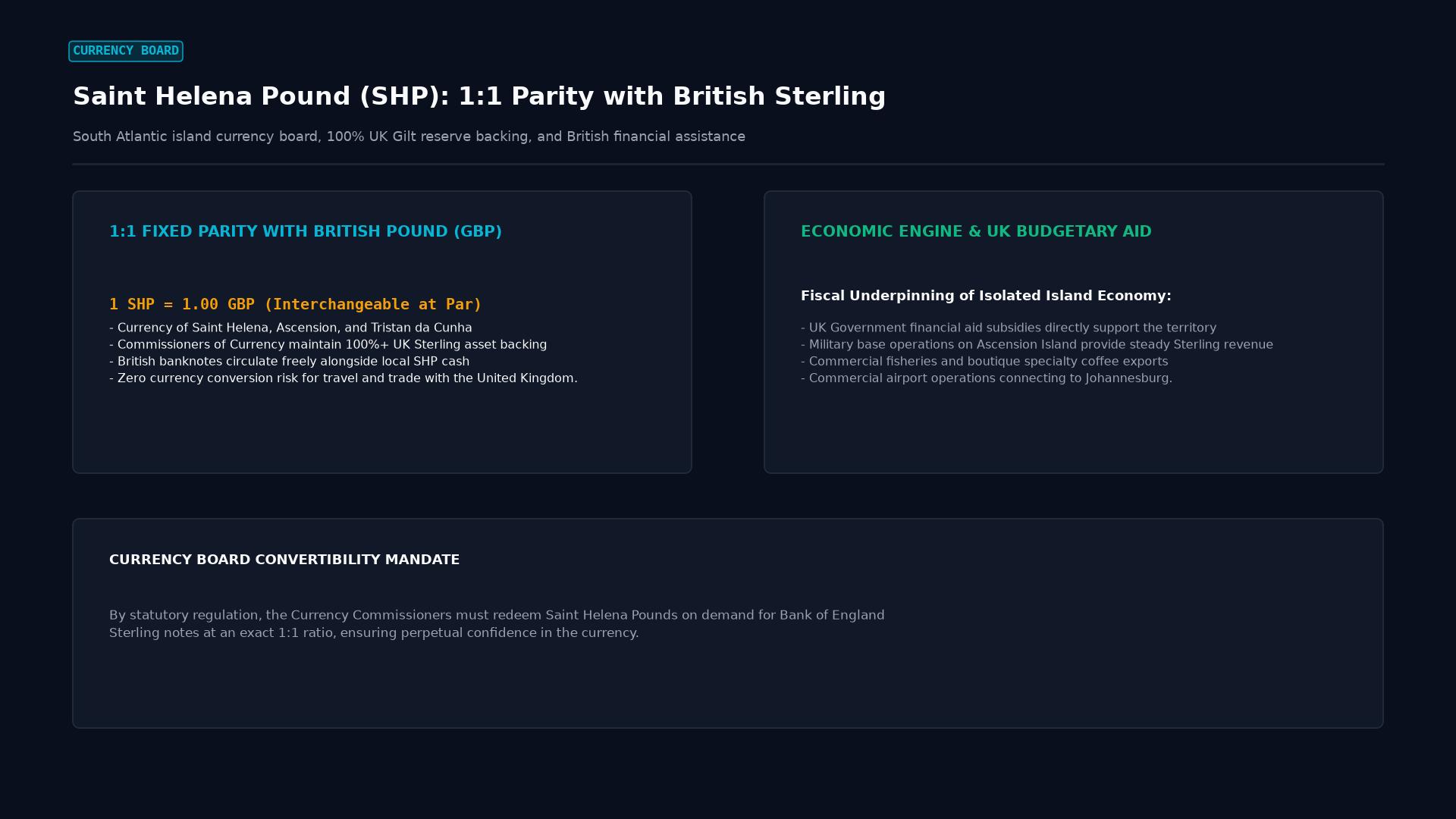 Figure: South Atlantic island currency board, 100% UK Gilt reserve backing, and British financial assistance
Historical Origins and Currency Legislation
The monetary history of Saint Helena reflects its strategic isolation and historical role as a vital provisioning station for East India Company vessels rounding the Cape of Good Hope.
East India Company and Colonial Coinage
Discovered by the Portuguese in 1502, Saint Helena came under the administration of the British East India Company (EIC) in 1659.
- During the 17th and 18th centuries, a wide variety of foreign specie circulated on the island, including Spanish silver pieces of eight, Dutch guilders, Indian gold pagodas, and Venetian ducats.
- The island gained global prominence between 1815 and 1821 when the British government selected it as the place of exile for Emperor Napoleon Bonaparte following his defeat at the Battle of Waterloo.
- In 1821, the East India Company minted specialized copper halfpenny tokens for local circulation. In 1836, sovereignty transferred from the East India Company directly to the British Crown, establishing the British Pound Sterling as the formal unit of account.
1659-1834: East India Company Era
Circulation of Spanish Silver, Indian Pagodas, and EIC Copper Tokens
                      │
                      ▼
1836: Crown Colony Status
Adoption of British Sterling as legal unit of account
                      │
                      ▼
1975: The Currency Ordinance 1975
Creation of the Commissioners of Currency;
Issuance of first sovereign Saint Helena paper banknotes (1:1 with GBP)
                      │
                      ▼
1984: Issuance of Modern Coinage
Saint Helena and Ascension mint independent circulating coins
                      │
                      ▼
2004: Establishment of the Bank of Saint Helena
Creation of the island's sole commercial banking institution
The Currency Ordinance 1975
Prior to 1975, standard Bank of England and United Kingdom coinage circulated across the island. To generate local seigniorage revenues and assert administrative autonomy, the Legislative Council of Saint Helena enacted the Currency Ordinance of 1975.
This legislation:
- Created the Commissioners of Currency, a statutory body responsible for managing currency issuance.
- Authorized the printing of official Saint Helena Pound paper banknotes (initially in denominations of £1, £5, and later £10 and £20).
- In 1984, the government introduced its own circulating coins in denominations of 1p, 2p, 5p, 10p, 20p, 50p, £1, and £2, featuring local wildlife, the island’s coat of arms, and Queen Elizabeth II (and subsequently King Charles III).
Currency Board Mechanics and 100% Reserve Backing
The monetary stability of the Saint Helena Pound is guaranteed by the mechanics of its Currency Board System.
       Government of Saint Helena / Commissioners of Currency
                                │
                                ▼
       Every 1 SHP Note or Coin Issued into Domestic Circulation
                                │
                                ▼
       Must be 100% Matched by 1 GBP of Liquid Sterling Assets
                                │
                                ▼
       Sterilized Reserves Deposited with Crown Agents Bank (London)
       Invested in UK Gilts, Treasury Bills, and AAA Sterling Paper
                                │
                                ▼
       Generates Seigniorage Interest Income for Saint Helena Budget
1. Zero Independent Discretionary Policy
The Commissioners of Currency do not function as a standard central bank:
- They do not conduct open-market operations.
- They do not adjust policy interest rates.
- They cannot extend credit to commercial banks or print unbacked fiat money to finance local government deficits.
The supply of Saint Helena Pounds expands or contracts in direct response to the balance of payments. When an institution or individual deposits British Pound Sterling into the local banking system, new Saint Helena Pounds are minted or released. When local currency is converted back into UK sterling, the SHP notes are removed from circulation.
2. Seigniorage and the Reserve Fund
Under the Currency Ordinance, the backing reserves are held in an official Currency Fund managed via custodial agents (historically Crown Agents Bank in London).
These reserves are invested in safe, liquid sterling instruments, including UK Government Treasury Bills, short-dated Gilts, and AAA-rated cash management funds. The interest yield generated by these investments, known as seigniorage, flows into the general revenues of the Saint Helena Government, helping fund schools, roads, and healthcare infrastructure.
Geographical Circulation Nuances
Although the political territory is officially titled Saint Helena, Ascension and Tristan da Cunha, currency circulation across the three island groups is not uniform:
+------------------------------------------------------------------------------------+
|                         TERRITORIAL CURRENCY CIRCULATION                           |
+---------------------+-------------------------------+------------------------------+
| ISLAND JURISDICTION | OFFICIAL CURRENCY IN USE      | ACCEPTED SECONDARY CURRENCY  |
+---------------------+-------------------------------+------------------------------+
| Saint Helena        | Saint Helena Pound (SHP)      | British Pound Sterling (GBP) |
|                     |                               | Accepted interchangeably     |
+---------------------+-------------------------------+------------------------------+
| Ascension Island    | Saint Helena Pound (SHP)      | British Pound Sterling (GBP) |
|                     |                               | & US Dollars (USAF Base)     |
+---------------------+-------------------------------+------------------------------+
| Tristan da Cunha    | British Pound Sterling (GBP)  | Saint Helena Pound is NOT in |
|                     | (Sole Official Currency)      | general cash circulation     |
+---------------------+-------------------------------+------------------------------+
The Tristan da Cunha Exception
Tristan da Cunha, situated over 1,500 miles southwest of Saint Helena, is the most remote inhabited archipelago on Earth.
Despite being part of the same British Overseas Territory, Tristan da Cunha does not use the Saint Helena Pound. The island uses the British Pound Sterling (GBP) exclusively. Because communication and shipping between Saint Helena and Tristan da Cunha are infrequent, the island’s commercial council opted to maintain direct sterling accounts rather than adopt SHP notes.
Banking Architecture: The Bank of Saint Helena
Commercial banking on the island is managed by a single institution: the Bank of Saint Helena Ltd.
+------------------------------------------------------------------------------------+
|                         BANK OF SAINT HELENA ARCHITECTURE                          |
+-------------------+----------------------------------------------------------------+
| FOUNDING DATE     | April 2004 (Replacing the legacy Post Office Savings Bank)     |
| OWNERSHIP         | 100% Owned by the Government of Saint Helena                   |
| HEADQUARTERS      | Jamestown, Saint Helena (Branch office on Ascension Island)   |
| FINANCIAL NETWORK | Operates outside the UK Faster Payments / BACS clearing grid;  |
|                   | utilizes correspondent SWIFT banking via UK commercial banks.  |
| DIGITAL SERVICES  | Issues the local "Tourist Card" and island-wide debit cards.  |
+-------------------+----------------------------------------------------------------+
Because Saint Helena is geographically isolated and lacks a link to the UK mainland clearing grid:
- Island bank accounts utilize proprietary domestic account structures rather than standard UK sort codes.
- Electronic wire transfers to and from the island are routed through correspondent banking accounts in London, incurring international wire fees and clearing delays of 1 to 3 business days.
- In 2018, the Bank of Saint Helena introduced domestic electronic payment cards, modernizing commerce across Jamestown and the rural districts.
Economic Drivers and Numismatic Value
Saint Helena’s economy is supported by international development assistance, commercial fisheries, tourism, and high-value agricultural exports.
1. UK Government Financial Aid (DFID / FCDO)
Because the island’s domestic tax base is small, the public budget relies on annual budgetary grant-in-aid provided by the United Kingdom’s Foreign, Commonwealth & Development Office (FCDO). These budgetary transfers arrive in British Pound Sterling, maintaining the liquidity of the local currency board.
2. Tourism and the Saint Helena Airport
For centuries, the island was accessible only by sea aboard the Royal Mail Ship (RMS St Helena), a five-day voyage from Cape Town. The opening of Saint Helena Airport (HLE) in 2017 introduced scheduled commercial flights from South Africa, expanding eco-tourism focused on hiking, marine diving (whale sharks), and Napoleonic heritage sites.
3. Numismatic Demand and Collectible Revenue
Because the Saint Helena Pound is used by an isolated population of roughly 4,500 residents, its circulating coins and banknotes are produced in limited quantities.
- Commemorative gold and silver coins minted on behalf of the island (often depicting the East India Company crest, Napoleon, or maritime history) are sold worldwide to numismatic collectors.
- These sales generate foreign exchange royalties that flow into the island’s treasury.
Key Takeaways
- Official Currency of Saint Helena: The Saint Helena Pound (SHP, symbol: £) is issued by the Commissioners of Currency for Saint Helena and Ascension Island.
- Statutory 1:1 Parity: The SHP is fixed at 1:1 with the British Pound Sterling (GBP), with Bank of England notes accepted alongside domestic currency.
- Orthodox Currency Board: Every circulating SHP note and coin is backed 100% by sterling assets held in the UK, eliminating independent monetary expansion.
- Territorial Divergence: While Saint Helena and Ascension use the SHP, the island of Tristan da Cunha officially uses the British Pound Sterling (GBP).
- Sole Commercial Bank: Banking operations are handled by the state-owned Bank of Saint Helena, which operates via correspondent SWIFT clearing channels with London.
- Non-Convertible Outside the Island: The Saint Helena Pound is not legal tender in the United Kingdom and cannot be exchanged at standard high-street banks in London.
Frequently Asked Questions (FAQ)
Can I spend Saint Helena Pounds in the United Kingdom?
No. The Saint Helena Pound is not legal tender inside the United Kingdom, and British merchants, retail shops, and commercial banks on the UK mainland will not accept SHP banknotes or coins. Before departing Saint Helena or Ascension Island, travelers should exchange any remaining SHP currency back into Bank of England British Pound Sterling (GBP) at the Bank of Saint Helena.
Can I spend Bank of England British Pounds (GBP) in Saint Helena?
Yes. Bank of England banknotes and standard United Kingdom coinage circulate freely throughout Saint Helena and Ascension Island. Local merchants, hotels, restaurants, and the Bank of Saint Helena accept British Pound Sterling banknotes interchangeably with the Saint Helena Pound at a direct 1:1 ratio with zero exchange fee.
How does the government of Saint Helena make money from issuing its own currency?
The government makes money through an economic mechanism known as seigniorage. When the Commissioners of Currency issue Saint Helena Pounds to local banks, they receive an equal amount of British Pound Sterling in return. The government deposits this sterling into interest-bearing reserves, UK Treasury bills, and gilts held in London. The annual interest and yields earned from these secure investments belong to the Government of Saint Helena, generating revenue that helps fund public services on the island.
Ready to trade forex?
Open a free demo account with a regulated broker. Practice with virtual funds before risking real money.