SLL
SLL (Sierra Leonean Leone) was the historical currency code for the official legal tender of the Republic of Sierra Leone, redenominated in July 2022 to the New Leone (SLE) at a 1,000:1 ratio.
What is the Sierra Leonean Leone (SLL / SLE)?
The Sierra Leonean Leone (Historical ISO code: SLL, Modern ISO code: SLE, symbol: Le) is the official legal tender of the Republic of Sierra Leone, a sovereign West African nation on the Atlantic coast. Issued, administered, and defended by the nation’s central monetary authority, the Bank of Sierra Leone (BSL), the leone is subdivided into 100 cents.
In July 2022, the government of Sierra Leone executed a historic monetary overhaul to address decades of inflation that had eroded the currency’s purchasing power.
Under the Redenomination of the Leone Act, 2021, the Bank of Sierra Leone eliminated three zeros from the currency:
$$\text{1 New Leone (SLE)} = 1,000 \text{ Old Leones (SLL)}$$
Under ISO 4217 international currency standards, the historical code SLL was superseded by the modern code SLE.
In global foreign exchange markets, the Leone is an illiquid frontier currency operating under a managed floating exchange rate system. The value of the currency is governed by export receipts from mineral commodities (such as alluvial diamonds, rutile, iron ore, and bauxite) balanced against structural import requirements for staple rice and refined petroleum.
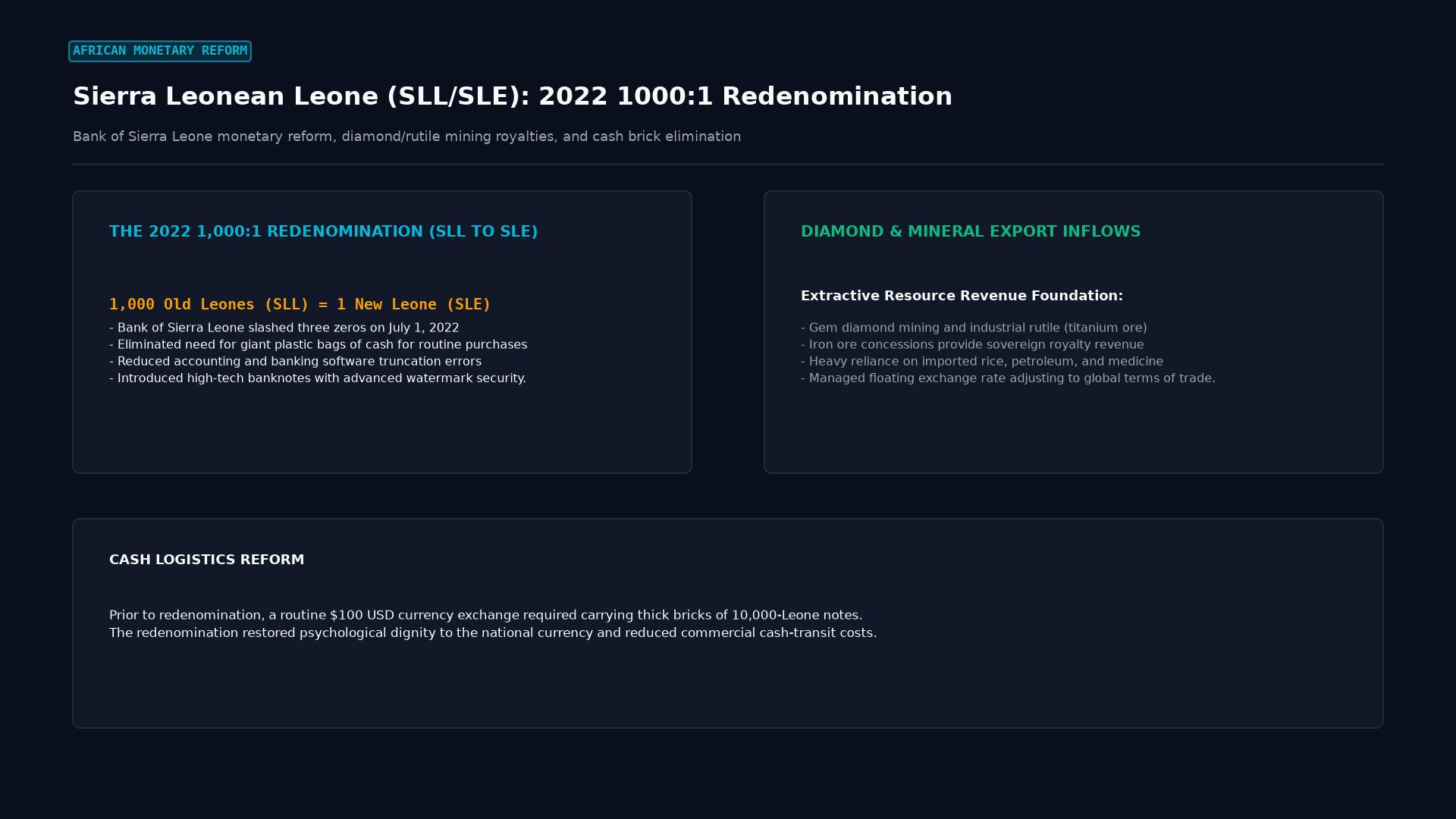 Figure: Bank of Sierra Leone monetary reform, diamond/rutile mining royalties, and cash brick elimination
Historical Origins and Currency Evolution
The monetary trajectory of Sierra Leone reflects its journey from a British Crown Colony and naval anti-slavery base to an independent republic navigating civil conflict, health epidemics, and economic reform.
Pre-Independence and the British West African Pound
Prior to 1964, Sierra Leone belonged to the British West African Currency Board (WACB), using the British West African Pound alongside Ghana, Nigeria, and The Gambia. The colonial currency was pegged at strict 1:1 parity with the British Pound Sterling.
The Creation of the Leone (August 4, 1964)
Following national independence in April 1961, the government moved to establish a sovereign currency. On August 4, 1964, the Bank of Sierra Leone (BSL) commenced formal operations and issued the Sierra Leonean Leone (Le):
- Replaced the British West African Pound under a decimalized conversion:
$$\text{Conversion (1964)}: 1 \text{ West African Pound} = 2 \text{ Leones} \quad (1 \text{ Leone} = 10 \text{ Shillings})$$
- Subdivided into 100 cents, the currency initially circulated in coins of ½c, 1c, 5c, 10c, and 20c, alongside banknotes of Le1, Le2, and Le5 bearing the portrait of Sir Milton Margai, the nation’s first Prime Minister.
1912-1964: British West African Currency Board
Colonial British West African Pound pegged 1:1 to Sterling
                      │
                      ▼
August 4, 1964: Creation of the Bank of Sierra Leone (BSL)
Introduction of Decimal Leone (1 Pound = 2 Leones)
                      │
                      ▼
1970s-1980s: Delinking and Devaluation
Delinked from Sterling in 1978; pegged to IMF SDR;
Declining mining output triggers chronic inflation
                      │
                      ▼
1991-2002: The Sierra Leone Civil War
Destruction of infrastructure; illicit "blood diamond" trade;
Hyperinflationary collapse of the currency's domestic value
                      │
                      ▼
2014-2016: The West African Ebola Epidemic
Border closures, mine suspensions, and severe reserve depletion
                      │
                      ▼
July 1, 2022: Landmark Currency Redenomination
Elimination of three zeros: 1,000 SLL (Old) = 1 SLE (New)
Macroeconomic Drivers of the Leone
The exchange rate of the Leone against the US dollar (USD/SLE) is shaped by mineral commodities, food and fuel import bills, and external donor assistance.
1. The Mineral Extractive Base: Diamonds, Rutile, and Iron Ore
Sierra Leone possesses rich geological mineral deposits that generate over 75% to 85% of national merchandise export earnings:
+------------------------------------------------------------------------------------+
|                         SIERRA LEONE EXTRACTIVE EXPORT SECTORS                     |
+-------------------+----------------------------------------------------------------+
| COMMODITY         | INDUSTRIAL PROFILE & ECONOMIC CONTRIBUTION                     |
+-------------------+----------------------------------------------------------------+
| Alluvial & Kim-   | Koidu and Kono diamond fields; world-famous gemstone-quality   |
| berlite Diamonds  | output regulated under the Kimberley Process Certification.    |
+-------------------+----------------------------------------------------------------+
| Rutile & Ilmenite | Sierra Rutile deposits; one of the world's largest high-grade   |
| (Titanium Ore)    | natural rutile deposits utilized in titanium dioxide pigments. |
+-------------------+----------------------------------------------------------------+
| Iron Ore          | Large open-pit operations at Marampa and Tonkolili producing    |
| (High-Grade)      | concentrated magnetite/hematite for Chinese steel smelters.    |
+-------------------+----------------------------------------------------------------+
| Bauxite           | Sierra Minerals operations supplying raw aluminum ore to       |
| (Aluminum Ore)    | international refinery markets.                                |
+-------------------+----------------------------------------------------------------+
When global commodity demand expands and international prices for titanium, iron ore, and diamonds rally, mining multinationals convert foreign currencies into leones to settle domestic concession royalties, harbor fees, and local payrolls. This generates foreign currency inflows that stabilize the currency.
Conversely, when global manufacturing slows or local mining disputes halt operations, the supply of foreign exchange in Freetown contracts, precipitating depreciation.
2. High Import Dependence: The Rice and Fuel Deficit
While Sierra Leone exports raw minerals, the country runs a persistent structural merchandise trade deficit due to its reliance on imported essentials:
- Refined Petroleum: Sierra Leone imports 100% of its petroleum products (diesel, gasoline, jet fuel). Higher crude oil prices expand the country’s import bill, requiring commercial banks to purchase large volumes of US dollars.
- Milled Rice (The National Staple): Although Sierra Leone possesses fertile agricultural land, domestic rice yields fail to satisfy national consumption. The country spends over $150 million to $200 million USD annually importing milled parboiled rice from India, Pakistan, and Thailand.
Surging Global Crude Oil or Rice Prices
                  │
                  ▼
Expanded Dollar Import Invoices at the Port of Freetown
                  │
                  ▼
Commercial Importers Compete to Buy Scarce USD from Local Banks
                  │
                  ▼
Depreciation Pressure on Leone (USD/SLE Moves Higher)
The 2022 Currency Redenomination: Transition from SLL to SLE
By 2021, decades of cumulative inflation had degraded the practical utility of the Leone:
- A simple restaurant meal or grocery purchase required hundreds of thousands of Leones.
- Businesses were forced to transport cash in plastic grocery bags or cardboard boxes because the largest banknote in circulation (the Le10,000 note) was worth less than $1.00 USD.
- Accounting software, automated teller machines (ATMs), and commercial banking ledgers routinely suffered data display errors due to excessive zeros.
       December 2021: Passage of the Redenomination Act
       Authorizes Bank of Sierra Leone to "Drop Three Zeros"
                             │
                             ▼
       July 1, 2022: Official Launch of the New Leone (SLE)
       Old SLL10,000 Banknote Replaced by New SLE10 Banknote
                             │
                             ▼
       Dual-Circulation Window (July 2022 to December 2023)
       Old SLL and New SLE Circulate Side by Side
                             │
                             ▼
       January 1, 2024: Full Transition Completed
       Old SLL Banknotes Cease to be Legal Tender
The New Banknote Family (SLE)
On July 1, 2022, the Bank of Sierra Leone issued a newly designed, physically smaller family of banknotes printed on durable cotton-paper substrates:
- SLE 1 (Equivalent to old SLL 1,000)
- SLE 2 (Equivalent to old SLL 2,000)
- SLE 5 (Equivalent to old SLL 5,000)
- SLE 10 (Equivalent to old SLL 10,000)
- SLE 20 (A newly created high-value denomination, equivalent to old SLL 20,000)
The redenomination simplified cash handling, reduced printing and transport costs for the central bank, and restored operational efficiency to retail banking systems.
Foreign Exchange Market Microstructure in Sierra Leone
Foreign exchange trading in Sierra Leone is divided between the formal interbank banking system and an active informal street market.
+------------------------------------------------------------------------------------+
|                         SIERRA LEONE FX MARKET SEGMENTS                            |
+--------------------+---------------------------------------------------------------+
| SEGMENT            | OPERATIONAL STRUCTURE & CHARACTERISTICS                       |
+--------------------+---------------------------------------------------------------+
| Formal Interbank   | Licensed commercial banks (such as Sierra Leone Commercial    |
| & BSL Auctions     | Bank, Rokel Commercial Bank, Standard Chartered, Ecobank).    |
|                    | Transactions settle via the BSL Real-Time Gross Settlement    |
|                    | system (RTGS) for documented commercial trade invoices.       |
+--------------------+---------------------------------------------------------------+
| Licensed Bureaux   | Regulated retail foreign exchange bureaus serving international|
| de Change          | travelers, maritime shipping crews, and NGO personnel.        |
+--------------------+---------------------------------------------------------------+
| Informal Parallel  | Unregulated street trading ("Black Market" / Street Dealers). |
| Market             | Trades physical dollar notes at a premium during periods of   |
|                    | official interbank foreign exchange rationing.                |
+--------------------+---------------------------------------------------------------+
Bank of Sierra Leone FX Auctions
To allocate scarce foreign exchange to commercial banks, the BSL operates periodic competitive foreign exchange auctions.
The central bank sells portions of its official foreign exchange reserves to authorized commercial dealers, targeting essential imports (fuel distributors and food importers). Commercial banks bid competitively, and the auction cut-off price helps establish the central bank’s published reference exchange rate.
Key Takeaways
- Official Currency of Sierra Leone: The Leone (symbol: Le) is issued and regulated by the Bank of Sierra Leone (BSL).
- 2022 Redenomination: On July 1, 2022, Sierra Leone removed three zeros, establishing 1 New Leone (SLE) = 1,000 Old Leones (SLL), updating the ISO code from SLL to SLE.
- Mineral Export Dependence: The economy relies on export revenues from alluvial diamonds, rutile, iron ore, and bauxite, leaving the currency sensitive to global commodity cycles.
- Structural Food and Fuel Deficit: Heavy reliance on imported milled rice and refined petroleum creates persistent commercial demand for US dollars, placing depreciation pressure on the exchange rate.
- Historical Shocks: The currency’s purchasing power was eroded by the 1991–2002 Civil War, the 2014–2016 Ebola epidemic, and global inflationary pressures.
- Frontier FX Structure: Trading operates through formal commercial bank channels supported by periodic BSL foreign exchange liquidity auctions, alongside an informal street cash market.
Frequently Asked Questions (FAQ)
What is the difference between SLL and SLE?
SLL and SLE represent the same national currency, the Sierra Leonean Leone, at different stages of its monetary history. SLL was the original ISO 4217 currency code utilized from 1964 until June 2022. On July 1, 2022, the Bank of Sierra Leone executed a currency redenomination that dropped three zeros from all prices and banknotes (1,000 Old Leones = 1 New Leone). To reflect this change in global financial networks, the International Organization for Standardization assigned the new three-letter currency code SLE to represent the redenominated New Leone.
Can old SLL banknotes still be used for payments in Sierra Leone?
No. Following the July 2022 redenomination, the Bank of Sierra Leone established a transition period during which both old (SLL) and new (SLE) banknotes circulated concurrently. That transition window concluded, and old SLL banknotes ceased to be legal tender for ordinary retail transactions. Holders of legacy SLL banknotes can only redeem them through the Bank of Sierra Leone or designated commercial bank counters for exchange into modern SLE legal tender.
How do diamond mining and the Kimberley Process affect the currency?
Diamonds are one of Sierra Leone’s primary export earners. Because diamond transactions are priced and settled globally in US dollars, legal diamond exports generate vital foreign exchange reserves that support the Leone. Following the civil war, Sierra Leone became an active participant in the Kimberley Process Certification Scheme, which verifies that exported rough diamonds are conflict-free. Formal Kimberley certification ensures that diamond revenues flow through official banking channels and state tax registries rather than disappearing into smuggling networks, helping stabilize the domestic currency.
Ready to trade forex?
Open a free demo account with a regulated broker. Practice with virtual funds before risking real money.