LRD
LRD is the ISO 4217 currency code for the Liberian Dollar, the official legal tender of Liberia, issued by the Central Bank of Liberia and operating within a dual-currency monetary framework alongside the United States Dollar.
What Is the LRD?
The LRD is the three-letter ISO 4217 currency code for the Liberian Dollar, the national currency of the Republic of Liberia. Subdivided into 100 cents, the currency is issued, managed, and regulated by the Central Bank of Liberia (CBL), headquartered in the capital city of Monrovia.
In macroeconomic analysis and African emerging market finance, the Liberian Dollar is distinguished by its operation within an entrenched, legally sanctioned dual-currency monetary regime. In Liberia, the local Liberian Dollar and the United States Dollar (USD) circulate simultaneously as legal tender. This dual-currency structure emerged from historical ties to the United States dating back to Liberia’s 1847 founding by freed African-American slaves, combined with severe disruptions caused by fourteen years of civil war (1989–2003) that eroded domestic institutional trust in the sovereign currency.
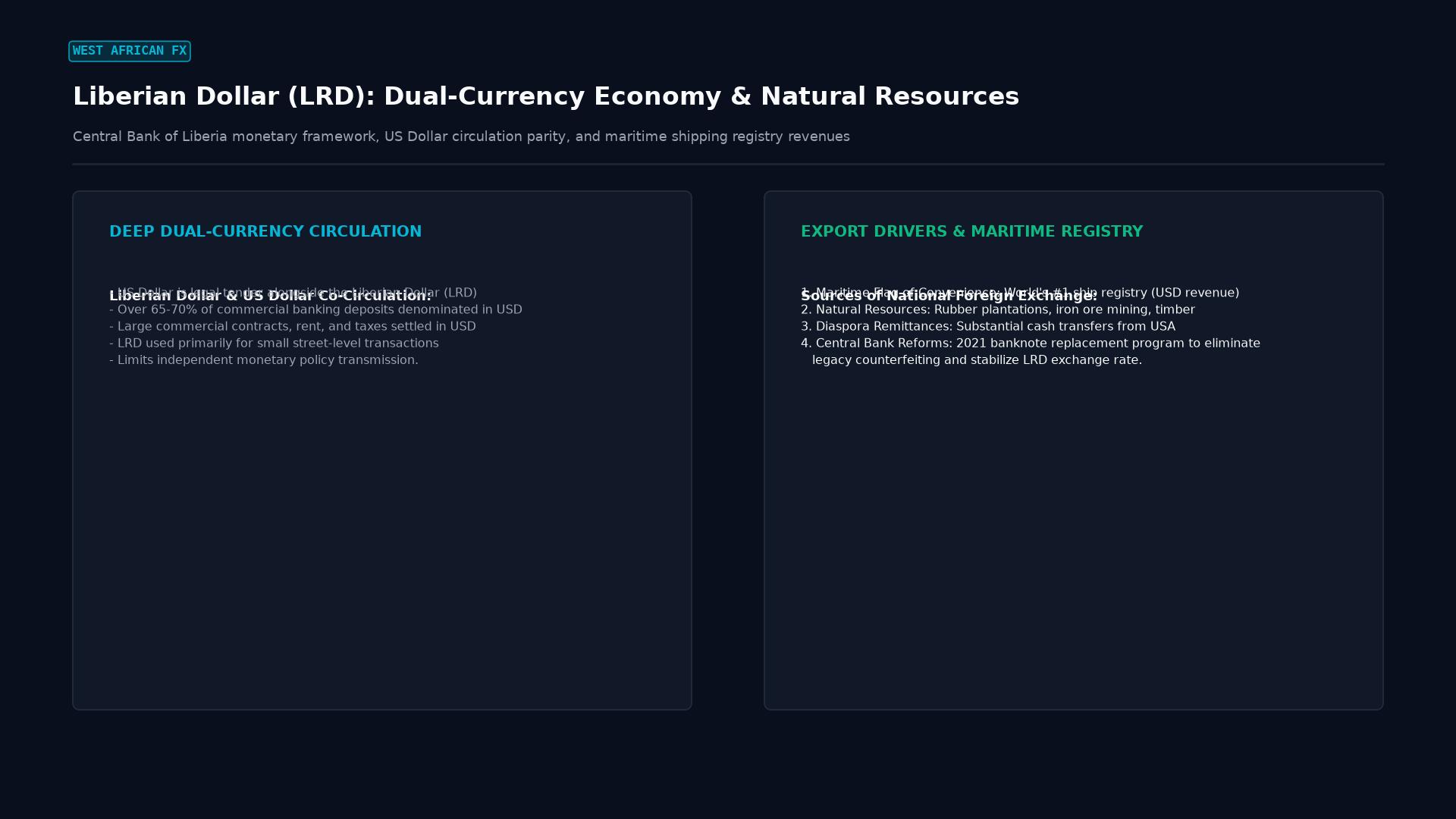 Figure: Central Bank of Liberia monetary framework, US Dollar circulation parity, and maritime shipping registry revenues
The Mechanics of the Dual-Currency System
Unlike dollarized economies where foreign currency operates informally on black markets, Liberia’s dual-currency structure is established in law under the Central Bank of Liberia Act.
The co-circulation of the two currencies follows a functional economic division:
1. The US Dollar Tier (Formal Capital & Trade)
- Over 65% to 70% of total commercial banking system deposits are denominated in US dollars.
- Corporate balance sheets, commercial loan disbursements, commercial lease agreements, and government utility bills are priced and settled in USD.
- Major international trade invoices (including refined petroleum, mining equipment, and rice imports) require direct US dollar settlement.
2. The Liberian Dollar Tier (Everyday Retail Cash)
- The LRD functions predominantly as a physical cash vehicle for domestic consumer transactions.
- Street markets, agricultural produce vendors, municipal transport networks, and informal labor wages are transacted in physical Liberian dollar notes.
While this system shields the country from catastrophic liquidity freezes during local banking stress (because hard US dollars circulate continuously), it severely restricts the Central Bank of Liberia’s ability to conduct independent monetary policy. When the central bank adjusts domestic interest rates, the policy changes affect only the minor LRD fraction of the broad money supply, leaving the dominant USD portion insulated from domestic monetary directives.
Macroeconomic Pillars and External Trade Drivers
The fundamental market exchange rate between the USD and LRD is driven by cross-border capital flows and merchandise export receipts:
| Economic Sector | Key Driver | Influence on Currency Valuation |
|---|---|---|
| Natural Rubber | Large commercial plantations (such as Firestone Liberia) exporting latex | Major private corporate source of hard currency inflows |
| Iron Ore & Mining | Concessions operated by multinational mining giants (such as ArcelorMittal) | Drives sovereign royalties and bulk export revenues |
| Gold & Diamonds | Commercial and artisanal gold mining operations | Generates export revenues but prone to unrecorded cross-border smuggling |
| Rice & Food Imports | Heavy reliance on imported rice (the national food staple) and refined fuels | Large structural outflow of USD; price surges trigger immediate LRD depreciation |
| Diaspora Remittances | Cash remittances sent home by Liberians working in the United States | Essential source of retail dollar liquidity supporting household purchasing power |
When international commodity prices for iron ore and rubber decline, foreign exchange receipts entering Monrovia drop. At the same time, because Liberia imports nearly all of its fuel and staple food, domestic demand for US dollars remains stubbornly high, putting downward pressure on the market value of the LRD.
The 2018 Banknote Scandal and 2021–2024 Currency Reform
The Liberian Dollar’s modern history was shaped by a high-profile currency crisis between 2018 and 2024:
The “Missing Billions” Controversy (2018)
In 2018, public outcry erupted in Liberia following allegations that shipping containers containing 16 billion newly printed Liberian dollar banknotes (equivalent to roughly $100 million at the time), manufactured overseas by Sweden’s Crane AB, had vanished upon arrival at the Port of Monrovia.
Subsequent independent forensic audits conducted by United States firm Kroll Associates revealed that the money had not physically disappeared into thin air. Instead, the Central Bank of Liberia had unlawfully ordered and infused massive unapproved quantities of newly printed banknotes into circulation without legislative authorization. This unchecked monetary expansion saturated the economy, causing annual inflation to exceed 30% and triggering a steep collapse in the value of the LRD against the US dollar.
The Comprehensive Currency Overhaul (2021–2024)
To restore public confidence and replace mutilated, legacy banknotes that were deteriorating in circulation, the National Legislature of Liberia passed a landmark joint resolution in May 2021 authorizing the CBL to execute a full currency replacement.
The reform program:
- Printed and minted a completely redesigned family of LRD banknotes and coins featuring advanced security fibers, tactile features for visually impaired citizens, and anti-counterfeiting watermarks.
- Introduced new high-denomination notes (including 500 and 1,000 LRD denominations) and standardized metallic coins to replace low-value soiled paper notes.
- Successfully demonetized older legacy printings through commercial bank exchange windows, stabilizing domestic money supply and reducing inflation back into single digits.
Foreign Exchange Microstructure and Trading Realities
For corporate treasurers, foreign non-governmental organizations (NGOs), and currency market participants, navigating the Liberian Dollar involves unique operational realities:
- Absence of Offshore Forward Derivatives: The LRD is a strictly non-deliverable, onshore frontier currency. International derivative desks do not trade spot or forward USD/LRD contracts.
- The Street Cambio Network: While commercial banks quote official exchange rates daily based on central bank reference data, a significant portion of physical currency conversion occurs through licensed private foreign exchange bureaus and street money exchangers (cambios) operating throughout Monrovia’s commercial districts.
- Cash Risk and Physical Note Quality: Due to high humidity and heavy cash velocity, physical banknotes deteriorate rapidly. Merchants and commercial banks frequently inspect notes for tears or excessive wear, sometimes discounting damaged notes during transactions.
Key Takeaways
- The LRD (Liberian Dollar) is the official currency of Liberia, regulated by the Central Bank of Liberia under a legally recognized dual-currency regime alongside the US Dollar.
- Over 65% of domestic banking deposits and large commercial contracts are settled in US dollars, while the LRD handles everyday local consumer retail transactions.
- Heavy dollarization limits the central bank’s ability to implement counter-cyclical monetary policy, making the exchange rate sensitive to iron ore and rubber commodity prices.
- A 2018 unauthorized monetary expansion caused severe inflation and prompted an emergency, multi-year comprehensive currency overhaul between 2021 and 2024.
- FX trading is concentrated in onshore commercial banks and local licensed exchange bureaus, with zero liquid offshore derivatives.
Frequently Asked Questions
Can an American traveler use US Dollars in Liberia without exchanging for LRD?
Yes. United States Dollars are accepted alongside Liberian Dollars throughout Liberia, especially for hotel accommodations, restaurant dining, car rentals, and supermarket purchases. However, carrying smaller-denomination US dollar bills is recommended, as change for large transactions is often provided in local Liberian dollars.
Why does Liberia continue to use the US Dollar alongside its own currency?
Liberia retains the dual-currency framework due to deep historical cultural ties to the United States and the need for monetary credibility. After devastating civil conflicts destroyed the banking infrastructure in the 1990s, the US Dollar provided an incorruptible store of value that stabilized the economy and prevented runaway hyperinflation.
How does the Central Bank of Liberia manage domestic liquidity?
The CBL manages liquidity primarily through the issuance of Central Bank of Liberia (CBL) Bills: short-term financial paper offered to commercial banks and institutional investors to mop up excess Liberian dollar cash from circulation and support exchange rate stability.
Ready to trade forex?
Open a free demo account with a regulated broker. Practice with virtual funds before risking real money.