Structural Unemployment
A long-lasting, involuntary form of unemployment caused by a fundamental divergence between the skills, geographic location, or qualifications of available workers and the technological demands of employers.
What Is Structural Unemployment?
Structural unemployment is a persistent and deeply entrenched form of unemployment that arises when the fundamental composition of an economy changes, creating a permanent mismatch between the capabilities offered by job seekers and the specific requirements demanded by employers.
Unlike cyclical unemployment—which fluctuates with the macroeconomic boom-and-bust business cycle and can be mitigated by central bank interest rate cuts—structural unemployment is immune to short-term monetary stimulus. It represents a permanent dislocation caused by technological obsolescence, globalization, automation, or institutional labor market rigidities.
Workers trapped in structural unemployment often remain jobless for years, requiring extensive retraining, vocational re-education, or geographic relocation before becoming economically re-employable.
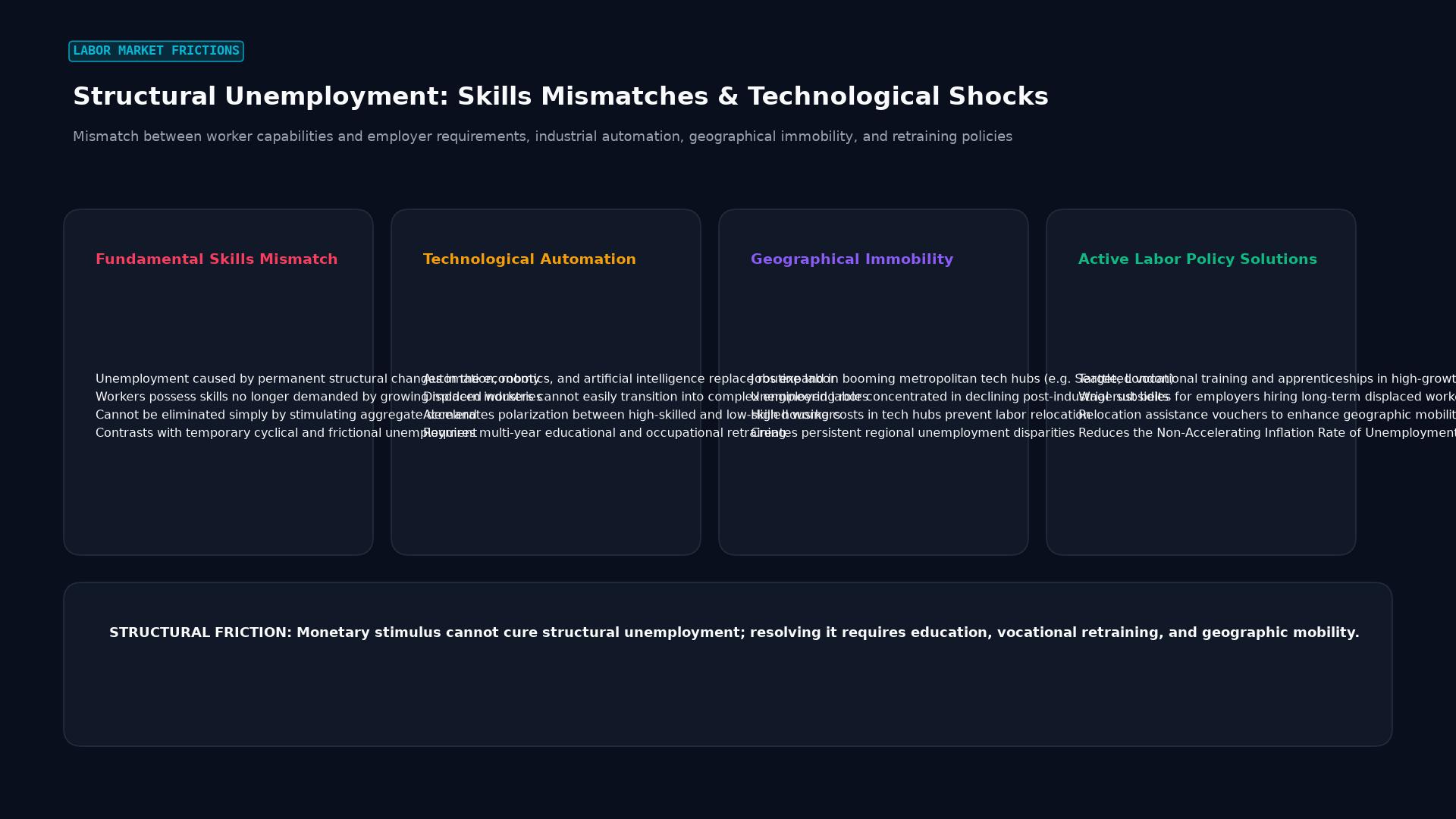 Figure: Mismatch between worker capabilities and employer requirements, industrial automation, geographical immobility, and retraining policies
The Four Primary Catalysts of Structural Unemployment
Economists categorize the structural mismatch of labor into four distinct economic drivers:
- Technological Disruption and Automation: As artificial intelligence, algorithmic software, and automated assembly robotics replace repetitive physical or clerical labor, administrative workers and assembly operators find their skillsets completely obsolete.
- Globalization and Offshoring: The transition of industrial manufacturing to lower-cost emerging economies (such as China, Vietnam, and Mexico) permanently eliminated millions of domestic blue-collar jobs across North America and Western Europe.
- Geographic Immobility: High-paying employment opportunities may concentrate in specific technology clusters or urban centers, while displaced workers reside in declining rural or industrial regions, unable to relocate due to housing costs, family obligations, or negative home equity.
- Institutional Rigidities: High statutory minimum wages, excessive occupational licensing mandates, and inflexible labor union contracts make it economically unfeasible for corporations to hire and retrain low-skilled workers.
Macroeconomic Modeling: The Beveridge Curve
Central bankers and labor economists identify structural shifts in the labor market by analyzing the Beveridge Curve—a graphical representation of the relationship between the unemployment rate (horizontal axis) and the job vacancy rate (vertical axis).
                      THE BEVERIDGE CURVE SHIFT

 Job Vacancy Rate (V)
   │
   │      \ (Curve 1: Efficient Matching)
   │       \
   │        \               \ (Curve 2: Structural Mismatch)
   │         \               \
   │          \       ──►     \  OUTWARD SHIFT:
   │           \               \ High vacancies EXIST, yet
   │            \               \ unemployment remains ELEVATED
   │             \               \ (Structural Unemployment Surge)
   └──────────────\───────────────\──────────────────────────────►
Unemployment Rate (U)- Movement Along the Curve: Reflects cyclical business fluctuations (during recessions, vacancies drop and unemployment rises).
- Outward Shift of the Curve: Signals rising structural unemployment. If employers post millions of unfilled job openings (high vacancies) while millions of citizens remain unemployed simultaneously, it proves that the available workforce lacks the requisite skills demanded by hiring firms.
Structural vs. Cyclical vs. Frictional Unemployment
| Unemployment Category | Primary Root Cause | Average Duration | Responsiveness to Interest Rate Cuts | Typical Economic Example |
|---|---|---|---|---|
| Structural | Permanent skills mismatch, technological shifts, globalization | Prolonged (Months to multiple years) | Zero to Negligible (Cannot solve a skills deficit with cheap money) | Coal miners displaced by renewable energy transitions |
| Cyclical | Deficiency in aggregate macroeconomic demand during a recession | Medium-term (Tied to business cycle) | Extremely High (Monetary easing stimulates hiring) | Construction workers laid off during a housing market downturn |
| Frictional | Normal transitional lag between leaving one job and finding another | Short-term (Weeks to few months) | Low (Natural market friction) | Recent university graduate interviewing for entry-level roles |
Real-World Institutional Case Study: The Deindustrialization of the U.S. Rust Belt
The classic real-world manifestation of structural unemployment unfolded across the American Midwest (the “Rust Belt” covering Ohio, Michigan, Pennsylvania, and Indiana) between 1980 and the mid-2000s:
       U.S. MANUFACTURING EMPLOYMENT COLLAPSE (1979–2010)

 19.5 Million ──┐ (1979 Peak Manufacturing Labor)
                │\
 17.0 Million ──┼─\  [ Automation & Offshoring to Japan and China ]
                │  \
 14.5 Million ──┼───\___
                │       \
 11.5 Million ──┼────────\___ Structural Trough: 2010 (~8 Million Jobs Lost)
                └─────────────────────────────────────────────────────────────
1979 1990 2000 2010- The Transformation: Cities like Detroit, Flint, and Youngstown were built around heavy automotive manufacturing and steel production. Over three decades, foreign competition and robotic automation permanently dismantled these factory floors.
- The Tragedy of Structural Immobility: Displaced automotive assembly line workers—many in their 40s and 50s—could not easily transition into the emerging software development, biotechnology, or financial engineering sectors emerging in Silicon Valley and New York.
- The Economic Legacy: Entire communities experienced decades of depressed labor force participation rates, generational poverty, and persistent structural unemployment that standard Keynesian monetary stimulus was completely powerless to reverse.
The Central Bank Dilemma: Structural Unemployment and NAIRU
For monetary policy committees (such as the Federal Reserve or Bank of England), correctly diagnosing structural unemployment is critical to preventing disastrous policy errors.
This is governed by the Non-Accelerating Inflation Rate of Unemployment (NAIRU) (or natural rate of unemployment):
- If a central bank mistakenly assumes that high unemployment is cyclical when it is actually structural, it will aggressively slash interest rates to stimulate hiring.
- Because companies cannot hire structurally unqualified workers, the cheap monetary stimulus fails to lower unemployment. Instead, the excess liquidity fuels runaway wage inflation among the scarce pool of qualified workers.
- The result is stagflation—persistent high unemployment coupled with high inflation.
Frequently Asked Questions
Can a government eliminate structural unemployment through monetary policy?
No. Central bank interest rate cuts or quantitative easing only stimulate aggregate demand; they cannot teach a displaced factory worker how to program machine-learning algorithms or perform neurosurgery. Structural unemployment can only be resolved through long-term supply-side policies, including vocational retraining, STEM education reform, apprenticeship subsidies, and lowering regulatory barriers to labor mobility.
How does artificial intelligence impact modern structural unemployment?
Unlike historical waves of industrial automation (which primarily replaced manual repetitive blue-collar labor), modern generative artificial intelligence directly automates cognitive, white-collar tasks—including basic computer programming, graphic design, legal paralegal research, and copywriting. This threatens to create a rapid wave of white-collar structural unemployment if knowledge workers fail to adapt to higher-level strategic integration.
What is the difference between structural unemployment and underemployment?
Structural unemployment describes individuals who are completely jobless because their skills do not match market needs. Underemployment describes individuals who are actively working, but are employed in low-wage, low-skill positions that fail to utilize their advanced educational qualifications (e.g., an individual with a master’s degree in aerospace engineering working as a food delivery driver).
Ready to trade forex?
Open a free demo account with a regulated broker. Practice with virtual funds before risking real money.