Unemployment Rate
The unemployment rate measures the percentage of the labor force that is actively seeking employment but currently without work. It is one of the most closely watched macroeconomic indicators in forex, because employment conditions directly influence consumer spending, inflation, and central bank interest rate decisions — all of which drive currency valuation.
Unemployment and Forex: The Connection
A country’s currency value and its unemployment rate are connected through a chain of economic logic: low unemployment → labor market tightness → wage growth → inflationary pressure → central bank rate hikes → currency strengthens.
The reverse chain: rising unemployment → weakening consumer demand → deflationary pressure → central bank rate cuts → currency weakens.
This is why unemployment data consistently ranks among the highest-impact scheduled data releases for major currency pairs. The monthly US unemployment rate — released alongside the Non-Farm Payrolls report on the first Friday of each month — moves EUR/USD, GBP/USD, and USD/JPY within seconds of publication.
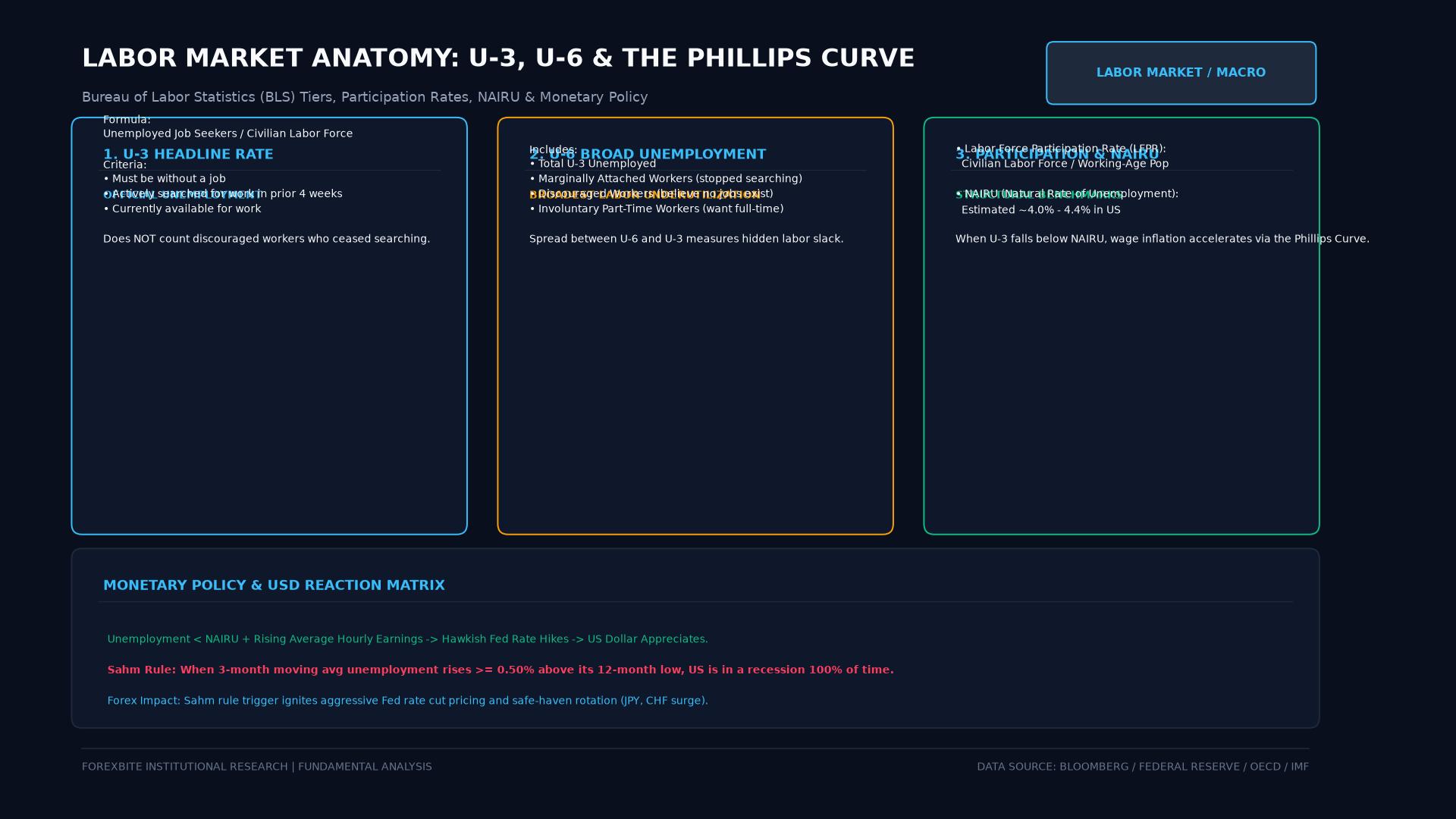 Figure: Comprehensive labor market metrics framework detailing official U-3 unemployment, broad U-6 underutilization, the Labor Force Participation Rate, the Sahm Rule recession indicator, and the Phillips Curve.
How the Unemployment Rate Is Calculated
The unemployment rate is not a simple count of people without jobs. The official definition (in the US, the Bureau of Labor Statistics U-3 rate) requires:
- The person must be jobless — not currently working
- The person must be available for work — able to take a job immediately
- The person must be actively seeking work — taken specific steps to find employment in the past 4 weeks
People who have stopped looking for work (discouraged workers) are not counted in the official unemployment rate. This creates an important nuance: the unemployment rate can fall not because more people found jobs, but because more people gave up looking.
The broader measures (US):
- U-3: The headline unemployment rate (most widely reported)
- U-6: The most comprehensive measure — includes U-3 plus part-time workers who want full-time work plus marginally attached workers. U-6 typically runs 3-4 percentage points above U-3 and is sometimes called the “real” unemployment rate
The “Natural Rate” of Unemployment
Economists refer to the Non-Accelerating Inflation Rate of Unemployment (NAIRU) — the unemployment rate below which inflation begins to accelerate. In the US, this is generally estimated at 4-5%, though it’s not a fixed number.
When unemployment falls significantly below NAIRU (as it did to 3.4% in January 2023), the Fed interprets this as a sign of excessive labor market tightness. Employers competing for scarce workers bid up wages, which feeds into service sector inflation. This is precisely why the 2022-2023 period of ultra-low unemployment forced the Fed into its most aggressive rate hiking cycle in 40 years.
Unemployment in Different Countries: Key Reports
United States: Monthly, released first Friday of the month alongside NFP. The unemployment rate comes from the Household Survey; NFP comes from the Establishment Survey (different methodologies, sometimes diverge).
United Kingdom: UK Claimant Count (monthly) and ILO unemployment rate (quarterly rolling average). The Average Earnings component (wage inflation) is the most Fed-equivalent metric for the Bank of England.
Eurozone: Eurostat releases monthly Eurozone unemployment; individual country data (Germany, France, Spain) comes out separately with more granularity.
Australia: Australian Bureau of Statistics releases monthly employment change and unemployment rate — high-impact for AUD pairs.
Interpreting Unemployment for Currency Trading
The number alone tells an incomplete story. Context matters:
Declining unemployment in a growing economy (typical): Bullish for the currency — supports rate hike expectations.
Declining unemployment amid falling participation rate: Ambiguous — the rate is falling partly because people left the labor force, not just because more people are employed.
Rising unemployment with rising wages: Uncommon but possible in supply-constrained conditions. Signals structural labor market issues rather than simple demand weakness.
Surprise vs. consensus: As with all economic data, the deviation from consensus expectations drives the immediate market reaction. A 3.9% reading when markets expected 4.2% is meaningfully dollar-bullish even if 3.9% isn’t dramatically low in absolute terms.
Forward-looking indicators: Weekly Initial Jobless Claims (US, released every Thursday) and ADP National Employment Report (US, released Wednesday before NFP) serve as leading indicators. Traders monitor these for early signals of what Friday’s NFP might show.
Key Takeaways
- The headline unemployment rate (U-3) counts only those actively seeking work — excluding discouraged workers
- Low unemployment below NAIRU triggers wage inflation concerns, pushing central banks toward rate hikes
- The US rate releases simultaneously with NFP on the first Friday of each month — both are equally market-moving
- Average earnings (wage growth component) is the most inflation-relevant part of the employment report
- Watch the participation rate alongside the unemployment rate for a complete picture
FAQ
Why does the unemployment rate sometimes rise when the economy is improving? A rising participation rate — more people entering (or re-entering) the labor force — can temporarily increase the unemployment count even when hiring is strong. If job creation (175,000) doesn’t keep pace with labor force growth (200,000 new entrants), unemployment rises despite an improving economy. Context is everything.
Is zero unemployment possible or desirable? Neither. Some level of “frictional unemployment” always exists — people between jobs by choice, new graduates searching, career changers. A 0% rate would imply a completely rigid labor market with no turnover. Most economists consider 3.5-4.5% healthy and sustainable for developed economies.
Ready to trade forex?
Open a free demo account with a regulated broker. Practice with virtual funds before risking real money.