Swing Option
A specialized exotic commodity derivative that grants the buyer the operational flexibility to vary (or swing) the volume of the underlying physical commodity received at predetermined dates and prices, bounded by contractual minimum and maximum quantity constraints.
What Is a Swing Option?
A swing option (often termed a variable volume contract or take-and-pay option) is a complex, path-dependent exotic derivative contract predominantly utilized in the physical energy, natural gas, and power markets.
Unlike a standard financial option—which dictates a single fixed quantity to be delivered upon exercise—a swing option gives the purchaser the legal right to dynamically adjust (or “swing”) the daily volume of the underlying commodity delivered over an extended contractual lifespan (e.g., across an entire winter season or multi-year pipeline concession).
The contract establishes strict operational boundaries:
- A minimum daily volume that the buyer is obligated to accept or pay for (the “take-or-pay” floor).
- A maximum daily capacity that the supplier is obligated to provide (the peak capacity ceiling).
- A cumulative total volume range that governs the aggregate commodity delivered over the full life of the contract.
Because demand for electricity and natural gas fluctuates wildly based on unforecastable weather shifts and industrial consumption patterns, swing options allow power utilities, municipal grids, and energy traders to optimize their procurement costs while guaranteeing operational supply security.
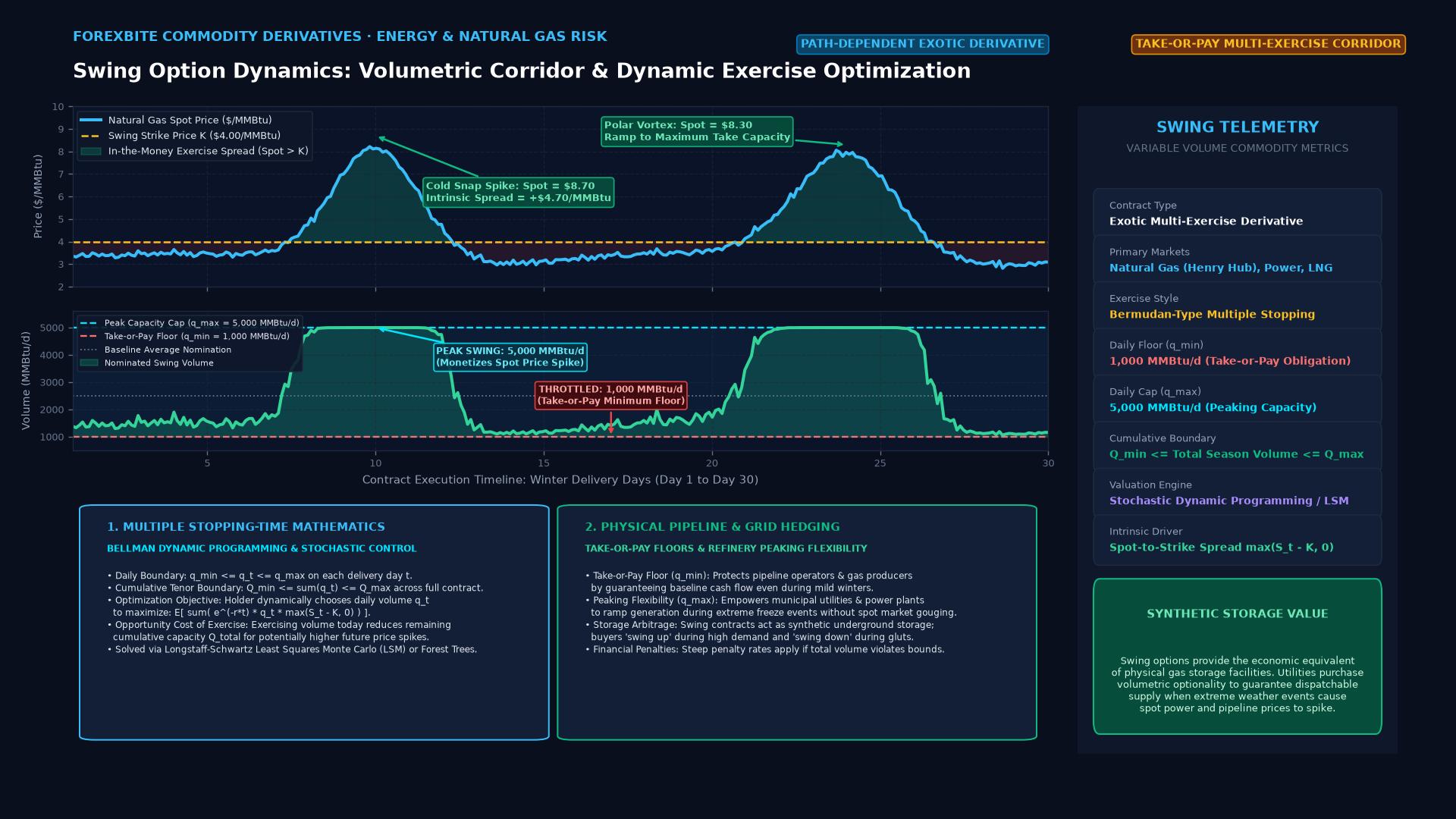 Figure: Volumetric corridor dynamics of a commodity swing option, contrasting daily take-or-pay floor (q_min) and peak capacity cap (q_max) against spot price spikes.
Mathematical Formulation of a Swing Contract
Valuing a swing option is one of the most computationally demanding challenges in quantitative financial engineering. It represents a generalized multiple stopping-time problem under continuous stochastic prices.
The contract parameters are formally defined as:
1. Volumetric Constraints
For each exercise day $t \in {1, 2, \dots, T}$, the holder chooses a delivery volume $q_t$ subject to:
$$q_{\min} \le q_t \le q_{\max}$$
Across the entire lifespan of the contract, the cumulative total volume $Q_{\text{total}}$ must satisfy:
$$Q_{\min} \le \sum_{t=1}^{T} q_t \le Q_{\max}$$
2. The Objective Function
The holder seeks to maximize the expected present value of the contract over time:
$$\max_{{q_t}} \mathbb{E} \left[ \sum_{t=1}^{T} e^{-r t} \cdot q_t \cdot \max\left(S_t - K, ; 0\right) \right]$$
Where:
- $S_t$: Spot market price of the commodity on day $t$.
- $K$: Contractually pre-agreed strike price.
- $r$: Risk-free interest discount rate.
If the market spot price surges above the strike price ($S_t > K$), the buyer “swings up” to the maximum daily limit ($q_{\max}$) to purchase cheap contracted gas and sell surplus into the spot market. If spot prices plunge below the strike ($S_t < K$), the buyer drops volume to the contractual minimum ($q_{\min}$).
Swing Option vs. Vanilla European Option vs. Take-or-Pay Contract
| Contract Type | Quantity Flexibility | Timing Flexibility | Primary Market | Pricing Methodology |
|---|---|---|---|---|
| Swing Option | Highly Dynamic (Bounded within daily and annual limits) | Multiple daily exercise dates across multi-month tenor | Natural gas, electricity grids, pipeline transport | Dynamic programming, Least-Squares Monte Carlo (LSM) |
| Vanilla European | Fixed (Single contract size specified at inception) | Single exercise point at final expiration | Equities, foreign exchange, sovereign debt | Closed-form Black-Scholes formula |
| Take-or-Pay Contract | Static or rigid minimums without optionality | Predetermined scheduled delivery dates | Long-term liquefied natural gas (LNG) maritime shipping | Bilateral commercial accounting |
Real-World Institutional Case Study: European Natural Gas Pipelines and the 2022 Energy Crisis
The strategic necessity of swing option architecture was demonstrated during the European energy crisis of 2022 following supply disruptions on major Russian pipelines (Nord Stream 1):
       EUROPEAN TITLE TRANSFER FACILITY (TTF) GAS VOLATILITY

 €340 / MWh ──┐                                         ┌─── All-Time Peak: Aug 2022
              │                                        /│
 €200 / MWh ──┼                                _..-''`/ │
              │                         _.-''`          │
 €100 / MWh ──┼                  _.-''`                 │
              │           _..-''`                       │
  €30 / MWh ──┼─-.._.-''` (Historical 2020 Baseline)   │
              └─────────────────────────────────────────┴─────────────────────
2020 2021 2022- The Supply Dislocation: European spot natural gas prices exploded from historical baselines of €20–€30/MWh to an unprecedented all-time high above €340/MWh in August 2022.
- The Utility Dilemma: Power utilities faced soaring consumer heating demand during sudden cold snaps, yet purchasing additional gas on the wholesale spot market meant paying exorbitant spot rates.
- The Swing Option Rescue: Utilities that had embedded long-term swing option provisions with Norwegian and domestic pipeline operators immediately exercised their contractual rights to “swing up” intake to the absolute legal maximum ($q_{\max}$) at fixed contractual strike rates (e.g., €45/MWh).
- The Financial Impact: Exercising swing options protected major European utilities from multibillion-euro spot market losses, preserving the financial solvency of critical national power infrastructure.
Quantitative Valuation Techniques
Because of the interaction between daily constraints, cumulative annual limits, and mean-reverting commodity price volatility, swing options cannot be priced using standard Black-Scholes formulas. Quantitative desks deploy three advanced numerical frameworks:
- Stochastic Dynamic Programming: Working backward from expiration across a multi-dimensional lattice tree, calculating the continuation value of remaining swing capacity at each node.
- Least-Squares Monte Carlo (Longstaff-Schwartz Method): Simulating thousands of stochastic price paths with mean-reversion and jumps, using regression to approximate optimal exercise decisions.
- Forest of Trees (Trinomial Meshes): Constructing parallel interconnected lattice trees representing discrete levels of remaining cumulative inventory.
Frequently Asked Questions
Why aren’t swing options traded on public financial exchanges?
Swing options are almost exclusively over-the-counter (OTC) bilateral contracts. Every pipeline network, power grid, and industrial facility has unique physical throughput limits, delivery pipeline nodes, storage characteristics, and seasonal weather dependencies that cannot be standardized into a generic exchange-traded contract.
What is a “Take-or-Pay” penalty in a swing contract?
If a utility consumes less commodity than the contractual minimum floor ($Q_{\min}$), the “take-or-pay” clause mandates that the buyer must still pay the producer for the full minimum volume at the strike price, regardless of whether they physically took delivery of the gas or power.
Can swing options be structured on foreign exchange or equities?
While structurally possible, swing options are virtually non-existent in equities and foreign exchange because currencies and stocks are infinitely divisible, liquid, and do not suffer from physical storage limits, pipeline capacity bottlenecks, or seasonal consumption spikes. Volumetric optionality is a direct solution to physical commodity logistical constraints.
Ready to trade forex?
Open a free demo account with a regulated broker. Practice with virtual funds before risking real money.