Exotic Currency Pairs
Exotic currency pairs are foreign exchange instruments that pair a major global currency—typically the U.S. dollar or euro—with the currency of an emerging, developing, or smaller non-major national economy.
In foreign exchange trading, currency pairs are classified into three primary categories based on daily trading volume, market depth, and global economic integration: major pairs, minor pairs (crosses), and exotic pairs.
An exotic currency pair pairs one heavyweight global currency (almost invariably the U.S. dollar or euro) with the currency of an emerging, developing, or geographically specialized economy—such as Mexico, South Africa, Turkey, or Poland. While exotic pairs represent a smaller fraction of the global $7.5 trillion daily forex market, their outsized volatility, high interest rate differentials, and long-running macroeconomic trends attract specialized macro funds and experienced retail speculators.
Forex Market Hierarchy: Majors, Minors, and Exotics
Understanding the distinctions among the three currency tiers is essential for managing execution costs and liquidity risk:
| Attribute | Major Currency Pairs | Minor Currency Pairs (Crosses) | Exotic Currency Pairs |
|---|---|---|---|
| Composition | EUR/USD, GBP/USD, USD/JPY, USD/CHF, AUD/USD, USD/CAD | EUR/GBP, EUR/JPY, GBP/JPY, AUD/NZD (Non-USD major pairings) | USD/MXN, USD/ZAR, USD/TRY, USD/PLN, EUR/TRY, USD/SEK |
| Global Turnover | Accounts for over 75% of daily global forex volume | Accounts for roughly 15% to 20% of daily volume | Accounts for less than 10% of total daily global turnover |
| Bid-Ask Spread | Ultra-tight (0.0 to 1.5 pips during active sessions) | Moderate (1.5 to 4.0 pips) | Structurally wide (25 to 200+ pips depending on pair) |
| Market Liquidity | Deep institutional liquidity across all global sessions | Robust liquidity during London and Asian sessions | Fragmented, localized liquidity; prone to sudden market gaps |
| Margin Requirement | Low (3.33% to 2.0% under regulated brokers) | Low to Moderate (3.33% to 5.0%) | High (10.0% to 20.0%+ due to volatility risk) |
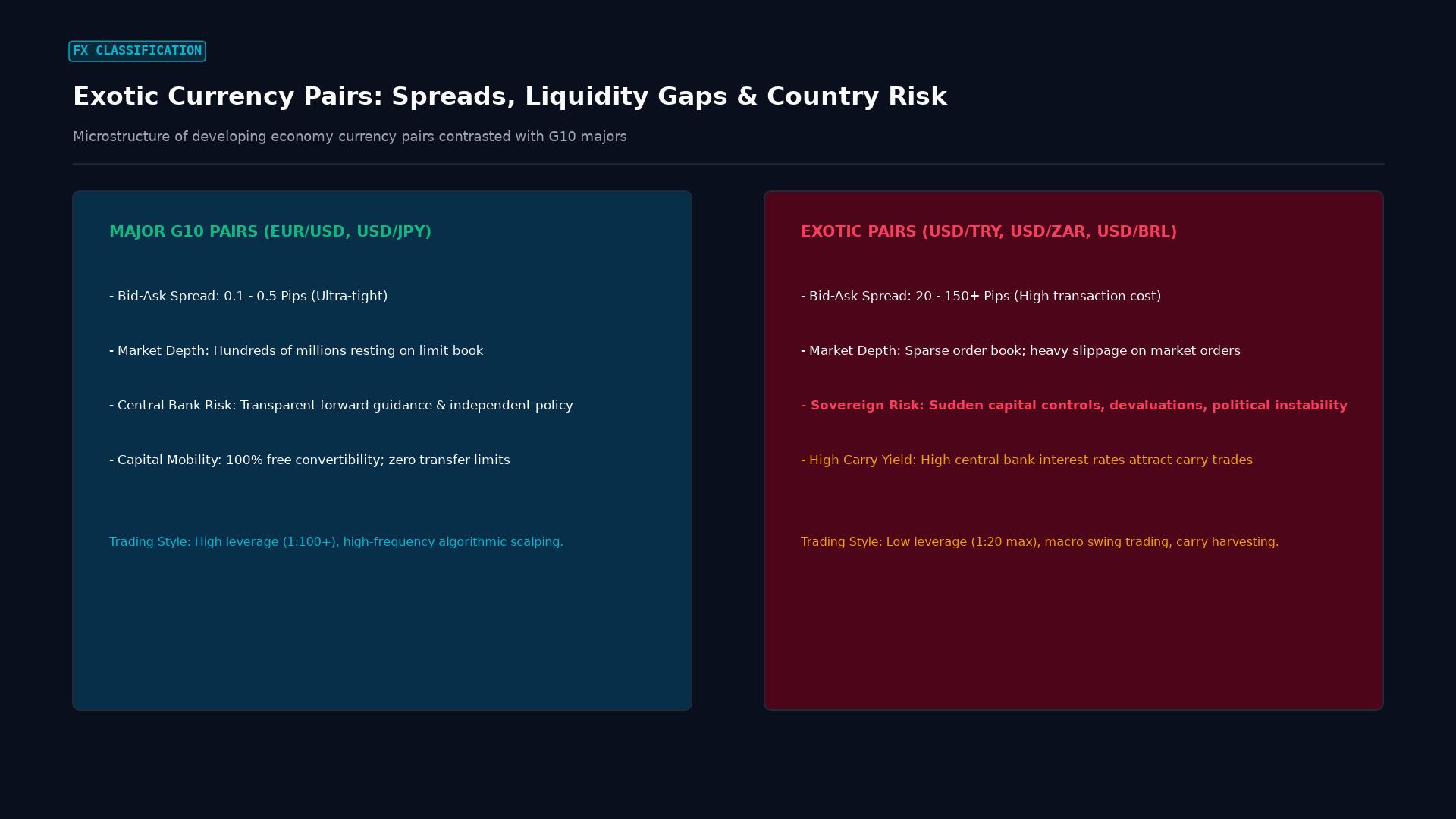 Figure: Market microstructure contrast: tight liquid G10 major pairs versus wide bid-ask spreads, low market depth, and sovereign risk premiums in exotic currency pairs.
Popular Exotic Currency Pairs Across Global Regions
Exotic pairs reflect the regional economic profiles of their respective developing markets:
- Latin American (LatAm) Exotics:
- USD/MXN (Mexican Peso): The most liquid exotic pair in the world, heavily traded due to bilateral U.S.–Mexico trade and high Banco de México interest rates.
- USD/BRL (Brazilian Real): Heavily influenced by agricultural commodity exports (soybeans, coffee) and domestic political cycles.
- European & Middle Eastern Exotics:
- USD/TRY & EUR/TRY (Turkish Lira): Known for extreme volatility, hyperinflation cycles, and dramatic currency devaluations.
- USD/PLN (Polish Zloty) & USD/HUF (Hungarian Forint): Correlated with Eurozone manufacturing health and Eastern European geopolitical developments.
- USD/ZAR (South African Rand): Highly sensitive to global gold, platinum, and mineral commodity export prices.
- Scandinavian & Asian Exotics:
- USD/NOK (Norwegian Krone) & USD/SEK (Swedish Krona): Technologically advanced European economies often categorized as exotics due to lower daily trading volumes and oil-price sensitivity (for Norway).
- USD/SGD (Singapore Dollar) & USD/THB (Thai Baht): Highly integrated Asian trade powerhouses with managed central bank policy corridors.
Unique Risks of Trading Exotic Pairs
Trading exotics demands specialized risk management rules that differ fundamentally from trading EUR/USD:
- Massive Transaction Costs (Spread Drag): While EUR/USD might carry a spread of $10 per standard lot, a volatile exotic like USD/TRY can easily carry a spread of 150 pips ($150+ per lot). Day trading and scalping are virtually impossible on most exotics due to this spread friction.
- Sovereign and Political Risk: Developing economies face unpredictable government interventions, emergency capital controls, unexpected central bank governor dismissals, and political unrest, creating sudden weekend gaps and liquidity voids.
- Severe Slippage: During off-peak hours or domestic market holidays, liquidity evaporates. Market orders can slip tens or hundreds of pips past designated entry or stop-loss prices.
Why Speculators Trade Exotics: The Opportunities
Despite higher costs, exotic pairs offer unique strategic advantages for macro traders:
- Lucrative Carry Trades: Central banks in emerging economies often maintain benchmark interest rates at 8%, 12%, or even 40% to combat domestic inflation. Going long a high-yielding exotic currency against the U.S. dollar or Japanese yen generates substantial daily positive rollover swap income.
- Persistent Macroeconomic Trends: When an emerging economy experiences chronic structural inflation, fiscal deficits, or balance-of-payments deterioration, its currency often depreciates in massive, multi-thousand-pip secular trends that persist uninterrupted for months.
Key Takeaways
- Emerging Market Mix: Exotic pairs match a major currency (USD or EUR) with an emerging or smaller national economy’s currency.
- Spread and Margin Reality: Exotics feature structurally wide bid-ask spreads, lower liquidity, and significantly higher broker margin requirements.
- Macro Sensitivity: Exchange rates are heavily driven by domestic political headlines, sovereign debt health, and global commodity cycles.
- Trend Persistence: Economic imbalances in emerging markets frequently create sustained, multi-month directional trends.
- Long-Term Horizon: Due to spread costs, exotics are best suited for swing traders, macro position traders, and carry-trade specialists rather than day scalpers.
Frequently Asked Questions
Why do brokers require higher margin to trade exotic currency pairs?
Brokers enforce higher margin requirements (such as 10% to 20%, limiting leverage to 1:10 or 1:5) because exotic pairs exhibit severe tail risk and erratic price gaps. Higher collateral cushions both the trader and the brokerage against rapid balance liquidation during sudden devaluations.
Is USD/MXN considered a true exotic pair?
Technically yes, but USD/MXN is by far the most liquid exotic in the world. Because Mexico shares a massive trade border with the United States and trades nearly 24 hours a day, USD/MXN offers substantially tighter spreads (often 2 to 4 pips) and greater liquidity than virtually any other exotic pair.
Can I scalp exotic currency pairs?
Scalping is generally unprofitable on exotic pairs. The wide bid-ask spread requires the price to travel 30 to 100 pips simply to break even, making quick 5-to-10-pip intraday scalping mathematically impractical.
Ready to trade forex?
Open a free demo account with a regulated broker. Practice with virtual funds before risking real money.